The film industry in one place - Articles, Reviews, trailers and hype!

Monday, 29 April 2019

The ‘Cobra Kai’ Season 2 Ending Explained

Fans who expected Cobra Kai to be nothing more than a lighthearted trip down memory lane were pleasantly surprised with the first season. The Youtube Premium series quickly established itself as a fresh continuation of The Karate Kid legacy, with its main ambition being to lead the saga into the future rather than swimming in nostalgia. That said, the past still has a vital part to play in the story. It hangs over Johnny (William Zabka) and Daniel (Ralph Macchio) like a black cloud, and in Season 2, it comes back to bite them in some unexpected and compelling ways.

It goes without saying that spoilers follow. (But yes, we said it anyway).

Spoilers

The closing moments of Season 1 saw Kreese (Michael Kove), Johnny’s villainous old sensei, make an unwelcome return. We knew he would cause trouble in Season 2, and our concerns were proven right. After conning his way back into Johnny’s life, Kreese uses his powers of manipulation and ruthless teachings to make his evil mark felt once again. For the most part, Cobra Kai has operated in a morally grey zone, with no clear cut heroes and villains. Going into Season 3, however, the show has a big bad in the form of Kreese and it’s going to be up to Johnny and Daniel to put their differences aside in order to defeat him and save the souls of his students.

Of course, the majority of Season 2 sees the titular dojo and Daniel’s newfound operation, Miyagi-Do, attempt to one-up each other. Daniel thinks Cobra Kai is a harmful institution, and his views are reaffirmed when Hawk (Jacob Bertrand) leads a group of miscreants to trash his property and steal Mr. Miyagi’s Medal of Honor. This was all unbeknownst to Johnny, however, whose goal throughout the season is to eradicate Cobra Kai’s bad reputation. He wants to instill honor and values in his students, but Kreese has different ideas. The arrival of Kreese divides the Cobra Kai students. Miguel (Xolo Maridueña) remains loyal to Johnny, but Hawk becomes the pet project of Kreese, which causes the young bully to fully embrace his worst tendencies. As the story progresses, Kreese secretly plots to turn the entire team against Johnny. More on that later, though.

Love also plays a major part in Season 2. Johnny develops stronger feelings for Carmen (Vanessa Diaz), who is the mother of Miguel. He spends the majority of the season daydreaming about her while simultaneously pursuing online dating on the side. Eventually, Johnny lands his dream woman, though, but it doesn’t take long until things go downhill. Elsewhere, we get to see the younger characters embark on their own fresh romantic ventures. After moving in with the LaRusso’s and spending more time with their daughter Samantha (Mary Mouser), Robby (Tanner Buchanan) finally makes his move and succeeds. Samantha isn’t quite over Miguel, though, and she doesn’t hit it off with his new flame — and fellow Cobra Kai badass — Tory (Peyton List). In the end, this bad blood between the girls ultimately leads to tragedy for Miguel.

In the episode “Pulpo,” Samantha gets drunk and kisses Miguel. Unfortunately for the ex-lovers, Tory witnesses the smooching and confronts Samantha about it in the hallway of their high school in the season finale. Robby is present when the dirty laundry is aired in front of the entire school, but before he can share his two cents, Samantha and Tory get into a fight and all hell breaks loose. When Robby tries to stop them from beating the snot out of each other, Miguel appears and attacks him. When their fight draws to a close, Miguel has an advantage over his opponent. But, during those heated moments, he remembers everything that Johnny taught him throughout the season and decides to show Robby some mercy. In a surprise turn of events, however, Robby goes against the honorable teachings of Daniel and attacks Miguel from behind, which causes his foe to fall over the stairwell and land on his spine. Ouch, indeed.

The final moments of the episode are dramatic, to say the least. For a start, Johnny’s new love interest wants nothing to do with him because she blames karate for her son’s situation. Afterward, we learn that Kreese has taken over the dojo because Johnny only had a handshake agreement with the building’s owner. The owner wasn’t Johnny’s biggest fan and was more than happy to let Kreese rent the dojo instead.

As for the Cobra Kai students, they opt to pay their allegiance to Kreese because they blame Johnny for what happened to Miguel. By teaching them to be merciful fighters, their friend got seriously hurt. We won’t see any of that mercy nonsense under Kreese’s tutelage, though. After losing everything, we see Johnny sitting on the beach. His phone beeps, but in a moment of anger, he decides to throw it away without even checking the notification. The episode closes with a shot of the phone highlighting a friend request from Ali Mills, his high school ex who fell in love with Daniel in the original 1984 film.

There’s a lot to look forward to going into the next season. The return of Mills is bound to cause further friction between Johnny and Daniel given that they both had strong feelings for her in the past. Still, they’ll have to overcome their issues with each other if they’re going to defeat Kreese. Despite their rivalry throughout the first two seasons, there was a few moments of growth between Johnny and Daniel which saw them reach temporary truces. There’s potential for unity there.

There’s a moment in Season 2 where Robby tells Johnny that he and Daniel “could learn a lot from each other.” If Season 2 proved anything, it’s that the long-time rivals have shared ideals about honor and integrity. The only thing that’s different is their teaching methods. But maybe Johnny’s more aggressive tutoring coupled with Daniel’s nicer approach to karate will make for an interesting combination.

The impending arrival of Mills (and the long-awaited return of Elisabeth Shue) could also be the happily-ever-after love interest that Johnny is looking for. Perhaps in their middle-age, they’ll manage to overcome the relationship difficulties they experienced together as teenagers. The romance between the pair took place before the events of the first film, so it’ll be interesting to see Season 3 dive into their past some more. Whatever happens, though, the next season is going to be exciting.

The post The ‘Cobra Kai’ Season 2 Ending Explained appeared first on Film School Rejects.

The Legacy of ‘Braveheart’

In 1995, medieval epics weren’t the hottest commodity in Hollywood. The early-decade interest in Robin Hood ran its course a couple of years prior thanks to Mel Brooks’ parody. The Middle Ages in cinema had gone the fantasy route in the 1980s, and the trend was not as successful as hoped, by the industry or the fans. Swords and shields action wasn’t the safest bet, even if Disney managed a minor hit by combining formulas of Young Guns and Robin Hood: Prince of Thieves in 1993 with its version of The Three Musketeers. And it wasn’t well-received by critics. Period pieces could be acclaimed and award-worthy if rather serious and stuffy or they could do well at the box office if they weren’t all that good.

Then came Rob Roy, a historical drama set in 18th century Scotland that not only earned professional praise, garnering awards buzz along the way, but it also performed rather favorably in its modestly released theatrical run. Perhaps it even paved the way for Braveheart, another action-filled Scottish biopic that arrived on the big screen the following month. This one set half a millennium earlier — not that audiences knew any different given the kilts and clans stuff blended together (the easiest superficial distinction: Rob Roy has guns) — it also starred one of the biggest names in Hollywood at the time, Mel Gibson, who’d recently proven he could appeal to mainstream audiences and critics alike with period pieces of the Shakespearean and Western varieties.

But Braveheart, which was also directed by Gibson, really managed to stand out. Never mind the positive reviews or the leggy box office success that kept the movie in cinemas for more than a year. Never mind its 10 Oscar nominations and five wins, including the honor of being named Best Picture. The biographical portrayal of William Wallace became a pop culture phenomenon and inspired a change in Hollywood where action blockbusters set in the past could be lucrative if produced with care and delivered a mix of quality drama and entertainment value. Some of its followers would also make tons of money while also garnering accolades, others wouldn’t. Still, there’s not been anything quite like Braveheart, which out of its three-hour runtime is mainly iconic for a single climactic moment remembered for some blue face paint and a rousing battlefield speech.

Almost 25 years later, Braveheart‘s influence can still be felt at the multiplex and in prestige television. Its main character may not always be recalled by name (who hasn’t heard someone just refer to William Wallace as “Braveheart,” as if the title is eponymously about a 13th-century superhero?), but his look and dialogue continue to be cited and quoted in both real life and in movies and TV shows. The film’s legacy is even stronger than that of its subject, if only because its success reestablished and furthered the significance and notoriety of Wallace and, more generally, put Scotland in the historical and geographical spotlight. Here is just a spattering of where Braveheart‘s influence has circulated this past quarter-century:

“Freedom” (1996)

The origin of Braveheart is rooted in tourism, as Randall Wallace became inspired to write the screenplay during a trip to Scotland to learn more about his ancestry, so it’s fitting that the movie’s popularity would, in turn, spark a boost in travel to the area. Reportedly, just a year after the release of Braveheart, tourism in Scotland was up almost $25 million (in US dollars) and it’s been up ever since, even if not quite the peak levels of the movie’s influence on fans worldwide 20 years ago. One of the most obvious spots for visitors who love the movie is the Wallace Monument, a tower built in the 1800s in tribute to the legendary hero played by Gibson. And for a time, the attraction included a newly carved statue of William Wallace.

Well, it’s more of a statue of Gibson as Wallace. The sculptor, Tom Church, was inspired by Braveheart to create his 1996 piece “Freedom,” which represents the hero in full but also has the face of the actor who plays him in the movie. In 1997, the statue was placed near the Wallace Monument visitor center, but it was so controversial you’d think it was a Confederate monument in the American South in 2017. While loved by tourists, locals hated it so much that it was regularly vandalized and had to be caged for its own safety. Finally removed in 2008, Church attempted to gift “Freedom” to Donald Trump in 2008 for placement at his golf resort in Aberdeen, which was controversial enough on its own. But apparently, even Trump didn’t want it.


Roar (1997)

Like a lot of hit movies of the 20th century, Braveheart appeared to spin off a small-screen copycat in the form of Roar. The beloved but short-lived Fox series about a young Celtic man (newcomer Heath Ledger) uniting clans and leading his people (including pre-stardom roles for Keri Russell and Vera Farmiga) to freedom against the Roman Empire was likely more of a byproduct of the cult popularity of the fantasy adventure shows Hercules: The Legendary Journeys and Xena: Warrior Princess (both also originating in 1995). But with its Atlantic Archipelago in the almost-Middle Ages setting of Ireland in 400AD, Roar easily invited comparisons to Gibson’s recent Best Picture winner.

Press at the time leaned on the Braveheart comparison because, as they noted, Roar treats its material more seriously than the Hercules and Xena types. TV Guide showcased it as looking to Braveheart for inspiration in their 1997 Summer Preview article. The Hartford Courant’s review favorably called it “Braveheart: The Series.” Variety championed it as “Braveheart meets Star Wars meets Bonanza meets Excalibur meets Conan the Barbarian meets The Lion King. Entertainment Weekly claimed, more negatively, “The producers regularly crib from Mel Gibson and Braveheart.” And when Ledger died in 2008, The Irish Times wrote that it was the young actor’s “Braveheart portrayal that got Hollywood interested in him.”


South Park: “Starvin Marvin” (1997)

Parodies of Braveheart could be found all over the place after the movie’s release, and they’ve continued more than 20 years later. Among the most prominent and memorable, you’ve got the boring Bob Newhart bit from the 1996 MTV Movie Awards, Triple-H’s tribute in Wrestlemania 21, and even a version for TBS’ Dinner and a Movie cast with chimpanzees. But the one to rule them all from those first few years of the movie’s legacy is the classic South Park episode “Starvin Marvin.” The Thanksgiving-themed eighth episode of the animated series’ very first season features Chef in blue makeup a la William Wallace leading the citizens of South Park against an army of genetically engineered turkeys, who are also led by a Wallace-inspired bird gobble-gobbling about their freedom.

According to Trey Parker in the audio commentary for the episode, “This is the first time we did a full-on parody of a movie, which we’ve since done a lot of,” though the previous episode, “Pinkeye,” spoofs zombie movies, most notably Return of the Living Dead. It’s also apparently the first time they got to show someone’s butt, for Kyle to moon the turkeys as the clans do in the movie. Parker and Matt Stone also say they enjoyed Braveheart, with Stone stating, “Braveheart‘s a cool movie” and Parker admitting, “It was cheesy and dumb, but it was sweet.”


“The Clansman” (1998)

A movie as stirring as Braveheart is obviously going to inspire musical compositions (beyond James Horner’s Oscar-nominated score, that is). The first real notable tune to come out of Braveheart‘s influence is the appropriately rousing Iron Maiden track “The Clansman,” found on their 1998 album Virtual XI. Leave it to a London-based heavy metal band to deliver a crowd-riling ode to a movie about the Scottish fighting the English. The song, which by name sounds easily mistaken for being about the Ku Klux Klan, is obviously inspired by the movie given its singalong chorus of “Freedom! Freedom! Freedom! Freedom!” These days, it’s hard to find a video of a live performance of “The Clansman” that fans haven’t added Braveheart footage to.

But the anthem didn’t necessarily begin as a Braveheart tribute. In the 2011 book Iron Maiden in the Studio: The Stories Behind Every Album, bassist and songwriter Steve Harris is quoted as saying that it began with the music, with its “wind in your hair” vibe and “Celtic flavor.” The latter is “why I wrote the lyrics about the Scottish clans,” he confessed. They were also inspired by the Braveheart and Rob Roy films.” Yeah, but try finding a video on YouTube with Rob Roy clips mixed into the concert footage.


Scottish Parliament (1999-present)

There are many ways in which Braveheart affected the land of its setting. National and cultural identity for Scots immediately changed, while the tourism industry became more successful than ever. Historical and political rallies, as well as sporting events, featured more attendees in outfits inspired by the costumes in the movie. But Braveheart did more than just reinvigorate national pride and international curiosity on a superficial level. Some historians believe the film directly influenced the people of Scotland toward greater autonomy and desire for independence from the UK. This all began with the 1997 devolution referendum that led to the creation of Scottish Parliament in 1999.

Scottish author Lin Anderson, whose books include the nonfiction work Braveheart: From Hollywood to Holyrood, said this while promoting that publication: “Without a doubt, Braveheart contributed to the political movement within Scotland, although I am not saying devolution would not have happened without it. But it gave an international perspective on Scotland, which gave people confidence. It has become part of the fabric of Scotland. There was anger that people didn’t know who William Wallace was and had been cheated of their history. But whether it is myth or reality, it created an aspirational national hero at a time when we needed heroes.”


Chicken Run (2000) and The Patriot (2000)

For Gibson, his fame as the star of Braveheart, specifically, peaked five years later. In 2000, the actor had a few consecutive hits in a variety of genres, and two of them owed a lot to his role as William Wallace. The Patriot (which co-starred Roar‘s Ledger) is basically Braveheart for the American Revolution, with Gibson once again battling the British for Freedom with a capital F. Only this time, while his hero has plenty of words of motivation throughout, his climactic moment involves a flag rather than his voice — somewhat disappointing considering this Independence Day favorite was made by the guy whose movie actually titled Independence Day features another iconic speech from a leader sending people to fight for their freedom.

Released the very same week as The Patriot that summer of 2000, Chicken Run had only Gibson’s voice to work with, but that was plenty. Although the Oscar-nominated animated feature is primarily a tribute to World War II POW escape films, there is a lot of Braveheart evoked, if only due to the fact that it’s him we hear in the role of a rooster with false-legendary repute and plans for “Freedom!” for himself and the rest of the literally cooped-up fowl. The young target audience wouldn’t feel the legacy but their parents would get it, and maybe the kids would grow up to appreciate Braveheart more for having subconsciously experienced its influence in the form of Chicken Run‘s parodic homage.


Ashanti’s Braveheart (2014)

“I am Braveheart,” declares American singer Ashanti on her 2014 track titled after the movie, from the album of the same name. And no, she’s not referencing the lion cousin of the Care Bears introduced in the toy and cartoon characters’ 1985 animated feature. Braveheart the album and “Braveheart” the song were inspired by Gibson’s movie. Never mind that the lyrics of the latter, following the speech in the intro, seems more to do with a relationship (“You know I got a Braveheart/He know he got a Braveheart/We both gotta have a Braveheart”). Ashanti told Philadelphia radio station Power 99 (via Rap Up):

“The metaphor that I took was basically in the movie — you have the Europeans, you have the soldiers from London and the UK. They have the big horses, they have the shields, the guns, the weapons. They’re all armored up. And then you have the Scots. They’re all raggedy, homemade weapons, and paint on their faces. It’s not an even playing ground, so I feel like, with the [major labels], they’re bossed up. They have the big engine and all the artists signed to them, and with the indies, it’s depending. It’s homemade, it’s homegrown. It’s a lesser engine. So the metaphor I was using was being brave and putting your blood and guts into it and fighting passionately to win.”


The Birth of a Nation (2016)

When it premiered at Sundance three years ago, Nate Parker‘s feature directorial debut, The Birth of a Nation, seemed like the movie of 2016. The historical and biographical drama won both the jury and audience awards in its program, received mostly rave reviews, and earned tons of Oscar buzz. Like Gibson in Braveheart, Parker also plays the lead, here the history book figure Nat Turner, a preacher who led a rebellion of his fellow slaves in Virginia in 1831. Before its official release, though, Parker’s rise to fame turned to infamy as the filmmaker’s past as an alleged rapist came back to haunt him. Unlike Gibson, he didn’t even spend many years in the limelight before controversy crushed his career.

Perhaps he’ll seek out advice (or has already?) from the occasionally reemerged former movie icon just as he went to the Braveheart star and director for help while making his own revolt-based period drama. As Parker told First Showing of Gibson’s influence on The Birth of a Nation during Sundance:

“I love that comparison [to ‘Braveheart’] because I do think that is what it is. The key in all of these comparisons that I attach to is the humanity. We’re dealing with people, real people with real issues, and real concerns, and real feelings, and real motivations. So to see ‘Braveheart’ and to see what Mel [Gibson] did with that, and to see the humanity he brought to it inspired me. He was someone I was able to sit and speak with about my film and get some thoughts, and ideas, and tips on how to shoot it…

“I sat with him and… It’s a funny thing. We spoke on the phone the day before my battle sequence since he was in Australia. And he was reminding me of the low angle shots, of how to get around the fact that I didn’t have a lot of time. So I had a great mentor. I do think this is something where I was influenced by ‘Spartacus.’ I was influenced by ‘Glory.’ I was influenced by ‘Braveheart.’ These are films that I feel like are about human people in the human condition wanting to have their most basic privilege, or right, as given by God, and that is – freedom.”


The post The Legacy of ‘Braveheart’ appeared first on Film School Rejects.

Contemporary Chinese Cinema: "The New King of Comedy" and "Hidden Man"

Contemporary Chinese Cinema is a column devoted to exploring contemporary Chinese-language cinema primarily as it is revealed to us at North American multiplexes.
The New King of Comedy
When I reviewed this year’s crop of Lunar New Year releases a couple of months ago, there was one title that was conspicuously missing from the group of films that were released in North America for the holiday season: Stephen Chow’s The New King of Comedy. I don’t know why it didn’t get a release here. It could be because its production was too rapid for the international distribution system to absorb it. It might have something to do with the involvement of Herman Yau, an outspoken proponent of democracy in Hong Kong and thus an unwelcome presence on the Mainland. Or, it may have just been overlooked in the mad rush to book The Wandering Earth on as many screens as possible (this appears to be why the U.S. release of Ning Hao’s comedy Crazy Alien got cancelled). As always, the why’s and wheres of the distribution of Chinese language films in the West remains an unfathomable mystery. Fortunately, however, the windows between theatrical and home video releases have become vanishingly short for Chinese films, and The New King of Comedy is now available on English-subtitled Blu-ray. And it is worth the wait: not only is it the best of this year’s Lunar New Year films, it’s the best Chinese language comedy in quite awhile, at least since, well, the last time Stephen Chow directed a movie, 2016’s The Mermaid
The new film is neither a remake nor a sequel to The King of Comedy, the 1999 film that was the culmination of a decade Chow dominated as Hong Kong’s biggest and most reliable star (one example of Chow’s 1990s dominance: in 1992 he starred in every one of the top five films at that year’s box office: Justice, My Foot; All’s Well Ends Well; Royal Tramp; King of Beggars; and Royal Tramp II). He began directing in 1993, at first in the rapid-fire nonsense (“mo le tau”) style of his biggest hits, but gradually developing a more sophisticated relationship to his material and his star persona. In The God of Cookery in 1996, he cast himself as a famous chef named “Stephen Chow” whose horrible abuses of power in his treatment of everyone around him precipitates a downfall, wherein he finds himself again among the wretched street chefs of Hong Kong’s lower classes. Finding a kind of enlightenment, he usurps his rival and reclaims his fame and fortune. In his subsequent films, Chow’s heroes will begin in this same state of wretchedness, ignored or shunned by society, their special talents unrealized or ignored until they’ve undergone sufficient humiliation. The King of Comedy is the most human-scaled of Chow’s great films, taking place entirely within a mostly realistic small beach community where an action movie is being filmed. Chow plays an aspiring actor with an encyclopedic knowledge of acting theory, but every chance he gets to rise above his station as an extra is thwarted by fate, usually in the form of a slapstick disaster. He has a love interest, a local call girl whom he helps with her acting toward clients, played by Cecilia Cheung, and the film is as touchingly romantic as it is hilarious in its bizarre twists of plot. Chow’s next several films, Shaolin Soccer, Kung Fu Hustle, Journey to the West: Conquering the Demons, and The Mermaid, would become increasingly reliant on computer generated special effects, expertly balancing humor, heart, and spectacle to massive success both at home and around the world. 
But this past year, as Chow realized that post-production on his sequel to The Mermaid would not be finished in time for the movie to open at Lunar New Year, he went back to basics. Dusting off a script he’d been working on for a few years and hastily assembling a cast and crew (including Yau as co-director: having completed nine films in the past three years, with a tenth on the way this summer, no one in Hong Kong knows how to make a movie quickly, at present, than Herman Yau), he put together The New King of Comedy in a matter of months and rushed it out to theaters. Under these circumstances, and the traditionally loose standards of New Year comedy plotting, Chow would have been forgiven if New King was a slapdash, derivative affair, an amiable goof along the lines of Pang Ho-cheung’s Missbehavior, a solid but decidedly slight film. But instead he went ahead and made another great Stephen Chow movie. 
The film begins, as the 1999 one did, with a shot of ocean waves. The opening of the original features Chow facing the water, back to the camera, shouting the film’s idealistic mantra, “Work Harder! Keep Going!” He’s absent from the new film's opening shot, as he has been from every one of his films since 2008, but the echo of the earlier film remains. We’re quickly introduced to an aspiring actor named Rumeng, played by E Jingwen. She carries the same acting manual, now every much dog-eared and bookmarked, that Chow had twenty years ago, and her mannerisms are much the same. She’s relentlessly optimistic—ten years working as an extra has yet to break her down. The film that follows will do its best to do so, throwing her into one humiliating situation after another: a botched plastic surgery, abuse from a now-downtrodden star who had been her idol (Wang Baoqiang, the one major star to appear in the film), abandonment by both a prettier friend and her boyfriend. Where the 1999 film was based around a hilarious John Woo parody starring Karen Mok, the film within a film in New King is called Snow White: Bloodbath in Chinatown, which is described to Wang, its star (he plays Snow White), as a “tribute to Chang Cheh’s Aesthetic of Violence.” Rumeng gets herself fired several times, mostly for her overeagerness in thinking through her simple roles as a stunt double, or as a corpse.
Where New King differs from the first film is in focusing more on Rumeng and her friends and family than in building increasingly bizarre scenarios for Chow to goof his way through (think his various interactions with the wannabe Triads, or the climactic shootout alongside Ng Man-tat’s cop). The perspective of her parents is especially important: King of Comedy is a film about struggling to make it made by a person who had very recently been struggling: Chow had been doing everything from bit parts (he’s supposedly one of the gangsters in A Better Tomorrow, but I’ve never spotted him) to hosting children’s TV (the local Hong Kong show 430 Space Shuttle, which Tony Leung also hosted in the 1980s), but had now achieved success beyond his wildest dreams. Now, twenty years later and a decade removed from his last starring performance, Chow has made a film about watching the next generation go through the same struggles he did we he was young, doing what he can to help them succeed (Rumeng’s big break will come, as E Jingwen’s has, with a Stephen Chow movie). Rumeng’s father vocally disapproves of his daughter’s career choice: why couldn’t she be a lawyer like her brother, or at least an online retailer like her sister-in-law? He throws her out of the house in an early scene, and yet sneaks behind the scenes of her work throughout the film, admonishing the people who bully her, cast, crew, and craft services among them, to be more respectful. She never sees this support, and even when, late in the film, her parents arrange for her travel to the big Stephen Chow audition, he won’t admit to it. But when she finally does make it, we see it not through her eyes, but through those of her parents. The King of Comedy was a movie about believing that if you work hard and stick to your dreams, you can find a kind of happiness in life with or without major success. The New King of Comedy is about that too, but it’s also about the joy and agony of watching your child struggle, and usually fail, to fulfill their dreams.
***
Hidden Man
Jiang Wen rose to fame just around the same time as Stephen Chow did, also making his first impressions as an actor. His debut was Hibiscus Town, a 1986 film directed by Xie Jin, one of the few Third Generation Chinese directors from before the Cultural Revolution (Woman Basketball Player No. 5 [1957], Two Stage Sisters [1965]) who continued to work after it had passed. He followed that up with an incandescent performance in Zhang Yimou’s debut Red Sorghum (1987) and in the Silver Bear-winning 1990 film Black Snow. He made his directorial debut in 1994 with In the Heat of the Sun, a coming-of-age story set during the Cultural Revolution that, while reminiscent of the modernist historical films of the New Taiwan Cinema, A Brighter Summer Day or The Time to Live, the Time to Die, was nonetheless filtered through Jiang’s sardonic view of human nature. His subsequent films are all deeply, darkly comic at their core, while cycling through a variety of different genres: the World War II morality play Devils on the Doorstep (2000); the convoluted network narrative The Sun Also Rises (2007); the Western noir Let the Bullets Fly (2010); and the scattershot pastiche Gone with the Bullets (2014), which references everything from Busby Berkeley to The Godfather in purportedly telling the story of China’s first feature film. Some of these experiments have been more successful that others: where Let the Bullets Fly set a new record at the Chinese box office, and routinely ranks among the country’s best 21st century films, Gone with the Bullets' reception was much more muted, with mixed reviews and disappointing box office. Neither film got a real release in North America (Let the Bullets Fly played for five weeks, maxing out at 10 screens with a gross of $63,000, while Gone with the Bullets didn’t even get that), and that appears to be the fate with Jiang’s latest, Hidden Man, which premiered on the fall festival circuit after opening in China last summer (it barely outgrossed, Gone with the Bullets, but the reviews were more forgiving). 
Like all of Jiang’s films, Hidden Man is set in the past, and like the last two, in the Republican Era, the period between the fall of the Qing Dynasty and the war with Japan. Opening in 1922 and then skipping ahead fifteen years to the eve of the war, it’s the story of a young man’s attempt to get revenge on the men, one Chinese (Liao Fan, from Ash is Purest White and Let the Bullets Fly) and one Japanese (Kenya Sawada, form Devils on the Doorstep), who murdered his master and his family before his eyes. The young man, Li Tianlan, has been in America in the interim, a mere thirteen-year-old boy when the murders took place, he’s now grown up to be Bruce Handler, a secret agent and gynecologist played by the dashing Taiwanese-Canadian Hong Kong star Eddie Peng (Our Time Will Come, Duckweed). Returning to Beijing (pointedly now known as “Beiping,” the capital having been moved south to Nanjing), Bruce/Li begins a lengthy cat and mouse game with his quarry, now risen to prominence in the city (the Chinese as head of the police, the Japanese as the leading opium supplier). Helping him, sort of, on his quest is a wealthy man played by Jiang himself, whose motivations are never quite clear but certainly appears to be working to eliminate at least two of the three principals in this murder triangle.
Complicating things even further (because it isn’t a Jiang Wen movie if you can understand exactly what’s happening at any given moment) are two women: Liao Fan's flirtatious girlfriend (Xu Qing, hilariously sexy) who has a soft spot for Bruce, and a tailor who seems to know much more than she should about Peng and Jiang and their mission. Played by Zhou Yun, the tailor is the most charming character in the movie, or at least the most sympathetic. While Peng appears to have all the necessary components for movie stardom—he’s handsome, athletic, with an infectious smile and an air of utter wholesomeness—he struggles when required to tap into darker energies. Hidden Man is more successful than Rise of the Legend, Peng’s take on Wong Fei-hung that is similar in plot (turning Wong into the driver of a mystery-revenge plot), if only because Jiang surrounds him with much better actors than that film did. Zhou, Liao, and Jiang himself are able to play all the multiple shades of motivation and embody the film’s broad and constantly shifting tonal spectrum that Peng himself cannot. He’s like a square-jawed all-American (well, all-Canadian) boy set adrift in a world of schemers and liars and murderers and he cannot hope to keep up. The best version of this kind of performance is Kurt Russell in Big Trouble in Little China. But Peng, while I do like him, reminds me more of KJ Apa’s Archie on Riverdale
For what is essentially an action comedy about double crossing and betrayal, Hidden Man is shockingly protracted, with long stretches of the film devoted to delaying the inevitable showdown. This is, of course, part of Jiang Wen’s perverse streak: where the two Bullets films overwhelmed the audience with a dizzying array of schemes and wild shifts in tone and plot, Hidden Man is explicitly about putting off the payoff for as long as possible. It’s Jiang’s own character at the heart of this: always he counsels patience and caution to all sides of the fight. This allows Zhou’s character room to unfold, and she ultimately proves to be the film’s true heart. Like Bruce she too had a quest for revenge, but was advised to wait and wait until the right moment, but that moment never came and perhaps now it never will. Possible allegories here abound: Liao is proclaimed as the heir to the Ming Dynasty, and thus represents Old China, as does Zhou’s attempt to recover from childhood foot-binding (she’s Future China); Peng’s American heritage, and the actor’s Hong Kong stardom, represents the Western influence on China; the Japanese influence is obvious. Jiang Wen sits at the center, attempting to juggle it all, to prolong the inevitable showdown between China and the West and Japan, knowing he stands a good chance of getting caught in the crossfire. 
As Anti-Japanese War spy stories go, Hidden Man doesn’t measure up in suspense or moral seriousness with Kim Jee-won’s 2016 The Age of Shadows, or Ann Hui’s 2017 Our Time Will Come. But it’s got a lightness, a breezy joy in its artifice that is hard to find in Chinese cinema today outside the old school Hong Kong directors (Jiang in many ways seems to me to be most akin to Tsui Hark, with their punkishly cynical approach to traditional genre material). Repeatedly Jiang lingers on Eddie Peng running across the rooftops of Beiping. He runs in various outfits, including half-naked wearing only a diaphanous robe, and he even bicycles across them. Zhou Yun, still recovering from surgery, has trouble walking, but she leaps from roof to roof with balletic grace. Fully embracing the enhanced colors of digital filmmaking, Jiang’s films are bright and vibrant, filled with reds and whites and browns, unbelievable purple blue twilights and lustrous imperialist interior spaces filled with rich yellows and blacks. He often cuts at the speed of dialogue, at times approaching Baz Luhrmann levels of excess, but never quite tipping over into indulgence, knowing when to slow things down and let a scene breathe. Hidden Man expends a lot of energy toward not a lot of action, but when it comes, it comes in a flurry: a cavalcade of bloody revenge that’s as comic as it is grotesque. 20th century Chinese history is, for Jiang Wen, a chronicle of corruption, stupidity, cruelty, viciousness, and betrayal by everyone and against everyone. But it’s also a place of mystery and wonder and silliness, where justice and honor and true belief are possible, but extremely rare and deeply buried. His gleefully anachronistic, chaotic period pieces understand our shattered history in a way the more literal-minded cinema of his peers in the Fifth and Sixth Generations never can.

Frisky at forty: FILM ART, 12th edition

DB here:

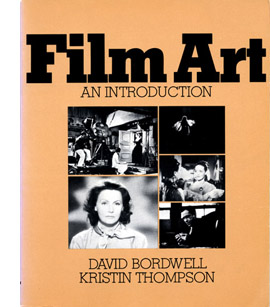
The first edition of Film Art: An Introduction rolled into an unsuspecting world in 1979. Its butterscotch jacket enclosed 339 pages of text and black-and-white illustrations. It was, I think, the first film studies textbooks to use frame enlargements instead of production stills. It was definitely the first to argue for a systematic aesthetic of cinema integrating principles of form (narrative/nonnarrative) with style (techniques of the medium). Our goal, of course, was to enhance the readers’ appreciation of the range and power of film as an art form.

Not that there wasn’t a lot of room for improvement. Across three publishers–Addison-Wesley, then Knopf, and finally McGraw-Hill–the book has gained subtlety, precision, bulk, and color images. It now has a suite of online supplements in the form of aids for teachers and video clips for student reference, and the website you’re now visiting. Then there’s our streaming series on the Criterion Channel.

The core of our efforts remain the ideas and information we explore in the text. That material, happy to say, has found support among teachers, scholars, and writers of other textbooks. Through their suggestions and criticisms, we’ve had four decades to refine what Kristin and I initially set out, and on the eleventh edition Jeff Smith joined us to make things even better.

What’s new about this twelfth edition? Of course, we’ve updated it. We incorporate examples from Get Out, Son of Saul, mother!, Moonlight, Guardians of the Galaxy, Tiny Furniture, Inside Man, Wonderstruck, Dunkirk, Fences, Manchester by the Sea, Baby Driver, The Big Sick, Hell or High Water, Hostiles, A Girl Walks Home Alone at Night, The Blind Side, Opéra Mouffe, My Life as a Zucchini, Kubo and the Two Strings, Lady Bird, Birdman, The Lost World: Jurassic Park, Tangerine, A Ghost Story, Snowpiercer, The Grand Budapest Hotel, and other recent titles.

One of the biggest changes involves the addition of an analysis of social and political ideology in Ali: Fear Eats the Soul. This detailed look at Fassbinder’s melodrama of prejudice replaces our study of masculinity and violence in Raging Bull. That earlier piece will be posted for free access on this site, joining analyses from earlier editions on this page.

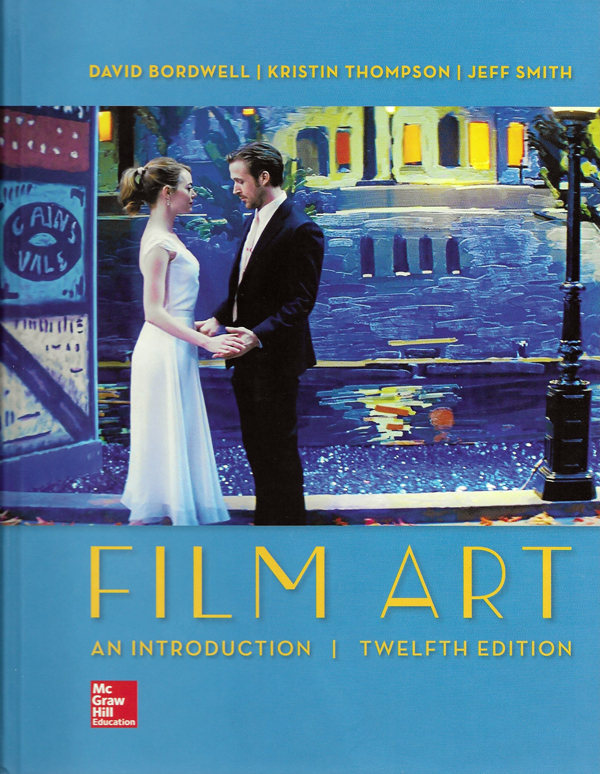
The most noteworthy difference, signaled on the cover you see above, is a new case study of how a film gets made.


Production: The hows and whys

The book’s opening chapter,”Film as Art: Creativity, Technology, and Business,” matters a lot to us. We try to provide concrete, systematically organized information about how people work with technology and within institutions to implement the techniques we’ll survey in later chapters. At the same time, our discussion of production, distribution, and exhibition tries to show how filmmaking institutions shape creative choices about form and style. Perhaps because we try to make those choices down-to-earth, we’ve been pleased to find that Film Art is used in film production courses.

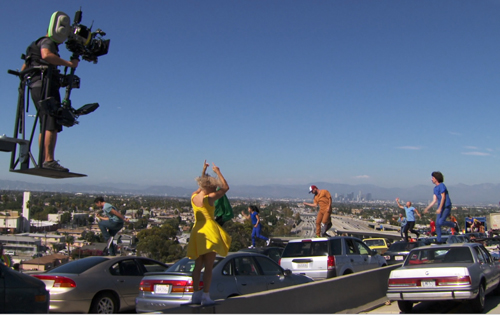
For several editions, Michael Mann’s Collateral served us well as a model of how decision-making in the production process shaped the final film. We thought, however, it was time to refresh that chapter, and La La Land provided us rich opportunities. We had already written blog entries (here and here) about aspects of the film, but we wanted learn more about how it had been created.

Made by a director not much older than our students, La La Land was perfect for a book that tries to be both up-to-date and sensitive to film history. From the burst of ensemble energy in the opening traffic jam to the parallel-reality ballet at the end, Damien Chazelle’s film was both contemporary and classical, what Kristin calls “a modern, old-fashioned musical.” We thought it would help students see that a young filmmaker can draw on tradition while staying firmly in our moment.

The film’s production decisions were well-documented, so we were able to trace four areas of creative choice. By considering the film’s mise-en-scene, camerawork, editing, and sound, we could set up the major stylistic categories to come in later chapters. For example, Jeff could point out unique features of Justin Hurwitz’s score.

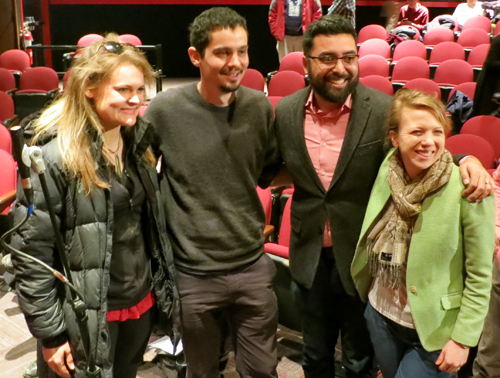
We were lucky to get guidance from Damien himself. He reviewed our analysis, and then went far beyond the call of duty. He came to Madison to talk with our students (chronicled here). He sat for interviews with the Criterion Channel on Jean Rouch and Maurice Pialat. He did three Q & A’s. He even took snapshots with his fans.

And Damien energetically helped us secure rights to the cover image, a process that all writers of film books approach with fear and trembling. In short, he proved a total mensch. The fact that he had already read our work when we first contacted him encouraged us in the belief that we might be helping young filmmakers find their way.


Film Art wherever you go

Film Art is now available in a variety of formats and prices. The print edition is now a looseleaf, unbound one. Bound copies still circulate for rental. Students may also rent or buy the e-book edition, which comes packaged as a digital resource called Connect. It’s possible to merge some of these alternatives. The various options for getting the book are charted here.

The Connect package includes teaching aids for the instructor (self-tests, quizzes) and access to thirty-six film extracts, courtesy of the Criterion and Janus companies. There are also four fine videos on production practice by our colleague Erik Gunneson.

As I discussed at exhausting length when I previewed our new edition of Film History: An Introduction, the variety of formats for the book reflects not only changes in technology and the publishing market but also changes in consumer preferences.

However it’s accessed, Film Art: An Introduction still makes us happy. We’ve tried our hardest to help readers understand a bit more about the techniques and effects of cinema. As we point out in the book, thanks to smartphones everybody is a filmmaker now. We think that students’ hands-on experience prepares them for our efforts to understand the creative choices filmmakers have faced from the very beginning.


Thanks as ever to the staff at McGraw-Hill: our editor Sarah Remington and the team consisting of Danielle Clement, Sue Culbertson, Maryellen Curley, Joni Fraser, Ann Marie Jannett, and Elizabeth Murphy. Thanks as well to Kaitlin Fyfe and Erik Gunneson here at the Department of Communication Arts, UW–Madison.

Instructors who want to learn more about this edition can find a McGraw-Hill representative here.

Jeff Smith, who wrote the analysis of Ali: Fear Eats the Soul for our book, also provided an incisive discussion of staging in the film for our series on the Criterion Channel.

There’s a fuller account of how we came to write Film Art in our announcement of the previous edition.

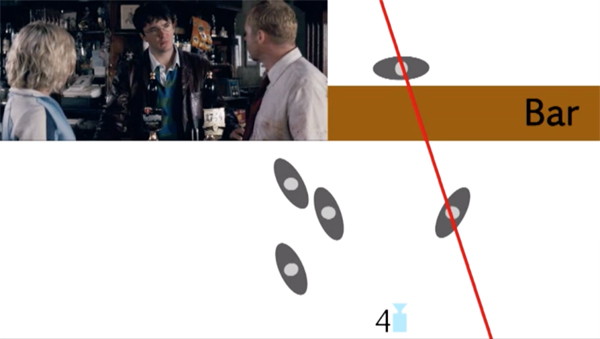
Video supplement: Shifting the Axis of Action in Shaun of the Dead.

Sunday, 28 April 2019

First Trailer for Peruvian Film 'Canción Sin Nombre' Playing in Cannes

Cancion Sin Nombre Trailer

"We will find her. I promise." Luxbox has debuted a festival promo trailer for Peruvian film Canción Sin Nombre, premiering at the Cannes Film Festival in the Directors' Fortnight sidebar next month. The title translates to Song Without a Name, and the film is the feature directorial debut of a Peruvian filmmaker named Melina Leon. It's based on a true account of child trafficking uncovered by journalist Ismael Leon, father of the film's director. Georgina is a young woman from the Andes whose newborn daughter is stolen at a fake health clinic. Her desperate search for the young child leads her to the headquarters of a major newspaper, where she meets Pedro Campos, a lonely journalist who takes on the investigation. The full cast includes Pamela Mendoza, Tommy Párraga, Lucio Rojas, Maykol Hernández, and Lidia Quipse. This vintage black & white look to this really adds to the storytelling. Will keep an eye on this one in Cannes.

Here's the first festival trailer (+ poster) for Melina León's Canción Sin Nombre, direct from YouTube:

Cancion Sin Nombre Poster

Peru, at the height of the political crisis of the 1980’s. Georgina is a young woman from the Andes whose newborn daughter is stolen at a fake health clinic. Her desperate search for the child leads her to the headquarters of a major newspaper, where she meets Pedro Campos, a lonely journalist who takes on the investigation. Based on a true story. Canción Sin Nombre, which translates to Song Without a Name, is directed by Peruvian filmmaker Melina León, making her feature directorial debut after a number of short films and other projects previously (visit her official website). The screenplay is written by Melina León and Michael J. White. The film is premiering in the Directors' Fortnight sidebar at the Cannes Film Festival this May. Stay tuned for more updates and reviews. No other official release dates have been set - the film is still seeking US distribution. For more about Canción Sin Nombre, visit the film's official website. Interested?

UK Trailer for German Film 'Balloon' About Fleeing from West to East

Balloon Trailer

"We can make it with your help." Studiocanal has debuted an official UK trailer for a German thriller titled Balloon, or simply Ballon in German. The film tells the true story of the Strelzyk and Wetzel families, who built their own hot air balloon and flew from the GDR to West Germany in the late 1970s when the country was divided. Günter Wetzel, played by David Kross, was inspired by a magazine article about the balloon show in Albuquerque, New Mexico. "While I’m happy now that we took that decision, if I had the knowledge I have now I wouldn’t do it, because it was so dangerous, but I didn’t recognise that then," he says (via The Guardian). The full cast includes Friedrich Mücke, Karoline Schuch, Alicia von Rittberg, Thomas Kretschmann, Jonas Holdenrieder, Tilman Döbler, and Till Patz. That cool shot with the patchwork colors of the balloon lighting up is gorgeous, that alone makes me really want to watch this film. Looks solid.

Here's the official UK trailer (+ poster) for Michael Herbig's Balloon, direct from Studiocanal's YouTube:

Balloon Poster

Balloon tells the true story of the Strelzyks and the Wetzels, who made their own homemade balloon in a cellar in Thuringia, in the German Democratic Republic, before flying across the border into Bavaria one chilly night in September 1979. Balloon is directed by German writer / comic / actor / filmmaker Michael Bully Herbig, director of the films Erkan & Stefan, Manitou's Shoe, Lissi and the Wild Emperor, Vicky the Viking, Buddy, and Bullyparade: The Movie previously. The screenplay is written by Kit Hopkins & Thilo Röscheisen & Michael Herbig. This premiered at the Zurich Film Festival last year, and originally opened in Germany last fall. Studiocanal UK will release Herbig's Balloon in select UK theaters starting June 14th, 2019 this summer. There's still no US release confirmed. Stay tuned for more. First impression? Thoughts?

Video Sundays: A Springtime Screening of Cherry Blossoms in Times Square

For the 40th anniversary of the nonprofit arts organization Electronic Arts Intermix, a leading resource and archive of digital and video art, special screenings were programmed throughout one week in April of 2011. Though these programs included works by artists like Nam June Paik and Gary Hill, the standout title of these is Shigeko Kubota's Rock Video: Cherry Blossom (1986), which glows in a warm pink with flashes of sky blue and gold. Following a 1-minute introduction by Takeshi Murata, the screen splits into a grid of squares, each refracting a different dimension of a blossom tree. Kubota's digitized floral arrangement renders nature as synthetic and contingent as the logos on a flashing billboard that act as the film's frame. When seen from the perspective of a passerby, everything appears to blur into a single advertisement.

Saturday, 27 April 2019

12 Questions Left Unanswered By ‘Avengers: Endgame’

Avengers: Endgame is in theaters now, and we have some questions. Some of them are admittedly silly and easily enough chalked up to a “meh” and a shoulder shrug, but most of them are weightier and worthy of asking. Well, worth asking for us anyway. And look, I get it. The answers to every single question below can probably be summed up with one or both of the following: “It’s a comic book movie Hunter!” or “Shut your pie-hole Hunter!”

But putting that unnecessarily mean reply aside for the moment, we demand answers! Of course, this all comes with a spoiler warning…

Thanos Spoilers Snap


Why does Thanos seem even stronger without the Infinity stones than he did with them?

Towards the end of Infinity War a handful of Avengers are able to nearly de-glove and defeat Thanos even while he wields the Infinity stones. They fail obviously because of that dipshit Peter “Star-Lord” Quill, but they come close. So why is it that they can’t even scratch Thanos in Endgame when he has none of the stones to empower him? Captain America, Thor, and Captain Marvel — these are incredibly strong, near god-like beings, but they all get knocked on their ass by Thanos who’s using little more than his fists. It’s nonsense. It’s also probably my own pet peeve with these movies, but the fluctuation in powers is just ridiculous and frequently lazy as characters are only as strong or as weak as they need to be depending on the scene. For example, seeing Captain America lift Thor’s hammer is great — he’s worthy! — but he also knows how to shoot lightning with it?!

Where does Loki go with the Tesseract?

One of Endgame’s highlights is the series of time heists they perpetrate to acquire the Infinity stones, but their attempt to steal the Tesseract as it and Loki are being escorted away by SHIELD at the end of the battle of New York erupts in shenanigans. Seeing the opportunity, Loki grabs the Tesseract and disappears — so where does he go? As it turns out, he went to Disney+ for a new series set to debut on the streaming service in the near future. That’s the legit answer, but it doesn’t explain where he went in the world of the movies. After being captured in The Avengers (2011) his next appearance in the MCU is in Thor: The Dark World (2013) where he was made to answer in Asgard for his crimes on Earth. That still happens thanks to Endgame‘s trouble-free take on time travel — changing the past doesn’t affect the present!? — but Loki’s the kind of trickster who might just show up in Asgard to rescue himself and steal the Tesseract (in that timeline) before it’s given to The Collector. Meaning yes, he could have two Tesseracts which is more power than someone like him should ever have. (This is turn sets up the worry that someone could time travel and collect dozens of *each* Infinity stone… imagine a glove with 72 stones!)

How flexible is that Soul Stone rule?

Per the Keeper of the Soul Stone, it can only be obtained by someone who sacrifices someone they love. In Infinity War that meant Thanos could toss Gamora to her death and be rewarded, but in Endgame the rules seem to change. Sure Hawkeye likes Black Widow — all the heroes like Black Widow apparently — and sure she likes him back, but love? At best they feel the platonic love of friendship for each other as otherwise the reunion with Hawkeye’s family is severely undercut emotionally. But fine, let’s say friendship is enough. We’re still stuck on the rule stating that someone has to sacrifice someone else. These two friends fight for the right to sacrifice themselves and against each other doing the same. Hawkeye doesn’t sacrifice Black Widow… he fails to stop her from sacrificing herself.

Did Steve Rogers spend sixty years in hiding and/or pretending he isn’t Captain America?

Captain America goes back to return the various Infinity stones — a sequence we don’t see but one I have to imagine would have been ten times harder to do than the thefts were — and instead of returning to the present he stays in the 1940s. (That’s another question. None of the stones were in the 40s so how did he get back there? Granted, I’m basing that on the scene of he and Peggy Carter dancing to 40s music while dressed in 40s clothes which I guess could have been a flashback to a themed dance party, but still…) That means he was around for the decades leading up to his discovery by SHIELD and there over the past decade of adventures. Did he spend any of that time doing heroic deeds? He would have to, right, as he’s not one to hide while people are suffering. If so, won’t Nick Fury and SHIELD be aware of him sooner? I know Chris Evans is done with the character, but maybe he can be tempted back for some one-off period adventures fighting baddies in the 50s, 60s, 70s, and 80s. (The 1990s already have a Captain America.)

Doesn’t Steve Rogers’ presence as an old man suggest that time travel into the past *can* affect the present?

Endgame makes a point of belittling and besmirching fine examples of time travel cinema like Back to the Future (1985) and Timecop (1994) by saying changes to the past can’t affect the present. But the appearance of old man Steve Rogers on that bench suggests otherwise. Instead of traveling back via the machine, he stayed in the 40s and lived out his life meaning Peggy Carter’s life was changed and there’s a very good chance they even had kids. (A super-powered daughter who takes up the mantle of Captain America when she turns 21? Hmm? Kevin Feige, give me a call…) This also means that Peggy’s grand-niece Sharon would have grown up knowing who he is and calling him Uncle Steve (which in turn means she probably wouldn’t have made out with him either). The point being, the present would be changed.


Next Page

The post 12 Questions Left Unanswered By ‘Avengers: Endgame’ appeared first on Film School Rejects.

Coming of Age in Korea: Kim Bora Discusses "House of Hummingbird"

House of Hummingbird
Kim Bora’s debut feature, House of Hummingbird, is a meticulous and compelling study of adolescence filtered through the lens of a fourteen-year-old girl, Eun-hee (Park Ji-hu), coming of age in mid-90s Korea.  The film is uncompromising in its cultural and historical specificity—we never get the sense that this film is anything other than this a young Korean teenager’s particular journey through the pains of realizing how flawed her family members are, the inevitable betrayal that arrives in trusting others, and the difficulty of being kind to oneself.  In doing so, however, the film strikes a chord with a collective and unconscious desire instanced by recent American coming-of-age narratives including Ladybird, Eighth Grade, and Boyhood:a desire to change the circumstances of our actual past by better understanding it.    
What distinguishes House of Hummingbird is how little it relies on nostalgia.  The film sets an unadorned, naturalistic tone that allows the audience space to bear witness to the film’s small but poignant moments.  Eun-hee’s home is a pressure cooker for the mini-dramas breaking out in the lives of each family member: Eun-hee’s father is maligned by customers daily; her mother struggles with depression; her siblings cope with life-or-death expectations of academic achievement.  None of these characters set out to hurt each other, but they cannot help but constantly doing so.  Eun-hee is our eyes and ears to a world that is indifferent to its own cruelty, and this is true both for her immediate circle of family and school as well as the larger context of Korea in the mid-90s.  Positioned between the military dictatorships of the 80s and early 90s and the 1997 IMF Financial Crisis, Hummingbird is as much a coming-of-age story for Korea as it is for Eun-hee.
Young-ji (Kim Sae-byuk), Eun-hee’s after school teacher, feels like a stand-in for the filmmaker herself; Young-ji alone can glimpse Eun-hee’s inner life, and appears the one character capable of returning Eun-hee’s need for genuine connection – but what follows here, too, is a story of loss. 
Bora Kim is one among a number of contemporary Korean female filmmakers whose work offers thought-provoking portraits of life in Korea, especially as it relates to gender, class, and sexuality.  I spoke with Kim in New York upon the film’s premiere at the Tribeca Film Festival.

NOTEBOOK: Your film made me think about how exactly opposite the experience must be of writing and directing a film about a 14-year-old, in which you are in control, versus actually being a 14-year-old, which in the film feels like a time of extreme disempowerment in which Eun-hee is subject to the whims of everyone around her, who is more powerful than her.  In beginning to make this film, were there particular core emotions and experiences you wanted to explore?
KIM BORA: I revisited my adolescence when I was in New York.  I was born in Korea and I came to New York to do my master’s degree, and at that time I was emotionally very much not content, so I used to have nightmares about my adolescence.  That was the start of my film.  I started to have nightmares about being back to middle school.  In my dreams, I had to go back to middle school for three years and it was a disaster.  You know, Korean guys have nightmares of having to go back to the army even after they finish their service, so I felt like I was in the same position.  So I asked myself, “why am I having these nightmares?  Let’s revisit that period, because there’s something going on underneath.”  So I began to write down episodes and scenes and dialogues of situations I was going through, so it wasn’t like a screenplay from the beginning but a collection of my notes here and there, and I started to write a treatment in 2013.  It took a long time.  I started with therapy and meditation, and after that, I began to write. 
NOTEBOOK: How did your feelings evolve as you began writing the full screenplay and as you began casting?  Did your emotions take on a specific form and guide the direction of your film?
BORA: You made a good point about writing and making a film about a 14-year-old girl versus being in the body of a 14-year-old girl, but I realized that even though we’re grown up physically, we still carry all the emotional baggage from that time that we need to revisit.  At the time, I thought I was the character Young-ji, mature, so on.  I thought I was mature, but throughout the process of making and casting the film, I realized I still have an Eun-hee part inside of me.  So that helped me make this film.  I also did my research about middle school girls and I talked to many middle school girls, and then talked about the emotions they go through with my main actress.  She and I had a good working relationship and we would talk for days about anything, not just rehearsal.  We tried not to do too many rehearsals because I did not want to kill the freshness.  We talked about what it’s like growing up, and what she’s concerned with these days.
NOTEBOOK: The very first scene of the film establishes the intimate relationship between the camera and Eun-hee in which it is just the camera and her and no one else, and that seems to structure how the camera lives in this world throughout the film.  Eun-hee is often times abandoned or misunderstood or unseen in various ways, but the camera never fails to see her.  I was curious if you came to the cinematography with a certain intention in mind in terms of placing the camera and Eun-hee in one corner, the world in the other. 
BORA: Of course, my cinematographer [Kang Guk-hyun] and I talked about how we wanted to focus on Eun-hee’s emotions.  In terms of camera movement and shot size, we followed her face and emotions and her body movement.  Eun-hee’s way of seeing life was our intention and we tried our best to be very honest about camera movement and camera language throughout the film because this film is a realistic film, and we didn’t just want to zoom in and move in the camera to make it fancy.  We wanted to focus on the emotion.  We had to make decisions of when to move the camera, when not to move, and every decision to move the camera was a very conscious decision, and our instincts told us when to do so.  I’m very glad that my DP and I had good instincts.
NOTEBOOK: That also seems true for sound design.  The film doesn’t rely on a score to reach a particular emotional register.  Often times it feels like coming-of-age films, especially American ones, rely on musical scores to reach an emotional high point, one that perhaps the film is not confident it can reach without a sentimentalized score.  The music in the film feels unique, and it seems to respond to the film’s emotional registers, rather than simply holding them up. 
BORA: My composer [Matija StrniÅ¡a] and I talked about how to convey the music throughout the film and he did a really good job and I purposely asked him to make electronic kind of music, very ambient electronic music that has a contemporary mood, because this is a period piece.  Because of that, I wanted music that felt a little modern—not hipster, but sort of classical.  I asked him to make classical inspired electronic music.
NOTEBOOK: Regarding the actress you cast for the role of Eun-hee, I was reading in another interview that it took you three years to cast for Eun-hee.  That’s a lot of patience.  Were you ever worried that you might not find the right actor for this role?
BORA: That was my biggest fear.  Really.  I’m really thankful for Ji-hu, who plays Eun-hee.  She calls this film her first love.  I was so fortunate to find her, in the end.  I didn’t cast every day for three years, but I would have auditions time to time whenever I got the chance.  The year we shot the film, I met this girl, she didn’t even have an agent.  She came to Seoul from Daegu, it’s not the countryside but it’s not a big fancy city.  From the very beginning she was good.  When it comes to reading lines and reading the subtext between lines, kids actors often can’t read the subtext, but she could, and she was very intelligent.  I was very lucky.   It was a blissful encounter. 
NOTEBOOK: I noticed two instances in which Eun-hee picks up a novel.  First is Knulp, by Herman Hesse, then The Red and the Black, by Stendhal.  The way the film focuses on the inner life of Eun-hee feels like a very novelistic project.  Were you thinking of novels when you wrote the screenplay? 
BORA: Yes.
NOTEBOOK: What novels inspired you?
BORA: I love reading novels, and novels really inspired me in making this film.  Especially Hesse’s books, his other books are much more popular than Knulp, but the main character of Knulp is very similar to Young-ji, because Knulp is a character who does not follow social norms or rules.  He doesn’t get married, he doesn’t have kids.  One thing I like about him is that he does not follow social norms or rules, but he doesn’t criticize others that do.  Sometimes people criticize others who have normal lives, but I don’t agree with them because these people are just different.  Young-ji is a character who is an activist and feminist, but she does not label others unlike her as stupid or mediocre, they’re just different.   
In terms of Stendhal, Julian Sorel, the main character in The Red and the Black was so similar to my own character back in middle school.  He thought deeply about things and was ashamed about himself.  Following his journey was very interesting to me.  But back to the question of the film being novelistic, I think I’m more interested in reading novels when I’m writing a screenplay.  I rarely watch films when I’m writing a screenplay.  I want to get inspired by other mediums like painting or photography.   I read a lot of novels when I was writing it and I think that gets conveyed in my film.  I guess I’m more used to seeing the world in a novelistic way.
NOTEBOOK: I want to ask about men crying.  Something that draws me to Hong Sang-soo’s work is that he has an incredible way—and tell me what you think—of capturing how men cry.  It’s an ugly crying, because the men in his film aren’t used to crying and they don’t know how to cry so it comes out halting and gross.  You have two instances of men crying in your film.
BORA: [laughs] Yes.
NOTEBOOK: Feelings in your film are something that are at once too dangerous to bring up, and also too trivial to mention.  It’s a paradox that’s happening, especially with the men. 
BORA: I never thought about the connection between my film and Hong Sang-soo’s films, but yes it makes sense because Hong Sang-soo also makes fun of men in general in his films, but my touch on that subject is warmer than his.  His is colder.  And he’s a man, so my approach has a different context.  You are Korean-American, so you know how Korean men behave.
NOTEBOOK: Yes.
BORA: I have actually seen many Korean guys crying abruptly, it’s so absurd.  I’m surprised each time I see it.  It’s interesting because they don’t know how to express their emotions, but when they cry it’s so out of context, out of nowhere.  And when they do, they’re so immersed in their own crying, it sometimes is a pity because they’re not even aware of what’s going on because they’re so focused on their emotions.  But I didn’t want to make it so funny or negative in my film.  I wanted to show that these people are human beings and they are three-dimensional and they are having hard times in their lives.  Society as a whole made men cry this way, and that’s sad.  I wanted to show a different side to men, maybe men in general, not just Korean men.  I was thinking at the dinner after the Seongsu Bridge collapses [in the film], I thought who’s going to cry the most?  Maybe the brother because he has such guilt about everything.  People might think he’s the one who’s getting everything and all the attention, but he’s not.  He’s also the victim, and he doesn’t get loved well, it’s a toxic way of loving.
NOTEBOOK: It’s a conditional love.
BORA: It’s a conditional love, and he’s under a lot of pressure.  I guess I have such affection towards this male character in this family because it’s a reflection of my family that I love deeply now, so I try my best to depict them as humanely as I can. 
NOTEBOOK: You were just talking about the dinner scene after the Seongsu Bridge collapse.  Koreans care a great deal about food, and it is such a big part of this film.  Food becomes a way that emotions get safely rerouted, where emotions can safely land.  What is it about Koreans and food?
BORA: I think you’re on point because food is important in general for Asian families.  I was very satisfied with my mom’s food when I was young.  She didn’t know how to express her emotions but she would always make really nice food.  I am her age now when she was raising our family, and now I think, wow she did such a great job!  She made such great food that I don’t make nowadays.  I wanted to show this family’s really warm side, and even though they’re messy in their own ways, and each family member is dealing with their own problems, it doesn’t mean that they’re always unhappy. 
NOTEBOOK: You were just talking about the scene where Eun-hee is eating gamja-jeon [potato pancakes] while her mother quietly watches.  As a Korean-American, I have that memory with my own mother.
BORA: No one will ever feed you like that.
NOTEBOOK: I imagine you will be asked or have been asked whether this film is your life story, or whether the film is autobiographical.  I’m not interested in this question.  Rather, I’m curious whether you have a different relationship to the film now, versus when it premiered in Korea at the Busan International Film Festival, where it was considered a “domestic” film, and then to Berlinale and now Tribeca, where it is considered an “international” film.
BORA: I’ve never gotten this question from anybody, so I have to think.  In the very beginning, I felt like this film was me.  Totally me.  But throughout the course of writing the screenplay for five years, I got to have a healthy distance.  Now after this [Tribeca] premiere, I don’t really feel it is about me, it’s about collective human emotions, about everyone’s emotions and everyone’s past.  It’s beyond my experience now.  Seeing people’s reaction was really emotional.  At Busan, everybody was crying.  At Berlinale, it was very different, they were very calm.  They expressed their reactions in a different way.  But at the Busan premiere, I really felt like this was about collective trauma that we have from the 90s as an underdeveloped country, as a person that lived through that era, as a woman who was living in that era of a male-dominated society.  Korea still is like that, in terms of male dominance.  It’s still going on.  So a lot of audience members were finding themselves in the film.  So I don’t feel this film is about me anymore, it became bigger.  It is really related to my past, but it is beyond that now.
NOTEBOOK: Have there been differences in how Korean critics talk about the representation of gay or bisexual identity in your film versus how critics at Berlinale or the States speak on the subject?
BORA: Yeah, totally.  In Korea, no one asked about Eun-hee’s bisexuality.  My feminist friends, my lesbian friends saw it very clearly, but other journalists didn’t even ask about it, I was surprised.  But in Korea, in middle school and high schools, girls always have crushes on each other.  It’s so common.  They are very open to bisexuality.  I guess Korean girls are often this way because they are so bored by Korean boys. 
NOTEBOOK: Bored?
BORA: Yes, bored.  I’m joking, but it’s true.  In Western countries, I am often asked why I depicted bisexuality in the film.  For that question I always say, there is no reason.  Bisexuality just exists, so I depicted it.  Some people think that Eun-hee’s bisexuality is just a passing phase or an experiment.  I don’t think it is an experiment.
NOTEBOOK: If Eun-hee were with us in present day, she would be 37, 38?
BORA: [laughs]  37. 
NOTEBOOK: In the history of Korean cinema there haven’t been as many female as male filmmakers.  But there have been some recent and remarkable films by Korean female filmmakers, like Microhabitat by Jeon Go-woon and Our Love Story by Lee Hyun-ju, which seem to be about what it’s like to be a young Korean woman now, in her 30s, under capitalism.  That seems to a shared focus.
BORA: Female filmmakers deal with these subjects a lot because they themselves are broke, so we have to reflect ourselves in our work.  And for Korean artists, it is not easy at all.  It took me five years to make this film, while male directors can get their projects funded more easily.  It is hard for women to even have the thought that they can make films.  But we do have a new wave of female Korean filmmakers that are making good films regardless of whether they are female or not.  But back to the subject of capitalism—women are having a tough time in Korea.  So are men, but women especially, because we are still suffering the after-effects of the IMF financial crisis.  But women are always under a double pressure because of gender inequality.
NOTEBOOK: That reminds me of a moment in Lee Chang-dong’s Burning, in which a character says “there is no country for women.” You’ve said in another interview that there aren’t many other female filmmakers to look up to.  Who are your inspirations as a filmmaker?
BORA: Actually, I like Lee Chang-dong.  Although he has this weird perception about women characters, I still appreciate his art.  There are not so many female directors in Korea, but I would say that I really appreciate female Korean novelists like Oh Jung-hee.  Growing up as a woman in Korea was tough, but was also a gift at the same time. If I were a Korean man, or a white male in the States, I would not have been able to make this film. You got to experience complex human emotions because you were going through a lot of things.

The ‘Avengers: Endgame’ Ending Explained

Heroes don’t trade lives. That’s what Captain America believed before he ever went shield to gauntlet against the Mad Titan Thanos in Avengers: Infinity War. When The Vision offered his head to the chopping block, begging his teammates to obliterate the Mind Stone that birthed him into existence, the selfless super soldier refused the gesture. No. Leave that “needs of the many outweigh the needs of the few” philosophy to Star Trek. Here in the Marvel Cinematic Universe, the Avengers either find victory together or they go down swinging together. After all, Steve Rogers is the greatest generation.

Cut to Cap fallen over the cold gray corpse of The Vision with half the universe blowing in the wind. “Oh god,” Rogers uttered. They went 10 rounds with Thanos, and the surviving “heroes” were left to contemplate all their noble, wrong choices. Everything Captain America believed before this moment delivered a catastrophic loss that every living lifeform is forced to reconcile. The good fight is a lie. There are only winners and losers. A person must do whatever it takes to stay on top.

The rules didn’t result in their preferred outcome. So, The Avengers can no longer play by them. Steve Rogers may struggle with cheating, but Tony Stark delights in misdeeds.

Avengers: Endgame Spoilers Below↓

Part one of Avengers: Endgame takes you through the five stages of grief: denial, anger, bargaining, depression, and acceptance. Then Ant-Man pops out of the Quantum Realm, rings the doorbell of Avengers HQ, and asks the two biggest (remaining) brains on the planet to plot a course through the Time Vortexes of the Microverse. Part two of the film involves a Time Heist that is not at all like Back to the Future, The Terminator, Quantum Leap, Bill & Ted’s Excellent Adventure, or Die Hard. Except that it’s kinda like of those paradoxes… well, maybe not Die Hard. The Avengers scrounge through their timelines stealing the Infinity Stones for their purposes before Thanos can ever get his grubby mitts on them.

Successful, Tony Stark constructs an Iron Gauntlet to wield the Infinity Stones. After fending off the mighty El Duderino Thor from shoving his rageful fist into it, The Avengers decide that Banner Hulk is the most suitable, clear-minded, and strongest subject to Snap on their behalf. There really is no other option considering how Thanos’ body nearly melted from his bones after his attempt in Infinity War and that the majority of radiation emanating from the Stones is of the Gamma variety. Banner Hulk was born for this.

Tony has very specific instructions for Banner Hulk: When you Snap, don’t get fancy. Bring back the fallen but to this time period. Do not erase what we’ve experienced in these last five years. Do not undo Morgan Stark, Tony’s precious daughter who loves him 3000.

Banner Hulk dons the Iron Gauntlet, the power of all six Infinity Stones courses through his system, and he snaps. The sun seems to come out. Birds suddenly appear. Ant-Man steps to the window to bask in their majesty and Clint Barton receives a phone call from his once-dusted wife. All’s good.

Unfortunately, Avengers HQ has an evil time-traveling stowaway. Nebula from the year 2014 has replaced the Nebula who went through some seriously significant character development between Guardians of the Galaxy Vol. 2 and Avengers: Endgame. She hijacks their time platform and transports Thanos and his army from the past to the present. Sanctuary II rains all its warheads upon the base, seemingly blasting The Avengers to the center of the Earth or at least many subbasements below the surface.

Past-Thanos has a new goal. Retrieve the Iron Gauntlet and use it to restart the universe. Forget balance. Clearly, if one soul remembers a time before the Snap, then they will fight to their last breath to correct the change. The only answer is a pure, new beginning for life to flourish.

Thor, Captain America, and Iron Man pull themselves from the rubble. While Hawkeye scurries about with the Iron Gauntlet under his arm, these three will finish Thanos once and for all. The battle is rough, brutal, and unwinnable despite Steve Rogers discovering his worthiness to wield Mjölnir stolen from The Dark World timeline. Even without the Infinity Stones, Thanos gains the upper hand on three of The Avengers’ heavy hitters. The Mad Titan points his army of Chitari, Badoon, and Outrider soldiers at Steve Rogers. Hope seems lost.

As Captain America attempts to calculate the Art of War in his mind he receives a radio transmission. “On your left,” says the newly resurrected Sam Wilson, calling back to their first encounter in Captain America: The Winter Soldier. Doctor Strange opens a portal and out steps T’Challa, Shuri, and Okoye. Captain America and Black Panther share a smile. Hundreds of other portals open up on the battlefield delivering hundreds of reenergized combatants eager to square off against Thanos’ horde.

Everyone whom we saw turned to ash at the end of Infinity War strikes a pose, plus several other heroes like an armored Pepper Potts, a pegasus straddling Valkyrie, and squadrons of Ravagers, Sorcerers, Asgardians, and Wakandans. With so many soldiers on the field, the sole concern becomes the acquisition of the Iron Gauntlet.

Captain Marvel appears at the last minute and nearly rips the Iron Gauntlet from Thanos’ grasp, but the dirty dog snatches the Power Stone from the knuckle and smashes Carol across the war-torn wasteland. Iron Man jumps on Thanos and pulls a switcharoo with the stones right before another cataclysmic click of the fingers. Thanos claimed, “I am inevitable.” Pishposh. Tony Stark responds to the Titan’s bravado as his armor’s nanotech arranges the stones into a new Iron Gauntlet, “I am Iron Man.” Snap.

BOOM! Whiteout.

Thanos and his armies get a taste of their own medicine, fading into nothingness. Tony Stark’s frail human body could not take the cosmic eruption of energy, and he readies himself for the end. War Machine is the first to arrive at his side, then comes Spider-Man, and finally, Pepper Potts has her last goodbye. She tells him not to worry. She tells him that they will be fine. Everyone will be fine. Tony Stark ends his life on the sacrifice play.

On the lake by their home, Pepper holds a funeral for her husband. She lays a wreath out on the water, at the center of which is the memento she made from the first mini-arc reactor that saved his life in the cave. Tony Stark had a heart. Here is the proof.

After the lakeside funeral for Iron Man, Thor appoints Valkyrie King of Asgard and joins the Guardians of the Galaxy. Happy Hogan promises to keep Morgan Stark forever fed on hamburgers. Steve Rogers returns all six Infinity Stones as well as Mjölnir to their proper time. However, he does not reappear as prompted. Instead, he sought out the life Tony Stark always told him he should find. He returned to 1942, got his dance with Peggy Carter, and presumably married her.

Mere seconds and feet from the mini-machine platform that sent Rogers back in time, Sam Wilson discovers a very old Steve Rogers sitting on a stone bench. Steve gives Sam his shield. Sam says it doesn’t feel like it belongs to him. Steve says that it does. Sam says, “Thank you.” Ladies and gentlemen say hello to your next Captain America.

Heroes do trade lives. That’s the gift that Thanos and Tony Stark gave Steve Rogers. If we’re not willing to lay it all on the line for each other than what the hell is the point of this whole mess? We all deserve our happy ending, but sometimes we have to redefine happiness to make it work and livable. The greatest joy we reserve for the ones we cherish the most, and there is no loss in dying to secure that love.

The post The ‘Avengers: Endgame’ Ending Explained appeared first on Film School Rejects.

Copyright © Cinenus | Powered by Blogger

Design by Anders Noren | Blogger Theme by NewBloggerThemes.com