The film industry in one place - Articles, Reviews, trailers and hype!

Showing posts with label The Daily Notebook. Show all posts

Thursday, 19 December 2019

Falling in Love with Céline Sciamma

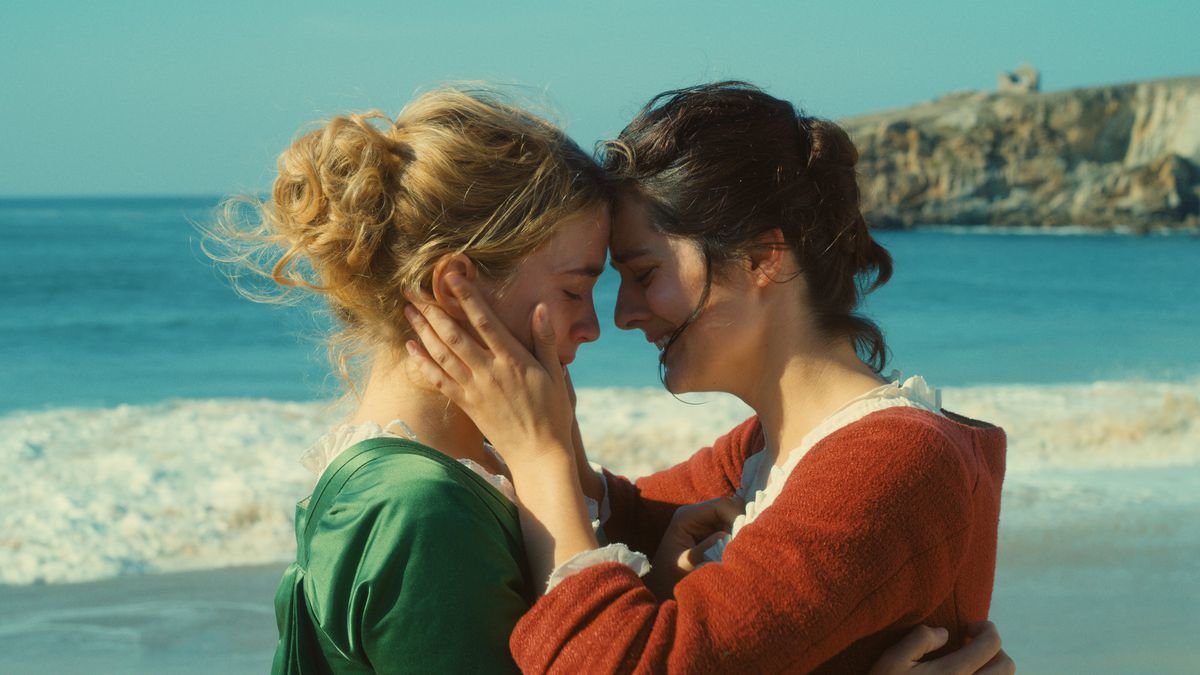
Halfway through Céline Sciamma’s Portrait of a Lady on Fire, Adèle Haenel turns to Noémie Merlant: “Do you think all lovers feel they’re inventing something?” Haenel’s Héloïse and Merlant’s Marianne have just become lovers: the question comes moments after their lips first met in a secluded stretch of the windswept 18th century French coast they’re stranded in. Heloise is a bride-to-be, waiting to be palmed off by her blue-blooded mother (Valeria Golino) to some affluent suitor in Milan. And Marianne is the painter hired to finish her portrait, which will be used to seal the deal. Merlant does not answer Haenel, but Sciamma lets the question carom off Héloïse’s scarcely furbished mansion, and resurface in a final heart to heart, with the young women now in bed, whispering in the dead of night. It’s the last they’ll ever share. They both know it. “I feel something new,” Héloïse tells Marianne: “regret.” And Marianne, holding her lover’s face in her hands: “do not regret—remember.”
In an interview following Portrait’s Cannes premiere, Sciamma told Film Comment she wanted the movie to trace “a luminous path” even as the devastating love story between Héloïse and Marianne ends in a heart-wrenching and untimely farewell. “Love is emancipation, and the movie says it’s something that can only grow, and it has a future.” I saw the film in Cannes, and then again earlier this month. In between the two occasions, I watched Sciamma’s earlier works. The remark seemed to traverse them all as some mission statement. 
Love, in Sciamma’s films, carries a liberating aftertaste. The sense of emancipation she evoked in the interview boils down to a struggle to renew yourself; to desire is to give birth to something you’ve been carrying inside you all along. Long before Haenel and Merlant’s first kiss, Sciamma populated her films with characters who heed to their impulses, and transform themselves in the process. There is something empowering about this: it’s the idea that love can change the way you carry yourself into the world, because it helps you understand the space you occupy inside it, embrace the image you project into it, and ultimately, rescue some of it from oblivion.
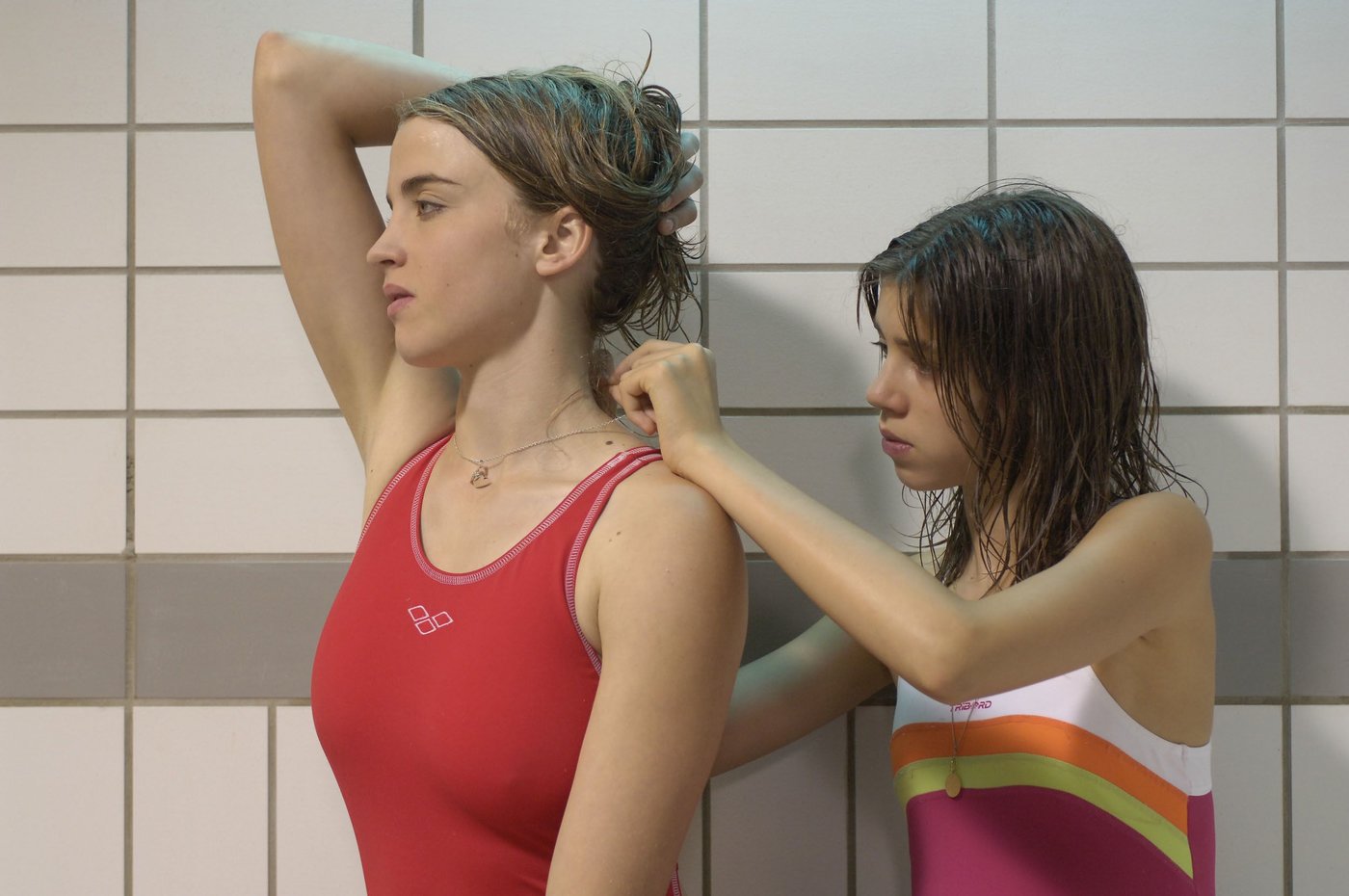
Water Lilies
Take Water Lilies, Sciamma’s 2007 directorial debut. In it, teenage Marie (Pauline Acquart) falls for a girl her age, the captain of a local synchronized swimming team, Adèle Haenel’s Floriane. As a title, the English Water Lilies loses all the transformative allusions of the French original. Naissance des pieuvres (literally, “the birth of the octopuses”) suggests a certain opening, an entry into the world. And Sciamma’s first feature is the story of a re-birth: Marie longs for Floriane, acts upon her desire, and is shaped by it—even as her interest is unreciprocated.
In interviews, Sciamma has recalled the day when, still a teen, she watched a synchronized swimming event, and found the experience seducing. You can feel this seductiveness, this bewitching allure, gleaming in every shot of Water Lilies. This is a film whose attention to routines and choreographies aligns Sciamma with the work of Claire Denis, and Crystel Fournier, whose cinematography Sciamma would rely on for every feature until Portrait, is as fascinated by the two young leads as she is with the rituals in which they partake. All around Marie, sensual and athletic bodies are glittered, exercised, depilated, lacquered. And the choreographies she watches—whether underwater routines or alcohol-fueled house-parties—turn into battlegrounds where identities are shaped and negotiated.  
Marie is transformed by her love for Floriane, and this causes her identity to constantly shift. Hypnotized and manipulated by Haenel, she turns from acquaintance to friend, from friend to confidante, and from confidante to a gateway into the world of sexually active adults. But even as Marie maintains a tragically subaltern relationship with Floriane, Sciamma captures that heartbreaking first crush as an empowering process. The transformation Marie undergoes isn’t so much physical as it is emotional: by acting upon her desire for Floriane, she learns to uncover and embrace something that was tucked deep within her. That love, unrequited as it may be, completes her, for it teaches her something—not necessarily something new, but something she could not previously articulate or accept with the same ease. In the end, as Floriane dances on her own, cooly beautiful under a party’s neon lights, Marie floats in the pool next to her best friend Anne (Louise Blachère), smiling at the ceiling. Could this be the luminous path Sciamma mentioned in reference to Portrait—that idea of love as emancipation, some liberating, electrifying force?
Anytime I revisit Sciamma’s films, I am stunned by all the courage her characters brim with. From Water Lilies to Portrait, desire traverses Sciamma’s universe intertwined with pain. Her heroines’ struggles are chronicles of frustrated pursuits, unanswered—or tragically short-lived—love interests. And yet none of them ever chooses to repress their longing as a way to stave off hurt. They'd rather pay the price of that yearning than numb themselves from pain. Which is one of the many reasons why, I suspect, Marianne invites Héloïse to remember, but to never regret.

Pauline
That lesson echoes all the way back to Pauline (2010), a short Sciamma was commissioned for for the collection “Five Short Films Against Homophobia.” Anaïs Demoustier plays a small-town girl who recounts, over an eight-minute monologue, the day she began to be “troubled by girls” and eventually fell in love with one. Her Pauline chose to follow that longing, and was chastised as a result: once the village found out she was a lesbian, she was shunned by her own family, and forced to flee. But pursuing that desire also emancipated her. By refusing to compromise or repress her longing, she was able to vindicate a sense of self she could have never otherwise set free. As the monologue ends, Sciamma shows this much is true. Far from home, Pauline has found love, and in a last-second twist we realize she’s been addressing her new girlfriend (Adèle Haenel), who jumps into her bed and hugs her. “Home is still over there,” Demoustier smiles at Haenel, “but that may change now.”
All through Sciamma’s work, desire has a distinctly corporeal dimension: you long, and you watch as that urge refracts through your body. Pauline does capture some of that in the words Demoustier mutters when she recalls the first aches of longing as “something in my guts, a bit like feeling nauseous.” But it’s in Tomboy (2011) that the interplay between yearning and body receives its most thorough examination. Sciamma’s second feature follows a few weeks in the life of Laure (Zoé Héran), a 10-year-old who moves with her family into a new suburban neighborhood. Short-haired and blue-eyed, graced with a luminous and androgynous beauty, Laure inhabits that pre-adolescent age suspended between genders. But she identifies as a boy, so much so that when she is befriended by Lisa (Jeanne Disson), a girl who’s visibly smitten with the newcomer’s cherubic looks, she introduces herself as Mikaël. And Mikaël she remains, all through the summer, in the eyes of her new pals.
The double identity goes unbeknownst to her parents. Laure at home and Mikaël outside of it, Sciamma’s heroine spends her days studying her new male friends, memorizing and imitating their gestures. Fournier’s camera assumes here a near anthropomorphic character, trailing behind the kids as an anonymous observer, and placing us at their eye-level. It works through close-ups and medium shots that keep us near them at all times, and force adults to bend down to enter the shot. Oscillating between rest and hyperactivity, rapid cutting and longer takes, Tomboy replicates the cadence of children: it brims with that observational quality that makes so much of Sciamma’s work feel like ethnographical footage. Still, the longing Laure confronts is altogether different from the yearning that permeated Water Lilies or Pauline. Sure, there are traces of erotic tension with Lisa, but the overarching struggle here pivots on a quest for acceptance. Laure’s desire is to pursue an identity independent of the one her body comes attached with.
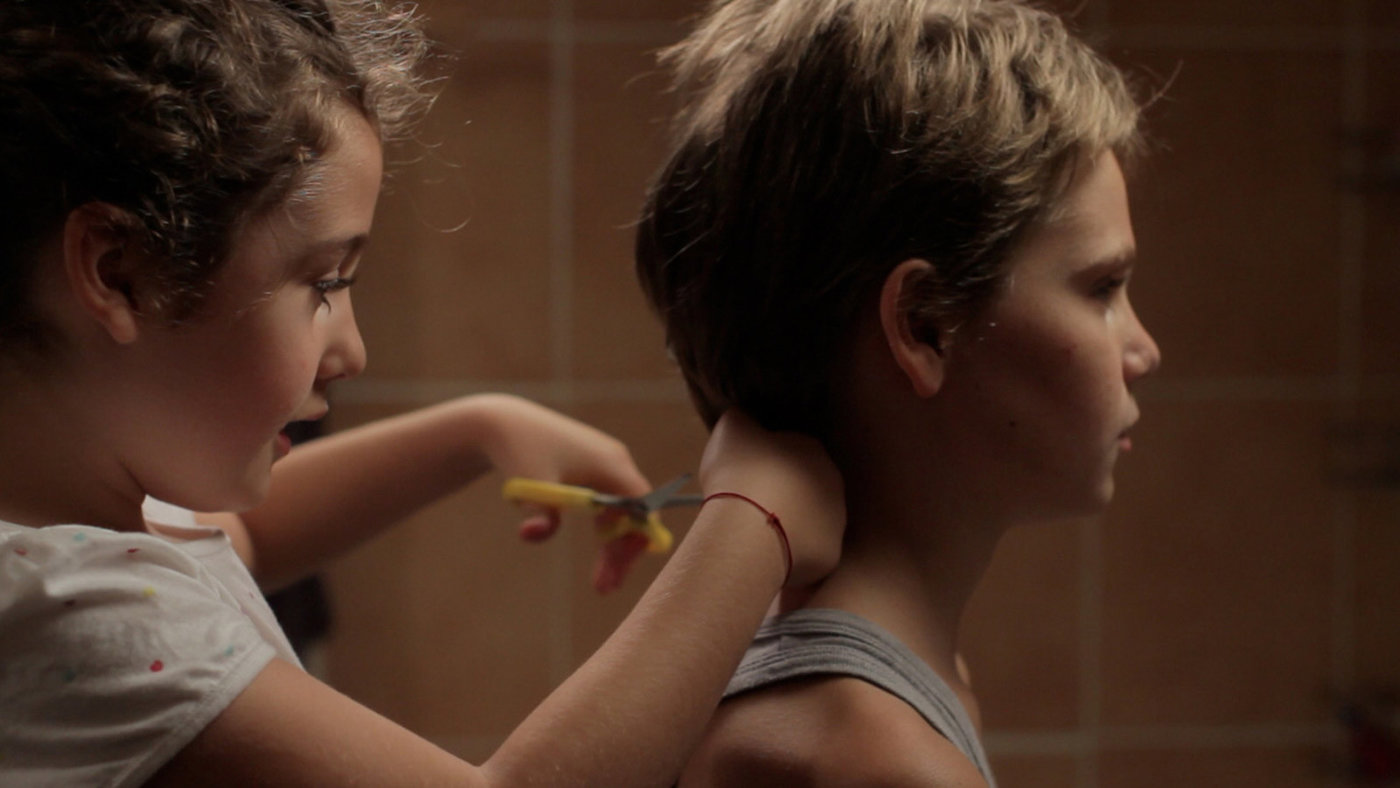
Tomboy
“The body is the object and the limit of the film,” Sciamma has noted about Tomboy, and just how clunky and big an obstacle becomes apparent in the film’s brutal denouement. Like Marie’s and Pauline’s before her, Laure’s longing is imbued in pain. As her mother comes to know about her secret, she forces her to confess it to her new friends. It’s an unspeakable humiliation. For the kids are more furious than dumbfounded by what they perceive as a deceit, as if Laure had violated some invisible and sacred rule. And yet Tomboy lands on a heart-warming note. Laure and Lisa bump into each other again, and Lisa asks for the child’s name a second time. Laure’s dream may have shattered, exposing her in the most belittling way possibly, but pursuing that desire may have helped her embrace a different understanding of her self. Whether or not she’ll be able to vindicate a new space in the world remains to be seen, but there is a sense that things have changed, and can begin anew. That “Laure” she finally tells Lisa after a long pause is the same Laure she was when they first said hello, but a different one, too: a freer, lighter being. She smiles, and we cut to black. 
It’s interesting that the closest relative to Tomboy’s heroine should be a girl hailing from a diametrically opposite turf. With Girlhood (2014), Sciamma’s shifted her focus away from white female culture and turned it onto France’s multicultural banlieue. Her third feature follows Marieme (Karidja Touré), a black teen who seeks solace from an abusive family situation and lack of school prospects, and finds it in a local three-girl gang headed by Lady (Assa Sylla), a charismatic figure against which shy Marieme is pitted like Marie opposite Floriane in Water Lilies. But even as some of Lady and Marieme’s interactions crackle with desire, there is no infatuation like in that film, no unrequited and tragic love story like Demoustier’s in Pauline. In fact, much like Laure’s in Tomboy, the sense of longing simmering through Girlhood boils down to a struggle to belong and find acceptance into a new group—in this case, a family surrogate.
There’s a scene in Girlhood that has jostled itself in my mind like few others. It’s the moment the four girls break into a full rendition of Rihanna’s “Diamonds” inside a hotel room they’ve got for the night, a safe space Fournier’s deep blue palette turns into some marine reverie. Lady stares at the camera as she lip-synchs and dances, and a reverse shot reveals Marieme staring back. The camera pulls out to show the three girls dancing together, and pushes in on Marieme’s face. She’s lying on the bed as she watches, and Touré lets the image work on her physically, contracting and relaxing her gaze, until she rises and joins in. It’s a moment brimming with contagious energy and affection; a short-lived mirage, sure, but in that magical space suddenly opened up by the love for her friends, the world seems a far more welcoming place than it probably ever did.
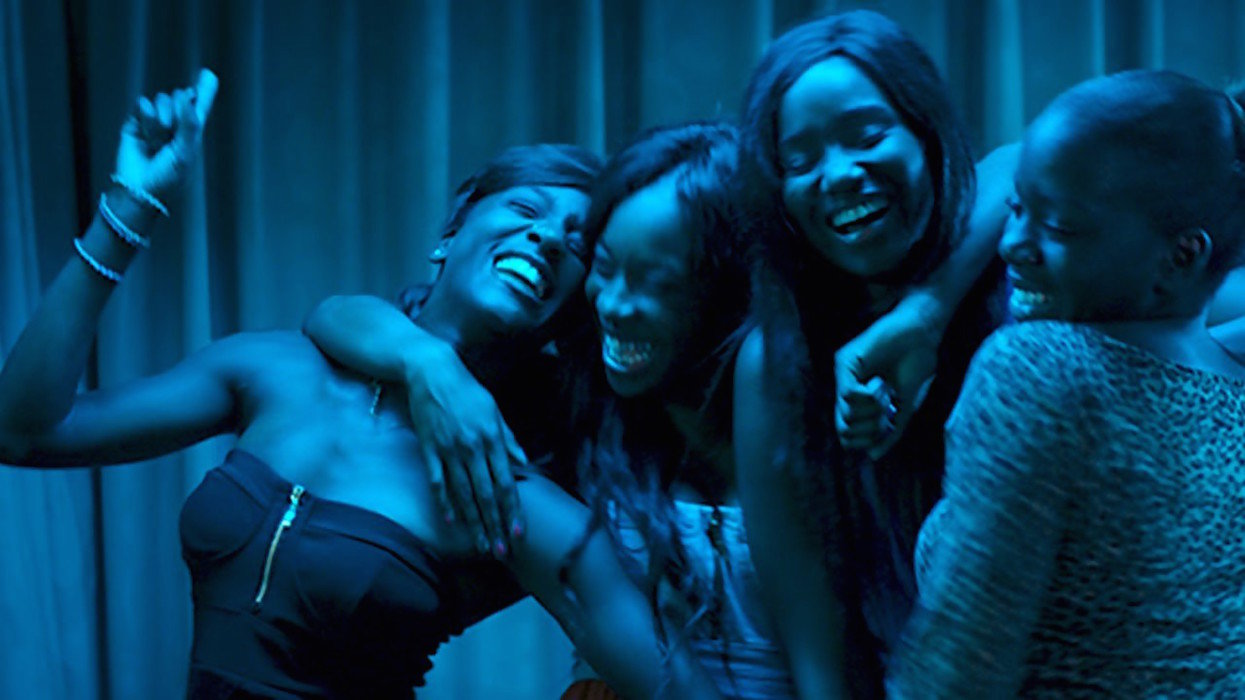
Girlhood
And even if that mirage won’t survive, even if the four will grow apart and the violence Marieme is escaping won’t cease but only finds new shapes and perpetrators, that love she begins sharing with them will help transform her. It’ll provide her with the safety net and confidence to imagine a new place in the world. This is a film that could have ended by lingering on the tears Marieme sheds as she finally realizes she will never be able to return to her family. Instead, it closes with the teen’s profile, tears wiped away, marching into the future and the city sprawling below the projects.
Girlhood may well have been a departure for Sciamma, but like Water Lilies and Tomboy, the film follows characters preoccupied with the images they project into the world. Portrait of a Lady on Fire, on the other hand, focuses on those they choose to hold on to and rescue from oblivion. Which makes Marianne’s plea to Héloïse, “remember,” all the more harrowing. Here too, love traverses Sciamma's world as a transformative force. Lovers do not necessarily invent something new, but exhume and nurture something they had only kept hidden. Watching Marianne and Héloïse fall in love—a choreography of searching and wanting glances—is to witness them grow together and complete each other. Nowhere in Sciamma’s work has a relationship ever been as symmetrical as the one between them. “That’s the heart of the film, equality,” Sciamma noted in Cannes, “[Merlant] is being looked at as much as she looks.”  
But love takes on a far more urgent meaning, too. The longing Marianne and Héloïse feel for each other is as much about consummating an incandescent desire as it is about saving and crystallizing some of it into eternity. Which is why the myth of Orpheus the young lovers discuss plays such a crucial role—Orpheus, the Greek god who turned his head back to look at his beloved Eurydice as she reemerged from Hades, knowing all too well that doing so would cause her to vanish from the world forever. Why would he do such a thing? Maybe it was Eurydice who asked him to turn around, offers Héloïse—and Marianne will only understand her words in their devastating farewell. It is not an egotistical choice. It is not about preserving some lover as young and beautiful, but the memory of a love at its most powerful and vivid. Only then will it never truly finish, forcing you to grasp for air anytime it will resurface, as Héloïse will do anytime she’ll listen to Vivaldi’s “Summer.” From Water Lilies to Portrait of a Lady’s arresting final shot, falling in love, in Sciamma’s world, is to escape the things that made you; in this case, your own mortality. It’s all an illusion, of course. But it’s just too beautiful to resist giving it one last look.

Wednesday, 18 December 2019

Rushes: In Memory of Anna Karina, "Nosferatu" in Prose, Best Undistributed Films

Get in touch to send in cinephile news and discoveries. For daily updates follow us @NotebookMUBI.
NEWS
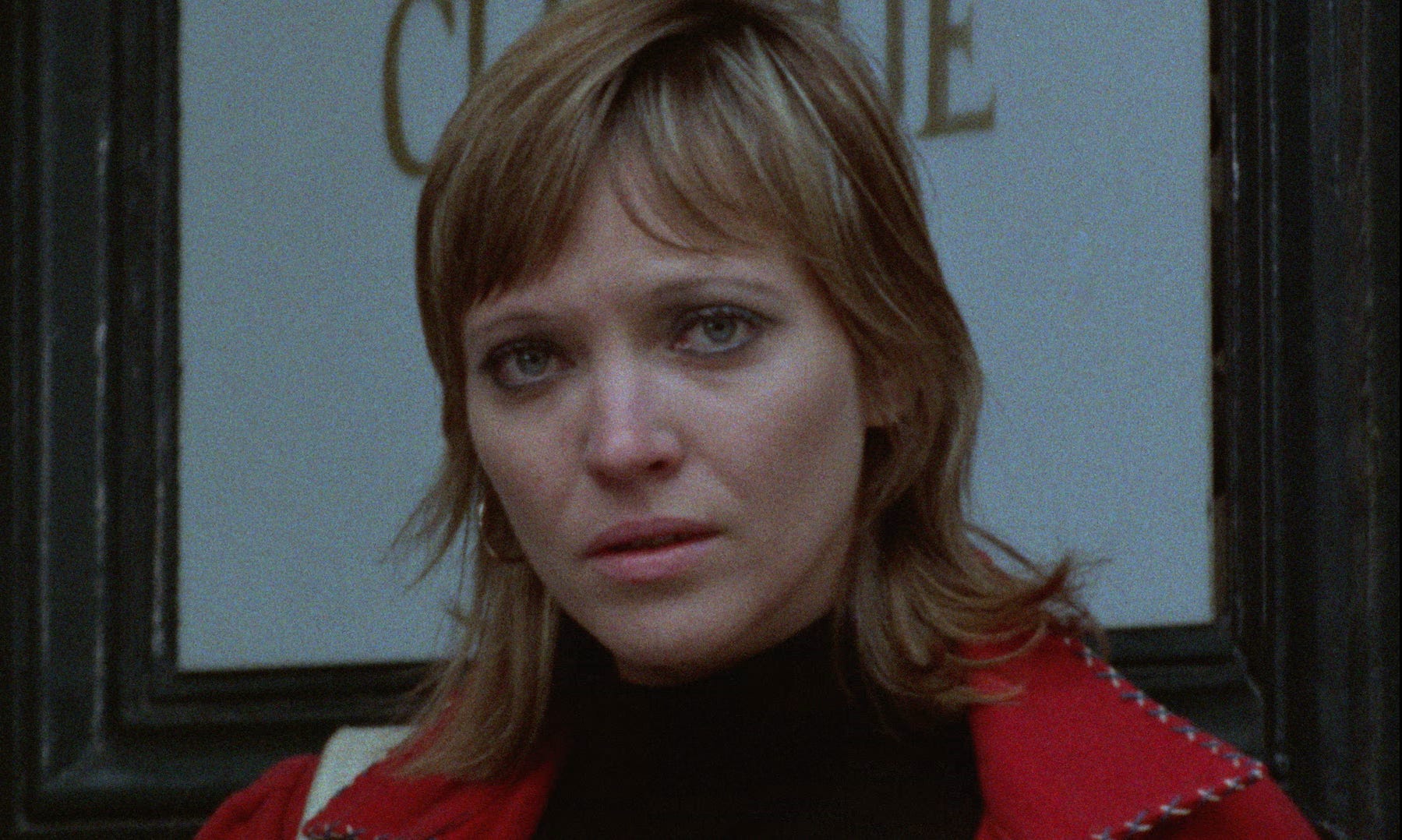
  • We're saddened to hear that Anna Karina, one of the defining figures of the French New Wave, has died. Though primarily remembered as the muse of Jean-Luc Godard, Karina was a remarkable actor, writer, and filmmaker in her own right. Justin Chang of the LA Times recalls her toughness and charm as seen throughout her expansive career.
  • Courtesy of Josh Martin, the Chinese Film Bureau has shared a promising updated on the long gestating anthology film Seven-Person Band (previously titled Eight & a Half). The omnibus film is produced by Johnnie To, and features "some of Hong Kong's most renowned directors," including the late Ringo Lam.
  • Alex Ross Perry is set to adapt Stephen King's 1989 novel The Dark Half, which follows an author whose literary alter ego comes to life with grisly intentions.
RECOMMENDED VIEWING
  • The tense, beguiling trailer for Rose Glass’s feature debut Saint Maud has premiered. Notebook writer Kelley Dong deemed the film “a […] spiral of maroon, beige, and chestnut, a boldly crafted object that demands to be seen with eyes wide open.”
RECOMMENDED READING
Nosferatu (1979)
  • Werner Herzog's Scenarios III contains four scripts for Herzog’s early films. Lithub has published an excerpt of his prose script for Nosferatu: "Dracula speaks with exceptional courtesy, all in a very soft voice. Something about it conveys menace; his very presence fills us with trepidation."
  • The Brooklyn Rail interviews David Lynch, who has a new exhibit entitled David Lynch: Squeaky Flies in the Mud showing at Sperone Westwater, and examines "the complexity of Lynch’s 'anti-teleological spirit.'"
  • The best undistributed films of 2019, as compiled by Film Comment, include Sergei Loznitsa's State Funeral, Abel Ferrara's Tommaso, and Miko Revereza's No Data Plan.
Anna Karina in her self-directed film, Vivre Ensemble (1973)
  • In loving memory of Anna Karina, David Hudson of Criterion has provided an essential overview of Karina's career and her relationship to stardom, acting, and filmmaking.
  • Helen Beltrame-Linné investigates the year in Brazilian cinema, in which "the industry [suffered] from less institutional and economic resources, [and] from a declared war of the government against the artistic class."
  • Juliette Binoche's recent career-spanning conversation from the International Film Festival and Awards, Macao, includes insights into the actress's work with filmmakers from Abbas Kiarostami to Hirokazu Kore-eda, and "the spark that keeps her going."
RECOMMENDED LISTENING
  • Daniel Lopatin, otherwise known as Oneohtrix Point Never, continues his fruitful collaboration with the Safdie Brothers on their latest cinematic descent, Uncut Gems. The equally riveting and disturbing soundscape is now on Spotify.
RECENTLY ON THE NOTEBOOK
EXTRAS
  • A text by Daniil Kharms, an inspiration for the band GUO and for Peter Strickland's new short film, GUO4, currently playing on MUBI.

International Film Festival Rotterdam 2020. Lineup

My Mexican Bretzel
The titles for the 49th International Film Festival Rotterdam are being announced in anticipation of the event running January 22 – February 2, 2020. We will update the program as new films are revealed.

TIGER COMPETITION
El año del descubrimiento (Luis López Carrasco)
Beasts Clawing at Straws (Kim Yonghoon)
The Cloud in Her Room (Zheng Lu Xinyuan)
Desterro (Maria Clara Escobar)
Drama Girl (Vincent Boy Kars)
La fortaleza (Jorge Thielen Armand)
Kala azar (Janis Rafa)
Nasir (Arun Karthick)
Piedra sola (Alejandro Telemaco Tarraf)
Si yo fuera el invierno mismo (Jazmín López)

BRIGHT FUTURE COMPETITION
Babai (Artem Aisagaliev)
Chaco (Diego Mondaca)
Los fantasmas (Sebastián Lojo)
Fellwechselzeit (Sabrina Mertens)
For the Time Being (Salka Tiziana)
I Blame Society (Gillian Wallace Horvat)
Moving On (Yoon Dan-bi)
My Mexican Bretzel (Nuria Giménez Lorang)
Ofrenda (Juan María Mónaco Cagni)
Panquiaco (Ana Elena Tejera)
A Rifle and a Bag (Isabella Rinaldi / Cristina Hanes / Arya Rothe)
Sebastian jumps über Geländer (Ceylan-Alejandro Ataman-Checa)
The Trouble with Nature (Illum Jacobi)
Truth or Consequences (Hannah Jayanti)
Wisdom Tooth (Liang Ming)

BIG SCREEN COMPETITION
El cazador (Marco Berger)
Eden (Ágnes Kocsis)
Énorme (Sophie Letourneur)
The Evening Hour (Braden King)
Fanny Lye Deliver'd (Thomas Clay)
Mosquito (João Nuno Pinto)
A Perfectly Normal Family (Malou Reymann)
Synapses (Chang Tso-chi)
A Yellow Animal (Felipe Bragança)

Lined Lips, Spiked Bats: When You’re a Woman It’s Always Political

Lined Lips and Spiked Bats is a monthly column devoted to women in genre cinema.
When Bob Clark’s Black Christmas was released in 1974 it was coming right off the victory of Roe v. Wade, which gave women legal access to abortion in the United States. It was a major win for the women’s liberation movement, and the question of abortion slowly started to seep into movies of the period. Black Christmas is about Jess Bradford (Olivia Hussey) receiving obscene telephone calls at her sorority house while her friends disappear one by one, but in between the verbal and physical violence, she and her boyfriend Peter (Keir Dullea) fight over her desire to have an abortion. Black Christmas was always political, but its specific history of a proto-slasher made when Roe v. Wadewas finalized means that it has a unique placement in the genre.  
The slasher genre didn’t explode in popularity until John Carpenter and Debra Hill’s Halloween came out in 1978, but it was beginning to form as early as 1960 with Peeping Tom and Psycho. When Halloween was released it created a template for the genre to exploit again and again with slight alterations, as well as helping cement horror films as a genre of utmost prominence in the 1980s. During that decade the slasher found its footing as a genre of impulses, both sexual and violent. It was perfect fodder for teenagers to flock to in droves, because these movies offered something very straight-forward if the audience was looking at it from a surface level. They knew what to expect: a killer would pick teenagers off one by one until a final girl (usually a virgin) took down the monster. Before the DNA of the genre became commonplace and cheap to reproduce, the proto-slasher offered something more complicated. Black Christmas is one of the best of these films, because it fully embraces the national conversation over abortion. In an interview recorded for the initial Black Christmas DVD release, Olivia Hussey stated that it was this aspect that initially drew her interest to the film.  
Clark’s Black Christmas suggests a world of quotidian mistrust of the voices of women while also centering the relationships that women have with one another. The film is endowed with a sense of timelessness by accomplishing both of these goals with a script that doesn’t flinch at violence, and allowing women to have a college life beyond flirtatious beach adventures. Scenes between sorority girls are treated like a hangout, and even with the telephone calls and the disappearance of their friends they treat the company of one another as their own safe space. Olivia Hussey and Margot Kidder are both really remarkable and have a wattage about them that’s easy to gravitate towards. Kidder plays her character Barb like she’s out to a live a life occupied only by substances and sex, and even when she’s a little more provocative than the other girls she’s still treated like a sister: like their fuck-up. But the film revolves around Jess’s realization that her boyfriend might be the one making the obscene phone calls when the pervert over the phone starts bringing up her pregnancy and the guilt she might have in terminating the fetus. The horror revolves around a woman’s right to choose and the frustration that comes from men who are hellbent on making that decision for women. All of the violence in Black Christmas unravels from that central point of conflict. It is all tinged with the degradation of men losing control and trying to take back what they assume is their decision to make.  
Much of Black Christmas is shot like Alan J. Pakula’s Klute (1971). The shadows are ominous, the light sources are usually extensions of the bedrooms that the sorority girls have decorated themselves, and the hovering threat of the telephone interrupting a girl’s sense of safety is tangible. Much of the violence in the film is also shot with its ear bent toward phallic symbolism and male frustration: an agonizingly long death scene of a plastic bag pulled over sorority sister Clare Harrison’s (Lynne Griffin) head, the horn of a unicorn plunged into Barb’s chest. All of these violent scenes are given substantial weight, because every aspect of societal protection feels unsafe for women. When the girls go to the police to make a missing person’s report for Clare they don’t believe the girls and suggest that she’s probably off somewhere with her boyfriend. They tell the girls to calm down. They only begin to investigate when a male friend of Clare’s also expresses worry. Clark navigates all of these various difficulties that women face systemically with a deft touch that never emphasizes the importance of making a point. It feels lived in and natural, and it’s easy to feel almost cozy in the unsafeness of the original Black Christmas, because the tone of how women are treated begins to feel normal, like day to day life, something we’ve all had to put up with. The only difference being that sometimes we aren’t killed. Sometimes.
The original Black Christmas remains one of the finest horror films of the 1970s because it is expressly in conversation with the advancements made by the activism of the women’s liberation movement. It is unique among slashers because the genre tropes are not set in stone, and the distrust in societal figures, and the escalating violence of North American cinema brought about by the New Hollywood movement all collide in a perfect expression of women’s anxieties. There’s a new remake of Black Christmas (now in cinemas directed by Sophia Takal and co-written by April Wolfe, that throws all subtlety out the window in favor of a blunt anger with the state of how women are treated in 2019. Sophia Takal’s Black Christmas suggests that the only way to rid the world of monsters who call themselves men is to burn everything down, because nothing else is working these days.
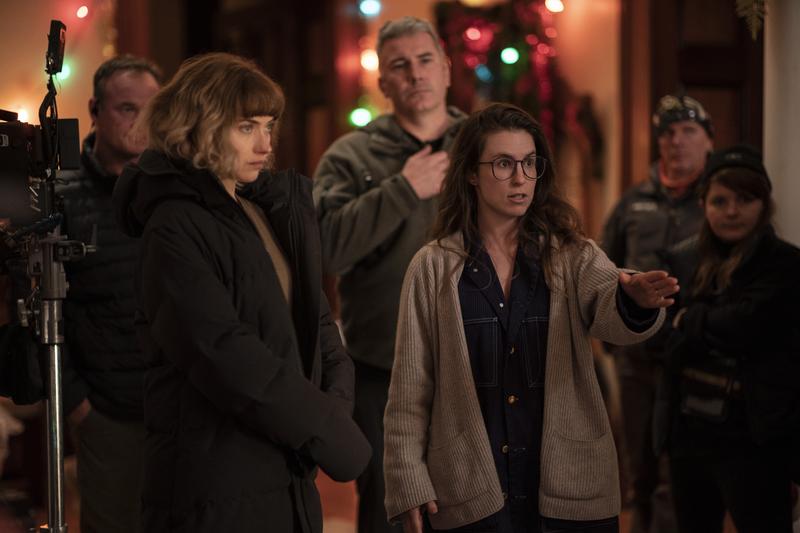
While watching Takal’s new movie I was left thinking about the little ways women go through day to day life without letting anger at being treated like second class citizens worthy of distrust boil over into outright violence. There’s one scene early on where Riley Stone (Imogen Poots) is working her day job as a barista. Everything is normal until a man walks in she immediately recognizes. He’s the best friend of the man who raped her. He’s there for no reason other than to exert his power over her, but because Riley is working her day job she can’t say or do anything, except serve him. The new Black Christmas is filled to the brim with examples like these and goes about delivering them in frank, to the point,  fashion that feels more appropriate for the times we now live in. Instead of dirty phone calls, the new edition of this story includes suggestive threatening text messages, and the anxieties around abortion and a woman’s right to choose are updated to that of rape culture. But more than anything else, Takal’s film feels like a genuine response to the agony of women that came in the wake of President Trump, an accused rapist,endorsing fellow abuser Brett Kavanaugh to become a Supreme Court Justice and the dismissal of Christine Blasey Ford’s heroic testimony.
The horror of the new Black Christmas comes from the danger of the fraternity houses. There’s an easy good versus evil dynamic at play which heightens the danger experienced by the sorority sisters. Takal’s direction is at its most comfortable when suggesting the horror around the edges of the actual violence, like the scene involving the coffee shop, but this isn’t to say that there are not moments of genuine terror. There’s a strangulation scene which plays out like the classic jump scare from The Exorcist III (1990) that horror fans far and wide adore, and the opening killing is among the best the slasher genre has seen in some time. Takal is always interested in asserting her form in ways women find familiar and scary, and in the case of the opening murder, that comes when a man is following Lindsay (Lucy Currey) home. She keeps getting weird texts, and when she sees the man behind her using his phone she gets scared. He steps stride for stride with her, but we never see his face because Lindsay doesn’t turn around until she can get her keys placed between her knuckles for protection (something I’ve done myself on multiple occasions). When she does finally turn and confront him he runs away, only for a hooded figure to jump out of the bushes and chase her up the street before killing her: her flailing limbs make a snow angel on the lawn. When her friends realize that Lindsay has disappeared they report it to the cops, but Riley struggles going back to them, because they didn’t believe her when she reported her rape earlier that year. They don’t believe her again when she insists something is happening to her friends.
When the girls start to suspect it is the frat house that is hunting, abducting, and killing their friends they have no support from the college institution, because the staff  thinks it’s all in good fun that the boys get the razzing of girls out of their system before they move on to things like political positions. Again, this is all very blunt—boys will be boys, coded for our times, language that could very easily become nothing more than t-shirt feminism—but for the most part Takal and the crew do a good job of suggesting a righteous anger with a lived-in quality among girls who are just trying to survive. The best moments in Black Christmas are the smaller ones that ache with the frustration of institutions and political organizations failing us again and again. In that way, the movie was cleansing to watch at times, even if I think the go for broke finale of wielding bats and turning an otherwise lovely bit of dialogue about the solidarity of ants, as a metaphor for women needing to stick together, into the literal text of a girl gang, lands with a thud.
The 2019 Black Christmas is a genuine #MeToo film. The movement gets thrown around in just about every movie written or directed by a woman these days, to the point where it can sometimes feel like those words no longer have meaning, but it’s appropriate here. When the #MeToo hashtag was surfacing on Twitter and becoming commonplace on other social media outlets and within the entertainment industry at large, it had nothing to do with branding. It was political because being a woman is a political act in and of itself. The #MeToo movement was our bodies crying out that enough was enough.  It was meant to be healing, to bring light to just how widespread women had been assaulted, abused and raped with the hope that we would be heard and believed. Black Christmas is sometimes too neat to fully express that feeling , but it tries to get there, with an active acknowledgement that women bottle up more than men will ever know. The #MeToo movement was a primal scream that rose up from the throats of women. Black Christmas is an echo of that initial feeling.  
The horror genre has always been political, because a large portion of the storytelling has centred the death of women as a spectacle. When you’re the one being killed it’s always political. If women find comfort or relatability in these stories it is due to the fact that we are familiar with the vulnerability and the inherent danger that comes with that violence. The Black Christmas films were always political, because they were fundamentally interested in the problems that women were facing at different points in history, even if the past hardly feels like it’s in the rear view mirror these days.

Tuesday, 17 December 2019

An Experimental Decade, the Features: 30 Films of a Fortunate Man

At least once a decade since, I don't know, the 1960s, someone has declared the End of Cinema, sometimes with an air of triumph, occasionally a sense of relief, but usually a general tone of defeat. As we should have learned by now, cinema is resilient, not unlike the flu. It mutates, but it doesn't ever really go away. And as a specific subset of Cinema writ large, experimental film (and video? Do we still need to stipulate that?) has had its basic DNA rewritten dozens of times since the supposed heyday of the genre, the sixties-into-seventies sweet spot where autobiographical expressionism evolved into formalist rigor. The avant-garde, with its battered but still pulsating community ethos, and its inherent since of opposition (be it latent / aesthetic or blatant / political), has managed to keep on keeping on, even through the dim years of 1985–1993. Someone's always cooking up something good.
Reviewing a decade in the life of any artform is, of course, an arbitrary way of seeing where things are at. I was teaching an art history course this past term, and I was trying to get my students to see how particular canvases displayed transitional effects between the Renaissance and the Baroque, reminding them that there was no bowler-hatted Art Bureau who showed up in 1520 to announce, "okay, Renaissance is over, pack it up." These things are frayed along the edges, and we only pretend otherwise for convenience's sake. So attempting to assess the finest achievements in cinematic art between January 1, 2010 and December 31, 2019, is perhaps even more absurd.
This is only exacerbated, of course, by the fact that defining "experimental film" is notoriously dicey. It's a subjective process, of course, but not entirely. I refer above to a community ethos, and I don't think I'm alone in using this idea as a yardstick for making some of these difficult category rulings. Experimental cinema, in the "classic" sense, has been artisanal, operating mostly in the "one man/woman band" vein, as opposed to the industrial production crew style. Once, it was a bit easier, using 35mm as the cutoff between "us" and "them," but now that celluloid is as quaint as a rotary telephone, more and more experimentalists have access to 35mm and even 70mm. Obsolescence has turned out to be an advantage, just like it was for 8mm and 16mm before.
There are also tricky distinctions between genres: experimental documentaries, slow cinema, and the like. So in terms of deciding on thirty key experimental feature films of the decade, I decided to abide by this possibly outdated but at least semi-objective metric. Films that circulate in the not-for-profit co-op channels of distribution, and tend to be made by a single artistic entity with the possible help of a few friends, would serve as the basic definition of "experimental." So this ruled out films like Tsai Ming-lang's Journey to the West, Kirsten Johnson's Cameraperson, Jean-Luc Godard's The Image Book, Maddin / Johnson / Johnson's The Forbidden Room, and a few other films that straddle the line between artisanal and industrial, a line that digital production is gradually obliterating.
But enough about the films that are not on the list.
One thing I will say about the final thirty I came up with is that the ranking gets a bit shakier and less defensible as the numbers get higher. At the end of the year, and the decade, we are inundated with lists, and as such we are implicitly asked to ponder the vagaries of taste. There is often a lot of agreement on these lists, and this has to do with institutional factors as much as anything else: which films played what festival, who got how much grant support, and which films were championed by critics, myself included. We'd be deluding ourselves if we chalked widespread agreement simply up to meritocracy.
But on the other hand, there are certain artists who have earned the support they've received by consistently showing us something unexpected, taking the medium in directions we didn't even realize that it needed to go. The films on this list by David Gatten, Jodie Mack, Blake Williams, Heinz Emigholz, and Lewis Klahr, for example, are all instances of established artists, all at varying points in their careers, taking up their skill sets and breaking off into a distinctly new direction. For some, such as Williams, Michael Robinson, Ben Rivers, and Isiah Medina, it was a first-time move into feature-length, which involved the broader articulation of their previous concerns. In other cases, it was a question of research and exploration, bringing their particular methods to bear on new concerns, like global capitalism (Jodie Mack), autobiography (Heinz Emigholz), or the tactility of video versus film (David Gatten).
Other key films of the decade marked the emergence of major new voices in experimental cinema, perhaps none more forcefully than Ja'Tovia Gary, whose previous films only hinted at the intellectual depth and emotional expansiveness of The Giverny Document. But the decade also witnessed the wider emergence of artists such as Khalik Allah, Stephen Broomer, Soda_Jerk, and the long-overdue acknowledgement of Kevin Jerome Everson and Deborah Stratman as modern masters.
Meanwhile, some of the very same individuals associated with that late 60s / early 70s avant-garde golden age remained active during the last decade, making work that easily compares with anything they've previously produced in terms of quality and scope. For the most part, we have the turn to digital filmmaking to thank for this. Of course, Ken Jacobs has long been indefatigable, and his Eternalism method has spawned another period of intense productivity. But the embrace of digital tools has also provided a flurry of significant new work from James Benning, Ernie Gehr, and Dan Barnett. And even Peter Hutton embraced the new technology for his final film, before his untimely death.
Apart from all this, it seems as though one should look for defining commonalities, as a way to locate some sort of Zeitgeist. It has, of course, been a turbulent ten years: a global refugee crisis; the rise of right-wing politics; greater evidence of pending environmental disaster and the immediate rise of catastrophic weather; and the rather sudden drop of the benevolent ideological mask of American hegemony, in favor of open and unapologetic white supremacy. But if all I've articulated above means anything, it's that I, my taste, and my relation to cinema itself does not stand outside of those relationships, nor do the films themselves somehow simplistically express them.
Rather, the thirty films I've chosen are a triangulation of my own interests and perceptions vis-à-vis the decade of crisis, as well as my frequent need to seek refuge from it in the realm of the abstract. Your thirty films would, of course, be different than mine based on what you have seen that I haven't. (I never saw Betzy Bromberg's films, for example.) But more importantly, your thirty would differ based on how engaged you are able to remain in the ugly immanence of the world, and for how long, and to what extent your subject position allows you to slip away or forces you to stay in the fight.
As we know, these are problems of situation and history, written on the body, and they are not the same for all of us. Which is why we're all in this mess—because our differences are freighted with power or its lack. Here are thirty films as seen by a very fortunate man, who has a lot of room for ruminative beauty alongside the necessary rage.
1. The Extravagant Shadows (David Gatten, U.S., 2012)
2. The Grand Bizarre (Jodie Mack, U.S., 2018)
3. The Giverny Document (Single Channel) (Ja'Tovia Gary, U.S. / France, 2019)
4. PROTOTYPE (Blake Williams, Canada, 2017)
5. Differently, Molussia (Nicolas Rey, France, 2012)
6. Streetscapes [Dialogue] (Heinz Emigholz, Germany, 2017)
7. Sixty Six (Lewis Klahr, U.S., 2015)
8. Park Lanes (Kevin Jerome Everson, U.S., 2015)
9. American Colour (Joshua Bonnetta, Canada / U.S, 2011)
10. Episode of the Sea (Lonnie van Brummelen, Siebren de Haan, and the inhabitants of Urk, Netherlands, 2014)
11. Field Niggas (Khalik Allah, U.S., 2015)
12. The Realist (Scott Stark, U.S., 2013)
13. Watching the Detectives (Chris Kennedy, Canada, 2017)
14. Terror Nullius (Soda_Jerk, Australia, 2018)
15. American Falls (Phil Solomon, U.S., 2012)
16. Daredevils (Stephanie Barber, U.S., 2013)
17. The Lanthanide Series (Erin Espelie, U.S., 2014)
18. The Illinois Parables (Deborah Stratman, U.S., 2016)
19. Tondal's Vision (Stephen Broomer, Canada, 2018)
20. Seeking the Monkey King (Ken Jacobs, U.S., 2011)
21. Easy Rider (James Benning, U.S., 2012)
22. Science Without Substance (Daniel Barnett, U.S., 2019)
23. Two Years at Sea (Ben Rivers, U.K., 2011)
24. Invention (Mark Lewis, Canada / U.K, 2015)
25. Three Landscapes (Peter Hutton, U.S., 2013)
26. 88:88 (Isiah Medina, Canada, 2015)
27. The Royal Road (Jenni Olson, U.S., 2015)
28. Circle in the Sand (Michael Robinson, U.S., 2012)
29. Ouroboros (Basma Alsharif, Palestine / Qatar / France / Belgium, 2017)
30. Where the Chocolate Mountains (Pat O'Neill, U.S., 2015)

Friday, 13 December 2019

The Best Movie Posters of 2019

1. The Last Black Man in San Francisco
No surprises here if you’ve seen my Best of the Decade list, in which this design came in at #4. To be honest, I could almost have filled an entire top ten with Akiko Stehrenberger’s 2019 posters. In the last few weeks alone she has released a stunning alternative art print for Breathless, superb new posters for Honey Boy, Bikram: Yogi, Guru, Predator, and, most notably, a gorgeous minimalist optical illusion for Portrait of a Lady on Fire. But my favorite of the year still remains this miracle. As I said in my decade poll, “this was the second poster by Akiko that A24 released for The Last Black Man in San FranciscoThe first was masterful and striking and beautifully painted, but the second one was next level...a conceptual piece that conveys both place (the impossibly steep streets of the titular city) and theme (the uphill struggle of the title character) in one concise, brilliantly witty, disorientating, makes-you-look-twice design.” If you want to see more of Akiko’s work, she has a brand new book coming out this month.
2 & 3. Hotel By the River and Asako I & II
Also from my decade’s top ten so forgive me if I repeat myself: “A bit of a cheat here I guess, but these two posters go together as well as the pairs of figures that are their subject matter. Both these films were in the 2018 New York Film Festival and when I did my annual wrap-up of the posters for that festival a year ago, neither of them had a particularly compelling country-of-origin or festival poster. But when both films were released in the U.S. earlier this year, their forward-thinking boutique distributors had commissioned these two indelible designs. Hotel by the River is by Brian Hung, Cinema Guild’s in-house designer, and Asako I & II is by Sam Smith for Grasshopper Films. I have written about both designers’ work before: in an article about another of Hung’s posters for a film by Hong Sang-soo (he’s designed five to date) I called his Hotel by the River ‘a monochrome minimalist masterpiece with exquisite bespoke lettering.’ And when I premiered Sam Smith’s poster back in April I described it as being ‘as elegant and restrained and endearingly odd as the film itself.’ Anyone who knows me knows that I love minimalism and graphic restraint in movie posters, I love well-used negative space and I love perfectly chosen (or hand-written) lettering. And both of these posters have all of that in spades.”
4. Nimic
If this had been the only poster Vasilis Marmatakis had designed this decade it might well have made my best of decade list but of course his poster for The Lobster was already among my favorites. Marmatakis is to Yorgos Lanthimos what Saul Bass was to Otto Preminger, and I was happy to see that he had designed a poster for even this 12-minute Lanthimos short which premiered at Locarno last summer. As with the best of Marmatakis’s work it is simple, unsettling, and unlike anything else you’ve seen before.
5. La Flor
From a 12-minute film to an 808-minute one. How do you solve a problem like La Flor? How do you encapsulate a film that took ten years to make and runs nearly fourteen hours, that uses the same four actresses in six intertwining episodes that play out in a variety of genres; a film that, I’ve heard said, “contains everything.” Scott Meola’s lush yet concise solution may not be the only answer (the original festival poster was even more gnomic) but it is a statement poster if ever there was one. It tells you nothing about the film except that it is maybe something special, which that Justin Chang quote reinforces. Kudos to Grasshopper Film for releasing this behemoth into the world, but for me their greatest leap of faith was allowing Meola to break up the title the way he did to give it its graphically satisfying shape. The casual viewer may read it as Laf Lor but this is not a film for the casual viewer.
6. Parasite
The original Korean poster for Bong Joon-ho’s international barnstormer was really the first glimpse any of us got of this soon-to-be sensation back in April. Its placid yet ominous domestic scene, rendered undeniably creepy by the censor bars across the protagonists’ eyes—reminiscent of Kendrick Lamar’s Good Kid, mAAd City—featured half the major players (not least that boxy, modernist home, the ultimate star of the film) and a number of significant objects (the teepee, that ornamental rock, those legs...) without giving much of the game away. A Screen Daily case study entitled “How Parasite became the highest-grossing foreign-language Palme d’Or winner in the US” says of the poster that “the art revealed a grand imagination and promised intrigue, while giving away nothing more,” which is a winning strategy that one could claim for a number of the posters in this list. Though the article attributes the poster to Neon, they were simply smart to adapt the Korean design. They have released a number of alternative art posters since (some of which have been given away at screenings) but none can quite compare to this.
7. A Bigger Splash
The original 1974 poster for A Bigger Splash also featured a photographic cut-out against a background of David Hockney’s 1972 painting Portrait of an Artist (Pool with Two Figures). In the original it’s a shirtless young man with slicked back hair, in Midnight Marauder’s elegant 2019 re-imagining for Metrograph Pictures’ re-release, it’s Hockney himself examining his own work. The image of Hockney is taken from a scene in the film in which the artist is crouching in front of an unfinished version of the same painting in which the pink-jacketed figure is nowhere to be seen. I love how Midnight Marauder has adapted that image and created a series of frames within frames. And his type choices are on point, giving the rounded sans serif of the original poster a more sophisticated update. Fun footnote: in November 2018, Portrait of an Artist (Pool with Two Figures) became the most expensive painting by a living artist ever sold at auction, selling for $90.3 million.
8. Satantango
Another re-release poster and another behemoth. While Mariano Llinás’s 13-hour La Flor is twisty and playful, Béla Tarr’s 7-hour 1994 masterpiece Sátántangó is monumental and elemental, a film of drear landscapes and bleak houses. The top half of Dylan Haley’s poster for Arbelos’s 2019 restoration gives us an empty swathe of black rain that seems to be crying out for a series of pull quotes proclaiming the film’s greatness, but Arbelos have resisted the temptation, letting this haunting image, and the film’s reputation, speak for themselves. At the bottom of the poster, almost as if he couldn’t help but drag in the mud from outdoors, Haley seems to be nodding to Hans Hillmann’s leaf-strewn poster for The Fire Within.
9 & 10: Birds of Prey and The Isle of Birds
From the subdued to the multi-hued. I couldn’t resist pairing these two bobby dazzlers together either. Despite their avian-related titles these films couldn’t be further apart: one a big-budget franchise spin-off, the other a small Swiss documentary. The Birds of Prey poster, designed by Hollywood power agency BOND, is part of a vibrantly colorful onslaught of key art in service of one Harley Quinn. As Bond’s website says “with a multitude of eccentric pieces, including payoff and character art, we went all out to give Harley explosions of color and style, showing her off as the delightfully dangerous beauty she is.” It’s unusual to see any blockbuster key art that really stands out from the crowd these days so hats off to BOND for taking the harlequin out of Harley Quinn and running with it. The equally colorful Isle of Birds poster was illustrated by the wonderful Belgian cartoonist Brecht Evens for the design firm Les Bandits. In a year in which beige was the in vogue color for movie poster design, these multi-colored wonders stand out like a sight for sore eyes.
18 Runners-up (in no particular order beyond an aesthetic one)
Runner-up posters above designed or illustrated, where known, by Brandon Schaefer (The Sharks and Shooting the Mafia), Akiko Stehrenberger (Portrait of a Lady on Fire), Midnight Marauder (Black Mother and Dreamland), Works ADV (Ad Astra), Matt Taylor (The Gospel of Eureka), Mika Kimoto (What You Gonna Do When the World’s on Fire?), Scott Meola (The Wild Pear Tree), Dylan Haley (Anne at 13,000 Ft.), Ivo Francisco (Diamantino), Propaganda B (I Was at Home But...), Tony Stella with Midnight Marauder (A Hidden Life), June Bhongjan (The Secret Life of Pets 2), Kyuyoung Hwang (Rams) and The Dream Factory (The Silent Revolution).
You can see my all previous Best of the Year posts here: 2018; 2017, 2016; 2015; 2014; 2013; 2012; 2011; 2010; 2009. And if you’re new to this site, do check out my regular (if not always weekly) Movie Poster of the Week posts on Notebook, and you can follow me on Instagram or Twitter.

A Requiem for "The Cotton Club Encore"

The Cotton Club Encore is showing December 13, 2019 – January 11, 2020 on MUBI in the United States as part of the series Francis Ford Coppola: Reignite Cinema.
Albany, New York is far from a cinephile hub but there exists a stronger network to the arts than what one would suspect. The city is synonymous with politics by being the state’s capital city and, especially if you live outside of the state, mostly associated with the setting of William Kennedy’s “Albany Cycle” novels that include his Pulitzer Prize-winning Great Depression-era masterwork, Ironweed. Kennedy, a former local newspaper journalist turned novelist, still remains a titan in the Albany area where he founded and developed, through MacArthur Foundation grant money, The Writer’s Institute with the University at Albany, State University of New York (SUNY Albany) to foster local artists and help expose the area to the best of  literature, non-fiction writing, journalism, theater, and film. If you went to see a Federico Fellini film for free on a Friday night while SUNY Albany classes were in session over the last few decades, you could thank William Kennedy for that.  This past October, Kennedy, now at 91 but still as sharp as a tact, held a regional film premiere at The Writer’s Institute. The film was the first screenplay Kennedy ever worked on and was credited to do, Francis Ford Coppola’s The Cotton Club (1984). But this time it was Coppola’s director’s cut, The Cotton Club Encore, with Kennedy and Coppola both in attendance. The final product of The Cotton Club Encore is a requiem of a masterful collaboration between two great artists and a brilliant cast and crew. The theatrical cut of the film, widely proclaimed a compromised, messy, over-budget commercial failure with notoriety in lawsuits and even murder hanging over its 1984 release, reflected the post-New Hollywood anxieties of ambitious, historical passion projects and also, depressingly, the racism within the film industry that gutted the soul of the movie. Luckily, the film has now been restored in this version that Coppola and Kennedy sought to create.
The film started without Kennedy as the writer nor with Coppola as the director. The general idea of the film, a crime drama set at the height of the Harlem Renaissance and primarily at the legendary gathering of The Cotton Club, based on the James Haskins non-fiction book on the famous location, was the passion project of the film producer Robert Evans, who optioned the book in 1979 and wanted to direct the film. He tapped Mario Puzo, best known for authoring The Godfather, whose adaptation Evans produced, to do a draft of a screenplay. This development caused multiple studios to express interest. Evans began working on getting talent in front of the camera, meetings which included those cast in the picture, like Richard Gere and Gregory Hines, as well as stars of the era such as Sylvester Stallone and Richard Pryor. But the Puzo script had many problems, for Evans and Gere’s dissatisfaction with the script had him making intimations of leaving the project altogether. Evans contacted his previous major collaborator, Francis Ford Coppola, to rewrite the script.
At this time, Coppola was still in massive financial straits from his self-financing of Apocalypse Now (1979) along with the disappointment of his deeply personal Las Vegas musical One from the Heart (1981). He was slowly trying to work out of it with his S.E. Hinton film adaptations of Rumble Fish and The Outsiders. Coppola and Evans were both branded by the Hollywood press as geniuses but also two men who had flown too close to the sun, Evans himself facing massive difficulties from subsequent flops after his peak with Chinatown (1974) and the two Godfather films. Coppola was sympathetic and loyal to Evans as a former collaborator and also sympathetic to him trying to make his passion project. Coppola was also burning for any cash flow and $500,000 to do a new draft of a screenplay paid better than the other directing gigs he was attached to at the time. But Coppola was not going to just be just a screenwriter for long. Evans knew what his name recognition and strongest association was in Hollywood with The Godfather films, and the fact he had Coppola and Puzo (who still had official co-credit on the screenplay) “reunited” could attract investors, as he was looking for money to be loaned for the film and Coppola had to be in the director’s chair for the film to secure funds for the project. Although seemingly a simple solution, things soured quickly.
Coppola’s first draft was not well-received by investors and temporarily resulted in Edward and Fred Doumani, Las Vegas casino owners who Evans got to bankroll the movie, to suspend their funding.  Coppola’s draft was described as a “PBS-like documentary,” derided as a “history lesson,” with Coppola presenting “historical montage” of the era that broke from traditional narrative, which would include recreations of the civil rights marches of that period as well as actors reading the works of black poets of the Harlem Renaissance on-screen. Evans managed to coax the Las Vegas investors back into the project after revisions from Coppola and presented them with a copy of the book Memo From: David O. Selznick, linking the initial troubled production of the 1939 epic Gone with the Wind, which stemmed largely from script problems, to their own predicament, as in that this can happen to great, commercially lucrative art. Once in the director’s chair and with final cut, Coppola began to craft the project more into his personal vision, assembling a cast and crew to go along with his Jazz Age image of the project, intending to create a film that could not be boxed in as either a gangster picture nor a musical but something never seen before.
After reading the novel Legs, which was recommended to him by actor Mickey Rourke, Coppola decided to reach out its author, William Kennedy, to help him with the screenplay of the film.  Published in 1975, Legs would be the novel that put Kennedy on the map. The first of what would be the “Albany Cycle” novels, Kennedy’s fictionalized account of the rise and fall of real-life gangster Jack “Legs” Diamond through the eyes of Diamond’s lawyer, Marcus Gorman, Kennedy’s novel was widely praised, earning comparisons to F. Scott Fitzgerald’s The Great Gatsby. Unlike more parochial entries of historical fiction, Kennedy’s prose offered a bittersweet and psychological account of a bygone era where gangsters were feared but also treated like movie stars. This is what attracted Coppola to Kennedy, making a narrative involving gangsters that transcended a pulpy crime novel and gangster cliches in popular culture for a deeper statement about men and country.  Kennedy agreed to enter the project and with him now involved, the foundation of the script and basic story of the film was formed.
The film’s story was a mix of fictional characters and real-life gangsters as well as Jazz Age legends but was mainly about two sets of brothers in corresponding narratives, one white and the other African-American. There was Dixie Dwyer (Richard Gere), a cornet player who rubs shoulders with the mob to advance his career, ultimately becoming an actor in gangster films (loosely based on the life of actor George Raft). The complications are that his brother Vincent Dwyer (Nicolas Cage) is becoming an unpredictable, hyper-violent gangster in his own right, and Dixie finds himself falling for Vera (Diane Lane), the girl of real-life gangster kingpin Dutch Schultz (James Remar). Vera, a lounge singer who wants to open her own club, and Dixie both owe their career aspirations and advancement to Dutch, but they can only compromise and flirt with each other so much. In Dixie’s Harlem neighborhood is the character of Delbert “Sandman” Williams, who is a dancing act with his brother Clay (played by Hines’ real-life brother Maurice), but Sandman is immediately captivated by light-skinned performer Lila (Lonette McKee) and soon leaves his brother behind. Sandman’s complications are that, especially compared to Dixie, his career aspirations are capped due to systemic racism of the era. He can be an entertainer of the nightclubs and even be a performer for mostly white audiences, but there are parts of New York City he cannot set foot in without him getting suspicious looks or being in danger. Meanwhile, Lila, biracial, can pass as white, which troubles her romance with Sandman because being in present company with a black man does threaten her ability to pass and be able to go into the spaces to have the career she wants.  That was the skeleton of the story, a rich and sprawling American epic on race, violence, crime, capitalism, and fame, but details and tangents that Kennedy and Coppola were wont to do were subject to daily changes and revisions due to pressure from financiers and production.
Coppola and Kennedy would work several hours a day on the script, their inspiration coming from movies and music of the era. They also bonded over their mutual love of the Irish author James Joyce. Coppola has noted that for the 1979 Cannes Film Festival when he showed a still not-yet-finished Apocalypse Now on the Croisette he referred to it as “Work in Progress,” a nod to when Joyce’s Finnegans Wake was initially published in fragments as “Work in Progress” before its publication as a whole. Kennedy and Coppola in one initial draft had an explicit allusion to Joyce’s Ulysses in scripting a musical number to the song, “Those Lovely Seaside Girls,” famously featured in the novel, which imagined a scene of a wedding. That segment was excised but it showed how these two extremely creative minds met and worked in harmony, while being under the gun of a difficult production that was day-to-day largely predicated on what the financial situation could afford them by powerful, shady investors.  When the whole process was done, it was estimated dozens of different drafts were turned out by Coppola and Kennedy. Script length was cut from 135 pages to 110 pages to save on costs; most of what was excised per Kennedy was that the film’s initial drafts portrayed a fuller picture of gang violence in showing scenes of widows and those impacted by senseless deaths. At one point, Kennedy, back home in Albany and away from the film’s New York City shooting location, had to phone in a scene for Coppola to shoot in an effort to save money.  
Evans was still presenting The Cotton Club as a Godfather reunion to keep investors happy. Kennedy’s Ironweed was published in 1983, around the time of this film still being in production, and Kennedy, while getting strong notices for Legs and Billy Phelan’s Greatest Game, was not yet in the arena of Puzo in commercial name recognition.  He was still a Hollywood outsider but he rolled with the punches even if the author never quite saw the mystique of Robert Evans that others around Kennedy did. The film ran into numerous troubles that overshadowed the narrative of the film itself. Gere tried to quit numerous times, to the point Coppola floated the suggestion that Matt Dillon become the new lead; financier Roy Radin was murdered under mysterious circumstances that caused Evans to be paranoid; the Doumanis ran out of money; Coppola shot over a month without getting paid; mob-related figures from Las Vegas began showing up on set to see through that this production finished on time; and despite cost-cutting efforts in the script, the film went significantly over-budget.
The anxiety around the film could not rest even after shooting was completed. Due to the box office disappointment of Sidney Lumet’s adaptation of The Wiz, Evans struggled to even fund this picture that was largely centered around African-Americans. Coppola’s cut of the film featured numerous scene-to-scene musical numbers of only African-Americans (with Lane’s Vera being the most prominent non-black character to lead a musical number). Despite the fact it was historically accurate and honored many black performers of the era, the notion that “there’s too many black people in the film” was the general complaint Coppola heard from the studio at the time and has since gone public about.  Although having final cut, Coppola was still shell-shocked from his experiences in One from the Heart and Apocalypse Now, and so he obliged the studio with what they wanted. Length, musical numbers, and much of the narrative threads of the African-American characters were cut, with Gere, Lane, Cage, and Remar more central while Hines and McKee’s performances feel sidelined with their musical numbers serving as their calling cards rather than delivering any dialogue.  "I didn't have the courage nor the perspective to realize that maybe this was a different kind of musical," Coppola would admit in a post-screening panel with Kennedy.
The Cotton Club Encore
The Cotton Club premiered in December of 1984 as an Orion Pictures release, with Kennedy’s Ironweed winning the Pulitzer earlier that April, and would fail to make a fraction of its budget. The film received good but not great reviews and managed to get two Oscar nominations for the Herculean editing work and lavish, rich in detail production design. But the financial difficulties of the film that preceded its release remained a dark cloud that impacted the final product of the released film. Luckily, Coppola had saved his rough cut of the film on Betamax tapes and from there worked to make what is now available as the Encore cut.  
The Cotton Club Encore expands on what made the film great and in adding more numbers becomes one of the best American musicals of the 1980s. The dynamic pairing of Fred Gwynne and Bob Hoskins as partners Frenchy Demange and Owney Madden is terrifically lived in and scene-stealing. John Barry’s musical score compliments the jazz standards like “Stormy Weather” and “Ill Wind,” each performed in the film incredibly well. Stephen Goldblatt’s virtuoso cinematography has fluidity and unpredictability in the musical scenes in framing and movement, going from a vérité approach going off-stage to on-stage to near abstract Dutch angles. The cross-fades in the editing are dream-like, harkening back to pre-Code crime films, and the cross-cutting is just as smooth as the work in the first Godfather film. The performances of Lonette McKee, Jackée Harry, the Hines brothers, and the other black performers, some of whom are standing in for real-life entertainers like Cab Calloway and the Nicholas Brothers, are hair-raising and spectacular. The final number shot at New York’s Grand Central Station rivals some of the best scenes of any Golden Age Hollywood musical. And by re-centering the story on African-Americans and how the Cotton Club slowly integrated—in part thanks to the rise of the black mob best embodied by Laurence Fishburne’s Bumpy Rhodes—during a time when African-Americans were originally segregated from watching their own kind in white clubs, the film easily functions as a meta-commentary of the Hollywood system’s treatment and neglect of African-Americans. Having a high-point of African-American culture not be foregrounded into being a story on blackness and black stardom was malpractice and luckily Encore exists to right its own initial wrongs.  
While the Encore cut is still a marked improvement from what was a good film to begin with, there still feels like there were more depths to explore in the narrative due to the ambitions of Coppola and Kennedy’s script. McKee’s storyline as Lila in terms of racial passing is such a complicated and fascinating narrative, and one that has a complex cultural legacy in many other works of art, but it feels like there should have been more explored with her character. The exposition-filled information consigned to her speaks to Kennedy and Coppola’s limitations in telling the black woman’s experience as white male artists. Lila and Vera’s friendship is another off-screen event that could have been afforded at least another scene to present their connection as women who want to move up in society at this time.  Nicolas Cage suffers the most in the new cut, as he is the white character who gets less foregrounded and becomes more of a phantom. What was, even for Cage’s standards, an eccentric early performance becomes even stranger. But Cage’s loss is Gregory and Maurice Hines’ gain, with the brotherhood of the Williams, and not the Dwyers, ultimately being what endures in the film, approximated in the wonderful and heartfelt musical dance number “Crazy Rhythm.”  
The Cotton Club Encore presents a dizzying, rich, inspiring achievement in the creative partnership of Francis Ford Coppola and William Kennedy. After thirty-five years since the film’s initial release, these men, now elder statesmen of their fields of film and literature, show how a “work in progress” can be fully realized in due time. 

Review: Terrence Malick's Ecstatically Anti-Fascist "A Hidden Life"

The Hidden Life
There are few working filmmakers with whom you feel an electric encounter with the world that he or she is filming, an awe and fascination with what is before the camera and can be transmitted through it. One of these rare practitioners is Terrence Malick, who this year returned to the Cannes competition (The Tree of Life won the Palme d’Or in 2011) with A Hidden Life, an adaptation of the real story of Franz Jägerstätter, an Austrian farmer who refused to join Hitler’s Wehrmacht, was arrested for this, and eventually executed. The film opens in the small mountain town of St. Radegund and astonishing visions of mountains embracing a verdant and idyllic landscape, home for the life, work, and love of Jägerstätter and his wife Fani (Valerie Pachner). This is an idealized, innocent utopia like the South Pacific islands in The Thin Red Line or pre-Columbus America in The New World, an exaltation of the balance between human world and the natural, anchored by a love swimming between person and person, person and land. Archive footage of Hitler, much of it pulled from Triumph of the Will, introduces the spark of human evil that, as in those films through war and colonists, will corrupt paradise.
While the setting may appear similar to other Malick films, the dilemma at the film’s heart is quite different, as it is about actively rejecting, both bodily and spiritually, taking part in this spread of evil. Jägerstätter, a fervent Catholic whose devout faith makes up a great deal of the film’s questioning monologues, makes the choice to turn away from fighting for the Germans and being complicit in the darkness spreading across the land. After the film's typically glorious introduction to paradise there is a period of gradual souring of the purity in St. Radegund as the town becomes converted to the German cause and starts ostracizing the Jägerstätters over the father’s nonconformity. Finally, there is Franz's arrest—and in this long section of a nearly three-hour movie, Jägerstätter is imprisoned and the movie transforms into one of the rare films of spiritual imprisonment, akin to Joan of Arc adaptations or the apostasy stories of the two versions of Silence. Jägerstätter is asked to renounce his anti-Hitler beliefs in order be released or at least reprieved, and he instead holds true. This is the section of the film that has most in common with Malick’s most abstract dramas, Knight of Cups and Song to Song, where narrative time and the trappings of the period setting both fall away and characters and figures pace around the frame, asking unanswered questions of each other and themselves. Juxtaposed with the lonely freedom of Fani back on the farm, holding her own in a strong feminine independence unusual for the filmmaker, A Hidden Life boldly dedicates a dominant part of itself to evoking imprisonment of space and of the soul. Only one year passes in prison, but in the film Malick renders this sequence without markers of time, an endless isolation and containment whose only succor is the light that pierces through prison windows and letters of love from home.
Malick has spent the last several films increasingly deconstructing conventional filmmaking and reenforcing his unique film language. As his productions have gotten more spare and in turn more abstract, he has also left behind the specificity of setting found in The Thin Red Line and The New World that, for many viewers, helped anchor or even excuse what many took to be directorial flourishes: The wandering camera, the poetic internal ruminations spoken in voice over, the seemingly random incursions into the drama of non-narrative characters or moments, and frequent cutaways to nature. But these are not quirks, they are building blocks, and in subsequent films Malick daringly broke down his cinema even more to its basic elements, barely staging what any would consider dramatic scenes in favor of two main kinds of human interaction: Two or more people running, touching, tumbling, fleeing, goofing, and otherwise finding joys in playfulness; and two or more people shuffling around in shyness, consternation, thoughtfulness, or confrontation. Rarely does anyone have a dialogue, and instead one character will talk to another in such a manner it almost feels like one is a figment of the imagination of the other, an external, expressionist utterance of a doubt or feeling inside. Barely has a scene begun, a conversation started, when Malick will cut to a new image, a new staging of the scene, and new lines, as if we’re seeing multiple fractured versions of the same singular expression, whether of joy or doubt. This lack of conventional dramaturgy is a technique, not a flaw. Whether it works for an audience wide or small is another question, but it most certainly is a coherent and, for me, frequently tremendous and moving approach not to storytelling but to the evocation of the spirit. Rarely does a filmmaker photograph the world, whether moments of delight between a family or of the sun breaking over a mountain, as if these are new images. Malick is always looking for new images; for him, a shot of the sun isn’t another shot of the sun, but rather it’s a sun never previously seen. In the film there is a moment of possible self-portraiture, of a church painter in St. Radegund who says that he “help[s] people look up from those pews and dream.” In A Hidden Life you constantly have the sensation that each image, however superfluous, is needed, perhaps desperately. You may disagree with that necessity, but how many films insist, are so sure that what they share is an essential revelation? 
These films' attraction to what Werner Herzog, another photographer of revelations, would call ecstatic truth understandably wears down many people, especially since their doubled, tripled, quadrupled emphasis on similar motifs both inside and between the films frequently has a dulling effect that takes away from the majesty of the imagery rather than amplifying it. Nevertheless, A Hidden Life's Austrian setting, with its dramatically curving hillsides, stark mountain ranges, and Old World farmsteads, houses, and church, prove a revitalizing subject for Malick and his new cinematographer, Jörg Widmer, a long-time camera operator for Malick who replaces Emmanuel Lubezki with no noticeable drop in quality of natural light or invention of composition. Shooting with extremely wide lenses, the world spills around its characters, bending and bowing, rendered bracing and unusual. Immersion and wonder is the desire, and the fact that Malick is working on a VR piece makes a great deal of sense, since with that technology perhaps he can place the viewer even closer to glory. 
In St. Radegund, Malick’s approach is nearly as fresh as it was in The New World, genuinely breathtaking at times and evoked through two touching, genuine embodiments by the actors. In prison, the film becomes as frustrated as its protagonist and far more trying an experience for the audience, yet it easily conjures for Franz and for us the absence of the outdoors, of freedom, of play, of fulfillment, and of lightness.  Shot all the way back in the summer of 2016, during the American presidential campaigns and the increased popularity of Austria's far-right political party, the film’s central protest, which is in fact a very private one—Jägerstätter is constantly told no one will hear of his moral stance, that “no one will be changed” by his sacrifice—speaks with unusual direct address to this present moment. “This is what happens when the world dies, but men survive,” remarks St. Radegund’s Nazi-sympathizing mayor. Going to the bishop to protest her husband’s imprisonment, Fani is told of the Church's collaborative position: “let every man be subject to the power above them,” referring to the Third Reich. From this utterance, Malick cuts to a shot of monks carefully tending the church garden, and it is quite clear what power we should be exalting.

Review: The Gleaming Thrills of "Uncut Gems"

Uncut Gems
If you want to be grabbed by the throat, then I’ve got just the movie for you: Josh and Benny Safdie's Uncut Gems. Like the brothers’ last two features, Heaven Knows What (2014) and Good Time (2017), it’s a showboating immersion into a gritty but resiliently existent side of New York that is nowadays rarely set to film. And like Good Time, their collision of Robert Pattinson with a borough-based B-film, Uncut Gems is driven by the monomania of its protagonist, Harold Ratner, and the stunt-casting appeal of the actor who plays him: Adam Sandler. Ratner is a Jewish jeweler in Midtown’s Diamond District and another addict looking for a rush—in this case, the rush of moving capital around with dangerous risks at the hope of a big pay off.
The film opens with Ratner in debt and in panic, and its anxiety only climbs higher from there. Ratner parlays debt into prospects, gains money, lays bets, pawns this, trades that, dodging heavies looking the vig, and chasing after a rare black opal lent early on to Kevin Garnett. (Ratner being a compulsive gambler, he adores basketball, which leads to a climax literally hinging on whether the 2012 Celtics win a game or not.) A fraught amusement park ride through midtown, Uncut Gems is less geographically antic and exploratory than Good Time, but even better at finding locations, actors, and milieu that ground this genre story in a tactile subculture of New York City. The production has a field day with the gleaming Diamond District shops, construction scaffolding, Ratner’s Long Island suburban luxury home, and his mistress’s midtown flat, clad head to toe in black leather and mirrors. Uncut Gems is filled with the details and textures that most other movies set in New York miss. While it’s hard not to think of William Friedkin’s The French Connection, Ratner’s panting needs and frenetic movement around just a few Manhattan blocks at the risk of his career and his life are most reminiscent of poor publicity man Sidney Falco in Sweet Smell of Success.
Cinematographer Dharius Khondji, shooting on 35mm, works great beauty from the midtown streets, the jeweler’s glass, and the high-key lighting of Ratner’s store, hidden as it is several floors up and behind two security doors in some anonymous skyscraper: in long frenetic bursts we glimpse the wheeling-and-dealing of a world usually unseen, one that rushes past you on the street without explanation and plunges deep within unmarked city buildings, its secrets kept within. Daniel Lopatin returns with another out-of-time electronic soundtrack of swelling synths, but this score doesn’t channel the headspace of a thrill-seeker, as it does with Pattinson in Good Time, but rather keeps a distance and connotes not only the rush Ratner needs to live within, but the disjointed alienation of that addiction. Sandler’s shambling, propulsive performance hinges mostly on his constant raging, a cornerstone of some of his comedy that Paul Thomas Anderson also mined for Punch-Drunk Love with a bit more modulation. What the Safdies do get so right with Sandler is the orgasmic—quite literally, in fact—ecstasy Ratner attains when he feels his bets are paying off. A car ride taken as he receives good news transforms into a masturbatory triumph, sublimity momentarily achieved.
At the very worst moment of the very worst day, juggling multiple debts and threats of violence, Ratner is asked if he’s having a good time. Even then he quickly, sheepishly admits: yes. He strings connection to connection, debt to debt, parlaying one risk into another. But when the film leaves midtown, stops a moment and gathers its breath, its thinness and the tiredness of its conceit is apparent. For a while, energy and motion cover this up, but the further we get from sidelong impressions of the Diamond District, the more the film is like every other movie about a deadbeat welcher: The exasperated wife (Idina Menzel, saddled with a role so boring that her more than justified exasperation with her husband is tedious rather than sympathetic), threats to their family, a mistress (Julia Fox) who is a sexy doormat fantasy more than a person. The jeweler's relationships and success with affluent black customers (an aside reveals Harold was among the first to supply rappers with pieces for their videos) are tantalizing but under-explored. Critically, we don’t see Howard Ratner ever at his best. We see the man juggle his responsibilities but never his success—how did this obviously weak-willed and sniveling businessman ever make it this far, keep his store—let alone his knee caps—or have a wife and kids? It’s impossible to imagine, as the grand commotion of Uncut Gems—and it is grand, thrilling and frequently hilarious—suggests this is a normal state of affairs and not the flailing climax of a sequence of bad luck or heightened risks. 
The audience’s possible ambivalence not just to Ratner but the film as a whole is ingeniously evoked in the film’s climax, which has us watch the gambler watching a crucial basketball game on which rides all his many obligations. Watching it along with him are his enraged debtors, stuck between the security glass of Ratner’s store, forced to watch both the game—with their money on the line—and Ratner’s unhinged swings from fury to agony to ecstasy as it proceeds. The debtors couldn’t care less about what they’re watching; for Ratner, it is the most important thing in the world. Here, the Safdies brilliantly allow the audience to either share Harold’s gambling rush, or step back from his mania with skeptical exasperation.

Moviegoing Memories: Victor Kossakovsky

Moviegoing Memories is a series of short interviews with filmmakers about going to the movies. Victor Kossakovsky's Aquarela is MUBI GO's Film of the Week of December 13, 2019.
Victor Kossakovsky
NOTEBOOK: How would you describe your movie in the least amount of words?
VICTOR KOSSAKOVSKY: What if we do not talk about water but just look to it! This is an example of how a film can show a story instead of telling a story.
NOTEBOOK: Where and what is your favorite movie theater? Why is it your favorite?
KOSSAKOVSKY: My favorite cinema theater is the Aurora on the main street of St.Petersburg - Nevsky Prospect. It is oldest cinema in Russia; it was opened in 1913. It is not a huge cinema theater—only 590 seats—but it has perfect proportions of the room and a 100 square meters screen. I loved to go there since my childhood. I saw many great films there, including my favorite films of Chaplin and Tarkovsky. And there I decided to became a filmmaker. I just wanted that one day my films will be there in the Aurora and on this big screen. And it happened. They screened all my films for a few months. Aquarela is already twos and half months at the Aurora as well! 
NOTEBOOK: What is the most memorable movie screening of your life? Why is it memorable?
KOSSAKOVSKY: It was a screening of Fellini 8 1/2.  I was about 12 years old. The cinema theater was full. But I was sure that Fellini is talking directly to me, as if this screening is happening just for me. When the film finished people went out and I was not able to stand up. I was alone in the empty cinema theater crying non-stop—with sadness and happiness.
NOTEBOOK: If you could choose one classic film to watch on the big screen, what would it be and why?
KOSSAKOVSKY: It is hard to chose just one film. My heard is broken on three films: Andrei Rublev, by Andrey Tarkovsky, Intolerance, by D. W. Griffith, and Faust, by Alexander Sokurov. 

Wednesday, 11 December 2019

Rushes: Behind "The Deer Hunter," Re-Making "Black Christmas," Film Festivals and Systemic Change

Get in touch to send in cinephile news and discoveries. For daily updates follow us @NotebookMUBI.
NEWS
  • Late last month, we were saddened by the death of Jean Douchet, whose criticism as co-editor-in-chief of Cahiers du cinéma and as a mentor figure for many in the French film community was invaluable.
RECOMMENDED VIEWING
  • Kino Lorber's first trailer for Kantemir Balagov's Beanpole, which follows the bond between two women in post-WWII Leningrad. Read Ela Bittencourt's Close-Up on the film, which received its online premiere in the UK on MUBI earlier this fall.
  • Corneliu Porumboiu's The Whistlers, a crime thriller about a cop, a mob in the Canary Islands, and El Siblo, an intricate indigenous language that involves whistling.
RECOMMENDED READING
Michael Cimino and Robert De Niro on the set of The Deer Hunter
  • The Guardian has published an excerpt of One Shot: The Making of The Deer Hunter, which includes exclusive photos from Robert De Niro's personal collection.
  • An illuminating interview with Martin Scorsese, who breaks down the expansive production and the intricacies within The Irishman.
  • Montecristo Magazine has provided a profile of documentary filmmaker Alanis Obomsawin and the "true clarity of vision [with which] she presents a historical record that captures moments of resistance and a new paradigm for the future."
Sophia Takal on the set of Black Christmas
  • Sophia Takal, director of Blumhouse's Black Christmas remake, discusses the "boy's club" within the horror community, the influence of the "post-mumblecore Brooklyn scene," and the exploration of gender dynamics in her re-imagining of a sorority.
  • Why has a restoration of Giuseppe Tornatore's forgotten The Legend of 1900 become a smash hit in China, where it has just now received its release? Clarence Tsui investigates the compelling draw of state-of-the-art restorations in the Chinese box office.
  • For the latest issue of Filmmaker Magazine, critic Abby Sun investigates the various initiatives and attempts by film festivals to reckon with "thorny questions" of justice in ways that lack self-reflection and systemic change.
RECOMMENDED LISTENING
  • Criterion's release of Wim Wenders' 1991 Until the End of the World comes with the re-issue of the film's alluring soundtrack, which features songs by Nick Cave and the Talking Heads.
RECENTLY ON THE NOTEBOOK
  • “It is not enough to say that Portrait of a Lady on Fire is about queer desire, but rather about the queerness inherent in desire.” Peter Kim George reviews Céline Sciamma’s Portrait of a Lady on Fire
  • Why would the nicest actor in Hollywood play the nicest figure in television history? Greg Cwik considers the career and screen image of Tom Hanks.
  • “It’s a film that has been within us for a long time. A film which resembles our characters, a monstrous, instinctive, unreasonable, romantic, and extreme film. We hope it resembles us. “ Caroline Poggi & Jonathan Vinel introduce their sublime Jessica Forever, which is now playing on MUBI. 
EXTRAS
  • Though it's only a ten-second clip, here is a first look at Michael Snow's Cityscape, a continuation of La région centrale, shot in iMax and filmed in Toronto.
  • We’re struck by the quietude and sense of comfort in this poster for Angela Shanelec's I Was At Home, But…
 

Copyright © Cinenus | Powered by Blogger

Design by Anders Noren | Blogger Theme by NewBloggerThemes.com