The film industry in one place - Articles, Reviews, trailers and hype!

Sunday, 29 September 2019

Ana Girardot in Official US Trailer for Self-Discovery Film 'Entangled'

Entangled Trailer

"I'm tired of being in my head… I just want to feel desirable again." Samuel Goldwyn Films has debuted an official US trailer for Entangled, a new drama marking the feature directorial debut of Milena Lurie. This also went under the working title of Little Faith while in production. The film stars French actress Ana Girardot as Marin, a young French woman living in New York City after a tragedy. She soon finds herself disconnected from her body, boyfriend, and her family. During a tumultuous weekend, highlighted by many chance encounters with a stranger and an ex-boyfriend, she starts to find her voice. Also starring Grégory Fitoussi, Jonathan Cake, Jay Wilkison, Lucy Walters, and Katerina Tannenbaum. This looks like a very sensual, intimate self-realization drama with a strong lead performance. Check out the trailer below.

Here's the official US trailer (+ official poster) for Milena Lurie's Entangled, direct from SGF's YouTube:

Entangled Poster

Marin (Ana Girardot) is a young French woman living in New York City who has suffered a miscarriage. Growing increasingly numb, she finds herself disconnected from her body, boyfriend, and her family. A tumultuous weekend, highlighted by chance encounters with a stranger and an ex-boyfriend, helps her start to find her voice and sense of self. Entangled is both written and directed by newcomer filmmaker Milena Lurie, making her feature directorial debut. Produced by Jonathan Burkhart, Devin Landin, and Milena Lurie. This first premiered at a small film festival last year. Samuel Goldwyn Films will debut Lurie's Entangled direct-to-VOD (find it on iTunes) starting on October 11th coming up soon. Anyone interested?

First Trailer for 'Blue' Dramedy by Gabriela Ledesma & Callie Schuttera

Blue Film Trailer

"You've been a little… disconnected lately." Gravitas Ventures has debuted an official trailer for a film titled Blue, an indie dramedy made by wife and wife duo Gabriela Ledesma and Callie Schuttera. The two co-wrote the screenplay together, while Ledesma directs and Schuttera plays a character based on Gabriela's own experiences earlier in life. Based on true events, a young woman struggles to piece her world together after a botched suicide attempt. The film has a bit of dark humor, presenting a raw and honest look at the struggles of life and how hard it is to keep it all together. Starring Callie Schuttera, Shaw Jones, Judith Scott, Laura Harrison, Chelsea Lopez, Johnny Loquasto, Jennifer Daly, Todd Stroik, Aubrey Manning, and Vanessa Sawson. This probably won't connect with everyone but it's worth a look anyway.

Here's the official US trailer (+ new poster) for Gabriela Ledesma's Blue, direct from YouTube:

Blue Poster

Written by wife and wife duo Gabriela Ledesma and Callie Schuttera and directed by Ledesma, Blue tells the story of a young woman struggles to piece her world together after a botched suicide attempt. What's interesting about this title is that it is based off of Gabriela's life - and her wife, Callie Schuttera plays her in the film. Together they take on a deeply personal story and use it as an opportunity to shed light on a incredibly important topic, while incorporating humor where they can. Blue is directed by Brazilian actor / filmmaker Gabriela Ledesma, making her feature directorial debut after a few short films previously. The screenplay is from Gabriela Ledesma and Callie Schuttera. This premiered at the Romford Film Festival last year. Gravitas will release Blue direct-to-VOD starting on October 22nd this fall. Visit the official website.

SSIFF Review: Tim Roth Sifts Through the Past in 'The Song of Names'

The Song of Names Review

Music is a remarkably powerful stimulus, capable of transmitting the greatest emotions and stories across space and time. A number of excellent films this year have shown the power of music (most notably Portrait of a Lady on Fire - read our review). Another one joining that list is The Song of Names, which is indeed about "The Song of Names", as the title indicates, from World War II. The film is described as an "emotional detective story spread over two continents and a half century", though that's not really the best description for it. The Song of Names is a moving Holocaust memorial film about a Polish Jewish violin prodigy named Dovidl who suddenly disappears in London just before a major concert, then is found again 35 years later by his British friend, living a much quieter life. It's good! But it's mostly bogged down by formulaic storytelling.

The Song of Names has only one main character: Martin, played by Tim Roth. This is being pointed out because, as much as the story needs to focus on him some of the time, it could've benefited from spending more time with the other characters. All of them are secondary, in the shadow of Martin, which doesn't make sense because the film is really, truly about this Polish violin prodigy. At the very beginning of WWII, Dovidl's parents take him (at age 9) to London to study in a prestigious music program. He is accepted, but his family returns to Poland and suffers a horrible fate in a concentration camp after Germany invades. The film is framed around a concert he was going to give in London, but he doesn't show up - no one knows why or where to, but through time we learn the actual story and it's not as surprising or as shocking as they want it to be. He just learns the truth about his family, tragically, so he leaves that London musician life behind.

The younger cast - Misha Handley and Luke Doyle - from the WWII time is slightly better than the older cast. But everyone is solid in it - lead by Tim Roth and Clive Owen in the later years. It's most important that the music and violin scenes stand out and they really do. Considering the film is about a musical genius who gave up his talents because of the tragedy of the Holocaust, it must stand out as an extraordinary work of aural storytelling. In that sense, it does succeed. The scenes where music is important are the best scenes, and they're the ones that will stick with most viewers. While there are a few of these very powerful moments, the film overall lacks any emotional resonance and is often bland during the many dramatic "investigative" scenes. A few days following the screening it's already hard to even remember much of what happened aside from the big music moments. It's far from being the remarkable "emotional detective story" it wishes it was.

As everyone knows, there have been numerous films throughout history about the lives of people affected by the Holocaust - survivors, family members, relatives, allies, saviors, even tormentors. The Song of Names is another film that memorializes the horrors of the Holocaust, reminding us how atrocious & destructive war always is, but doesn't offer us anything new that hasn't been covered in all the other films before it. Sure it doesn't need to, but this does hold it back. The music is exquisite, and makes it more than just another story about lives lost. But it never goes above and beyond the music, and focuses too much on the one British boy when the lives of the other people involved in the story are that much more interesting. It's still an engaging watch, and I can certainly appreciate the passion that everyone put into telling this story, but the film isn't the most memorable or effective. I still hope some viewers are moved by the film, and I expect many will be.

Alex's SSIFF 2019 Rating: 6.5 out of 10
Follow Alex on Twitter - @firstshowing

Double Take: Unpacking The Controversies of ‘Joker’ and ‘Jojo Rabbit’

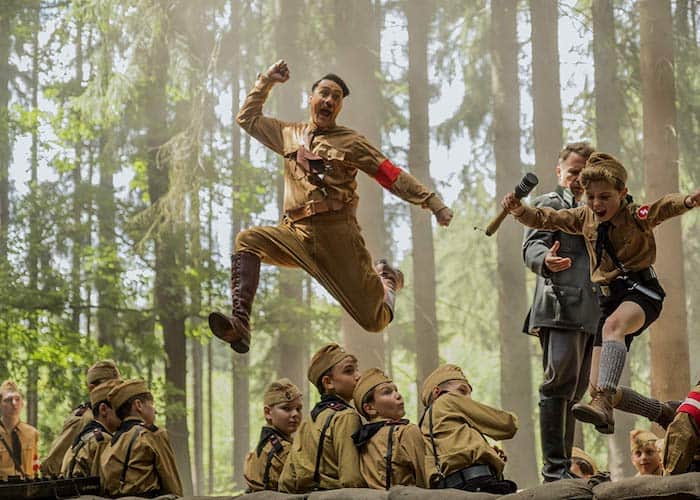
Double Take is a series in which Anna Swanson and Meg Shields sit down and yell at each other about the controversial, uncomfortable, and contentious corners of cinema. Meg and Anna were on the ground this year at the Toronto International Film Festival where they caught screenings of 2019’s hottest tickets: Jojo Rabbit, Taika Waititi’s “anti-hate satire” about a boy and his imaginary friend, Adolf Hitler; and Joker, Todd Phillips’ gritty comic book villain origin story.

Joker became a source of contention after its Venice Film Festival debut generated responses of overwhelming praise and moral apprehension, a mixed critical response that only became more fraught after Joker waltzed away with Venice’s coveted Golden Lion. Some feared Joker would serve as a dangerous blueprint of an unstable, disaffected man resorting to violence, with others going so far as to refer to the film as “a portrait of the supervillain as the original incel.” The other big-ticket hand-wringer on the TIFF docket was Jojo Rabbit, a heartwarming de-radicalization comedy trying to walk the tightrope of a twee aesthetic and a weighty World War II backdrop. 

The Double Take duo came away from both screenings with reactions they didn’t expect. After taking some time to sort out how they felt about both films, they sat down to untangle the films’ similarities and the reasons they both felt uneasy about the latest TIFF People’s Choice Award winner. This is the conversation that followed.

The following contains spoilers for Jojo Rabbit and Joker. 

Red Dots

AS: So, I guess where we could start is that at Venice, where Joker premiered, there were reactions saying “This film is dangerous.”

MS: Dangerous in the sense that it was going to be a movie for incels, which is a hideous thing, absolutely.

AS: Yeah, and I can see how the Joker story could loan itself to those connotations. You can very easily have this be a story about someone who feels slighted by society, but specifically by women.

MS: Or even at the very least that the narrative could fit an already existing incel narrative about misfit men. From the trailer, that did feel like a possibility. So even people who hadn’t seen it, just hearing reactions from Venice, were like: “Yikes!”

AS: There were also some people pushing back against that take, saying that just because the film might be working with difficult ideas didn’t necessarily mean it would condone the character or want you to support him. The idea being that films shouldn’t have to present a morally “correct” narrative to be good, which I agree with. I don’t need a 1:1 ratio of personal ethics to content. 

MS: Yeah we are on record agreeing with that

AS: We had points where we were like, “What if we like Joker?”

MS: It’s not difficult to talk about why an incel-ish movie might be dangerous. On the other hand, with something like Jojo Rabbit, finding the words to explain why a comedy based around WWII and Nazism doesn’t sit right requires a level of nuance that Twitter is not known for. I think it’s easy to pick up on what it is about Joker that could be dicey, but for some folks, myself included, it’s more challenging to articulate why this “Anti-Hate Satire” doesn’t sit right.

AS: And I do want to say, I’m all for satire. Satirize Nazis. Like, what Mel Brooks has done is great. But there’s something so on the nose about calling the film “an anti-hate satire.” I feel like if you call it that you’re almost undoing something. It reads as not putting faith in your audience to figure it out.

MS: I think it also shows that for the marketing team, there’s this idea of “if we position this film as something daring, the people will see it.” 

AS: People will think it’s more transgressive than it is. It’s that feeling of thinking that you “get” something other people don’t. 

MS: I also think, and I’ll don my tinfoil hat here, that Disney saying they didn’t know how to handle Jojo Rabbit was a lie. I think that was a marketing scheme to make it seem edgy. 

AS: Yeah, it also sets itself up as a satire about Hitler as an imaginary friend, which is why when I saw the film I was shocked to discover it is not a satire and not about Hitler as an imaginary friend. The Drop Dead Adolf stuff is barely in the film to the point that if you took it out it would be basically the same movie. The film starts being kinda satirical, but it’s ultimately so earnest that I just don’t buy the branding. And humor is so subjective, but aside from one or two moments, this movie isn’t funny to me. 

MS: Yeah, so after seeing these two films, the twist is that Joker isn’t really dangerous.

AS: It’s not good enough or bad enough to really warrant these reactions. It’s a fine film but there’s nothing dangerous or truly brazen about it. 

MS: And when Joker goes off the deep end, it’s not because of women. It’s not an incel movie.

AS: He’s angry at the rich.

MS: It’s a movie about the 1%. It’s not about Joker failing with women and being angry because of that. It isn’t about gender. I mean, it does capture a certain male tendency to go into standup, but other than that—

AS: Joker’s targets are men! The anger he has towards women is not because they’re women. I’m not saying this makes the movie good, but it’s just not doing the things people said it was going to do.

MS: As far as Joker being a radicalization narrative, it’s about political dissatisfaction, economic unrest, and a lack of healthcare. Those are good things to critique.

Joker

AS: Jojo Rabbit is another film about radicalization that was packaged on the surface as being more transgressive and edgier than it actually is. But, I think that below Jojo Rabbit‘s performatively dangerous surface there’s something genuinely insidious that isn’t really being talked about. 

MS: Jojo Rabbit‘s big points are that “Nazis are idiots” and that “we’re all human beings.” It’s too twee to actually say anything that could ruffle feathers.

AS: It’s using this Wes Anderson cutesy thing. It’s Moonrise Kingdom with Nazis. Moonreich Kingdom. 

MS: (Laughing) Yeah, it doesn’t have any teeth. It makes Nazis look ridiculous but it doesn’t take the extra step of saying anything more substantive than “Aren’t Nazis dumb?”

AS: There were moments where the audience was applauding for the bare minimum “Nazis are bad” moments and it just felt like such a pandering, pat-yourself-on-the-back film that makes audiences feel good for what should be considered a basic fucking human decency opinion that Hitler is bad. It’s not actually saying anything insightful or interesting about fascism and radicalization. 

MS: I will say two things: Taika Waititi does have a Jewish background and people process their own histories in different ways. Two: someone could conceivably make a case that sometimes you just need to laugh at stupid Nazis. Is it so bad to sometimes laugh at something that’s dangerous?

AS: Mel Brooks already did that.

MS: Exactly. If that’s what you want, there’s a long history, from before the United States even entered WWII, of movies making fun of Hitler. Chaplin and Brooks and others have done this. Waititi’s a funny, charming guy but there’s a functional angle where I don’t know what this adds as a satire.

AS: I think it’s too focused on its child-centric narrative to be able to engage with these themes in an adult way.

MS: When you take the comedy out, I don’t think you have anything more radical than the kind of humanity-affirming Holocaust tearjerkers that show up in the Academy’s foreign bracket every now and then. This is basically Wes Anderson’s Boy in the Striped Pajamas, and I don’t know what that adds. 

AS: “Hitler Imaginary Friend” also just feels like a two-hour version of a rejected SNL sketch they would have done in 2002. But also, “Hitler Imaginary Friend” was a huge part of the marketing and it’s barely in the film. It’s there for maybe the first fifteen minutes. 

MS: Which is the strongest section of the film. 

AS: Because that’s actual satire. And then the kid blows up and so does the movie. 

MS: (Laughing) It’s true.

AS: Which leads me to believe the film is just using “Hitler Imaginary Friend” as a way to posture as being more complicated, interesting, and edgy than it actually is. 

MS: The most complex this film gets is that love is the answer, which in the context of very late-stage World War II Germany feels really gauche. Even in 2019, it feels gauche! I think that’s the sort of sentiment you have when you’re in the bleachers 100 years down the line after a historical atrocity. And because history has come back, and really never left, it feels uncomfortable. And not in the way the film promised it would feel uncomfortable. 

AS: Yeah. 

MS: People were expecting a radicalization narrative from Joker, and that turned out to not actually exist in the way we were led to believe. 

AS: A false alarm. Meanwhile, Jojo Rabbit was setting the fire next door. 

MS: Jojo Rabbit is a de-radicalization narrative. And what’s at the heart of that deradicalization narrative is actually kind of unsettling

AS: It’s basically: Jojo becomes de-radicalized because he figures out Jews are people when he falls in love with one. 

MS: And the emotional burden of his transformation falls to Elsa, to the Jewish teenager being harbored in his house. The film never goes so far, but when you look at it from a distance, it’s on her to deprogram this radicalized young boy. 

AS: Even Jojo’s mom (Scarlett Johansson), who is a figure of resistance, who actually does work fighting with the capital-R Resistance—it’s not any of her work that changes Jojo…

MS: It’s the power of love, Anna!

AS: Oh my god. 

MS: The power of love! But not a mother’s love. 

AS: It’s not actual resistance or actual attempts at de-radicalization work—you need a pretty love interest. It’s Elsa’s job to be loveable and human enough to save Jojo. 

MS: I think about women online, specifically about Natalie Wynn, who have been positioned as “doing the work of de-radicalizing the alt-right.” That’s a wild expectation for women: to do the emotional labor of reminding men that women are people. And I think that, probably unknowingly, Jojo Rabbit does a similar move. 

AS: And it’s not satirizing the narrative of Jews having to prove to people that they’re human, or how the onus is often placed on oppressed people to prove themselves as being worthy of basic human decency.
Jojo Rabbit Jump

MS: In the film’s defense, it tries. Elsa says things that are ridiculous about Jewish folks, how they have horns and sleep upside down like bats, to show how ludicrous Jojo’s beliefs are. But it’s so silly and toothless that it never registers as a satirical hit because none of us need to be convinced that the dehumanization of Jews is wrong. That humanistic leap, if you can call it that, has been done many times, better in other movies. 

AS: And anyone who doesn’t feel that way is not going to be convinced by this film. 

MS: “Getting along with the enemy” is the heart of the movie. That’s what it’s trying to reveal with its purported satire: that our common humanity will unite us and allow us to dance in the streets once the dust is settled. That the “weight” of that reveal is carried on the back of someone being oppressed leaves a bad taste in my mouth. 

AS: The way that the film frames that reveal in emotional shots is just cheap. Like, “Oh you want people to feel a certain way? Great: Bowie song.” It’s the most basic, pandering route. 

MS: I just don’t know why, in 2019 of all years, we need to have a feel-good movie about World War II and the Holocaust. 

AS: If it actually had teeth and if it was actually a satire, then absolutely there’s a place for that. 

MS: Sure, when Nazis are a thing again and you look at a film like Jojo Rabbit you think: “okay, there’s something there.” But Jojo Rabbit never leaves 1945. It’s a modern movie in a lot of ways, but there’s nothing that acknowledges our current predicament. 

AS: I don’t know if the thing of a historical film throwing in references to our contemporary period always works for me, though. 

MS: I meant it more in the sense that the modern Nazi presence is the only thing that could justify Jojo Rabbit as a satire, and make it different from anything we’ve seen before. That it’s being made in 2019, a year where Nazis walk among us, was what gave it some bite and it never digs into that. 

AS: Right that’s what would distinguish it from The Great Dictator

MS: …or To Be or Not To Be, or any of these movies. That’s what would have made it relevant as a satire, not the fact that it was directed by a comedic director whose tone we like right now. 

AS: Waititi is such an earnest filmmaker, I don’t know if he knows how to work with satire. It’s such a sincere film. And you can see that he gets this sort of imaginary friend conceit out of the way and then it becomes a very straightforward, emotional-beat driven film. And I think something like Death of Stalin is the much better version of a similar idea. 

MS: We all know that dictators suck and that the vulturous bureaucrats that encircle them are stupid. But they’re not just goofy. Death of Stalin goes the extra step of revealing the pettiness and self-destructive tendencies of an inner circle. It’s great, funny, and disturbing. I don’t know if Waititi can be disturbing, which is what satire does: it uses comedy to help us put on our big boy pants and walk into a fire and find the thing no one wants to talk about. 

AS: Satire has to involve a certain degree of the rug being pulled out from under you, where you get to a comfortable place with something and then the film pulls back to reveal what’s actually going on that’s insidious. If what Jojo Rabbit reveals, aka “Nazis are bad,” doesn’t really provide any insight on how people become radicalized or deprogrammed. There’s no bait-and-switch. There’s no rug, there’s no floor! 

MS: This is an extremely comfortable film about Nazi Germany. And I don’t know how that’s productive. And now it’s won the Audience Award at TIFF. 

AS: Should we talk about its Oscar chances?

MS: I mean, I was going to leave to go make a bunch of alt-right boys fall in love with me so I can de-radicalize him. That’s what I’m going to do.

AS: Yeah, that’s the lesson of this film.

MS: Guess we’ll have to wait and see if the Academy makes the bold stand that Nazis = bad. What an opportunity for them after Green Book. Look, I don’t know, Jojo Rabbit is fine if you take a few steps back and you squint, but the problem is that once you step that far back you start to wonder about what it all means. 

AS: The film is too childish to actually get the depth it to function as a satire. It has floaties on. It can’t sink. 

MS: (laughing)

AS: It can’t. It’s splashing around at the top of the water trying to dive and it can’t. 

MS: I just don’t know what “safe Nazi comedy in 2019” does.

AS: If the Academy truly wants to reward a film that’s good for the Jews, Uncut Gems is right there. Oscar for the Sandman, that’s how we’re ending this. 

The post Double Take: Unpacking The Controversies of ‘Joker’ and ‘Jojo Rabbit’ appeared first on Film School Rejects.

Saturday, 28 September 2019

SSIFF Review: James Franco's Wacky Old Hollywood Fable 'Zeroville'

Zeroville Review

There's no place like old Hollywood… Zeroville is actor / writer / director James Franco's latest cinematic endeavor, a feature film adapted from Steve Erickson's novel of the same name, a dream-like story that starts out in 1969 and drifts into the 1970s in Hollywood. Franco's film is as wacky and as weird as expected, especially considering James Franco has been churning out films (as a director) by the dozen over the last few years, and yet none of them seem to make any real impact. The Disaster Artist being one of the few exceptions. Has anyone seen any of his last two - Future World or The Pretenders? Since it was playing at the San Sebastian Film Festival, I took a chance and went to see Zeroville and you know, it's not that bad. It doesn't deserve the hate it's getting (in other reviews) but there's nothing really that interesting in it, either.

Watching Zeroville feels a bit like a hallucination, some kind of weird fever dream a bit like Midnight in Paris. We follow a naive, carefree young man named Vikar (Franco) who arrives in Hollywood hoping to be an actor. He hasn't experienced much in his life yet, and his trademark is the distinct tattoos of Montgomery Clift and Elizabeth Taylor inked right onto his shaved head. He's a die-hard film nerd longing for the golden oldies, and finds himself working at a studio as a set construction shop assistant. His life changes forever when he meets a veteran film editor, Dotti played by Jacki Weaver, who takes him under her wing and teaches him how to edit 35mm films. He also meets a beautiful actress, Soledad played by Megan Fox, who becomes his only other obsession outside of movies because she reminds him of Elizabeth Taylor. Of course.

The film drifts around Hollywood and takes us through some of the iconic moments in film history. There's an amusing but also incredibly awkward scene set at a party where George Lucas, Francis Ford Coppola, and a bunch of other filmmakers bluntly talk about the state of cinema and make fun of the films each one is making. It's kind of funny, but at times feels more like a Weird Al Yankovic spoof than an homage or tribute to old Hollywood. Which isn't to say it's bad, just a bit ridiculous. By the end of the film, including the eye-roll-inducing last shot, it's obvious that Franco is having fun and is playing around with this story. We're not supposed to take the film seriously, even though it is a serious story, it's more of a dream that throws in some wacky revisionist cinephile history. The kind of dream every film nerd has had at one point or another.

Honestly, I thought I might hate this film but it's playfully fun. Franco knows he's making something weird and obvious in its references. It's indulgent and funny; part satire, part old Hollywood romance, part movie-making extravaganza. It doesn't deserve to be totally written off, and it doesn't deserve to be called stupid, especially once you realize the ridiculousness is exactly what Franco is going for. He plays an "innocent" person in the film which makes it a bit of a challenge to disconnect from that character and recognize he's also directing, and he knows what he's doing. Jodorowsky's The Holy Mountain has a good cameo - perhaps the best "real" cameo in the film. Some nice creative touches and self-deprecating humor are quite good and make it entertaining. It's not so bad, really, just strange. Give it a look, you might get something from it, too.

Alex's SSIFF 2019 Rating: 6 out of 10
Follow Alex on Twitter - @firstshowing

Friday, 27 September 2019

James Norton & Vanessa Kirby in First Full UK Trailer for 'Mr. Jones'

Mr. Jones Trailer

"What's being done here will transform mankind." Signature Ent. in the UK has debuted the first trailer for Mr. Jones, the latest film from Polish filmmaker Agnieszka Holland (of Europa Europa, Washington Square, Copying Beethoven, Spoor). This first premiered at the Berlin Film Festival earlier this year, and has stopped by many other international festivals, heading to the London and Zurich Film Festivals next this fall. Mr. Jones brings to the screen the extraordinary and powerful story of the real-life Welsh journalist who uncovered Stalin's genocidal famine in Ukraine in the 1930s, which killed almost 10 million. Before the start of WWII, he travels first into Russia, then down to Ukraine, becoming the first to break the news in the western media of the government-created famine in the Soviet Union. Starring James Norton as journalist Gareth Jones; also featuring Vanessa Kirby, Peter Sarsgaard, Joseph Mawle, Kenneth Cranham, Celyn Jones, Krzysztof Pieczynski, Fenella Woolgar, and Martin Bishop. It's a thrilling, sometimes gloomy film about the importance of journalism and its necessity in order to maintain a free & honest world.

Here's the first official UK trailer (+ poster) for Agnieszka Holland's Mr. Jones, from Signature's YouTube:

Mr. Jones Film

Mr. Jones Poster

1933. Gareth Jones (James Norton) is an ambitious Welsh journalist who gained fame after his report on being the first foreign journalist to fly with Hitler. On leaving a government role, Jones decides to travel to Moscow in an attempt to get an interview with Stalin himself. Hearing murmurs of government-induced famine, Jones travels clandestinely to Ukraine, where he witnesses the atrocities of man-made starvation. Deported back to London, Jones publishes an article revealing the horrors he witnessed but is accused of being a liar by those who have an interest in silencing him. As the death count mounts, Jones has to fight for the truth… Mr. Jones is directed by award-winning Polish filmmaker Agnieszka Holland, director of many feature films including Angry Harvest, To Kill a Priest, Europa Europa, Olivier Olivier, The Secret Garden, Total Eclipse, Washington Square, The Third Miracle, Julie Walking Home, Copying Beethoven, In Darkness, and Spoor previously. The screenplay is written by Andrea Chalupa. This originally premiered at the Berlin Film Festival earlier this year, and plays at the London Film Festival next. Signature will release Holland's Mr. Jones in cinemas early next year. No US release is set yet - stay tuned for updates.

Third Trailer for Animated 'Spies in Disguise' Movie Starring Will Smith

Spies in Disguise Trailer

"Did anyone else see uh– uh, a pigeon?" 20th Century Fox has unveiled a third trailer (and a new poster) for Blue Sky Studios' animated movie Spies In Disguise, following the first two trailers earlier this year. This spy comedy has a funny concept about a spy who gets turned into a bird, but is that all there is here? Lance and Walter. One is a super cool and charming spy, and the other invents the super cool gadgets Lance uses. When Walter turns Lance into a bird, they must learn to rely on each other like never before in order to save the world. Will Smith voices Lance, and Tom Holland voices Walter. The main voice cast also includes Ben Mendelsohn, Karen Gillan, Rashida Jones, DJ Khaled, & Masi Oka. Inspired by the short film Pigeon: Impossible, about a spy battling a pigeon. This looks like it's borrowing a lot from The Incredibles, both in style and story, along with James Bond. Easily the best trailer yet - hopefully it turns out any good.

Here's the third trailer (+ poster) for Nick Bruno & Troy Quane's Spies In Disguise, from Fox's YouTube:

Spies In Disguise Poster

You can still watch the first trailer for Blue Sky's Spies in Disguise movie here, and the second trailer here.

Charming, super cool, super spy Lance Sterling (Will Smith) and scientist Walter Beckett (Tom Holland) are almost exact opposites. Lance is smooth, suave and debonair. Walter is… not. But what Walter lacks in social skills he makes up for in smarts and invention, creating the awesome gadgets Lance uses on his epic missions. But when events take an unexpected turn, Walter and Lance suddenly have to rely on each other in a whole new way. And if this odd couple can't learn to work as a team, the whole world is in peril. Spies In Disguise is an animated comedy set in the high-octane globe-trotting world of international espionage. Spies In Disguise is co-directed by filmmakers Nick Bruno & Troy Quane, from Blue Sky Studios. Inspired by the animated short film Pigeon: Impossible by Lucas Martell. 20th Century Fox will release Blue Sky's Spies In Disguise in theaters everywhere starting December 25th, Christmas Day, this year. Looking fun?

Italian Trailer for Turturro's 'Big Lebowski' Spin-Off 'The Jesus Rolls'

The Jesus Rolls Trailer

Get ready. Europictures Italia has debuted an official trailer for the indie film The Jesus Rolls, a spin-off from the Coens' The Big Lebowski centered on notable bowler Jesus Quintana, played by John Turturro in the original film. This has been in the works for a while, and John Turturro himself has taken on the task of not only starring but also writing & directing the film. The film is opening first in Italy in October, despite not premiering at any festivals yet and having no other international release dates besides this. It features one of those crazy Coen-esque plots that involves a gun-toting hairdresser, in addition to Jesus Quintana. This also features Bobby Cannavale, Audrey Tautou (!!), Jon Hamm, Susan Sarandon, and Pete Davidson. This looks kooky and potentially entertaining, but it's hard to tell from this first trailer. Maybe it will be worth the wait? Or maybe not? The film is in English despite the Italian dubbing heard in this trailer.

Here's the first international trailer for John Turturro's The Jesus Rolls, from Europictures' YouTube:

The Jesus Rolls Film

John Turturro's The Jesus Rolls follows a trio of misfits whose irreverent, sexually charged dynamic evolves into a surprising love story as their spontaneous and flippant attitude towards the past or future backfires time and again, even as they inadvertently perform good deeds. When they make enemies with a gun-toting hairdresser, their journey becomes one of constant escape from the law, from society and from the hairdresser, all while the bonds of their outsider family strengthen. The Jesus Rolls is directed by American actor / filmmaker John Turturro, director of the films Mac, Illuminata, Romance & Cigarettes, Passione, and Fading Gigolo previously. The screenplay is also written by John Turturro, originally "based on stories and characters" by Bertrand Blier (& the Coen Brothers). The film will open first in Italy starting this October. No official release date has been set yet - stay tuned for updates. First impression? Who's in?

Official US Trailer for Animated 'Arctic Dogs' Film with Jeremy Renner

Arctic Dogs Trailer

"Are you sure about this?" Entertainment Studios MP has debuted an official trailer for the snowy animated adventure Arctic Dogs. This film has gone under different titles including Arctic Justice, and also Arctic Justice: Thunder Squad, but they're sticking with the simple Arctic Dogs for the US release. It's a wonky film from the director of that other wonky animated film Spark: A Space Tail. Swifty the Arctic Fox works in the mailroom of the Arctic Blast Delivery Service but dreams of one day becoming a Top Dog (the Arctic's star husky couriers). To prove himself worthy of the Top Dog role, Swifty he delivers a mysterious package to a secret location and encounters a blubbery evil genius walrus. Starring an all-star voice cast: Jeremy Renner, Heidi Klum, James Franco, John Cleese, Omar Sy, Michael Madsen, Laurie Holden, Anjelica Huston, and Alec Baldwin. They packed in quite a voice cast to make up for how dull this looks.

Here's the official US trailer (+ poster) for Aaron Woodley's Arctic Dogs, direct from ESMP's YouTube:

Arctic Dogs Movie Poster

Swifty the Arctic fox works in the mail room of the Arctic Blast Delivery Service but dreams of one day becoming a Top Dog (the Arctic's star husky courier dogs). To prove himself worthy, Swifty secretly commandeers one of the sleds and delivers a package to a mysterious location. He stumbles upon a secret fortress where he comes face to face with Otto Von Walrus, a blubbery evil genius who walks around on mechanical legs and commands a loyal army of oddly polite puffin henchmen. Swifty soon discovers Von Walrus’ plan to melt the polar ice caps and flood the world in order to reign supreme. Now, Swifty has to enlist the help of his friends: PB, a concerned polar bear, Lemmy, a scatterbrained albatross, Bertha and Leopold, two conspiracy theorist otters and Jade, a worldly fox. This ragtag group of Arctic misfits has to band together to stop Von Walrus’ sinister plans and save the day. Arctic Dogs, or Arctic Justice, is directed by Canadian filmmaker Aaron Woodley, director of the films Rhinoceros Eyes, Tennessee, The Entitled, and Spark: A Space Tail previously. The screenplay is by Bob Barlen, Cal Brunker, Aaron Woodley; created by Matthew Lyon. ESMP will release Woodley's Arctic Dogs in US theaters starting November 1st.

Movie Poster of the Week: The Posters of the 57th New York Film Festival

Above: French poster for Parasite (Bong Joon Ho, South Korea).
This evening the 57th edition of the New York Film Festival comes in like a lion with the world premiere of Martin Scorsese’s The Irishman and, as I’ve been doing every year since 2010, I have tried to collect posters for all of the twenty-nine films in the main slate. Sadly, it’s a rather uninspiring bunch this year (I mean the posters, not the films), many of them nothing more than an arresting still with the title slapped on, which isn’t unusual for festival posters, but there still seem to be fewer designs of note than usual this year. The most unique poster—to me, though it won’t be to everybody’s taste—is the simple sketch of a bird (a pheasant?) for Angela Shanelec’s I Was at Home, But..., but that poster premiered nine months ago for the film’s Berlin debut. Last year, I had said that the handful of illustrated posters were among my favorites, but this year I Was at Home, But... is the only illustrated poster in the entire group, unless you count the cartoon seagulls (more birds!) in the poster for by Varda by Agnès. Full disclosure: the distribution company I have been the design director of for the past two years, Kino Lorber, has five films in the main slate and while I did design the poster for one of them (Synonyms); we have not yet produced our own posters for three of the others (Bacurau, Martin Eden and Young Ahmed) because it’s too early in the release process. In one other case—for Beanpole—we are using the festival poster for our release because it is just such a gorgeous and, yes, arresting, image.
The poster for Parasite was among the highlights of the Cannes competition posters back in May and I love the new French variation, above. Other mild highlights are the matching silhouettes for Marriage Story, the duochrome grid layout for The Money Changer, the hand-lettering covering the Chinese poster for Saturday Fiction, and the giant type for La Gomera, a.k.a. The Whistlers. And as lettering-on-an-arresting-image goes, the poster for Portrait of a Lady on Fire, adapted from the original festival poster, is beautifully done.
The only two films I haven’t been able to find posters for are Kelly Reichardt’s First Cow and Pedro Costa’s Vitalina Varela, but both films’ distributors, A24 and Grasshopper respectively, can usually be counted on for something special down the line.
Posters are presented in alphabetical order by English-language release title.
Above: French poster for Atlantics (Mati Diop, France/Senegal/Belgium).
Above: Brazilian poster for Bacurau (Kleber Mendonça Filho, Juliano Dornelles, Brazil).
Above: US poster for Beanpole (Kantemir Balagov, Russia).
Above: French poster for Fire Will Come (Oliver Laxe, Spain/France/Luxembourg).
Above: Japanese poster for A Girl Missing (Koji Fukada, Japan).
Above: German poster for I Was at Home, But… (Angela Schanelec, Germany). Designer: Propaganda B.
Above: US one sheet for The Irishman (Martin Scorsese, USA).
Above: French poster for Liberté (Albert Serra, France/Portugal/Spain).
Above: US one sheets for Marriage Story (Noah Baumbach, USA).
Above: Italian poster for Martin Eden (Pietro Marcello, Italy).
Above: Festival poster for The Moneychanger (Federico Veiroj, Uruguay).
Above: US one sheet for Motherless Brooklyn (Edward Norton, USA).
Above: French poster for Oh Mercy! (Arnaud Desplechin, France).
Above: UK quad poster for Pain and Glory (Pedro Almodóvar, Spain).
Above: US one sheet for Portrait of a Lady on Fire (Céline Sciamma, France).
Above: Chinese poster for Saturday Fiction (Lou Ye, China).
Above: French poster for Sibyl (Justine Triet, France/Belgium).
Above: US one sheet for Synonyms (Nadav Lapid, France/Israel/Germany). Designer: Adrian Curry.
Above: Japanese poster for To the Ends of the Earth (Kiyoshi Kurosawa, Japan).
Above: US one sheet for The Traitor (Marco Bellocchio, Italy).
Above: US one sheet for Varda by Agnès (Agnès Varda, France).
Above: Festival poster for Wasp Network (Olivier Assayas, France/Spain/Brazil).
Above: Romanian poster for The Whistlers (Corneliu Porumboiu, Romania).
Above: Festival poster for The Wild Goose Lake (Diao Yinan, China/France).
Above: French poster for Young Ahmed (Jean-Pierre and Luc Dardenne, Belgium).
Above: French poster for Zombi Child (Bertrand Bonello, France).
You can see my previous New York Film Festival poster round-ups here: 2018, 2017, 2016, 2015, 2014, 2013, 2012, 2011, 2010, as well as flashback posts to 1988, 19681965 and 1963.

Copyright © Cinenus | Powered by Blogger

Design by Anders Noren | Blogger Theme by NewBloggerThemes.com