The film industry in one place - Articles, Reviews, trailers and hype!

Friday, 29 March 2019

Horrifying New Extended Trailer for Evil Superhero Movie 'Brightburn'

Brightburn Trailer

"I want to do good, mom. I do." Sony Pictures has released another new extended (3 minute) trailer for the evil superhero thriller Brightburn, a new film from director David Yarovesky. Produced by James Gunn, it's being described as "a startling, subversive take on a radical new genre: superhero horror." This trailer is an alternate, extended version of the second trailer and it's terrifying - incredibly intense and brutal and so dark. What if a child from another world crash-landed on Earth, but instead of becoming a hero to mankind, he proved to be something far more sinister? What if he took all that anger inside of him and went the other way with it? This is what you get. Elizabeth Banks stars, along with David Denman, Jackson A. Dunn, Matt Jones, and Meredith Hagner. There is also a new poster to go along with this footage - view below.

Here's the new extended trailer (+ poster) for David Yarovesky's Brightburn, direct from YouTube:

Brightburn Poster

You can watch the teaser trailer for Yarovesky's Brightburn here, ot the second full-length trailer here.

What if a child from another world crash-landed on Earth, but instead of becoming a hero to mankind, he proved to be something far more sinister? With Brightburn, the visionary filmmaker behind Guardians of the Galaxy and Slither presents a startling, subversive take on a radical new genre: superhero horror. Brightburn is directed by up-and-coming filmmaker David "Yarvo" Yarovesky, his second feature film after directing The Hive previously, as well as some short films and music videos. The screenplay is written by Mark Gunn & Brian Gunn; and it's produced by James Gunn & Kenneth Huang. Sony will release Yarvo's Brightburn in theaters everywhere starting May 24th coming up this summer. How freaky does that look?

Watch: Sci-Fi Short Film 'The Jump' Following a Deep Space Traveler

The Jump Short Film

"I've taken so much for granted…" Time never stops ticking, and we can never go back. That's just how it is. The Jump is a new sci-fi short film made by filmmaker Andy Sowerby, following an astronaut on a distant journey. The concept is intriguing, but the filmmaking is minimal - featuring mostly footage from recordings taken on the spaceship. The Jump is about an astronaut who embarks upon a pioneering solo mission into deep space, leaving behind her husband. Starring Roseanna Frascona as Nina, plus Philip Arditti and Raad Rawi. It's a short sci-fi drama about the elasticity of time, love, and loss. The film was produced for the NASA short film competition CineSpace, where filmmakers are asked to make a short film, of 10 mins or less duration, that contains at least 10% footage from the NASA Archives, using actual NASA imagery within the film. It's a pretty good film, not the best, trying to examine how much time changes and affects all of us.

Thank you to Chris Jones for the tip. Original description from YouTube: "An astronaut travels alone on an innovative mission into deep space, where time and space begin to warp, slowing time down for her. She's also escaping a horrible loss back on Earth, and the isolation of space mirrors the isolation of her grief and sorrow. Though she's alone, she receives disjointed, sometimes delayed messages from her loving husband. Thanks to the elasticity of time, he ages before her very eyes in his messages, emphasizing just how much faster time moves on Earth -- and how much the life she left behind is changing. As she faces the possibility of losing everything she loves entirely, she must confront the loss she left behind." The Jump is directed by filmmaker Andy Sowerby - find more of his work on his website. The screenplay is written by Uriel Emil and Rachael Halliwell. Featuring cinematography by Jan Vrhovnik, and music from Gonçalo Abrantes. For more info on this short, visit impact50film or the film's YouTube. To see more shorts, click here. Thoughts?

First Trailer for Horror Film 'The Silence' About Terrifying, Deadly Bats

The Silence Trailer

"We can't trust anyone now." Netflix has debuted an official trailer for a horror thriller titled The Silence, from filmmaker John R. Leonetti (Annabelle). Although the description for this sounds a lot like A Quiet Place, the novel it's based on was actually written years before that movie was made. The Silence tells the story of a family struggling to survive in a world terrorized by a deadly, primeval species of bat, hunting only with their acute hearing. As the family seeks refuge in a remote haven where they can wait out the invasion, they start to wonder what kind of world will remain when they're ready to emerge. Starring Stanley Tucci, Kiernan Shipka, Miranda Otto, John Corbett, Kate Trotter, and Kyle Breitkopf. This looks way more intense and horrifying than A Quiet Place, with a much scarier apocalyptic feel. Those darn crazy bats.

Here's the first official trailer (+ poster) for John R. Leonetti's The Silence, direct from IGN's YouTube:

The Silence Poster

When the world is under attack from terrifying creatures (a lethal bat called Vesps) who hunt their human prey by sound, 16-year old Ally Andrews (Kiernan Shipka), who lost her hearing a few years before, and her family seek refuge in a remote haven. But they discover a sinister cult who are eager to exploit Ally's heightened senses. The Silence is directed by filmmaker & cinematographer John R. Leonetti, director of the films Mortal Kombat: Annihilation, The Butterfly Effect 2, Annabelle, Wolves at the Door, and Wish Upon previously. The screenplay is by Carey Van Dyke & Shane Van Dyke, adapted from Tim Lebbon's novel of the same name. Netflix will premiere Leonetti's The Silence streaming exclusively starting on April 10th.

Official Trailer for 'The Spy Behind Home Plate' Biopic Documentary

The Spy Behind Home Plate Trailer

"He loved being a mystery." The Ciesla Foundation has debuted an official trailer for an indie documentary titled The Spy Behind Home Plate, which is opening in limited theaters starting this May and expanding to more theaters nationwide throughout June + July. The biopic doc tells the story of Moe Berg, a Jewish baseball player from New York City turned WWII spy. Berg's life story was also turned into a feature film recently, with Paul Rudd playing him in The Catcher Was a Spy. The Spy Behind Home Plate reveals the life of this unknown Jewish hero through rare historical footage and photographs as well as interviews with an All-Star roster of celebrities and other individuals from the worlds of sports, spycraft, and history. Berg may have had only a .243 batting average during his 15-year major league career, but it was the stats he collected for the OSS that made him a most valuable player to his country during WWII. Looks like a fascinating doc.

Here's the first official trailer for Aviva Kempner's doc The Spy Behind Home Plate, from YouTube:

The Spy Behind Home Plate Poster

The Spy Behind Home Plate is the first feature-length documentary to tell the real story of Morris "Moe" Berg, the enigmatic and brilliant Jewish baseball player turned spy. Berg caught and fielded in the major leagues (mainly for the Brooklyn Robins) during baseball's Golden Age in the 1920s and 1930s. But very few people know that Berg also worked for the Office of Strategic Services (OSS), spying in Europe and playing a prominent role in America’s efforts to undermine the German atomic bomb program during World War II. The Spy Behind Home Plate is directed by filmmaker Aviva Kempner, director of the docs The Life and Times of Hank Greenberg, Yoo-Hoo Mrs. Goldberg, and Rosenwald previously. This did not premiere at any festivals or elsewhere, as far as we know. The Ciesla Foundation will release Kempner's The Spy Behind Home Plate in select theaters starting May 24th. Visit the official website. Anyone interested?

Iconic French Filmmaker & Master Storyteller Agnès Varda Has Left Us

Agnès Varda

"In my films I always wanted to make people see deeply. I don't want to show things, but to give people the desire to see." Oh no… Not Agnes! Not now, we need you. Her soul, her wit, her positivity, her honesty, her ingenuity. I hope she continues to inspire men and women, young and old, artists and dreamers and storytellers. A legend forever. It is with great sadness we must report that French filmmaker / storyteller / cinephile Agnès Varda has passed away at the age of 90. Varda just premiered her documentary Varda by Agnès at the Berlin Film Festival a few months ago, and was nominated for an Oscar for her wonderful film Faces Places that she made with JR. I am writing this tribute because, although I only came to learn about and discover her recently, I have quickly become a fan. And I hope to encourage others to explore her films.

The news of Varda's death has been confirmed by AFP, making many people all over the world very sad. "The director and artist Agnes Varda died at her home on the night of Thursday, March 29, of complications from cancer. She was surrounded by her family and friends." Here are a few more tributes found on Twitter:

Whether you've already seen all of her films, or none of them, Varda deserves your attention. She is and will always be an inspirational icon of cinema. Agnès Varda's career in filmmaking began in the 1950s, though she gained prominence in 1962 with her film Cleo from 5 to 7 - which played at the Cannes Film Festival in-competition. She has spent the last six decades making more films, exploring art and photography, writing screenplays, acting, and speaking to crowds all over the world. Her most recent return to the spotlight came in 2017 when she premiered Faces Places with JR at the Cannes Film Festival, and ended up with an Oscar nomination and plenty of accolades. I can't recommend enough exploring her films and her work (view her filmography) - she has directed 12 features, and 11 documentaries, plus lots of shorts and other videos. She was a true master of cinema, a humanist & lover who always let her heart inspire her art throughout her life.

Between seeing her in Faces Places and Varda by Agnès, I've come to be immensely moved by her wisdom and empathy, and have grown so fond of her. Varda left an impression on me, and I am only just beginning to explore her filmography. Now it's up to all of us to help carry on her legacy, and to make sure everyone is forever inspired by her life. "This is all you need in life: a computer, a camera, and a cat." Au revoir, Agnès.

First Trailer for 'Stuck' Musical About People Stuck on a NYC Subway

Stuck Trailer

"We're just trying to get to where we're going…" Eammon Films has debuted an official trailer for an indie musical film titled Stuck, which originally premiered at a few smaller film festivals back in 2017. Based on a play by Riley Thomas, the film is about six strangers who get stuck on a New York City subway together and change each others lives in unexpected ways. This is definitely a theater concept, but adapted for the big screen and brought to life with a few vibrant and uplifting performances. This looks charming and inspiring, in all the ways Broadway can be. Starring Giancarlo Esposito (seriously singing his heart out), plus Amy Madigan, Ashtanti, Omar Chaparro, Arden Cho, & Gerard Canonico. Don't know why it has taken almost two years for this to be released, it's looks wonderful. Who doesn't love a good musical? Check it out.

Here's the first official trailer (+ new poster) for Michael Berry's Stuck, direct from YouTube:

Stuck Poster

An original pop musical film about six commuters who get stuck together on a New York City subway. Through the power of music, they learn about each other’s lives and, in turn, have a profound effect on one another. Connecting across lines of race, culture and class in a way that only situations of circumstance or happenstance can create, this will be a day that none of them will ever forget. Stuck is written and directed by American actor / filmmaker Michael Berry, his second feature film after making Frontera, as well as a few short films and other Broadway work. Based on the musical play by Riley Thomas. This first premiered at the Newport Beach Film Festival in 2017, and also played at the Raindance and Woodstock Film Festivals. Eammon Films will release Berry's Stuck in select US theaters starting on April 19th this spring. Who's in?

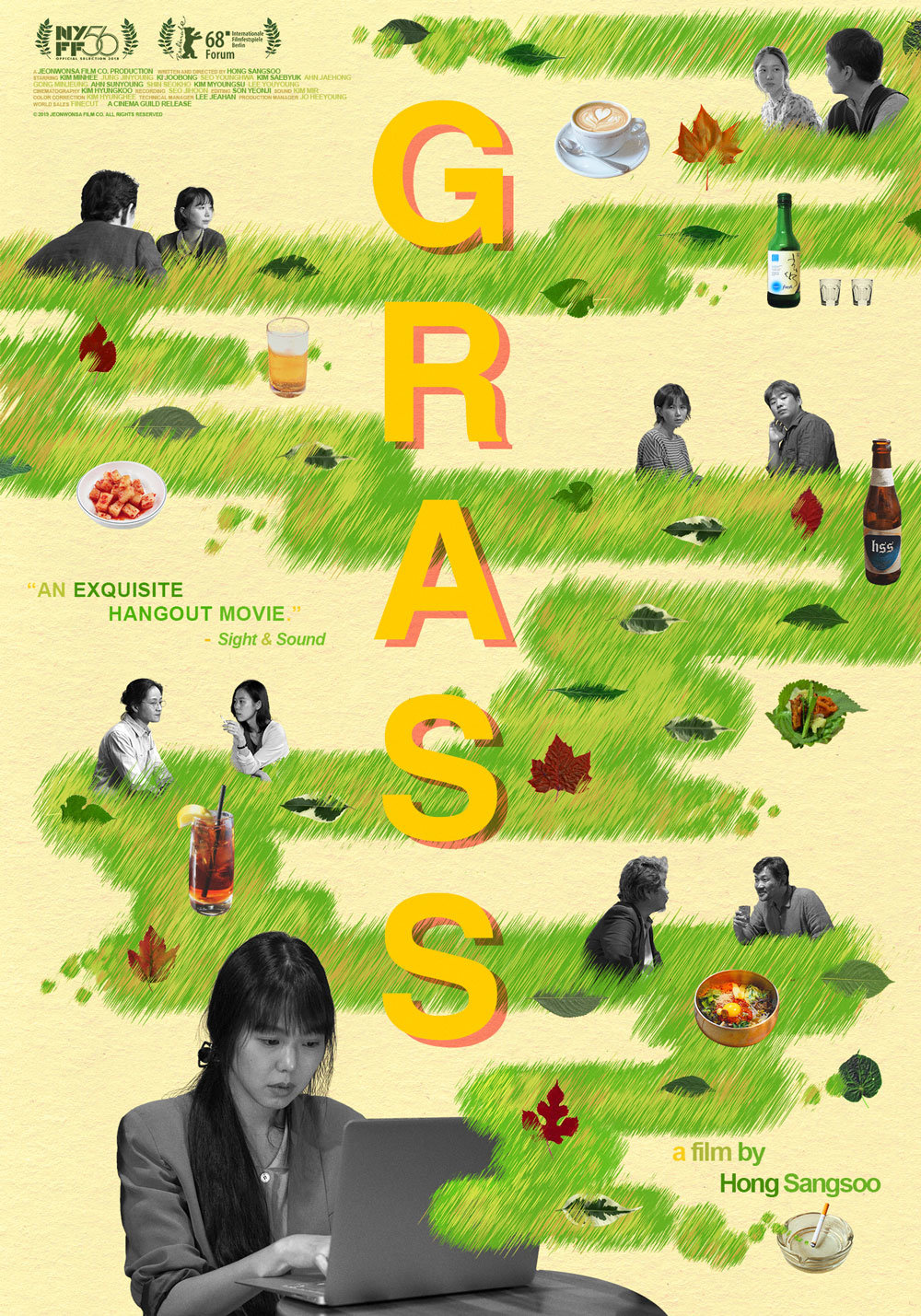
Exclusive Movie Poster of the Week: Hong Sang-soo’s “Grass”

Since his debut in 1996 with The Day a Pig Fell Into the Well, the remarkable Korean auteur Hong Sang-soo has made twenty-two feature films, which effectively averages out at a film a year. He started slow (one every two years) but recently has started to reach Fassbinder-levels of prolificacy: between the 2017 Berlin Film Festival and Locarno in 2018, just eighteen months later, he premiered five new films. Almost as miraculously, all five have been—or are about to be—released in U.S. theaters by Cinema Guild. Just a few months ago the boutique distributor unveiled what will surely be one of my, and many people’s, favorite posters of the year: a monochrome minimalist masterpiece with exquisite bespoke lettering for Hotel by the River. And now Movie Poster of the Week is honored to premiere their latest design for their newest Hong Sang-soo release: Grass. A spry and whimsical collage of coffee, cigarettes, soju, and the various patrons of the café where most of the film takes place, and anchored by a rambling pathway of green, the poster was designed by Brian Hung, Cinema Guild’s in-house designer. Hung has designed all five of their recent Hong Sang-soo posters and each one has been a delight. One false criticism leveled at Hong is that all his films are alike, but the same can’t be said of these posters, each of which has a unique style, while all displaying a sense of playfulness and graphic experimentation that ties them all together.
Brian’s previous Hong Sang-soo designs are below.
Many thanks to Brian Hung and Peter Kelly. Grass opens in New York on April 19 and in Los Angeles on April 24. You can watch the exquisite new trailer for the film here. And you can purchase all these posters from Cinema Guild’s website.

Do You Speak Kaurismäki?

Aki Kaurismäki. Photo courtesy of Janus Films.
Watching an Aki Kaurismäki film can feel like dropping in on a world just out of step with our own. All the elements are there—the streets, the buildings, the people (and their docile dogs). But something is always off. A man’s desk is taken away while he’s still sitting at it to indicate he’s been laid off. A woman asks a pharmacist what rat poison does. “It kills,” the pharmacist says blankly. It’s as if the Finnish filmmaker is recreating a version of planet Earth with all the nuance removed. These highly orchestrated facsimiles should feel foreign, but their simplicity and dry humor instead allows for a familiarity to sink in. His universe is in fact far more relatable—and far more human—than meets the eye.  
Although he’s gained a reputation as a comically cynical auteur, Kaurismäki has in fact been earnestly cataloguing commonalities among people throughout his nearly 40-year career, which New York’s Metrograph will be highlighting March 29–April 10. Kaurismäki has said that his goal is to make films that can be understood across cultures without any subtitles. His characters are often stripped of everything belonging to them at a moment’s notice—their jobs, their money, their memories. What remains when all this disappears are the simple indicators of what constitutes a life: the way bus doors close, how to light a cigarette, the sound of a music filling the room. When it seems all is lost, Kaurismäki throws out a life raft to his characters, and to his audience, no matter what country they’re in.
Kaurismäki’s work focuses on society’s rejects: the outcasts and loners, the criminals and refugees. The director himself grew up working a long list of “honest jobs,” including stints as a mailman and a dishwasher, before starting his first production company in Helsinki in 1980. He’s always been more interested in the have-nots than the haves, saying, in a 1990 interview with Cinéma cinémas, “I lose the rest of my little talent when I go in a bourgeois place.” If anything, his work has only sunk deeper into the depths of Europe’s invisible classes in recent years, portraying those impacted by the growing refugee crisis in his films Le Havre (2011) and The Other Side of Hope (2017).  
But no matter how dark Kaurismäki gets, he never takes himself too seriously. His set design alone is nearly impossible to see without smiling, with its bright, contrasting color palate and whimsically sparse prop arrangement. While his penchant for telling underdog stories may invite some to say he makes “realist” films, he disagrees. “I would call it melodrama more than realism,” he told Cinéma cinémas. “Melodrama is cruel and comical at the same time.” And it’s clear the director admires more than the technicolor interiors of auteurs like Douglas Sirk and Rainer Werner Fassbinder—his stories share the romance and fatalism that set these directors apart, with an added smirk.    
His work is in a category all its own, but the director takes it upon himself to further divide his films into trilogies. “I’m so bloody lazy that I have to tell everybody I make trilogies,” the director explained in his typically droll tone in 2011. “If I didn’t, I wouldn’t do anything but play cards.” Perhaps his most well-known, “The Proletariat Trilogy,” documents the lives of several people barely hanging on to their meager existences. Shadows in Paradise (1986) tells the shaky love story between a garbage collector and a grocery store clerk, played by two of Kaurismäki’s formidable troupe of regulars, Matti Pellonpää and Kati Outinen. In Ariel (1988), out-of work miner Taisto (Turo Pajala) navigates a frigid Helsinki with nothing but a convertible with a soft-top roof that won’t open. In The Match Factory Girl (1990), eponymous antihero Iris (again played by a magnificently dour Outinen) spends her days at her tedious low-paying job, and her nights waiting for someone to notice her at the local nightclub.  
Here we see what people reach for when they have nothing left. While suicide is an ever-present theme in his work, his characters eschew the temptation to end their suffering in one fell swoop, seeking out a level of dignity in the midst of desperation. In Ariel, Taisto checks in to a homeless shelter as if it’s a hotel, grabbing a free newspaper on his way in and adorning his bedside with a portrait of then-president Urho Kekkonen. In The Match Factory Girl, Iris chooses to spend most of her paycheck on an extravagant pink dress in the hopes of attracting some attention. And in Shadows in Paradise, even when sitting alone in his apartment, Nikander will don sunglasses.  
It’s these small choices that come to define these characters, and that end up forming a universal language that echoes across Kaurismäki’s work. Just as putting on a pair of sunglasses can transform your mood, so can putting on the right song. Music is Kaurismäki’s global currency, one that transcends time, place and state of mind to alter one’s circumstances, at least for the length of a song. In The Man without a Past (2002), “M” (Markku Peltola), a man suffering from amnesia, recognizes the need for a jukebox in the shipping container that’s become his makeshift home. Jukeboxes pop up all over Kaurismäki’s world, from bars to bedrooms, playing everything from Elmore James to Finnish polka. A character like Iris in The Match Factory Girl may come to a key decision as she sits alone beside a jukebox belting out a song by The Renegades. And in Hamlet Goes Business (1987), part of Kaurismäki’s trilogy of classic literature adaptations, including Crime and Punishment (1983) and La vie de bohème (1992), Hamlet shuts off the classical music on his record player after Ophelia rejects his sexual advances, kicking his personal jukebox awake in frustration to play Lowell Fulson’s “Talkin’ Woman”: Now honey hush. You know you’re talkin’ too much. / Just listenin’ to your conversation, just about to separate us.
Live music, too, features largely in Kaurismäki’s universe. The storylines will pause for interludes from real-life musicians like Joe Strummer and Anniki Tähti, in case the audience, too, needs a respite from the barrage of bad luck his characters are dealt. His trio of films about the Leningrad Cowboys, “the world’s worst rock n’ roll band,” (Leningrad Cowboys Go America [1989], Leningrad Cowboys Meet Moses [1994] and Total Balalaika Show [1994]) are somewhere between road movies and mockumentaries, following the group as they travel to the United States and back to their native Siberia, charming audiences with their aggressively long faux-hawks, winklepicker boots, and American-inspired sound.  
The only things that loom larger than music in Kaurismäki’s world may be alcohol and cigarettes, which are paired neatly together in most scenes. These globally understood  commodities take the place of conversation in many cases, allowing characters to stare off into space, or into their glass, instead of engaging with another human. When conversations between characters do take place, they’re stilted and aloof, often avoiding eye contact. Bars and restaurants become safe havens, especially when Kaurismäki transposes the action of his films to locales other than Finland. In I Hired a Contract Killer (1990), Henri, a French expat in London (played by the perfectly cast Jean-Pierre Léaud, who has frequently portrayed the outsider since beginning his career in The 400 Blows), tries to call-off his plan to have a hitman kill him after visiting his local pub. Here, he’s introduced to beer, cigarettes, and women, for what seems to be the first time.  
While the scenery may occasionally shift from Helsinki to places like London, Paris, and Le Havre, Kaurismäki’s stories remain largely the same. It makes sense that a director who began his career by adapting Crime and Punishment would continue to portray variations on common themes throughout his work. The “Loser Trilogy” (Drifting Clouds [1996], The Man without a Past [2002] and Lights in the Dusk [2006]) picks up where the “Proletariat Trilogy” left off, focusing on the growing issue of unemployment in Finland. Kaurismäki’s not afraid of typecasting either, with his actors often maintaining similar characteristics across multiple roles. Outinen’s character names alone are hard to distinguish, as she goes from playing Iris in The Match Factory Girl, to Ilona in Drifting Clouds, to Irma in The Man without a Past. And the same Marcel Marx (André Wilms), the writer and lovable lush from La vie de bohème, reappears again twenty years later in Le Havre. He’s just as jovial, if a little worn down, as he scrapes by as a shoe shiner in northern France.
These little points of familiarity are everywhere in Kaurismäki’s world, and are fun to pick up on when watching his films in sequence. Within his works, characters are confronted with a different kind of familiarity, that of recognizing others’ suffering—turning on the TV will likely yield a news story about horrors taking place on the other side of the world. In The Match Factory Girl, Iris and her family watch the news of the Tiananmen Square Massacre, and in Drifting Clouds, Ilona learns of a storm in the Philippines that “forced 250,000 people out of their homes,” and a “Nigerian civil rights leader” who was executed. No matter how bad his characters have it, they’re reminded that others have it worse.  
In his two most recent films, Kaurismäki decides to take up the point of view of those actually living these nightmares. In Le Havre, Marcel Marx tries to help a young African refugee, Idrissa (Blondin Miguel), escape the French port city and join his mother in London. And in The Other Side of Hope, Khaled (Sherwan Haji) escapes warfare in Syria, seeking asylum in Finland while trying to locate his sister with the help of fellow refugees and a struggling restaurant owner (Sakari Kuosmanen). It’s perhaps the first time Kaurismäki has depicted what it’s like to escape to Finland instead of showing those trying to escape from the country (usually to Mexico). Here, as in all of Kaurismäki’s work, desperation recognizes desperation, and two people in dire circumstances help pull the other up. It’s a bold political statement on his part, one that encourages us to recognize what we have in common when all the nuances are stripped away, and we all speak the same language.
 "Total Kaurismäki Show" runs March 29 – April 10, 2019 at the Metrograph in New York.

The Luxury of a Low Budget: Mark Jenkin Discusses "Bait"

Bait
The Cornish are often condescended to onscreen, represented as folksy, even aggressive and primitive, through films like Sam Peckinpah’s Straw Dogs (1971). But in Mark Jenkin’s Bait it is the locals who are under attack, their traditions under fire by a relentless tourist economy and a permeating sense of outsider privilege.
Premiering in the Forum section of last month’s Berlinale, the Cornish fishing drama was described by the Notebook as “employ[ing] the cinema of the past to tell of the aggravated Brexit present.” Through the gorgeous grain of its 16mm photography, Bait has the visual texture of a 1960s industrial film, while the immediacy of Jenkin’s bold close-ups bind us to recognizable British archetypes, and the jarring editing provides a dislocation which mirrors its characters’ own. Jenkin’s technique distorts time to create a sense of an eternal, cyclical struggle. 
It tells the tale of Martin (Edward Rowe), a Cornish fisherman trying to save up for a boat, who is foiled at each turn by the acquiescence of his hometown and even his brother to the tourist trade. This is is crystalized by a family of rich Londoners who have bought his family home and have turned it into a rental.   
Bait is a funny, satisfying, and deeply angry film that takes the temperature of the current British social climate and offers few easy solutions, taking an all-too-familiar story about gentrification and turning it into a desperate struggle of mythic proportions.
I spoke to Mark Jenkin about Bait, about his distinctive style, filmmaking in his own community, and why anything can be a Brexit film.  

NOTEBOOK: The first thing that jumps out about Bait is the style and intensely restricted viewpoint. How did you go about visualizing the town and bringing it to life?
MARK JENKIN: I don’t go into anything until I've got a huge list of limitations to work within, because where I shape all of the work is within what I'm not able to do. Working at small budgets helps because you've got a huge limitation straight away so you have to start working in different ways. Not everybody has that luxury of a low budget, which is why some people make such terrible films.
The town is a composite of three different locations and then several other interiors. It’s not a single place. It was a composite out of necessity rather than design. Which is handy because we can’t be accused of making a film that's an issue in a specific town, we can’t piss off any locals who feel like we’re commenting on their way of life. It becomes an allegorical space as much as anything.
NOTEBOOK: The whole film feels like a study of faces. Did you have a specific approach to that portraiture?
JENKIN: We create a language and a way of working around what we’re able to do. There were angles we couldn’t shoot. Which was great because you think, “we can only shoot in this direction,” so you can throw away the idea of doing any establishing shots after that, so it becomes a film of close-ups, which is a prominent aesthetic within the film. I love the power of the montage and I love the fact that the one unique property of film as an art form is the close-up, so it’s crazy not to use it!
If you’re working on a small budget you have to be alive to what you’ve got to use that’s free. And once you’ve cast it, you’ve got these amazing expressive faces, so if someone has a beautiful face, an interesting face, an ugly face, whatever that might be—I like to see that on screen! So I give them big, Academy-ratio close-ups, which works great for people’s faces.
NOTEBOOK: You shoot on set without sound—how does that affect how you behave with the actors? 
JENKIN: It’s never discussed. Although the actual words they say at the moment disappear into the wind, they really are captured because the eyes do more of the talking than the voice does. The performance is set in that moment. When they come in and re-voice it months later, I used to think you could make them change the performance, but you can’t change a close-up.
If they’ve said it in a way with their eyes, if you try to make them change the pace or intonation, it creates quite an interesting effect, but it’s unnatural. It’s always the same actor who voices their own performance, so they say the line in the same way, they look at their face saying it and then repeat it. Nine out of ten times its absolutely bang on.
NOTEBOOK: With faces doing the talking and your use of non-actors, I felt the influence of Bresson: people as figures.
JENKIN: Bresson is never far from my thinking. I’m from the Scorsese school of if you’re stuck, ask yourself what Bresson would do because he would always choose the most simple thing. And I think that when I’m writing, I write visually. I write a scene and imagine it as five shots, but can I do it in four, three? I’m always simplifying, and that’s where Bresson is with me. But the kind of montage way that I like to work is probably something that he would have disapproved of quite vehemently because it’s too impressionistic for his Catholic tastes.
But in the performance and simplicity, a lot of it is built out of the limitations in how I work with the camera. I’m working with a [Bolex 16mm] that needs a finger holding down the shutter, so one hand is always busy when the camera’s running. I can either pull focus or move the tripod head. So you never get a shot where I move camera and pull focus. There’s a real austerity in that which has something in common with what he did, but in a different way.
NOTEBOOK: How did you first come to find this style?
JENKIN: People tell me I’m making horror films without any horror in. You know,The Shout [1978], the British horror film with John Hurt? That’s my thing, using the form, not invisibly. But making something where the horror exists in the edits as much as the content of the shots.
I think it was born out of the practical limitations I put upon myself. Limitation of shooting 100 foot, 2 ½ minute rolls. It’s expensive, so you can’t be too extravagant. I shoot no coverage, so sometimes when it comes to the edit I haven’t got enough footage to put a scene together so I’ll grab stuff from elsewhere and I might flash forward or back in the story to make a scene work.
Sometimes I wonder if the content should be at the mercy of the shortcomings of the form, but then I think it’s silly to ignore the fact that film has a very distinct form that should influence and affect the content. In this country we get so much film that just looks like filmed theatre. Because the shortcomings and potential of the form hasn’t been engaged.
NOTEBOOK: You set up a lot of information early on through imagery you later return to. Was that planned, or another way to fill in the blanks?
JENKIN: It’s planned randomization. When I’m writing I see every single shot. I shoot the exact shot list I have written. I leave nothing to chance. But the brilliant thing about how I work with the camera is if I get to 95 feet and I need 10 for the next shot on the list, I will use 5 feet to find something on offer in the location and grab a quick cutaway or two.
For example, with the pub scenes in Bait there’s all these figureheads. I was shooting and needed to change the roll, so I spun around, saw them looking at me, shot them, and that’s how they ended up in the film.  
That's how that shot of handcuffs goes in. Once it's there it becomes something greater than its literal meaning. If it was in the scene of [Wenna, played by Chloe Endean] getting arrested, that would just be information saying she's having handcuffs put on. But [shown] earlier in the film, and in a position where she's arguing with somebody, it has another meaning. You know her fate already, so she can shout all she wants to this bloke, but her destiny, because of who she is, where she lives, who are parents, and what has standing is in the community, she's already fucked.
But I wouldn’t have had the shot if I hadn’t been shooting on film and got to 95 feet and thought, actually let’s get this quick cutaway. Maybe it's something that comes over you when you’re thinking creatively; there’s some reason why I filmed those figureheads and the handcuffs. There’s always something there on a film shoot, you just have to put your hand out. The angels of happenstance will be there to help you through it.
NOTEBOOK: That goes back to your idea of restriction as being liberating in itself
JENKIN: Yeah, it is. And you almost get to talking about authoritarian politics [laughs]. You have your freedom taken away and suddenly you don’t have to worry anymore. Not to take that out of context, but without having to worry about this or that you can get on with the living of it.
NOTEBOOK: So was that local community a necessary part of the process for you?
JENKIN: I’m trying to make films about things that aren’t often talked about and are considered unimportant. So if we come in and act in a way that isn’t in keeping with the way that our main character would see the world then that’s not a good way to be working.
At one point down by the harbor—when Martin confronts the people who now own his home, he shouts about them as incomers who stopped him being able to live in the way that he must in order to work—we had a member of the crew shouting over to some people on the other side the harbor to get out of the shot. They happened to be locals, so we did have to bring out the Irony Klaxon by telling local members of the community to stop living their life in order for us as outsiders to come in and make a film about someone who... [Laughs.] It just brought it home that we’re not a big film crew who rolls into town, buys everybody off.
This is my place and these are my people. I want to walk down the harbor and not be thought of as “that wanker who makes films about us that aren’t very accurate.”
NOTEBOOK: How do you feel about the potential that as Bait goes into the wider world, it will be embraced by a cinephile community largely made up of the same demographic that you criticize in the film?
JENKIN: That’s been an issue all along, for the twenty years I’ve been trying to make Bait. Sometimes we would try to get in touch with producers of public funding bodies who were impossible to get ahold of in the summer. Then I started thinking, I wonder where they are, they’re probably here [in Penzance]! There I am trying to get a call in London, and they’re probably 200 meters away in a holiday cottage or in their family holiday home.
But I hope the film isn’t black and white on that issue. [Martin] is refusing to work on the boat with his brother because he’s out there taking out holidaymakers. Instead, he says he’ll just catch fish off the beach in a throw and hand net and earn honest money that way.
NOTEBOOK: He’s a martyr…
JENKIN: He is, but it’s not that simple. Because when he catches those four fish he’s got to sell, he goes to the pub and sells the fish to a local woman who owns the pub who pays over the odds to him because he’s caught them on the local beach and she knows she can mark them up in price, and then they get sold to holidaymakers. So really, what’s the difference between what him and his brother are doing?
But even the Airbnb guests aren’t bad. They’ve been sold a lie. They’ve been sold a silent picture on a website of a beautiful harbor. You don’t get to click on a picture and hear the seagulls or boats. There’s no Smell-O-Vision, no diesel and fish guts. So they’ve been sold a lie.
But I can’t control how people feel about the movie, and we all project ourselves onto it. Your insecurities might come out when you see yourself or people you know projected on screen, but I know a lot of people who are part-timers down here and I haven’t witnessed anybody getting upset of affronted by anything I say in my film.
Sometimes you get paranoia from local people, especially if they’re involved in the tourist trade, people say, “you can’t say that!” But it’s a self-censoring thing that they feel. When push comes to shove they’re the same people who lose their shit, because they don't have a voice and they aren’t discussing the problems associated with living in a tourist service economy.
NOTEBOOK: How do you feel that Bait fits into the canon of Cornish cinema?
JENKIN: I don’t see [all films set in Cornwall] as Cornish cinema. That’s not to say it has to be made in Cornwall by Cornish people to be a Cornish film, but I think a lot of films in the past set in Cornwall are about somebody coming into Cornwall in crisis which is crystalized by being in a rural place full of real people who are archetypal at best, mostly stereotypes. And they will, through the sum of their parts, make this newcomer see the error of their ways, they’ll adjust their worldview and head home.
That can be done brilliantly, like in Local Hero [1983]. But a lot of films outside of the urban setting use their rural settings for background color. And what I’m interested in is bringing that to the foreground, because it’s been seen less. It’s one of the only things I can write about because it’s what I know. But I think if you can create those authentic, complex, flawed people, I think that’s the Cornish cinema I want to see. And any kind of regional or national cinema that brings out the reality.
The more specific you get with something the more universal it becomes. A Bayesian woman who’s dad was a fisherman  came up to me after a screening in Berlin and she said, “That was his life.” The other side of the ocean, nothing I know about, but it's the issues people face. I started twenty years ago with a small comment about a small issue specific to where I lived, but now the gap between the haves and have nots has become a huge talking point. In some way it's become an allegory for the world, and as I saw in Berlin it became a Brexit allegory.
NOTEBOOK: How do you feel about the Brexit analogies?
JENKIN: Well, it only happened because on the final day of sound mix one scene had too much dead sound. So [producer] Kate Byers wrote a current affairs feature about chlorinated Chicken, which we recorded straight onto the film, which I matched with a shot of these fresh fish being handed over. It was too good to ignore. But when it went to Berlinale, the subtitlers included the news report which gave it a prominence which wasn’t there to me.
NOTEBOOK: Maybe like the pick-up shots, it was subconscious.
JENKIN: If we had premiered in the U.K. without those subtitles, those early reviews might not have mentioned Brexit. So it picked up all this momentum, and people saw that in it. I think you’re right that it was in it, but I think it's often the context of where and when you watch it. It’s about fishing for God’s sake, the foreground of Brexit. And fisherman have been forgotten about again, but when they’re helpful for either side they were very prominent.  
NOTEBOOK: Do you think that “Brexit cinema” exists or is it an easy label?
JENKIN: I think it's difficult to tell until the dust has settled and the context has moved on. Maybe we’ll look back and work out what a Brexit film is. Is Ray and Liz a Brexit film? Is The Kid Who Would Be King, shot in Cornwall, a Brexit film because it’s about reconciliation and people getting over their differences to unite? Somebody referred to Bait as the “New British Strange” and I like the idea of that as a new art movement while we’re in this unsteady ground. People have asked if the film is “Leave” or “Remain”—which is handy for me where I live because I can walk around the harbor without getting thrown in! [Laughs.]

Arya Stark’s Kill List: A Retrospective

In this series…


Westeros’ very own version of Kill Bill’s The Bride, Arya Stark (Maisie Williams) has become a Game of Thrones fan favorite thanks to a satisfying story arc involving lots of bloody, righteous, and well-orchestrated acts of vengeance. The final season could bring us a slightly more humane Arya than we’ve seen over the past few seasons, as she’s back in Winterfell with family after years of brutal formal and informal training. Still, the kill list she recites like a lullaby isn’t quite finished — Cersei Lannister, Melisandre, and Gregor Clegane, among others, are still alive — and she’s found plenty of other villains worth drawing her sword for along the way.

From Ned Stark to Syrio, Yoren to Jaqen, Sandor to Brienne, and the House of Black and White, Arya has learned strategy and wisdom from the best and boldest warriors the realms have to offer. Williams has grown with her character, playing the youngest Stark girl with distant cool, wry humor, petulant irritation, or genuine sorrow depending on what the moment calls for. The choreography and writing of her fight scenes are frequently matched by the verbal barbs she trades with well-matched actors, and she still likely has several significant character reunions ahead of her.

As the series draws to a close this spring, Arya’s final chapter is rightfully one of the most anticipated, so let’s take a look back at the kills and grudges that made her who she is today.

“The Tickler”

The Tickler

Offense: A torturer for Gregor Clegane back in Season 2, The Tickler picked one prisoner per day and forced them to endure interrogation while a hungry rat is strapped to their chest and taunted by fire. A real sicko, The Tickler always ended up killing the prisoner in the end regardless of the information gleaned.

Status: Dead. When Jaqen H’ghar offers Arya three deaths in exchange for the lives she saved, her first choice is The Tickler, and she finds him with a broken neck a short time later.


Amory Lorch

Amory Lorch

Offense: Lorch kills fatherly Night’s Watch recruiter Yoren and imprisons Arya and her friends in Season 2. Later, he catches Arya stealing an important letter and intends to turn her in, to Tywin Lannister.

Status: Dead. While escaping Lorch, Arya runs to Jaqen and yells his name, selecting him as her second free kill. H’ghar assassinates the man with a poisoned dart.


Sandor Clegane, listed as “The Hound”

Sandor Clegane

Offense: In the series’ second episode, Sandor “The Hound” Clegane kills a local butcher’s son, Mycah, under orders from sadistic Prince Joffrey. The butcher’s boy had been Arya’s friend and sword-fighting partner on the road to King’s Landing.

Status: Alive. In Season 3, the Brotherhood Without Banners puts Sandor to trial by combat for the death of Mycah, and he slays Beric Dondarrion, proving himself innocent. Arya witnesses this, though when Sandor later kidnaps her for ransom, she contemplates killing him with a large rock while he sleeps. Eventually, the two bond, and when Sandor appears mortally wounded after a savage battle with Brienne, Arya refuses to kill him. She hasn’t seen him since but confessed in the House of Black and White that she removed his name from her list.


Polliver

Polliver

Offense: Polliver helps capture the kids in Season 2, killing a boy with an injured leg named Lommy in the process. He helps Gregor Clegane torture prisoners and later robs an innkeeper and threatens his daughter, telling Sandor and Arya that as the King’s men, he and his pals can do anything and get away with it. He also stole Arya’s sword, Needle.

Status: Dead. In one of the duo’s most memorable scenes, Arya and The Hound encounter Polliver and his crew at an inn, where he’s disgustingly on brand in his assumptions about their relationship and his bragging attitude about the crimes he’s committed. When Sandor tells Polliver to bring him a chicken to eat, it’s not long before a brawl breaks out, and Arya ends up killing Polliver with Needle after reminding him about Lommy. “Something wrong with your leg, boy?” she asks him, echoing the question he asked the boy before killing him.


Joffrey

Joffrey

Offense: Joffrey was consistently and horrifically evil, but Arya hated him especially for ordering the execution of Ned Stark.

Status: Dead, but not at Arya’s hand. Lady Olenna poisoned Joffrey at his own wedding, a crime that was pinned on Sansa and Tyrion.


Cersei

Cersei Lannister

Offense: Around the same time that Sandor killed the butcher’s son, Cersei ordered Ned to kill Sansa’s direwolf, Lady, because of Arya’s direwolf, Nymeria’s, perceived misbehavior. This soured the relationship between the two sisters. Cersei also shares blame for Ned’s death and Sansa’s mistreatment at the hands of Joffrey.

Status: Alive and sitting on the Iron Throne. Last season Arya planned to head to King’s Landing to kill her, but after hearing that Jon was alive and at Winterfell, she traveled there instead. Looking at the rest of this list, though, we should assume that once she’s in Arya’s crosshairs her odds for survival aren’t good.


Walder Frey

Walder Frey

Offense: Killing Robb, Talisa, and Catelyn Stark at the Red Wedding in a surprise attack during a moment of apparent hospitality.

Status: Dead, along with dozens of his family members. Arya infiltrated his ranks and killed Walder, slitting his throat to emulate the way her mother was killed. Then she stole his face and, assuming his identity, held a feast. A toast was made with poisoned wine, and all the male heirs of House Frey swiftly died.


Meryn Trant

Meryn Trant

Offense: The Kingsguard knight presumably kills Arya’s beloved water dancing instructor, Syrio Forel, and later begins habitually beating Sansa at Joffrey’s request (though Arya doesn’t know about this). He is later revealed to have a penchant for violent abuse of young girls.

Status: Dead, with an ultra-violent demise to match his crimes. In Season 5, Trant visits a Braavosi brothel, where he proceeds to beat three very young girls. The third girl is Arya in disguise, and she reveals her true face before stabbing Trant repeatedly in both eyes and elsewhere, stuffing a cloth in his mouth, and slitting his throat.


Tywin Lannister

Tywin Lannister

Offense: Tywin led an army against Robb Stark, and although he didn’t kill Robb, Roose Bolton’s famous line, “The Lannisters send their regards,” led many to lay the blame on House Lannister in the confusing aftermath.

Status: Dead by his son Tyrion’s hand. After relentlessly persecuting his son for his entire life, Tywin committed his final sin by bedding Tyrion’s lover, Shae, then calling her a whore when Tyrion had a crossbow aimed at his chest.


Melisandre, listed as “The Red Woman”

Melisandre

Offense: Arya calls Melisandre a witch for taking her closest friend Gendry away from her for nefarious purposes.

Status: Alive, although Melisandre has prophesied both that she will meet Arya again and that she will return to Westeros to die. In Season 7, she was set to leave Dragonstone for Volantis, cowed by her banishment after sacrificing Shireen and convinced her singular duty — to help Daenerys and Jon meet — had been fulfilled.


Thoros of Myr

Thoros

Offense: The Brotherhood Without Banners allowed Melisandre to take Gendry away, and also freed Sandor Clegane after trial by combat.

Status: Dead, frozen to death during Season 7’s expedition north to catch a wight.


Beric Dondarrion

Beric

Offense: Like Thoros, he allowed Melisandre to take Gendry away and freed Sandor after trial by combat.

Status: Alive, although Sandor points out that without Thoros, he won’t be able to resurrect again. It’s unclear whether or not Arya still wants to kill him because she’s since made peace with Sandor and Gendry is still alive.


Ilyn Payne

Ilyn Payne

Offense: Payne is the Lannisters’ executioner, and he beheaded Ned Stark with his own sword back in Season 1 under orders from Joffrey.

Status: Presumed alive. As of Season 4, a reference from Tyrion confirms that he is still in the Lannisters’ service.


Gregor Clegane, listed as “The Mountain”

The Mountain

Offense: Along with Polliver and The Tickler, Gregor tortured and killed kids at Harrenhal. His ruthlessness and penchant for torture and are well-known, and Arya later learns that he sadistically burned Sandor’s face when they were children.

Status: Undead. Clegane was fatally wounded in combat against Oberyn Martell, but Cersei’s creepy doctor Qyburn brought him back to life. He no longer speaks or looks the same, but is still capable of violence. Most recently, Sandor came face to face with him during the Queen’s parlay and said “You know who’s coming for you. You’ve always known.” This seems to point to the popular fan theory that Sandor and Gregor will ultimately battle to the death, so whether by Arya’s sword or another, Gregor’s days may be numbered.


Rorge

Rorge

Offense: When Arya is a Night’s Watch recruit, Rorge, The Biter, and Jaqen are the three prisoners, threatened by a spreading fire, whom she frees during an attack. While imprisoned, Rorge threatened her with rape, and he later joined the Lannister army.

Status: Dead. Sandor and Arya encounter Rorge and The Biter pillaging someone’s home and are engaged in combat. Sandor kills The Biter, then asks Arya if Rorge is on her kill list. She says he isn’t because she never knew his name; Rorge thoughtlessly tells it to her and she stabs him in the heart.

The post Arya Stark’s Kill List: A Retrospective appeared first on Film School Rejects.

Copyright © Cinenus | Powered by Blogger

Design by Anders Noren | Blogger Theme by NewBloggerThemes.com