The film industry in one place - Articles, Reviews, trailers and hype!

Saturday, 29 December 2018

Movie of the Year: Black Panther

Black Panther is the greatest celebration of African and African-American culture to ever grace a cinema screen. Based on the Marvel comic book property of the same name and created by the late Stan Lee and Jack Kirby, this 18th entry of the Marvel Cinematic Universe reawakens your imagination and dares you to think of something grand.

No more slaves, drug dealers, or white saviors, Ryan Coogler‘s superhero blockbuster, which stars Chadwick Boseman as the title character (aka T’Challa), bucks the usual stereotypes of its characters, setting, and genre, giving audiences young and old something to believe in and inspiring a change not just in film, but society.

The greatest premise of Black Panther is that of a technologically advanced nation — Wakanda — which has existed for hundreds of years watching as the world waged its wars, while its people hid within its secret borders. And this civilization has a resource more valuable than oil, and the power to defend it: vibranium.

Black Panther SuitWakanda is the most fleshed out setting of the Marvel films, as it represents the beauty of Africa and scientific and social advances that human minds in the real world have yet to develop. The harsh but gorgeous Jabari Mountains, the mighty rivers, and majestic plains surround cities unaffected by colonialism or racism.

Every character has significance, as the screenwriters made sure to embed each with a complexity that transcends their original comic book concepts. For example, with valid reasons for challenging Black Panther, M’Baku (Winston Dukes) rises above a one-dimensional minor villain to become a fan favorite. From his first appearance at the waterfalls to aiding T’Challa, he demands our attention.

Feminism and black beauty also take center stage with a cast of powerful women. Lupita Nyong’o, Danai Gurira, Letitia Wright, Angela BassettFlorence Kasumba — just to name a few. There are no damsels in distress, and often it is the women doing the saving. For instance, the Dora Milaje, personal bodyguards of T’Challa are more than capable of holding their own and inspiring awe and fear in whomever they come across.

The costume design, which is often overlooked in blockbuster movies, is the key to making Wakanda believable. How can you have a grand civilization if the clothing that the citizens wear doesn’t reflect that? Clothing has symbolism, as well as empowerment, in Black Panther. The costumes pay homage to real-life fashions found in different regions of Africa. It is the first step to making the characters appear radical yet also authentic.

More importantly, cinematographer Rachel Morrison aids Coogler in creating luscious shots not common to the comic book movie genre. The spiritual plain where T’Challa speaks with his ancestors makes for a scene that will be long remembered for its imagery.

And the visuals are heightened by the original score by Ludwig Göransson, which adds to the gravity of each scene. The African flute used to cue Black Panther in Captain America: Civil War is no more. Göransson’s score is a perfect blend of modern hip-hop and traditional African instruments and choirs.

When the main villain, Erik Killmonger (Michael B. Jordan), ascends to the throne, we get the ultimate combination of cinematography and score. The way the scene bends to the music elevates it to a higher level signifying a new reign of Wakanda.

But what about the overall message? For every hero there is a villain, but what happens when that villain serves a just cause? Killmonger represents a feeling that is oh so real in African-American culture — resentment. How we feel as a minority subjected to racism, violence, and disdain is always addressed in film, but he raises the question of what if someone or something could have freed you from this abuse and, in a sense, your prison.

Yes, Wakanda is the most advanced nation in the world. It can create what most would consider impossible. To maintain its way of life, it was shielded from the world. But with that comes a moral problem. Wakandans sat idle as their sisters and brothers were oppressed across the world. Choosing to hide additionally produced a great, resentful adversary.

Black Panther embodies its moral dilemmas and identity issues in the two main opposing characters. T’Challa and Killmonger have parallel paths leading to their climactic duel. You cling to their words as they speak about social injustices. Coogler was very careful in how he framed these two against each other.

The contrasts between the calm and calculated king vs. the radical and energetic newcomer are intentional. The two characters represent personalities and traits found in people of color. Their viewpoints and ideologies resemble Martin Luther King, Jr. and Malcolm X. T’Challa represents the former, seeking peace, and Killmonger is the latter.

Even more, Killmonger represents our anger and bitterness against injustices performed against us for hundreds of years. He represents how easy it would be to give in to anger and violence and fight back against oppressors. T’Challa represents our doubts about what is the right thing to do — should we rise above the violence and seek peace, or match fire with fire? Rich character study and progression of these two characters leaves you with something to reflect on long after the credits roll.

Thus, to look down on Black Panther as just a superhero film belittles everything it accomplishes on and off the screen. It is a cultural phenomenon portraying people of color in a positive light, and it forces society to look at its ugly past of slavery and general prejudice. What better way to hammer that message than with Killmonger’s last line of “Bury me in the ocean with my ancestors who jumped from the ships because they knew death was better than bondage.”

Finally, we have a hero who looks like us, and thinks likes us, someone who strives for greatness, and as a black man that is one hell of a feeling. And to have the Film School Rejects team chose it as Movie of the Year, it feels as if Black Panther has broken the stigma associated with other superhero films and blockbusters.

The post Movie of the Year: Black Panther appeared first on Film School Rejects.

The Best Foreign Language Movies of 2018

This year, like every year, saw many great films from all around the world. Some reached the United States through festivals or an actual release while others still haven’t touched our shores in an official capacity. Staggered release schedules play havoc with availability and year-end lists, so far my purposes here I focus on films that first played the US in some capacity in 2018. Happily, there was no shortage of fantastic cinema to choose from.

One note, the Taiwanese gem Mon Mon Mon Monsters had its official US release this year via Shudder and is easily among the year’s best, but I included it in last year’s ranking after seeing it at festivals.

Keep reading for a look at the 18 best foreign language films of 2018.


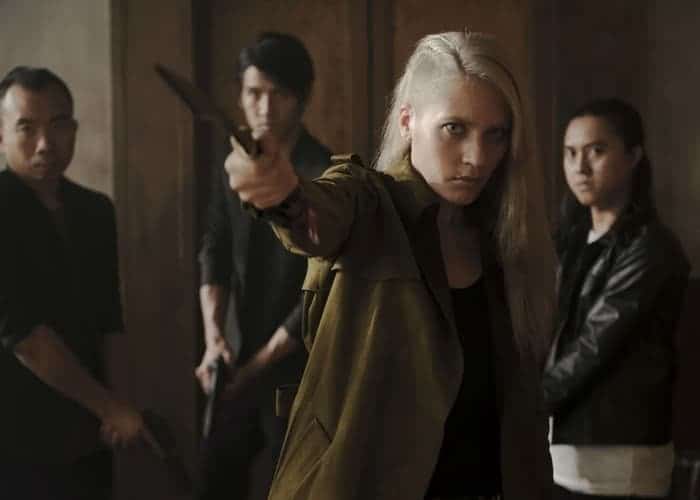
18. The Night Comes for Us (Indonesia)

Night Comes For Us

Directed by Timo Tjahjanto

Timo Tjahjanto’s blistering epic about a bad guy gone good landed in the top spot for my Best Action Movies of 2018 list, so it seems only fitting it also secure a spot here. The story may be familiar and the dialogue may be generic, but the characters, style, and sweet, glorious action make it one of the year’s most entertaining and re-watchable films.

Netflix ButtonReview Button


17. One Cut of the Dead (Japan)

One Cut Of The Dead

Directed by Shin’ichirô Ueda

My #2 horror movie of the year also makes the cut here as in addition to bringing the flesh-eating goods this deliriously fun zom-com pulls the unexpected out of its tooth-marked ass in the form of something truly special. It’s funny, it’s gory, and it’s entertaining, but it’s also a whip-smart look at the art and business of indie film-making. I know, didn’t see that coming right? Its structure is genius as it reinvents itself in surprising ways that both embrace the genre elements and shift towards something altogether different.

Review Button


16. Sicilian Ghost Story (Italy)

Sicilian Ghost Story

Directed by Fabio Grassadonia & Antonio Piazza

There’s darkness in this world, and while the youth sees too much of it they don’t always understand. This tale is based loosely on the true story of a boy’s abduction, but it puts the focus on a pre-teen who falls for the boy before he disappears only to wonder why no one else seems to care. It’s a lyrical, fable-like coming of age tale pairing innocence and tragedy in beautiful yet painful unison.


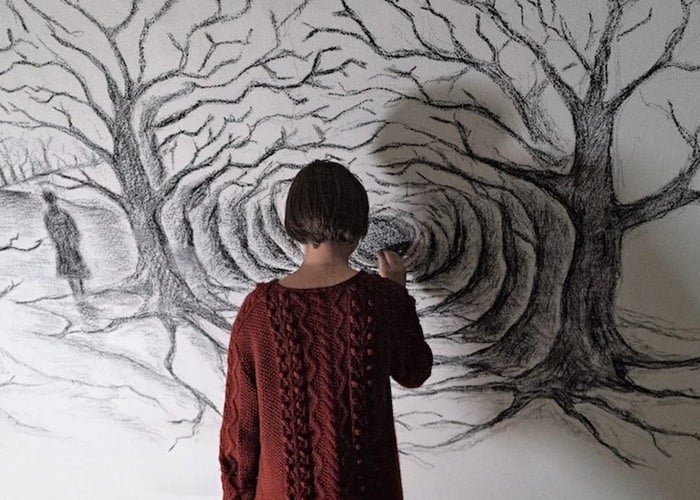
15. November (Estonia)

November

Directed by Rainer Sarnet

Movies that choose to film black & white these days do so as both an immediate attention-grabber and sometimes as a way to focus the eyes on characters and images in a new light, and this beautifully crafted fairy tale from northern Europe succeeds on both counts. It’s a love story, of sorts, but it’s one with magic, creatures, and a dark sense of humor as absurd as it is silly. It’s a madly poetic concoction that’s also striking in its beauty, and it’s quite unlike anything else you’ve seen this year.


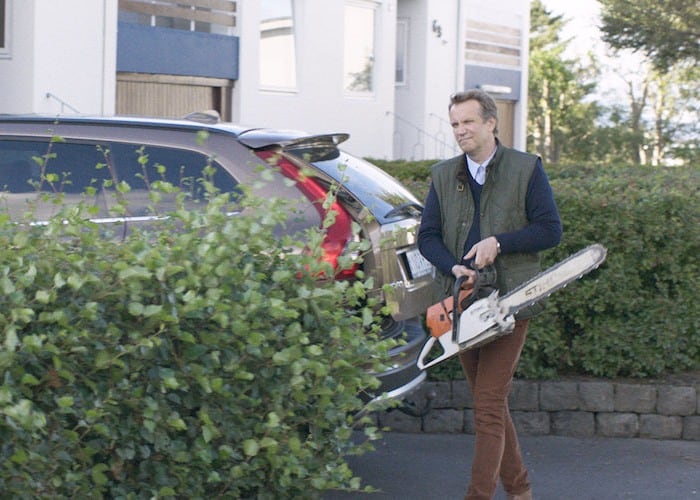
14. Under the Tree (Iceland)

Under The Tree

Directed by Hafsteinn Gunnar Sigurðsson

Tales about small things like interactions and conflicts that spin wildly out of control are often exhilarating in their structure when played for thrills and/or laughs — think Martin Scorsese’s brilliant After Hours (1985) — but there’s a different kind of weight when things grow more serious. This tale about feuding neighbors starts in the realm of the understandable but grows into something angry, violent, and irreversible. The fact that it’s also able to deliver a few laughs along the way is impressive too.


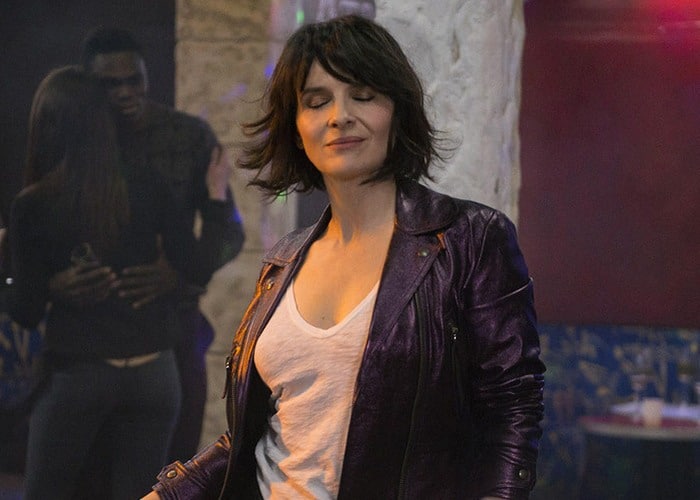
13. Let the Sunshine In (France)

Let The Sunshine In

Directed by Claire Denis

It’s always a welcome sight seeing a female lead in her 50s, and that’s doubly so when the woman is Juliette Binoche. Here she plays a divorced mother on the hunt for love with frequent stops for sex along the way. Writer/director Claire Denis crafts a film that never judges its protagonist and instead lets her be herself, for better or worse, on her own journey of self-discovery. There’s a plot here but it’s secondary to simply letting Binoche’s character enjoy the sunshine.


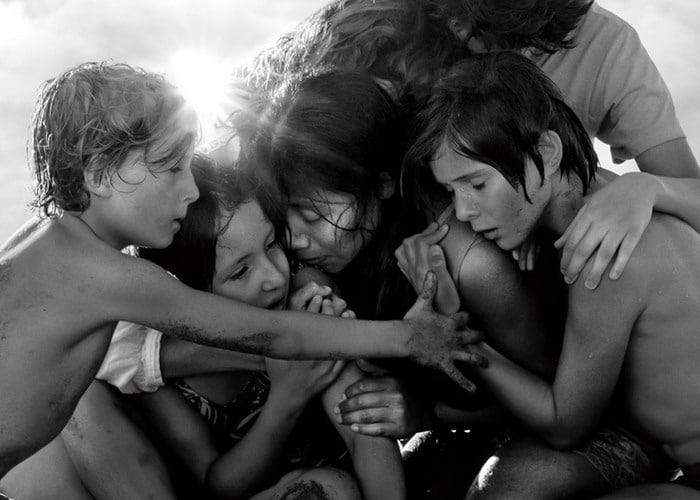
12. Roma (Mexico)

Roma

Directed by Alfonso Cuarón

A maid working for a middle-class family in Mexico City during the 70s is the focus of this intimate and very personal tale from writer/director Alfonso Cuarón, and while her story holds no surprises it’s a strongly relevant one all the same. Her experience is her own, but the year covered here speaks to the changing world around her as well. Cuarón shoots an attractive film capturing the place and the person at the center of it all — someone who doesn’t see herself that way at all.

Netflix Button


11. Angels Wear White (China)

Angels Wear White

Directed by Vivian Qu

There’s plenty of misery on this list, but few of the films are as relentlessly bleak and cynical as this soft-spoken but visibly angry drama. It concerns a teenager made privy to the abuse of two young girls and her struggle to find a voice that people will listen to in a world that values women as virgins or sexual objects — with nothing of note in between. The imagery is clear in the giant Marilyn Monroe statue, the white dress, and general behaviors of those around the seaside community, and we’re left struggling with our optimism. It’s a sad film that’s never merely exploitative, and that makes it hurt all the more.


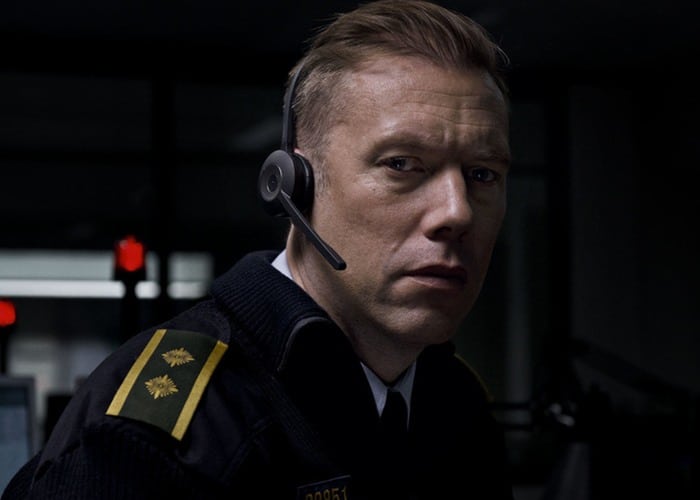
10. The Guilty (Denmark)

The Guilty

Directed by Gustav Möller

Gimmick movies, even great ones, don’t typically make year-end lists, but this Danish thriller is such a near-perfect example of how to do this right that it basically forced its way onto the list. It’s essentially a single-location suspense flick focused on a single 911 operator dealing with a call from a woman who’s been abducted. It’s a smart, thrilling, and tight ride at only 85 minutes, and you’re riveted through to the very end.


Next Page

The post The Best Foreign Language Movies of 2018 appeared first on Film School Rejects.

The Editors of ‘Black Panther’ Explain Marvel’s Labor of Love

Touted as a well-deserved repeated fave here on Film School Rejects, Black Panther did not just experience some flash-in-the-pan success as yet another installment in the ever-growing Marvel Cinematic Universe. Rather, the legacy of this origin story will continue to inform our expectations of all the films to come, even as it moves forward toward higher stakes of inevitable doom and welcome rebirth.

Truly, it takes a village to put together one of the best movies of 2018. In post-production, editors Debbie Berman and Michael P. Shawver aided Black Panther helmer Ryan Coogler in determining the nuances of storylines and character arcs that make us love the movie all the more. In our interview with Berman and Shawver, they break down some key cinematic milestones that combine for a richly immersive experience of the African nation of Wakanda.

The road that this powerful blockbuster took from page to screen was a long but exhilarating process. Let’s take a deep dive into it in our edited chat with Berman and Shawver.

Black Panther is so perfectly-paced as a politically-infused coming-of-age story and an overtly enjoyable blockbuster. How did you and Ryan Coogler find a balance between all those elements?

Debbie Berman (DB): Tonally, balancing all these things was certainly a challenge, but we let the heart of the story and the characters lead the way. Did we want to have fun? Or feel something? Or did we need to learn something to move the story or characters forward? What we personally wanted to see, feel, or know dictated what journey we would go on cinematically.

Michael Shawver (MS): There’s an interesting paradox in filmmaking that we’ve learned through the years that the more unique you make something, the more universal it becomes. We have a very diverse team, made up of men and women, of all ages, from all over the world, and every one of us has a story to tell. Ryan will be the first one to admit when someone has a better idea than him and leans on his team to tell their own version of his story. In the cutting room, there were days we’d spend a few hours talking about the current state of the world… and in a lot of ways, those conversations and feelings make their way into the movie, sometimes even subconsciously.

One of my favorite things about Black Panther is that it invites us as viewers to richly immerse ourselves in Wakanda, instead of just hearing about it in pure exposition. What was it like crafting this nation in the editing room to ensure that kind of experience?

DB: It was an editorial balancing act, deciding how much time to spend simply feeling the culture and traditions, and when it was time to move on with the story. Some of the action and the comedy is in the DNA of the film, but we could discern when to lean into these moments if we felt that they had an emotional payoff, or when to abandon them if they didn’t serve the emotion or the core narrative of the film.

MS: I think you nailed it when you said “experience.” This should be an experience. Before every project, Ryan has me do research and put together sequences of other movies that achieve what we’re trying to do. Panther was “scenes of transit” and “world-building.” I compiled clips from Star Wars, Lord of the Rings, Blade Runner, even Willow, and we watched them while he was in pre-production.

We constantly check ourselves and our work in the editing room, making sure we’re telling the story from the perspectives of the characters. We want you to feel like you could reach out and touch things. Ryan also will shoot scenes that show everyday life in a very documentary style, like the scene in the market with T’Challa (Chadwick Boseman) and Nakia (Lupita Nyong’o). That scene actually has a lot of exposition in it as far as what Wakanda is to the people who live in it and those people’s opposing viewpoints.

However, every scene is on the chopping block at all times, especially expository scenes, and our job is to keep the viewer immersed in the story enough to gain information without feeling like we’re explaining everything to them.

Black Panther Shuri

The film excels in little details that organically build around characters and their arcs. For example, Shuri (Letitia Wright) works on her Vibranium gauntlets before actually using them later on in the film. Was there a specific discussion with Ryan about the narrative purpose of such technicalities?

MS: The question of whether or to show Shuri’s gauntlets earlier in the film was ultimately decided in post. We decided that leaning on Everett’s (Martin Freeman) POV in that scene was the better way to go because he is a closer representation of where is the audience is, as far as their knowledge of Wakanda and Vibranium [goes]. We had versions where we didn’t see the gauntlets in service of the story but we eventually found a way to have the gauntlets in an organic way.

We’re constantly looking for ways to plant things that will pay off later. Thematically, Shuri is also an innovator and even has a line at the beginning of the film that says, “just because something works, doesn’t mean it can’t be improved.” That line has so much depth for all aspects of the movie, from T’Challa’s story to Wakanda’s role in the world. The whole theme of innovation and process while honoring your history and heritage is interwoven in almost every aspect of the movie, which starts and ends with Ryan.

DB: Ryan is a deep thinker and it is almost unbelievable how many layers are embedded in every single frame of the film.  So yes, this was all intentional and planned, and one of the things I love about the film is that every time you watch it, you can see some new detail you didn’t notice before.

The throwdown in the underground casino in South Korea operates like a seamless fluid shot. Talk us through weaving a scene like that.

MS: A lot of work went into that scene. During the month before principal photography, I was involved in the rehearsals with Ryan, the producers, assistant director, stunts and camera departments, and others. Ryan wanted to do the whole scene as a oner once the action kicks off. But because of the mayhem and extras and practical effects, it was necessary to shoot in sections to be stitched together later, hiding the cuts in whip pans or characters crossing the camera.

I would stitch together the rehearsals and watch with the team to discuss what was working and what wasn’t, and how to improve it. Once Ryan and the team felt good about a take, they would run it over to me and I’d build the sequence live. Once we all felt good, we’d move to the next take.

DB: I think it is important for any action scene to function at multiple levels. Yes, it should be fun and exciting, but you should have enough clarity to be able to understand and follow the action — because if you are confused and trying to figure out what is going on, you emotionally detach from the moment. If you can add in character moment, like with Klaue [and T’Challa acknowledging each other] at the top of the stairs, it adds another layer. I usually also try to find ways to integrate humor into the scene so that it can be more enjoyable.

And speaking of action, you excelled at putting together the very emotional and harrowing challenge battle between T’Challa and Killmonger. Was all that already in the script or was it something that had to be finetuned with Ryan during the editing process?

DB: This is Mike’s masterpiece, so I am leaving this question to him.

MS: When it comes to fights, all the punching and kicking in the world won’t make you feel for the characters as much as a reaction shot of someone who loves the person getting hit. In that scene, knowing [that this is] not the same T’Challa from the first Warrior Falls fight was very important. He’s conflicted and doesn’t want to kill his cousin. We know where Killmonger is, emotionally, because he has his speech of how he got there and the previous [confrontation] in the throne room.

But it’s also important to check in with the other characters who have something at stake. The key is finding which moments to go the which character and how they’ll react to the specific moments of the fight based on their individual story arc. And if we did our job leading up to the moment where T’Challa is thrown from the Falls, we just need to make sure it builds to a climax and the audience should be along for the ride.

Black Panther T'challa Killmonger Challenge

Killmonger is easily one of the best villains the MCU has ever had by virtue of how he resists singular characterization. It’s easy to see how Michael B. Jordan’s powerful performance brings a lot of that to life, but how much of it was further enhanced in editing?

DB: We both put a lot of love into honing the character and performance editorially. We wanted to create an empathetic villain, but also expose enough of his intentions to understand that, ultimately, he was going about it in the wrong way. We wanted the audience to have a complicated relationship with him. Michael B. Jordan gave a fantastic performance, and we leaned into its authenticity and were very careful to craft it in a complex manner.

MS: Mike is a great actor and gives his editors a great range of performance. He understands that…his job is to be as honest to the character and his story as possible and give us the tools we need to bring his story to life.

There were some things we realized once we had the movie put together that we needed to work on, whether grounding the character more or making him more dangerous. We focused in post-production on the specifics of Killmonger’s plan and the clarity of what he was doing and why. There were some new lines and scenes written that were shot in reshoots to help this. We felt like we wanted to see a more strategic side to him. A lot of it was honing in [Jordan’s] performance so [Killmonger] felt grounded but justifiably extreme in his decision and actions.

On the flip side, Chadwick Boseman finds a real hero in T’Challa. His subtle gravitas – especially when he’s just observing situations – and his character’s arc are in perfect sync. What’s the secret behind making him just as immediately impactful on screen, even without the extremism of Killmonger?

DB: We put a lot of work into ensuring that despite the fact that the film is layered with so many other strong characters, we kept things in T’Challa’s perspective. An example of this would be when we go to Warrior Falls. Originally, there was a whole introduction to this scene explaining the traditions before T’Challa arrives. We decided we needed to see the scene through his eyes. So, we enter the scene when he does, on his back, through the doors, and view the moment through his eyes. And Chadwick gives a really fantastic performance — sometimes it was about just letting us spend a moment sitting with him while he takes in information so that we can feel the scene through his emotional perspective.

MS: The thing that we had to thread as editors was when to let T’Challa let his team figure things out, or when he should be the one who is proactive. One of the reshoot moments that helped his character in being a strategic thinker was when he asks Shuri to turn off the Sonic Stabilizers during the train fight and use them to disable Killmonger’s suit, giving them a chance to win the fight. Giving that decision to T’Challa shows a side of him that he is still learning, but that ultimately — in the comics and possible future movies — is a side that will let him be the Panther he needs to be.

In general, no character overstayed their welcome. But is there any that either of you would have included more of if given the time to craft specific scenes?

DB: I’m so in love with all the strong female characters in this movie. I would refer to them as my “Goddesses.” I think ultimately the right amount of time was given to each character, but I could easily watch an entire film with any of them as the sole protagonist.

MS: There are two scenes that I would have loved to see in the final cut. The first is between T’Challa and Zuri (Forest Whittaker). It was after T’Challa sees his father in the ancestral realm for the first time and he is talking to Zuri about what it was like. It was nice because it gave us a more intimate look into what T’Challa was going through. But it also established Zuri as a father figure, making the moment he is killed more emotional.

The other is a scene after T’Challa is thrown from the Falls. It’s between Okoye (Danai Gurira) and W’Kabi (Daniel Kaluuya) and it has some of the best performances in the movie. It was about what direction Wakanda will move in and, since they’re in a relationship, what the world will be like for their kids. The problem with that scene was that it fell during a time we all think T’Challa is dead and that section had to be paced just right. On one side we had to feel the loss of our beloved king and give the other characters their time to save Wakanda. But we also know that the audience knows in the back of their mind that T’Challa is coming back.

I think both of these scenes are on the DVD, so at least the world can see them for how great they are.

Lupita Nyong'o Black Panther

Was there anything in particular that drastically needed to be reshot for Black Panther to tie together well?

DB: There were no drastic reshoots, but there were many little moments that were shot to take things to the next level emotionally or narratively.  It wasn’t clear why T’Challa was getting Nakia from Nigeria. It potentially seemed that they might be going home for a funeral. So we added a moment of him saying, “I will be crowned King tomorrow, and I wish for you to be there.”

We wanted to strengthen W’Kabi’s reasons for betraying T’Challa, so we added in a moment in the throne room where he speaks about Klaue killing his parents, and T’Challa promises him that he will bring Klaue back.

One of the reshoots that I am particularly happy about is that [at first] all the Jabari Warriors at the end of the film who save the Dora Milaje used to be male. I told Ryan that I felt that took away from so much of the female empowerment we’d explored with these strong characters over the rest of the film. He agreed and had the brilliant idea to make some of the Jabari female, which changed the whole impact of that moment.

MS: There were a lot of little moment and lines that were done the elevate the film and story. But the ending scene in Oakland was part of the reshoot and ultimately became one of our favorite scenes and the perfect ending to our story.

That ending is definitely impeccable. How did you and Ryan come to the conclusion to come full circle to the very beginning of the film?

DB: Interestingly enough, this wasn’t the planned ending. In fact, it didn’t even exist in original photography. The film used to end with a longer version of United Nations scene, and although it was a beautiful moment and it was amazing to see T’Challa so strong and speaking so eloquently to the world, it felt like it wasn’t personal enough. It never sat right with me, and I had quite a few conversations about it with Ryan, who ultimately felt the same way.

While searching for a new ending, I suggested that he look and see what was already planted in the film. He then disappeared into his room for two days and researched great endings to films, and emerged with this amazing idea of going back to where it all began. As soon as he pitched this small, personal ending to this huge epic film, we all knew it was the right one.

This was such a last-minute decision that we literally didn’t have time to watch the entire film through to see how this felt, and the first time we managed to do so was when we were sitting on the soundstage and we had a final run-through. I remember telling Ryan that it was kind of crazy that we locked the film without watching it through…sometimes you don’t know how something feels until you play it in complete context of the entire film and experience it.

I remember holding my breath hoping it would play, and when it did, I remember just feeling this deep emotional moment that we had found the true ending to the film. I think the entire room felt it because as the playback ended I heard [producer] Kevin Feige lean over to Ryan and whisper to him:

“I think this is the best movie we’ve ever made.”

MS: The idea of showing kids in Oakland the Royal Talon Fighter (the King’s ship) was, in spirit, a concept that in the script and early cuts actually came from Killmonger. In the scene where Killmonger dies on the cliff, he had a few lines to T’Challa about how beautiful Wakanda was and maybe if people around the world could see what was done there, that’s all they would need to realize their own potential.

We realized in that scene that one, T’Challa shouldn’t get his answer to the whole movie from Killmonger. He can be influenced, but shouldn’t get the idea directly from him; he needs to decide this himself. Two, Killmonger felt like he was changing too much in his last moment and it was more honest to the characters that he goes out with the same ideals he came in with.

So, we kept the line about him being buried in the ocean with his ancestors and being in control of his own fate, which completed his arc perfectly and memorably. Ultimately, [this leaves] T’Challa to show those kids in Oakland what human potential can be manifested into. It also allowed us to end the movie with the line “who are you?” which comes up through the whole film [as] a major theme throughout.

Debbie, now that you’re onto editing your third MCU film (Berman edited Spider-Man: Homecoming and is now working on Captain Marvel), how has the process differed between each project?

Essentially, the storytelling process was the same as I try to delve into what makes these characters tick, what is their conflict, what is their journey. From my personal experience, Spidey was my big break and I always felt such a huge correlation to the character; I was trying to prove myself, and so was Spidey. And I think that really connected me to not only the film [and] Spidey, but also to [Homecoming director] Jon Watts. We were two film lovers whose lifelong dream of making movies was finally coming true, and we got to do it together, and every frame of the film felt like it was the most important thing in the world.

With Ryan Coogler, everything feels so intimate, intense, and personal. At the same time, he is absolutely hilarious, so you get to have fun also. He is a truly phenomenal human being and filmmaker, and I told him on my second day of the film that he is the greatest person I have ever met. I still feel that way.

Being a South African, Black Panther felt exceptionally personal to me, and I was able to utilize some of the skills I had acquired on Spidey to help tell the story. With Captain Marvel, I finally feel fairly comfortable in this world, having basically done two films back-to-back and jumping straight onto my third.

But now I am working with two directors, which has been a whole new dynamic to deal with. I got lucky because both [Captain Marvel directors] Anna Boden and Ryan Fleck are pretty amazing people and filmmakers. And of course, Captain Marvel being the first female to helm her own solo film in the MCU has made it an extremely important and personal story for me, too.

So, every film has been about nurturing creative relationships with the people around me and finding the heart, humor, stakes, and excitement in the stories we are trying to tell.

And Michael, what’s it like evolving a working relationship with Ryan over the years from intimate films Fruitvale Station to huge ones like Creed and Black Panther?

Ryan is big on loyalty and trust. It’s a big reason why you’ll see the same names in the credits on several [of his] movies. We actually met in film school at [the University of Southern California] and first worked together there. Ryan and I work well together because we’ll be the first to admit we don’t know the answer to something, but will work until we find a solution.

As each movie has gotten bigger and bigger, each of our responsibilities has grown as well. Ryan went from directing a crew of a few dozen on Fruitvale to several hundred on Panther. I know Ryan is always going to immerse himself fully into whatever he needs to at the time. So, during production, I only talk to him a handful of times about the cut. But other than that, he trusts his editors, much like he does with every other department, to tell their version of the story.

It’s a lot of responsibility, especially never having done a movie of this size before, but it’s also freeing. We also both know that we’re going to be spending lots of time together during post-production finding the best movie anyway, and because of our history, I have a bit of a safety net to try things that may not have been intended.

Producers and directors freaking out and firing editors is a real thing. The reality is that as an editor you may only get one crack at a scene or a movie before the director sees it even though there’s 10 hours of footage for one three-minute scene. But I can fully immerse myself and tell my story knowing that I’m still going to have a job after Ryan watches the first cut.

This level of trust was invaluable on a project of this size at a company like Marvel. With the amount that Marvel expects of their editors to fill multiple creative roles, knowing that Ryan trusts my taste and is comfortable with me representing him when he’s busy with something else, allowed this movie to evolve in the way it needed to.

Black Panther

One thing that a lot of superhero films are sort of saddled with nowadays is the inability to fully exist as independent entities compared to others within the same cinematic universe. I’d argue that Black Panther is a wonderful standalone, even as it sits between huge Avengers set pieces, and can stand the test of time in that way.

MS: One of my favorite things about comics as a kid was how they interconnected, and it’s one of my favorite things about the MCU as a whole. We knew coming in that [connectivity] comes with the territory and ultimately can improve the audience’s relationship to the characters the worlds they inhabit.

During the editing process, we worked to connect things like the Border Tribe’s sonic shields and tell the story behind that tech, because they’d be using the same thing to fight Thanos in Infinity War. It wasn’t an obligation, but it worked for our movie first and foremost and had the added bonus of informing a future movie and the biggest battle this shared universe had ever seen.

DB: There were enough nods to the MCU for true Marvel fans to enjoy the film, too, but yes, ultimately we wanted people to be able to enjoy Black Panther even if they had not been exposed to the Marvel Universe in any way before. The characters and story are so powerful that we felt this was a movie that even people who weren’t drawn to the genre could love.

The post The Editors of ‘Black Panther’ Explain Marvel’s Labor of Love appeared first on Film School Rejects.

John C. Reilly and Steve Coogan on the Artistry of ‘Stan & Ollie’

There are far worse things to talk about at a junket than Laurel and Hardy. The famous comedy duo is the subject of a tender new buddy movie, Stan & Olliewhich focuses on a slump in their relationship, both personally and professionally, as they toured and performed live long after their days of movie stardom. Director Jon S. Baird‘s (Filth) celebrates the lives of Stan Laurel (Steve Coogan) and Oliver Hardy (John C. Reilly) without ever falling into hero worship and stripping them of their humanity like many biopics tend to do.

Speaking with Coogan and Reilly, it was evident right away how much their love and respect for the performers grew during the making of Stan & Ollie. “It was really fun to remember these guys and how amazing they were,” Reilly told us over the phone, seated next to Coogan. “That’s one of the great things about promoting the movie is to remind people of the genius of Laurel and Hardy.” During our interview with the two performers, who are also both known for their work as comedic duos (with Will Ferrell and Rob Brydon), they reminded us of their genius as well.


It’s nice to think this movie could introduce a whole new generation to Laurel and Hardy’s movies.

Coogan: Well, that’s part of the kind of mission that John and I were on. We were kind of shocked that many people under 40, aren’t that familiar with Laurel and Hardy apart from the image of the fat guy and the thin guy. So really, part of our hope was the movie got some traction and people liked it, that it would have a knock on a bit, and that people would take a fresh look at these guys.

What was your relationship with their work growing up? Were you fans? 

Coogan: Yeah, I think both of us, we watched their stuff on TV, because it was during the period ’70s and ’80s when they would rerun a lot of Laurel and Hardy’s movies on TV during vacation during the kids TVs.

Reilly: Yeah, it’s funny, I almost thought they were almost like cartoon characters. I didn’t think of them as real people. I saw them as this delightful kind of pair of guys that were just … I mean, I couldn’t even think of them as actors, or whatever. When I was a kid, I would think of them like going home together after they made their movies, and cooking dinner, and with the cameras still on. So it’s hard to imagine them apart.

When you were performing research and looking at their material again, what maybe stood out to you about them as performers that you admired? 

Coogan: Well, Stan obviously was obviously the workhorse behind the relationship in terms of generating material. But for me, it was going through the rehearsal process, because we found a lot of information about them, but it was the experience that was a revelation because going through the rehearsal process that John and I did before we started shooting you sort of discovered how the … almost however throwaway and disposable and sort of random that their shows seemed to me, their short films seemed to be, it was almost a direct correlation of how hard that they worked and how much craftsmanship there was in their short films.

Reilly: Yeah, you quickly realized the nonchalance of their work was a result of hundreds of hours rehearsal and working the gag over and over and over again so that it seemed effortless.

It’s never effortless when it’s that good, right?

Coogan: Absolutely. So it was a lot of sweat and toil. It was good to go through that rehearsal process. It was good that we did demanding work, and John and I had to do the sketches, the dance routines, and all the rest of it. And that whole process helped us not only learn about Laurel and Hardy and how hard they worked together, the process of rehearsing gave John and I, a taste of the process that Laurel and Hardy would’ve had to go through.

Steve, being a writer, was there anything about Laurel’s process as a writer that you connected with as well?

Coogan: Yeah, I do a lot of comedy, and I write a lot of comedy. I mean, there have been times in my life when my personal life hasn’t gone exactly the way I’ve wanted it to, and sometimes I’d kind of console myself and think, “Well, I’m pretty good at my job.” I feel that Stan Laurel took that to an extreme, in that he was so dedicated to the craftsmanship of his comedy that he kind of sacrificed his personal life in a way that Oliver did not do. Oliver tried … John and I, we talk about it. We say that Oliver worked to live, but Stan lived to work.

Oliver had a pretty big zest for life, right? 

Coogan: Yes. Well, John will talk about this, but Oliver certainly had a kind of bon viveur, and he loved life.

Reilly: He was like a romantic. He enjoyed the fruits of their relationships. Hollywood, for well known actors at the time, had a lot of fruits, just wine, women, and song. And then he was great at playing golf. He’s like a savant at playing golf. He used to love to go to the horse races. And he spent his money as fast he could make it, because he was just trying to enjoy life. As someone came from pretty humble backgrounds, both Stan and Ollie, once they got a little cash in Hollywood, it made them feel really great. I think that’s one of the reasons why they didn’t push for a better financial arrangement with their producer in the first place, because they were so relieved to be employed during a period like the Great Depression.

He’s a really passionate guy, and that was what I found at the center of this kind of onscreen stage persona: the over-the-top romantic stuff that he would do when he was meeting a lady and twiddling the tie and all that, that was just like a more extreme version of, I think, his real personality.

Was there anything about him as a performer you found relatable? 

Reilly: Yeah, I think so. I mean, I consider myself a romantic. I’m someone that … I work very hard, and I work a lot. And when I’m not working, I don’t concern myself with it at all. I don’t talk to my agent. If I decide that I need time off, I completely disengage, and just go out and enjoy the world. And it’s something I actually say to actors all the time, younger actors that I meet on films. I say, “Listen, just because you’re away on location at work, it doesn’t mean that your life has stopped and that you’re just here to work, and that you should not be comfortable and not be enjoying yourself because you’re ‘at work’ Your life continues no matter where you are. You have to enjoy where you’re living, enjoy what you’re eating, take care of yourself, see the world, and continue to grow as a human being.”

And I think Oliver and I have that in common. It’s not just about endless devotion to work. Luckily, he had a partner who was devoted and can keep the quality level of their work so high that he has the luxury of having someone like Stan making sure that due diligence was done for the scripts and the gags. One of the things about their movies that’s really stunning, they did a lot of playful stuff with special effects, actual practical effects. Like, the way things would hit them, it took a lot of planning. A lot of their work is physical pratfall-ing kind of comedy, but behind their films took a lot of planning and art. That’s where Stan really made sure that all the Ts were crossed.

I was just watching this interview with them called “This Is Your Life,” which is around the same period as the movie. In 25 minutes, they just gave the audience so little, and you got no sense of their personalities. 

Coogan: Yeah, I think that wasn’t a good time in their life, and I think it was kind of disingenuous the way that was set up, because they were promised by [manager] Bernard Delfont, who helped set them up, and who’s actually a character in our movie, promised they were meeting someone about making a movie. So, it was kind of almost a disappointment when they found out that it was “This Is Your Life.”

Reilly: Yeah, the first moment when that wall pulls away and it’s revealed that they’re on a TV show, to me, is one of the saddest things I’ve ever seen. You see Oliver look out as if to think, like, “What on earth?” They were there hoping to have some kind of good news for their future, and in fact, they were sort of being used by the television show.

Coogan: Yeah, but people just want to go over the same old stuff.

Reilly: And also, they were of an older style of entertainer, where they didn’t really share so much of their personal story. It was about maintaining characters, these beloved characters, for the audience and never disappointing the audience, always letting them feel like I felt when I was a little boy, that these two characters are real, and the sweetness of them is real.

Coogan: They didn’t court celebrity in the same way. They wanted to make their movies successful, which they were, but they didn’t go tarting around on this that and the other.

Reilly: We look at great filmmakers and great actors in films now with a sense of their ongoing legacy, or a life career in this art form called filmmaking. But at the time these guys were working it was a very new art form, and in fact, most people thought of it as just a disposable art form. Films, you come out, you just make another one. They almost felt like we feel about reality TV, how like, this stuff just comes out, and you keep making it, and then things change, and you make some different stuff. And now, looking back on their work, you realize, “Wow, these guys, they actually are a very important part of filmmaking history, and they do have a legacy.” But I think it was somewhat lost on them and everyone else at the time.

Coogan: They couldn’t imagine there were people that were yet to be born who were going to enjoy their work.

Reilly: Yeah.

One scene that really stands out to me is when their manager, Bernard, is just blown away and moved by their performance, partially because I think we’ve all experienced that feeling watching a performer. Is there a performance or two you’ve witnessed that left you both in awe? 

Reilly: Well, I remember the first concert I ever went to was to see Steve Martin in concert. And well, some of my peers were more excited to see Rush, the rock band, or AC/DC or whatever. I was just so into Steve Martin, and that was a life-changing experience, getting to see his comedy onstage, getting to see the sort of mayhem that he created and laugh with him in real time, was a very impactful thing.

In fact, when I left that performance, I remember seeing … I can’t believe I saw this. I was walking out of the Chicago Amphitheater where I saw him in Chicago, and here he comes in his white suit jump into a limo, and then he’s waving out of his back window to me as he drives away from the concert in his white suit at the time. And Steve Martin could not have been bigger at the time. He was hugely popular. Anyway, yeah, that was a major, major performance. Also, seeing Ian McKellen live onstage as a young theater actor was also huge because I saw him in “The Cherry Orchard.” That was another one that really just knocked my socks off.

Coogan: For me, I think it was when Elvis came to my house and cooked me breakfast. I’ll never forget that. [Pauses] Yeah.

Reilly: He loved bacon, I heard. The King loved bacon.

Coogan: He did, yeah. He had a little too much of it, to be honest with you, but very good.


Stan & Ollie is now in theaters.

The post John C. Reilly and Steve Coogan on the Artistry of ‘Stan & Ollie’ appeared first on Film School Rejects.

The Conflicting Symbolism of Trains Inspires Powerful Cinema

The train has stood the test of time as a storytelling device throughout pretty much all of film history. On screen, locomotion can propel narratives forward, providing palpable stretches of suspense. They can also, paradoxically, be used to indicate reprieve. Grace Lee of What’s So Great About That? examines this very conundrum in her video essay Next Stop, Analysis: The Contradictory Trains of Cinema. She collates an array of iconic train sequences and dissects their significance as fictional allegory. Lee’s effective argument spans literature, film, and television, delving into the fascinating multiplicities of the train as a cinematic tool.

At first blush, just listening to Lee explain Spirited Away, Snowpiercer, and Train to Busan within this framework is a massive delight. Those are some of my own favorite films that utilize this motif so poignantly. Regardless of any plot commonalities that may or may not exist between these stories, Lee puts them alongside the Lumiere brothers’ Arrival of a Train at La Ciotat and the works of Charles Dickens, showing the intuitive interchangeability of a great train sequence.

Some of my most cherished films certainly employ the very dichotomy of mystery and respite through the train trope. I can’t think of locomotives without referencing the Harry Potter franchise. Notably, Lee does sneak in an extreme long shot of the Hogwarts Express in her video. However, the implications of the train’s shifting functionality throughout the personal journey of the series’ eponymous protagonist are worth exploring in more detail.

The Hogwarts Express is established as a comfortable location for Harry Potter. When we first board it in Harry Potter and the Philosopher’s Stone, it truly represents an extension of the character’s freedom from his traumatic childhood upbringing.

The Hogwarts Express takes Harry to a wondrous place beyond his wildest imaginations and lets him immerse himself in the magical world. The fact that this includes indulging in magical sweets and snacks from the train’s food trolley is a total bonus for an 11-year-old boy.

The Hogwarts Express serves as the propitious meeting spot for many of Harry’s life-long friends, too. As depicted in both the book and the film versions of Harry Potter and the Sorcerer’s Stone, Harry encounters his best friends Ron Weasley and Hermione Granger on the train ride to school.

Clearly, the Hogwarts Express basically breeds plot progression. The train drives Harry toward his own fate, literally and figuratively. Of course, it only does so for better or worse. Come the series’ third installment, the train begins to look more menacing just as the overarching plot of the franchise darkens.

In Harry Potter and the Prisoner of Azkaban, warmth and comfort are sucked out of the Hogwarts Express once a Dementor comes aboard. The wraith-like creature, tasked to retrieve a murderer with distinct personal ties to Harry, dredges up depressing feelings among his schoolmates and worst of all, forces the boy to relive the terrible memory of his parents’ deaths.

Dread and horror invade a train compartment that had previously represented the calm before the storm of Harry’s tumultuous school years. In Prisoner of Azkaban, the infiltration of the Hogwarts Express strongly hints at the darkness that will inevitably color Harry’s destiny. His future is suddenly uncertain when even his safest spaces are gravely threatened.

Inception

In a similarly fantastical example, Inception indicates the conflicting flexibility and rigidity of the train as a motif. We first meet the film’s protagonist, Cobb — excommunicated from his home country and indefinitely separated from his children — on a train ride attempting to steal trade secrets from a Japanese magnate. Cobb deals in corporate espionage via shared dreaming, requiring the significant stretches of time found in modern-day travel in order to extract the information he needs.

This initial supposedly run-of-the-mill job subsequently opens a door for the character’s absolution. But in order to jump-start Cobb’s path of redemption, he has to use the controversial titular method of planting an idea into a target’s unsuspecting subconscious.

The problematic, convoluted nature of this ploy is effectively distilled through the evocative appearances of trains in Inception. They are unstoppable, as demonstrated by a giant freight unexpectedly bursting through one of the dreamscapes during Cobb’s big heist. It disrupts and gravely endangers his crew at work.

Trains also help to personify the nagging issue of Cobb’s existence in identity limbo, linking him closely with his deceased wife, Mal. As they become masters of dream-sharing together, building worlds and growing old in dreamscapes, reality becomes too flexible for the latter.

Cobb attempts to save Mal from rejecting reality by waking her up through invoking the concept of them lying on some tracks, “waiting for a train…that’ll take [them] far away.” In a film where you are “killed” in-dream to awaken in the real world, the locomotive that rumbles toward the pair should symbolize some sort of finality.

Except it doesn’t. Instead, heightened tension sustains itself during subtle and overt deliberations of what’s real and what isn’t in the film, even after Cobb and Mal find themselves in their home. The train motif presents as a neverending loop that encourages characters in the film as well as audiences to mistrust many aspects of the narrative. Inception remains in a state of stasis right until the very end, evoking the uncertain journey of life via the unrelenting force of a train in motion.

In spite of the apparent contrariness of thematic trains, I absolutely enjoy them because they organically add narrative texture and excitement to the stories we love. They are extraordinary spaces that inexplicably elicit both rumination and action, making them the ultimate cinematic device.

The post The Conflicting Symbolism of Trains Inspires Powerful Cinema appeared first on Film School Rejects.

‘Spider-Man: Into the Spider-Verse’ Puts Sony Back on Track

For over ten years now the Marvel Cinematic Universe has been a juggernaut of franchise filmmaking, thrusting superhero movies back into the popular culture and popularizing the idea of the “cinematic universe” for a modern audience. The template has been so successful that everyone from their direct competitors in DC Comics, to the ill-fated Dark Universe (RIP), has tried to adopt it.

And one of the worst offenders for this was Sony, whose grasp over Spider-Man and his supporting players lead them to attempt their own Spidey cinematic universe hamfistedly. This, of course, crashed and burned after the all-around disappointment of the Amazing Spider-Man films, causing the character to be loaned back to Marvel. But Sony wasn’t giving up that easy.

As they continued to threaten a slew of spin-offs, one unique project appeared on their slate — an animated Spider-Man movie from the dream team of Phil Lord and Christopher Miller, entirely separate from the MCU. While you’d struggle to find those clamoring for another reinterpretation of the character, Lord and Miller’s magic touch has proven people wrong before, and the more we learned about Spider-Man: Into the Spider-Verse, the more appealing it sounded.

Miles Morales as the lead in a loose adaptation of Dan Slott‘s “Spider-Verse” certainly sounded like an appealing concept, and the film we got from directors Bob Persichetti, Peter Ramsey, and Rodney Rothman wound up being nothing short of a miracle. Having spent years stumbling over every effort to launch a Spidey equivalent to the MCU, Sony has finally made a step in the right direction.

When making the Amazing films, the studio’s priorities were all over the place–the then-new Spider-Man had to be moody and grounded so the films could compete with The Dark Knight. But after The Avengers more than doubled The Amazing Spider-Man‘s box office in 2012, Sony went into panic mode. The series was then completely revamped only two years later, as doom and gloom gave way to bright colors and lighthearted humor.

In addition to this, one of the biggest criticisms leveled at The Amazing Spider-Man 2 was that it was less a standalone movie, and more a series of promos for future installments. The film was a chaotic hodgepodge, the result of a tug of war between four writers and a studio determined to launch a franchise. Spending a great deal of its run-time setting up characters and teasing events that have no payoff, hoping that it would all make sense several spin-offs down the line. None of which saw the light of day.

But Into the Spider-Verse couldn’t be further from this way of thinking. The movie is, first and foremost, about Morales’s journey–one of self-discovery and finding the hero within. Even through all the wacky turns of events, we never lose sight of this, and everything here is in service of his arc. And while the film is far from shy about introducing us to a whole host of new Spider-people, none of them are afterthoughts. Each character serves the story in some form, while still leaving us wanting to see more from them.

Also refreshing is the standalone nature of the film. We’ve become so accustomed to being dropped into the same predictable world, one where everything is familiar, and we more or less know the outcome. But here, we’re dropped into a new world, one that’s already fully established–Peter Parker has been at the Spider-Man thing for years, and his rogues’ gallery is firmly in place. The film doesn’t need to explain or show the origin of Tombstone or the Green Goblin, assuming that we either know or can pick up what we need from context. It’s so rare to be dropped into such a vibrant, alive world like this and its the perfect jumping off point to tell a fresh new story, free from continuity or an established formula.

In contrast, the Amazing films’ clumsy attempt to build up all the villains as products of Oscorp was a bizarre undertaking. One that looked to do the MCU thing of building everything up piece-by-piece, but also to cram it all into one film and skip directly to the lucrative crossover. Into the Spider-Verse on the other hand, knows exactly what it’s doing–being a damn good movie first and a tease of things to come second.

Another essential step Into the Spider-Verse represents for Sony is reaffirming what makes Spider-Man special–he could be anybody. Peter Parker wasn’t born with his powers, nor does he have Tony Stark’s money, he’s just a regular person who got his powers in a freak accident. And as such, as the film so brilliantly affirms, anybody can wear the mask. Whether you’re a down on your luck kid or a pig from an alternate universe, you can be Spider-Man.

This is in direct opposition with the Amazing series’ take on the character, one who was destined to become Spider-Man because of experiments done by his father. In those movies, Peter was the only person who could gain those powers from the spider bite, not only making it an enormous coincidence that he did, but also cheapening the very idea of Spider-Man. But Into the Spider-Verse, with its anti-gatekeeping and pro-inclusion themes, gets Spidey more than any movie since Spider-Man 2, and represents a positive step for Sony.

While they’re still committed to making Venom a franchise (which considering its box office success, isn’t stopping any time soon) and refuse to let the Sinister Six movie die, Sony appears to have learned some crucial lessons where Spider-Man is concerned. And if we must get a continued stream of Spider-Man-adjacent movies, Into the Spider-Verse is the perfect place to start.

The post ‘Spider-Man: Into the Spider-Verse’ Puts Sony Back on Track appeared first on Film School Rejects.

Friday, 28 December 2018

Chevy Chase & Richard Dreyfuss in Official Trailer for 'The Last Laugh'

The Last Laugh Trailer

"Do you even have an act?" "I never had an act." Netflix has unveiled the official trailer for an indie road trip comedy titled The Last Laugh, the latest from filmmaker Greg Pritikin (Totally Confused, Dummy, Surviving Eden). The comedy stars Chevy Chase as a retired talent manager who is reunited with his first client, Buddy Green played by Richard Dreyfuss, a comic who quit show business 50 years ago. This is another one of those amusing old geezers go on a road trip and re-discover how much fun the world is kind of films. The small supporting cast includes Chris Parnell, Kate Micucci, and Andie MacDowell. This looks like it has a few good laughs, but not as many as you might be expecting from this duo. Watch below.

Here's the first official trailer (+ poster) for Greg Pritikin's The Last Laugh, direct from YouTube:

The Last Laugh Movie

When retired talent manager Al Hart (Chevy Chase) is reunited with his first client, Buddy Green (Richard Dreyfuss), a comic who quit show business 50 years ago, he convinces Buddy to escape their retirement community and hit the road for a cross-country comedy tour. The Last Laugh is both written and directed by American comedy writer / filmmaker Greg Pritikin, director of the movies Totally Confused, Dummy, and Surviving Eden, as well as all the episodes of the TV series "Easy to Assemble" and other screenwriting work. This hasn't premiered at any film festivals or otherwise. Netflix will release Pritikin's The Last Laugh streaming exclusively starting on January 11th, 2019 coming up very soon. How does that look? Anyone?

The ten best films of … 1928

La passion de Jeanne d’Arc

Kristin here:

Time for our twelfth annual alternative to the usual list of the ten best films of the current year. Instead, I offer a list from 90 years ago, in part for fun and in part to call attention to some lesser-known classics that are worth discovering. (See here for our lists from 1917, 1918, 1919, 1920, 1921, 1922, 1923, 1924, 1925, 1926, and 1927.)

The year 1928 marked the triumphant conclusion of the silent cinema. Very few sound films were made that year, and those that were often included only music, perhaps sound effects, and occasionally some passages of dialogue. Sound was not innovated because the silent cinema was in aesthetic decline. Quite the contrary. It was initially an enhancement that film-industry people assumed would make films more lucrative. In most cases the “talkies” that followed over the next few years were  inferior to their silent predecessors, in part due to the limitations of the new sound technology. Those who opposed the addition of sound could point to the films of 1928 as evidence that the young art form had already reached a peak of perfection that was being tarnished by the addition of recorded sound.

In compiling this year’s list, I came up with eight titles that seemed unquestionably to belong on it. There were another six on a list of possibilities for the final two slots. More than in past years, this year gave me a chance to go back and rewatch films I hadn’t seen in a long time, in some cases since graduate school in the 1970s. Some held up well, some not so much. In a few cases, restorations made since my first viewings revealed new strengths in films I remembered from poor prints.

As always, there are films that have been lost but which plausibly could have filled out the list, most notably Ernest Lubitsch’s The Patriot and F. W. Murnau’s 4 Devils.

First, the eight obvious choices, in no particular order apart from #1.


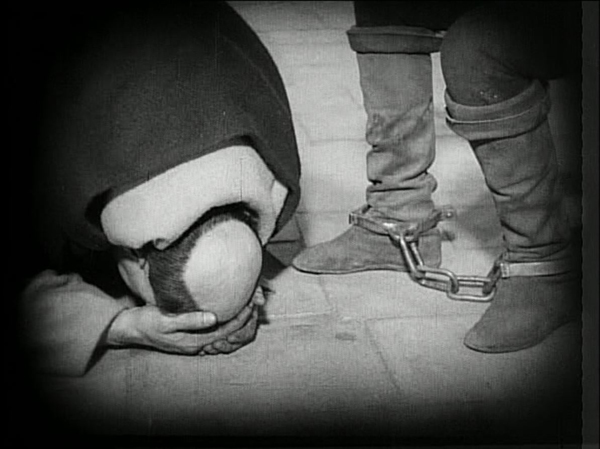
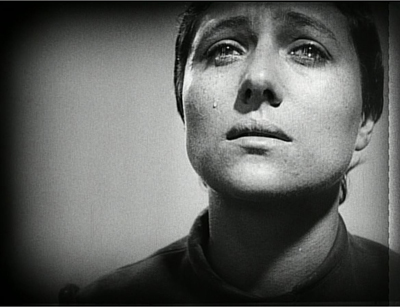
1. La passion de Jeanne d’Arc.

Not every year includes a film that is not only one of the tops of its year but of all cinematic history as well. Carl Theodor Dreyer’s final silent film is one such masterpiece.

Jeanne d’Arc seamlessly blended the stylistic traits of the great artistic film movements of the 1920s, German Expressionism, French Impressionism, and Soviet Montage and made something new and unique of them.

Expressionist designer Hermann Warm’s past credits had included two films that have featured in these lists, Robert Wiene’s Das Cabinet des Dr. Caligari and Fritz Lang’s Die müde Tod. Warm collaborated with French theatrical designer Jean Hugo to create spare, white, off-kilter sets that focus our attention on the spiritual drama. Fast editing conveys subjectivity, as in the scenes where Jeanne is threatened with torture and where the citizens are suppressed when they riot after her execution. Rudolph Maté’s cinematography is startlingly dependent on close shots, particularly on the face of Jeanne, played by Renée Falconetti in one of the most intense and affecting performances in any film.

The steady progression of the action condenses days of trial testimony into one apparently continuous story. Between the sets and this inexorable march toward Jeanne’s martyrdom, there is a sense of both spatial and temporal disorientation that focuses our attention intensely on the central conflict.

Until 1981, prints of Jeanne d’Arc were indistinct and incomplete. A pristine print that restored the original visual quality and detail was found in Norway. (The film was among the early ones to be shot on panchromatic film stock without the actors’ using makeup. The result is a detail of texture in the faces that enhances the performances tremendously.) This print is the basis for the Criterion Collection’s edition of the film.

It’s a film that one can see over and over and still be overwhelmed at the originality and intensity of Dreyer’s vision. We saw it projected last November in Houghton, Michigan, with Richard Eichhorn’s recently composed accompaniment, “Voices of Light,” essentially an oratorio and film score rolled into one. We were somewhat trepidatious about whether the score would be distracting, but it proved very effective. Once again, I was reminded of how great this film is. (“Voices of Light” is an optional accompaniment on the Criterion edition linked above.)


2. October

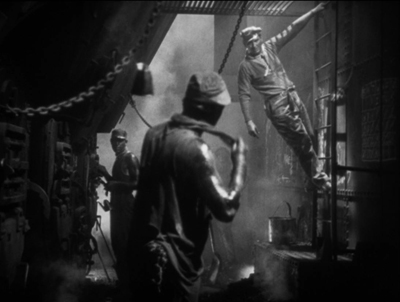
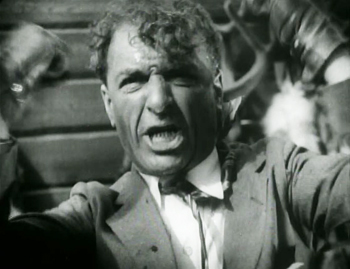
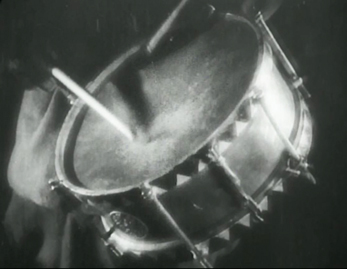
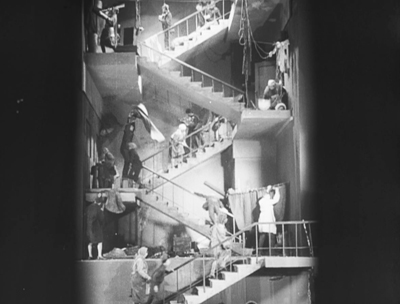
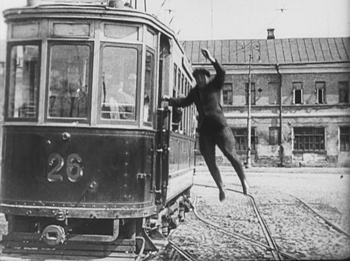
If Jeanne d’Arc gains intensity through a nearly claustrophobic treatment of space, Sergei Eisenstein creates an epic tenth-anniversary celebration of the 1917 Revolution in his October (finished and released a year late).

Perhaps the most extreme example of Soviet Montage’s frequent avoidance of a single protagonist, October cuts among a wide variety of the people involved in the revolution. Workers pull down a statue of the Tsar. Lenin speaks at Finland Station. Kerensky and his officials luxuriate in their Winter Palace headquarters. Sailors wait on the Aurora battleship. Elderly citizens try to protect the specious February Revolution. Female soldiers are summoned to protect the Palace from the attacking Red forces. Looterssteal bottles from the Tsar’s wine-cellar. The result is a sort of patchwork collage of the Revolutionary events leading up to the storming of the Winter Palace and the attack itself, with a slow build to an exultant climax as the Red forces triumph.

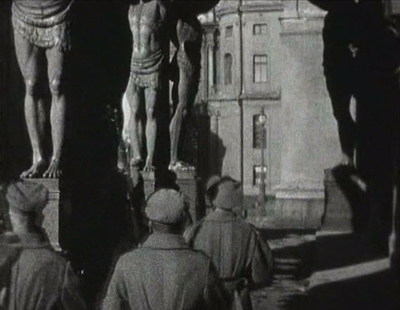
Eisenstein was given extraordinary access to the locales of the actual events, so that the vast halls of the Winter Palace and the trappings of royalty (Fabergé eggs and fancy crystal liquor bottles) give a sense of reality rare in fictional reenactments. (There was a time when October was plundered for “documentary” footage of events which had not been recorded by cameras at the time.) He used the settings to ridicule the anti-revolutionary forces, as when young cadets are summoned to help fight the Red forces and are dwarfed by the muscular colossi that line one area of the Palace’s exterior (above).

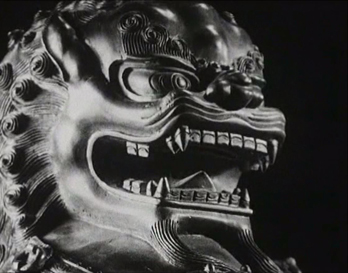
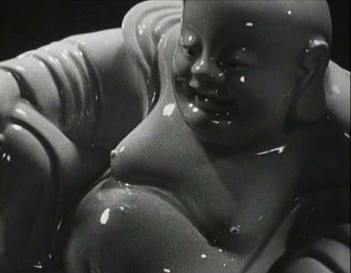
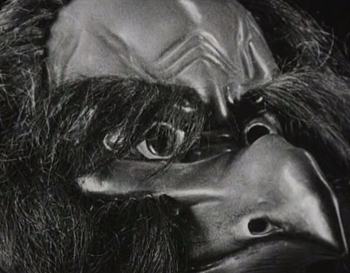
The film also represents Eisenstein’s experiments with “intellectual montage,” where he attempts to convey ideas strictly through juxtaposing series of images. In belittling the phrase “for God and country,” he tries to reduce the notion of “God” to absurdity by linking a long series of increasingly exotic depictions of deities from different religions.


Whether Soviet audiences of the late 1920s could make anything of such passages is impossible to know for sure, but one suspects that some of them would have been incomprehensible. Still, it is exciting to see an artist playing with such possibilities. Certainly the technique lived on, whether from the simple juxtaposition of cackling hens and gossiping women in Lang’s Fury or Jean-Luc Godard’s dense, often impenetrable strings of images, especially in his political films.

October exists in many versions. Beware the heavily cut versions under the title Ten Days That Shook the World. These images were taken from the 2008 release by the Soviet Ruscico company in its “Kino Academia” series.


3. Spione

Despite the widespread enthusiasm for Lang’s Metropolis, his other big films of the 1920s–Dr. Mabuse, der Spieler, Die Nibelungen (Siegfried and Kriemhilds Rache), and Spione–seem to me better. Metropolis is perhaps flashier in its design and conception and certainly very entertaining, but it’s also sprawling and implausible and essentially pretty silly.

Spione, on the other hand, has a tight, fast-paced narrative. It’s sort of Dr. Mabuse boiled down to one feature instead of two, and with the villainous Haghi (again played by Rudolf Klein-Rogge) as a banker secretly masterminding a spy ring rather than a gambling racket. There are no great “heart vs. hand” themes here–just a rattling good tale stylishly presented. Expressionism has disappeared in favor of a streamlined look (above), and Lang’s editing has sped up since Mabuse.

There’s not much point in detailing the plot here, since it would involve too many spoilers. Discover it for yourself if you haven’t already.

Spione circulated for years in the truncated American release version, which is how I first saw it.  A 2004 Murnau Stiftung restoration of the complete version was a revelation, not only for its more complete narrative but for its superb visual quality. It’s a feast of shots that only Lang could have composed (above and bottom). These frames are from the Eureka! DVD, but the company has subsequently released it in dual format DVD and Blu-ray. Kino Classics has also released it in Blu-ray. The same company has put out a boxed-set of all Lang’s silent films (including Die Pest im Florenz, directed by Otto Rippert from Lang’s script). We were given this recently and haven’t had time to explore it, but it looks like a must for any fan of Lang.


4. L’Argent

Marcel L’Herbier makes his second and final appearance on this annual list with his epic adaptation of Emile Zola’s L’Argent, updated to contemporary Paris. (See the 1921 entry for El Dorado; I also wrote about the Flicker Alley releases of the restored versions of L’Inhumaine [1923] and  Feu Mathias Pascal [1925].)

Inspired by Abel Gance’s even more epic Napoléon (1927), L’Herbier set out to make a film that would require a large budget. To obtain that, he made a deal for his own company, Cinégraphic, to co-produce with the mainstream studio, Cinéromans. The result contains brightly lit sets of big banks and expensive apartments, as well as shots made in the Paris Bourse over a three-day weekend (above). L’Argent also had an all-star cast. It included Brigitte Helm and Alfred Abel fresh off Metropolis, thanks to the German distributor, UFA. It also meant that Cinéromans tampered with the film, re-editing and shortening it.

Given L’Herbier’s reputation as an aesthete and an avant-garde filmmaker, L’Argent was dismissed by many at the time as a purely commercial endeavor. It remained unseen and hence virtually forgotten for decades. A screening at the New York Film Festival in 1968 surprised and impressed the spectators. The real recognition of the film as a major artwork came, however, in 1973, when critic and theorist Noël Burch published his monograph, Marcel L’Herbier (Paris: Seghers, 1973). In it he hailed L’Argent as a masterpiece, devoting the entire final chapter to an analysis of it. Burch also wrote the entry on L’Herbier for Cinema: A Critical Dictionary: The Major Film-makers ([New York: Viking Press, 1980], Vol. Two, pp. 621-28), edited by Richard Roud; again Burch devoted  much of his text to L’Argent.

I have expressed my reservations about L’Herbier’s films in earlier entries, but for me L’Argent is the big exception: stylistically daring and narratively engaging. Perhaps adapting Zola led L’Herbier to make a more conventionally suspenseful film than usual. Referring to the French Impressionist movement in general, Burch wrote, “L’Argent undoubtedly marks the end of the period of experimentation, since it is itself the culmination of all these experiments–not just L’Herbier’s, but those of the first avant-garde and even, to a certain extent, of the entire Western cinema (with the exception of the Russians)” (Roud, pp. 624-25).

The story involves two powerful bankers who spar for control of one large bank’s standing on the stock market. One, the villainous Saccard, aims to send a famous aviator on a perilous flight across the Atlantic to promote his bank’s oil holders in Latin America–while seducing the aviator’s wife during his absence. The other, Gundermann, tries to thwart him by buying up shares of his rival’s bank and then selling them to cause a drop in the bank’s value.

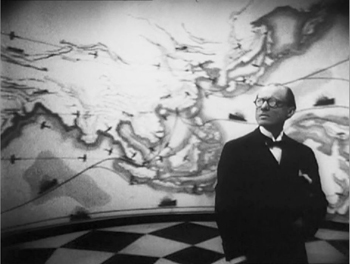
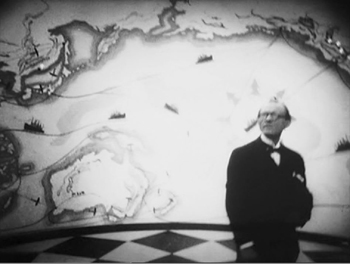
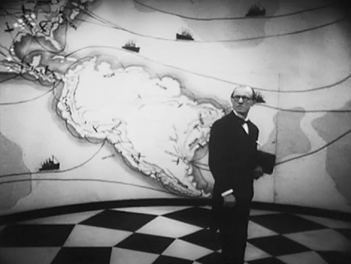
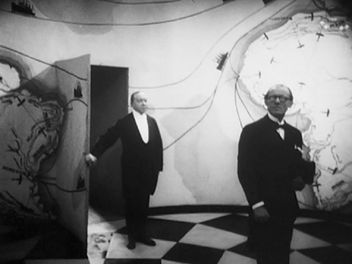
In portraying all the complex machinations going on, L’Herbier adopts a restless camera, frequently moving among and around characters rather than following them. The most striking example comes early on, when an underling comes to visit Gundermann and waits in an odd, unfurnished room decorated with a map of the world. As he looks around, the camera circles him until a servant unexpectedly appears through a door and escorts him in.


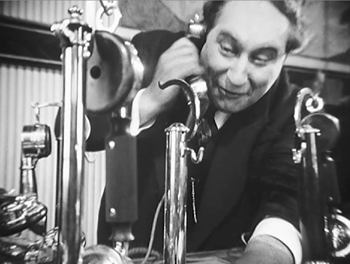
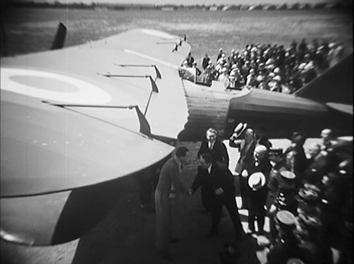
The odd distortions in these shot exemplify another cinematographic technique that was in increasing use during the late 1920s: conspicuous wide-angle lenses. On the left below, Saccard is nearly dwarfed by one of his telephones, while on the right the scene of the aviator’s departure makes the plane’s wings jut into the foreground and extend far into the background.


There are some subjective moments, carrying forward the tradition of French Impressionism. Yet for the most part the restless camera, the distorting lenses, the odd angles (see the top image of this section), and the unusual crosscutting are not subjective, which makes this an atypical Impressionist film. Instead they suggest the unnatural, disconcerting world of capitalism, of money and those who struggle over it. Perhaps by minimizing character psychology and striving to represent more abstract concepts, L’Herbier briefly carried Impressionism to a more political–and dramatic–level.

In 1980, L’Argent was released on DVD by Eureka! in the UK as a “Special 80th Anniversary 2 x Disc Edition.” The source material was a beautiful fine-grain positive struck from the original negative, with something close to L’Herbier’s original intended cut. It includes Jean Dréville’s Autour de “L’argent,” a 40-minute making-of (surely one of the first of its type), recorded during the original production. The DVD is still in print and is, as far as I know, the only release of this restored version.


5. Steamboat Bill Jr.

This was the first Keaton film I ever saw, and I immediately became a fan. (The director is credited as Charles Reisner, but we all know that Keaton was primarily responsible for the direction of his films of this period.) It’s not as good as The General (what is?), but it beats out The Cameraman, Keaton’s other feature of this year, by a nose.

Keaton plays the dandified son of a gruff steamboat owner. He returns home from school and gets put into working clothes by his father, whose deteriorating steamboat is competing for tourists with a larger, newer boat. Naturally young Bill is in love with the daughter of the other steamboat’s owner. The action mainly consists of Bill, Sr. trying to prevent Bill, Jr. from clandestinely meeting his girlfriend.

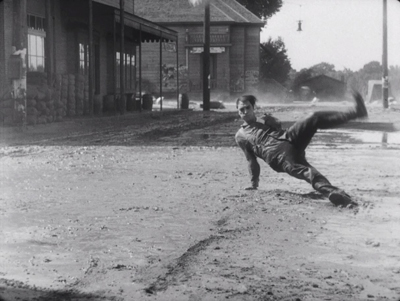
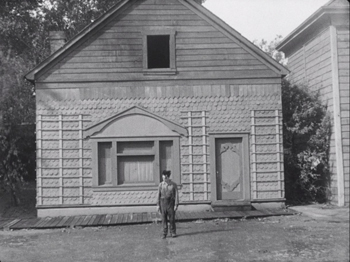
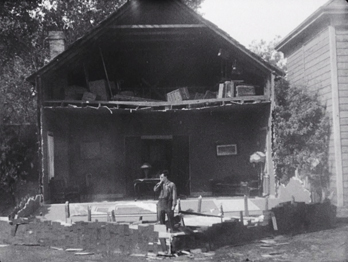
There’s lots of humor along the way to the climax, in which a huge storm hits the town. It’s a classic sequence of Keaton pulling variant gags on the situation of being in a high wind (above) and surrounded by collapsing buildings and flying objects. Perhaps Keaton’s most famous, and dangerous, gag comes when he pauses in front of a house’s façade, which tears loose and falls straight down on him–with a window sparing him from being crushed.


Reportedly the top of the frame missed his head by six inches, but we know Keaton was a little crazy in how far he would go for a laugh.

Steamboat Bill, Jr. was the last film Keaton made with his own production company. The Cameraman was made at MGM, and though it is very good, thereafter his career slowly declined after his move to that studio. This will, alas, be the last Keaton film represented in this series.


6. The Circus

Coincidentally, The Circus was the first Chaplin film I ever saw. I happened to take my first film course at the point where Chaplin had re-released The Circus, accompanied by a new musical score he composed himself. (Skip, if you can, the added opening, with Chaplin singing a maudlin song over an excerpt from later in the film.) The re-release was 1969, though I must have seen it in 1970 at Iowa City’s art-house, the Iowa. (Also coincidentally, my father managed the Iowa when he was at the university there on the GI bill in the years immediately after World War II. He was dating my mother at that point, and there she saw Day of Wrath. Hence when David and I became a couple in the mid-1970s, she understood what the book he was currently working on was about. But I digress.)

The print I saw at the Iowa was pristine.

Up to that point, The Circus had been unavailable to most viewers, though I suspect bootleg prints circulated among collectors. It’s among the least known of Chaplin’s features, and it’s still hard to see. There’s a Park Circus DVD available in England, consisting of the re-release version equally in mint condition; that’s the one I’ve taken these illustrations from. More recently the film has been released as a Blu-ray/DVD combination. There is also an Artificial Eye Blu-ray available, which gets high marks from DVD Beaver. I haven’t seen this and don’t know whether it’s the re-release version or the original.

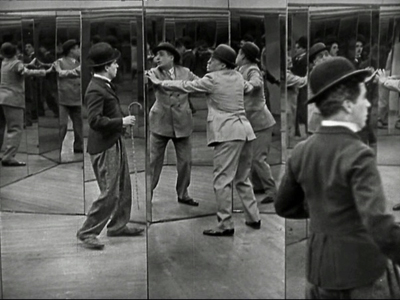
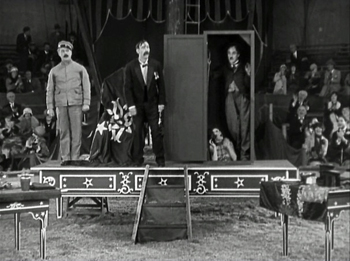
Chaplin plays his Little Tramp character, introduced wandering around the sideshow attractions near a circus. Mistaken for a pickpocket, he flees among the booths, occasioning a brilliantly staged triple scene in a hall of mirrors. When he first enters it, he is alone and struggles to figure out how to exit. A short time later, pursued by the pickpocket, the two stumble into the room, and a comic chase ensues (above). Finally, a cop is chasing Charlie, who tries to confuse him by luring him into the mirror maze. It’s a set of gags that builds, with the figures popping unexpectedly into the foreground when we had assumed that the real actors were in the depth of the shot. Each scene in the maze is handled in a single take from the same camera setup.

The flight from the cop leads the Tramp into a failing circus cursed with a group of highly unfunny clowns. Charlie inadvertently and unwittingly becomes a sensation for his antics, including his invasion of a magician’s act.

The cruel circus owner hires him, supposedly as a prop man, and the show becomes a huge success. Charlie falls for the maltreated daughter of the owner, who in turn becomes smitten by a handsome tightrope walker. Trying to impress the daughter, the Tramp goes on when the tightrope walker fails to show up one day. The result is a classic extended scene of Charlie on the high wire, executing a series of comic moments before the whole thing is topped off by a group of monkeys who escape and end up swarming over him as he struggles to keep his balance.

I hope now that The Circus is becoming more available, it can takes its place beside Chaplin’s other features.


7. The Docks of New York

I’ve already written about this, Josef von Sternberg’s final silent feature, in 2010 on the occasion of The Criterion Collection’s release of it alongside Underworld and The Last Command in an essential box-set. The six films von Sternberg made with Marlene Dietrich after she came to Hollywood generally get more attention than any of his silents. If I were allowed three of his films for a proverbial desert-island situation, I would take Underworld, The Docks of New York, and Shanghai Express.

Docks is a concentrated dose of the atmospheric cinematography the director is famous for, in this case employed to create the grungy settings of the film. In the opening, the oil and sweat on the stokers’ bodies (above) is palpable, and the fog, handing nets and lanterns, and smoke of the dockside sets establish the sleezy, hopeless milieu that drives the heroine to attempt suicide.

Evelyn Brent, who had a long but largely undistinguished career in Hollywood, is no doubt remembered most for her roles in these three von Sternberg silents. Her performance here gains our considerable sympathy for “the Girl” in a remarkably short time, and it has to–the film is only 75 minutes long and she spends her first onscreen appearances unconscious after her near-drowning. Her character and appearance here are so different from those of her earlier roll as “Feathers” McCoy in Underworld that I had watched the film three times before realizing that both parts were played by the same actress. George Bancroft, known mostly for supporting roles in westerns, came into his own as the protagonists of three von Sternberg films–including Thunderbolt but not The Last Command. Here he again plays the big lug with a well-hidden heart of gold.

Unfortunately the von Sternberg silents set from The Criterion Collection is out of print. Track it down somewhere or hope for a Blu-ray release.


8. Storm over Asia

After Mother and The End of St. Petersburg, Storm over Asia (the original title translates as “The Heir of Genghis Khan”) is the last of Vsevolod Pudovkin’s three great silent features. Unlike the first two, it is set in Mongolia. The Soviet industry officials were concerned to portray the Revolution in the various other countries that along with Russia made up the Soviet Union.

The story takes place during the Civil War years that followed the Revolution. A young Mongolian peasant tries to sell a valuable fox fur at a trading post, but the British dealer cheats him. The peasant strikes him and is forced to flee into the mountains, where he joins the Red partisans fighting the British imperialists. (This does not follow historical fact, since the British occupied parts of Siberia and Tibet, but not Mongolia. In reality, for a brief period in 1921, White Russian forces drove out the Chinese from Mongolia. In response, the Red Army moved in, supporting the Mongols in their quest for independence.)

The British shoot the protagonist but discover on him a document that seems to identify him as the heir of Genghis Khan. So they set him up as a puppet ruler in order to control the local population. Eventually he rebels and leads a storm-like assault that defeats his oppressors.

Storm over Asia uses many of the Soviet Montage devices that by 1928 were fairly conventional. For instance, there are many rapid, rhythmic alternations of shots. When the fur trader reacts angrily against the protagonist’s resistance to being cheated, brief shots of his angry call for troops to capture the young man alternate with shots of a drum being beaten. The final “storm” battle uses rapid montage as well. There is also the usual visual symbolism mocking the enemy, as exemplified by the empty officer’s uniform in the shot above.


Early Montage films tried to do away with a single central character in favor of a focus on the masses. October, for example, has no main hero. In Storm over Asia, though the story arc is definitely crafted around the Mongol’s growth into a rebellious leader of his people. We will see Eisenstein opting for a central identification figure in Old and New (1929).

My illustrations were taken from the old Image release, apparently no longer available. The Blackhawk print has been released by Flicker Alley.


Those are the eight films I put on my “top” list. I thought of stopping there, but the number ten is sacred for such lists, plus part of the point here is to throw a spotlight on lesser-known films.

I gathered a second group of films that might claim the remaining two slots. These were mostly films that were already hallowed classics when I was in graduate school: King Vidor’s The Crowd, Jean Epstein’s La chute de la maison Usher, René Clair’s The Italian Straw Hat, and Victor Seastrom’s The Wind. Beyond that there were the more recently rediscovered and much admired film, Paul Fejos’ Lonesome and the still little-known The House on Trubnoya, by Boris Barnet.

Oddly, the three American films on this list have some distinct similarities. The Crowd and Lonesome are surprisingly parallel. Lonesome follows two lonely people in New York finding each other and falling in love in one hectic day. The Crowd starts with a somewhat similar situation–both even involve dates at Coney Island–but follows the couple through several years of happy times and misfortune during their marriage. The Wind is less realistic, dealing with a sensitive young woman who travels to the west and, plagued by the incessant wind and a real or imagined rape, slips into madness. All three strive to reject the conventional Hollywood romance. Unfortunately all three, however admirable for most of their plots, lead to abrupt, implausible happy endings.

I saw The Italian Straw Hat in my graduate-school days and found it remarkably unfunny, given its reputation. Returning to it now, I still find the first two-thirds largely devoid of humor. (The dance scenes during the wedding party seem interminable, with no little vignettes or gags among the characters at all.) The last portion picks up, but on the whole it’s hardly the model French farce it is held to be. Certainly Clair made a leap forward in skill and sophistication in his early sound films. (Les deux timides, also 1928, is no doubt a better film.)

The Italian Straw Hat probably owes its classic standing in part to the fact that the Museum of Modern Art acquired and circulated it early on. Curator and critic Iris Barry adored it and lauded it in a 1940 essay (reproduced in the booklet included in the Flicker Alley release.) I wonder how many others of the films considered classics have become so because they were among the few silents available in the decades before the 1960s, when film studies and archival curatorship began to be more comprehensive. Knowing the range of international films we know now, would these films have become quite so highly respected above others? I found myself reluctant simply to fill out my list with old standards. The choice was difficult.

Wanting to avoid carrying on the older canon at the expense of more recently rediscovered films for at least one of my films on this list, I always try to include a little-known but worthy film here. This year there is only one (if you don’t count L’Argent), and that is Barnet’s The House on Trubnoya.

The final slot goes to Epstein’s The Fall of the House of Usher. I have always considered this a somewhat tedious film, but the restoration of the film’s full length and improved visual quality in the Epstein box-set released in 2014 by La Cinémathèque Française makes it far more interesting and effective.

So here is the completion of my list.


9. The House on Trubnoya

Boris Barnet was a member of Lev Kuleshov’s school in the early years after the revolution. He played a major role in Kuleshov’s The Extraordinary Adventures of Mr West in the Land of the Bolsheviks, and he began directing films on his own with the wonderful serial, Miss Mend. He made more films, and some others may show up in our coming lists. Right now, there’s The House on Trubnoya.

The House on Trubnoya is included in Flicker Alley’s major DVD set, “Landmarks of Early Soviet Film.” (I can’t believe that we didn’t feature this on our blog, but it includes eight major Soviet films of the silent era.) The copy on the back of the box describes Barnet’s film as “often described as one of the best Soviet silent comedies.” I’m not sure that’s a major distinction, though Kote Miqaberidze’s Georgian satire My Grandmother (1929; available on DVD and Fandor’s Amazon streaming site) is quite funny, as is Ivan Pyriev’s The State Functionary (aka The Civil Servant; not, as far as I know, available on home video).  But The House on Trubnoya is my favorite among the comedies I’ve seen.

It’s a satire on middle-class citizens’ maltreatment of their servants, though it doesn’t become Soviet-style preachy until well into the story. The film begins by setting up the titular house (on a well-known street in Moscow). We see it via its staircase and landings in the morning, rendered in a vertical view that looks startlingly like an iPhone image (above). It also recalls the seven levels in the staircase elevator shot climbing upward to 7th Heaven, though who knows whether Barnet had seen that by the time he planned his film. The residents of the various apartment emerge to use the communal stairway as a junkyard and work area, dumping trash, splitting firewood, beating curtains, and generally abusing the rules of the building, as one conscientious young Party member points out.

We are introduced to a barber, whose lazy wife makes him do all the chores. Then suddenly we’re with a professional driver with his own car. Just as suddenly we’re watching a peasant girl chase her runaway duck through a maze of traffic and nearly being hit by a tram. As the driver brakes hastily and jumps out to see if she’s hurt, there’s a freeze-frame.

A narrating title declares, “”But wait, we forgot to tell yo how the duck ended up in Moscow.” Reverse motion leads to another title, “A day earlier.”  A flashback to the heroine’s comic departure from a train station in the middle of nowhere shows the very uncle whom she is going to Moscow to visit arriving at the station just after she has left. Finding herself lost in Moscow with her duck, the heroine finds employment as a put-upon maid serving the barber and living in the house on Trubnoya. Her political awakening and the rehabilitation of the House on Trubnoya form the rest of the plot.

The House on Trubnoya is, in short, an imaginative, clever, and funny Soviet Montage film. Barnet’s other films are worth exploring as well. Check out The Girl with the Hatbox from 1927; it didn’t make last year’s top items, but it was on the long list.


10. La Chute de la maison Usher

Jean Epstein, who was probably the finest of the French Impressionist directors, has figured in these ten best lists before, in 1923 for CÅ“ur fidèle, in 1924 for the little-known L’affiche, and 1927 for his masterly La Glace Ã  trois faces.

I have long considered La Chute de la maison Usher interesting for its use of German Expressionist-inspired sets, but the fuzzy, incomplete prints that for decades were the only available versions made it difficult to enjoy. The restored version on the complete DVD set of Epstein’s works, which I discussed here, makes it far more interesting.

Taking its slim plot from Poe, the film follows a visit by an elderly man to the isolated castle of his old friend, Roderick Usher. Usher is painting a portrait of his beloved wife, but it is soon made clear that each time he presses the brush to the canvas, a little of her life is drained away–though the local doctor is mystified by her decline.

The film retains some of the traits of Impressionism, as when Madeline’s reaction to the effects of her husband’s painting are rendered in a superimposition of negative and positive images of her face.

The film has a minimal plot, but its focus is largely on experimenting in creating an eerie atmosphere. Shots of books falling in slow motion from their shelves, of curtains blowing in a cold wind that seems perpetually to invade the house, of frogs copulating in a nearby pond, and of the Expressionist-derived decors contribute less to a linear plot than to a mood of undefined menace.

The castle’s exterior is represented by obvious cardboard models, which tends to undermine the effect created by the interiors. The cheapness of these models is particularly noticeable in the climactic scene of the destruction of the house. This is unfortunate, but one must give Epstein credit for having done so much with so little.

This will be Epstein’s final appearance in our “Ten Best” lists, but I would like to call attention to his other 1928 film, Finis Terrae, the first of what the Epstein box-set collects as his “Poémes Bretons.” These are less Impressionistic, though Finis Terrae has a few impressive subjective shots. They are more realistic and poetic, largely involving the sea.


As I wrote at the beginning, 1928 was part of the period when the American industry was on the cusp of making sound standard in its films. Other national cinemas followed at various paces. One film that did not quite make my top-ten list demonstrates what must have worried film theorists and critics–and no doubt some filmmakers.

The restored version of Lonesome includes some dialogue sequences in a film otherwise accompanied by recorded music. There is an enormous contrast between the silent and sound footage. The story is largely told visually, but the dialogue scenes, clearly done in a sound-proof studio, are delivered in a stilted fashion by the young actors who are otherwise so casual and lively. The prospect of whole films being made in that fashion clearly disturbed lovers of films like La Passion de Jeanne d’Arc and Steamboat Bill, Jr. Watching Lonesome gives a dramatic insight into this slice of cinema history–a period that fortunately lasted only a few years as the technology improved and as filmmakers increasingly managed to make sound films that were just as imaginative, artistic, and engrossing as their silent predecessors.

Spione

Copyright © Cinenus | Powered by Blogger

Design by Anders Noren | Blogger Theme by NewBloggerThemes.com