The film industry in one place - Articles, Reviews, trailers and hype!

Tuesday, 29 September 2020

Emma Roberts & Luke Bracey in Trailer for Holiday RomCom 'Holidate'

Holidate Trailer

"Maybe this holiday thing will turn into something." Netflix has debuted a trailer for a romantic comedy titled Holidate, yet another holiday love story to enjoy this holiday season. Sloane and Jackson hate being single on holidays where they face constant judgment from their meddling families. So, when these two meet, they pledge to be each other's "holidate" for every festive occasion in the year ahead. Emma Roberts and Luke Bracey star as Sloane and Jackson, joined by Andrew Bachelor, Jessica Capshaw, Manish Dayal, Alex Moffat, Jake Manley, Cynthy Wu, Frances Fisher, and Kristin Chenoweth. Is anyone still looking for a perfect holiday plus one? Netflix is also running a fun a "virtual speed dating event" with Holidate's Luke Bracey and Andrew Bachelor, along with some fan favorites from Netflix. Oh boy. I'm sure it'll surprise everyone that Sloane and Jackson end up together, despite their forced distance. How original.

Here's the first official trailer (+ poster) for John Whitesell's Holidate, from Netflix's YouTube:

Holidate Poster

Sloane (Emma Roberts) and Jackson (Luke Bracey) hate the holidays. They constantly find themselves single, sitting at the kids table, or stuck with awkward dates. But when these two strangers meet during one particularly bad Christmas, they make a pact to be each other’s “holidate” for every festive occasion throughout the next year. With a mutual disdain for the holidays, and assuring themselves that they have no romantic interest in the other, they become each other's perfect plus-one which leads to some hilarious and provocative hijinks. However, as a year of absurd celebrations come to an end, Sloane and Jackson find that sharing everything they hate may just prove to be something they unexpectedly love. Holidate is directed by American producer / filmmaker John Whitesell, director of the films Calendar Girl, See Spot Run, Malibu's Most Wanted, Big Momma's House 2, Deck the Halls, Big Mommas: Like Father Like Son, and Thunderstruck previously, as well as lots of TV directing work, too. The screenplay is written by Tiffany Paulsen. Netflix will debut Whitesell's Holidate streaming exclusively starting on October 28th this fall.

Official Trailer for Blumhouse's 'The Craft: Legacy' - The Coven is Back

The Craft: Legacy Trailer

"If we can do that… what else can we do?" Sony Pictures has released an official trailer for the horror sequel / remake The Craft: Legacy, an update and/or continuation of the original (cult classic) witches in high school 1996 horror film The Craft. The story is pretty much the same - a group of four high school women form a coven of witches. Written and directed by Zoe Lister-Jones (of Band Aid previously), the new film stars Cailee Spaeny, Gideon Adlon, Lovie Simone, Zoey Luna, Nicholas Galitzine, with Michelle Monaghan and David Duchovny. Jason Blum's Blumhouse along with Red Wagon Ent. produced the film for Columbia Pictures. They're also dropping this film available at home (for the Premium VOD price of $19.99) starting at the end of October, just in time for Halloween. The coven is back - don't mess with them.

Here's the first official trailer (+ poster) for Zoe Lister-Jones' The Craft: Legacy, direct from YouTube:

The Craft: Legacy Poster

This Halloween, let the ritual begin… In Blumhouse’s continuation of the cult hit The Craft, an eclectic foursome of aspiring teenage witches get more than they bargained for as they lean into their newfound powers. An update remake/continuation of the 1996 film. The Craft: Legacy is both written and directed by American actress / filmmaker Zoe Lister-Jones, making her second feature film after directing Band Aid previously. Produced by Jason Blum, Lucy Fisher, and Douglas Wick. Based on the original film written by Peter Filardi and Andrew Fleming. Sony Pictures will debut Lister-Jones' The Craft: Legacy direct-to-PVOD services starting at the Witching Hour on October 28th this horror season. Who's excited for this already?

When ‘The Haunting of Hill House’ Performed a Cinematic Magic Trick

This essay is part of our series Episodes, a bi-weekly column in which senior contributor Valerie Ettenhofer digs into the singular chapters of television that make the medium great. This entry looks at the best episode of  Mike Flanagan’s The Haunting of Hill House: “Two Storms.”


When you think of the best writing on TV, what comes to mind? For most people, the answer likely involves stellar characterization, clever dialogue, and well-built plots. All are key to making a television series great, but it’s a mistake to think that writing only equals words. Great writing also involves the planning of the action, motion, and physical presence of a scene. Case in point: The Haunting of Hill House’s sweeping technical marvel “Two Storms.”

With several smart and humane genre films, including Hush and Oculus, already under his belt, writer-director Mike Flanagan was an emerging favorite among horror fans even before he cut his teeth at showrunning with Netflix’s The Haunting of Hill House. The very loose adaptation of Shirley Jackson’s most famous novel is a ten-part series that immediately found a fanbase thanks to its heartfelt storytelling, strong scare factor, and visuals that reward close watchers with glimpses of hidden easter eggs. Whereas Jackson’s novel follows a group of strangers staying at the possibly-haunted Hill House, the show instead focuses on the Crain family, former residents of the mansion, as they reunite in the wake of tragedy after years spent apart.

After four episodes of slow-simmering terror and scattered main characters, nothing could’ve prepared viewers for the one-two punch of the show’s fifth and sixth hours. “The Bent-Neck Lady” is an emotional and revealing episode that instills one with an unshakeable sense of existential anxiety by revealing that the specter that has haunted Nell (Victoria Pedretti) since childhood is actually an image of herself in the moment of her suicide. It’s a gruesome, queasy catch-22 that leaves viewers reeling, only to segue directly into the grief-riddled ensemble piece that is “Two Storms.”

The episode begins with the two surviving Crain sisters, Theo (Kate Siegel) and Shirley (Elizabeth Reaser), standing over Nell’s coffin. She doesn’t look like she’s sleeping, Theo points out, even though that’s what people always say. It’s the first comment of many in the hour that aims to crack open the cultural illusion that death and grief should look a certain way. Theo and Shirley are in an empty funeral parlor and a strike of lightning flashes in the background as they speak. The camera follows the sisters around the room as they talk about their sister: ”Nelly was always trying to get us together in one place,” Shirley says. Then the Crain men show up. There’s Luke (Oliver Jackson-Cohen), who’s newly sober and shaken up by his own recent haunting, and Stephen (Michiel Huisman), the skeptical writer whose book about the family’s traumatic childhood led to his estrangement.

It’s only when the camera captures Luke solidly in the center of the frame, lingering on his child-like face as he first takes in the sight of Nell’s coffin, that the central creative mechanism of “Two Storms” begins to become apparent. The camera hasn’t cut away. At all. In fact, for the first fifty minutes of the fifty-six-minute episode, there is only one visible cut, giving the episode the appearance of being just two or three long takes. The result is a claustrophobic, theater-like experience in which the camera swirls and loops around to capture motion, or holds steady on one character or another for a disorienting period of time. The Crain family’s grief and anger are mirrored by the progressing storm, but also by the pacing and movement of the cameras that circle and spotlight every emotional beat.

After Stephen sees Nell’s body — reacting with weird, breathless boyishness and then obvious misery — the family decides to sit out the storm in an adjoining room. Although thunder crashes offscreen, we get the sense that they’re not actually trapped, but rather staging an uneasy, unspoken vigil for Nell. Their youngest sister must know it, too, as once dad Hugh (Timothy Hutton) shows up, reuniting the entire living family for the first time in decades, Nell’s ghost begins to appear on-screen. Unlike every other episode of the series, which includes well-hidden extras doing a sort of ghostly Where’s Waldo in the background, “Two Storms” puts its undead visitors front and center.

Hugh excuses himself to the restroom, but when he turns the corner, he’s back at Hill House. It’s 1992 again, on the night of a huge, window-rattling storm. He watches a massive chandelier crash to the ground, then a younger version of himself (played by Henry Thomas) comes down the stairs in his pajamas. A gaggle of kids wanders down soon after, awakened by the commotion. Then there’s matriarch Olivia (Carla Gugino), the only character whose modern-day counterpart we never meet. In her flowing robes, she already has the air of an elegant ghost. Olivia is afraid of storms, we learn, but she reassures a young Luke (Julian Hilliard) nonetheless. “Do you know what storms do?” She says lovingly. “They pass.”

Determined to wait out the storm together, the family decides to huddle on the floor and play a board game, but as the camera tracks dreamy full circles around them from a safe distance, something goes unnervingly wrong. Theo (Mckenna Grace) is standing exactly where she had been moments ago, hand outreached to hold her sister’s, but Nell (Violet McGraw) is nowhere to be found. Panicked, the family fans out to find her. Then, twenty-three minutes into the episode, the first visible cut appears, taking audiences back to the present day. It’s a shocking and strange relief, like waking up from a dream or letting go of a breath that you didn’t know you’d been holding.

At this point, it’s impossible not to wonder how Flanagan pulled off “Two Storms.” Plenty of movies, from Alfred Hitchcock’s Rope to Sam Mendes’ 1917 have accomplished long takes, often by using invisible cuts and image matches to create an illusion of single shots. Yet there’s something exhilarating about seeing this project unfold across two sets and two time periods, with a large, multi-generation ensemble cast, all while delivering genuine scares and emotional moments. According to Flanagan, the episode script included eighteen-page-long scenes without any cuts and had much of the camera choreography written in from the start. The series’ Hill House set was built with “Two Storms” in mind, and the funeral parlor set was built nearby to make maneuvering between the two possible. The crew spent days planning camera movements, lighting cues, blocking, and plenty of offscreen quick-change set adjustments in order to pull off the long takes that make the episode come alive.

One would imagine that the mid-episode cut would break the tension, but by following it up with yet another long, unblinking stretch, “Two Storms” only grows more terrifying and heart-wrenching. In the present day, the Crain family’s attempts to memorialize Nell are constantly interrupted by their unresolved issues with one another. Stephen is a persistent voice of denial, countering his father’s claims that Nell was haunted with furious skepticism. Theo, growing drunker by the minute, is even angrier, while the rest of the family acts out each remaining stage of grief in turn. Shirley and her husband Kevin (Anthony Ruivivar) obsess over small details like refreshments and flower arrangements, doing a sort of mental bargaining technique in which they imagine that if they focus on the socially acceptable rituals of death, everything will be okay. Luke is suffering from a quiet depression, regressing into the teary-eyed child he was before he became an addict. Finally, Hugh, portrayed with steady melancholy by Hutton in a wonderfully lived-in performance, is the voice of somber acceptance. He’s seen this all happen before. He knows what Hill House does to people.

The second that we begin to ease into a sense of trust, recognizing the familiarity of a dramatic family gathering, Flanagan shocks us with a dose of horror once more. Shirley storms off towards Nell’s coffin, only to realize that the corpse suddenly has buttons placed over its eyes. Just then, the power goes out, and again we’re back at Hill House in 1992.

The third act of “Two Storms” is one of the most effective horror sequences in recent memory. The camera turns around each corner as the younger version of Hugh looks for Nell, and then, when Olivia also goes missing, for her as well. Every second of this scene has a nerve-jangling sense of suspense as if something might jump out at any minute. A jump scare would almost be a simple relief at this point. Instead, strange images seep into the corners of our vision, from a statue that subtly turns to face those who walk by to the dark edge of Olivia’s gown as she wanders, apparently in a trance, through the labyrinthine house. “Honey, I’m having the strangest dream,” she says in a daze when Hugh finally catches up with her. At that moment, the kids all scream in unison, spooked. Soon after, Nell reappears in the place where she’d been standing a half-hour before, shaking and distressed.

By this point, our nerves are so frazzled by the sustained tension — stretched rubber-band tight by the still-moving cameras and the increasingly frenzied pacing — that it’s hard to keep track of everything that’s going on. In the present day, Shirley reveals that the storm raging outside is centered only on the building that they’re in. Stephen and Hugh begin arguing again, and this time Nell’s coffin is framed squarely between them in the frame. The episode has become a visceral viewing experience by this point. Teeth are set on edge. Hearts are pounding. “My problem is that the wrong parent died,” Stephen yells at Hugh, and as if spurred on by the venom in his words, Nell’s coffin spontaneously falls over. Tension. Release. The camera cuts to the family, dumbstruck by Nell’s statement from beyond the grave. The camera is no longer a tool to weaponize our fears against us; for these last few moments, its presence becomes so normal that we stop noticing it. The lights flicker back on.

“Two Storms” is a cinematic spectacle, an ambitious vision fully realized. But it forces us into the Crains’ state of mind for a reason, one that its understated, heartbreaking ending puts in perspective. We hear audio of child Nell telling the others that during her disappearance, she didn’t actually go anywhere. She was sitting in the same spot, calling for help, but no one could hear her. Then we see the adult ghost of Nell, her neck broken and eyes filled with anguish, standing by her coffin as her childhood self speaks in voiceover. “I was right here,” she insists. Hers is a grief that her family — and we as viewers — have trouble look at directly or for too long, for fear of truly seeing the pitch-black depths of it.

Must Watch Nature Documentary Film 'My Octopus Teacher' Trailer

My Octopus Teacher Trailer

"I realized I was changing…" Netflix has released the incredible nature documentary titled My Octopus Teacher, and it's already available to watch streaming on the service right now. This groundbreaking, awe-inspiring film is about a South African filmmaker (named Craig Foster) who forges an unusual friendship with an octopus living in a South African kelp forest, learning as she shares the mysteries of her world. He befriends this octopus from the Atlantic, and visits her every single day for over a year, free-diving without a wet suit or SCUBA gear to meet her. After capturing this footage, he spent years crafting a film and building a narrative to tell her story and how it impacted his life and his connection with other humans (as well as all animals on this planet). Thanks to Kottke for the tip, I just watched this and it is phenomenal - one of the best docs of the year. Absolutely amazing to see all this footage of him befriending this intelligent creature.

Official trailer for Pippa Ehrlich & James Reed's doc My Octopus Teacher, found on Netflix's YouTube:

My Octopus Teacher

My Octopus Teacher Poster

In 2010, filmmaker Craig Foster began freediving in a cold underwater kelp forest in the Atlantic Ocean at the tip of South Africa. He started to film his experiences and, in time, a curious young octopus captured his attention. By visiting her den and tracking her movements every day for months, he won the animal’s trust. In the film, Foster describes the impact on his life of his relationship with the octopus. My Octopus Teacher is co-directed by doc filmmakers Pippa Ehrlich (making her directorial debut) & James Reed (director of the docs Jago: A Life Underwater, Rise of the Warrior Apes), making their first film together. This premiered at the Docs Against Gravity Film Festival this year. Netflix has already released My Octopus Teacher streaming worldwide starting on September 7th. It's already available to watch now. Interested?

Discovering a Parallel Universe in Indie Sci-Fi Film 'Expulsion' Trailer

Expulsion Trailer

"Don't let that door close behind you." Colossal Content has debuted an official trailer for an indie science fiction / parallel universe film titled Expulsion, marking the feature directorial debut of filmmakers Aaron Jackson & Sean C. Stephens. Scott & Vincent are top recruits at the prestigious Cicero Market Technologies Corp. where they are tasked with the development of cutting edge technologies. They push the boundaries of particle collision science to undiscovered levels stumbling upon a parallel universe with an alternate version of Scott. Of course they discover that others seek their tech to advance their own agendas. Agendas that they intend to fulfill at any cost. Colton Tapp gives a multidimensional depiction by taking on two roles as both the antagonist and protagonist. As his character crosses over to another universe he inadvertently invites a different version of himself home creating a ripple that threatens his very existence. Also starring Lar Park Lincoln. This looks like a Primer wannabe, but nowhere near as smart or as sleek as that indie sci-fi film.

Here's the official trailer (+ poster) for Aaron Jackson & Sean C. Stephens' Expulsion, from YouTube:

Expulsion Poster

Scott and Vincent are top recruits at the prestigious Cicero Market Technologies Corporation where they are tasked with the development and implementation of cutting edge technologies. The sole purpose of their work is to bring about medical, environmental and physics advancements. However, beaten by their own curiosity, the pair begin to sneak their work home. They soon push the boundaries of particle collision science to undiscovered levels stumbling upon a parallel universe complete with an alternate version of Scott. As their days and nights then unfold they begin to discover that others seek their tech to advance their own agendas. Agendas that they intend to fulfill at any cost. Expulsion is co-directed and also co-written by filmmakers Aaron Jackson & Sean C. Stephens, both directing their first film after various production jobs previously. This hasn't premiered at any festivals of elsewhere, as far as we know. Colossal Content will release Expulsion direct-to-VOD starting October 20th coming up this fall. Who's intrigued?

Vancouver: Three gems from Iran and India

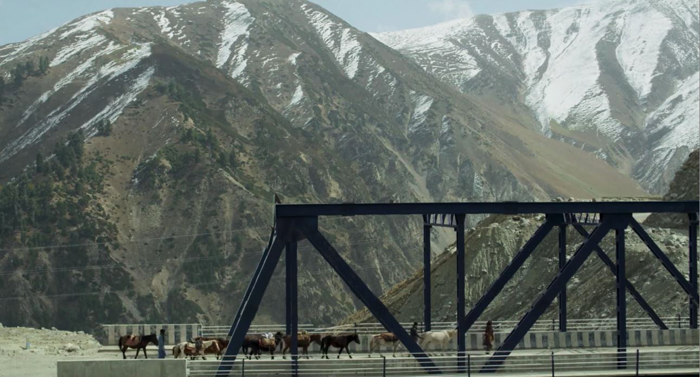
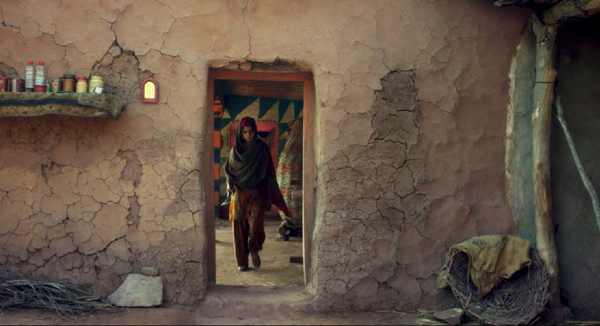
The Shepherdess and the Seven Songs (2020).

Kristin here:

Among the always bounteous offerings of the Vancouver International Film Festival, my favorite section is “Panorama,” since I enjoy seeing new films from countries all around the globe. Often some of these are from Iran, and the two Iranian films featured this year did not disappoint. The sole Indian film turned out to be an engaging, imaginative tale from an area of the world seldom represented on the screen.


There Is No Evil (2020)

Vancouver is in part a festival of festivals, drawing upon international films already premiered in Berlin, Cannes, Rotterdam, and other earlier festivals. Of necessity, this year’s items come from the pre-Coronavirus festivals, with films from Berlin especially prominent in the schedule. Mohammad Rasoulof’s There Is No Evil, Golden Bear winner as best film, continued the director’s regular contributions to past Vancouver festivals. (For entries on other Rasoulof films we have seen at Vancouver, see here and here.) Christian Petzold’s Undine, discussed by David in the previous entry, won the Silver Bear as best actress for Paula Beer.

There Is No Evil is a deeply ironic title, since its four self-contained episodes deal with one of Iran’s notorious evils, its record for executing its citizens. As Peter DeBruge pointed out in his Variety review, “According to Amnesty Int’l statistics, Iran was responsible for more than half the world’s recorded executions in 2017. The number has since dropped, but the country continues to kill its citizens at alarming rates.”

Often the process of carrying through executions is assigned to hired civilians or is forced to be performed by soldiers. Rasoulof explores various ways in which such executions affect the willing or unwilling people who carry out the orders, as well as the effects on people they know and love. I don’t want to spoil the slow development of these consequences for the characters by describing the plots of each of the four episodes in too much detail. Suffice it to say that the revelation of those consequences are worked up to very slowly and occur dramatically.

The four episodes are shot in quite different styles. Those styles are to a considerable extent determined by the fact that the episodes move to increasingly remote locales.

The first begins in a bustling city and is shot in a bright, ordinary style befitting the depiction of a bourgeois lifestyle, with appointments to pick up spouses and children, shopping trips, and alternately bickering and affectionate conversation.

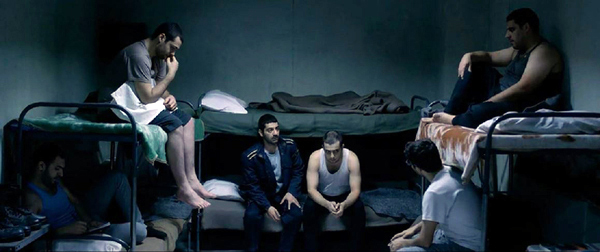
The second episode abruptly switches to a gloomy, desaturated color scheme of grays and muted browns and greens suited to a film noir (above). This segment begins with a military man assigned to perform an execution panicking because he cannot face killing anyone. During this episode, the tone and even the genre switch abruptly twice, from film noir to thriller to … something else.

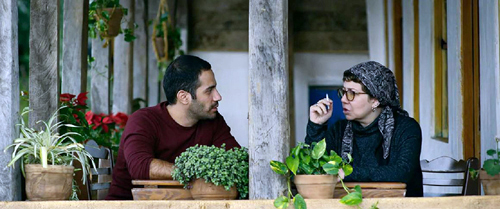
The third story has a soldier on leave visiting a family of old friends, including the daughter whom he loves and hopes to become engaged to. Here the film is done in a lyrical, bright style, emphasizing scenes in the lush woods and in the happy rural home of a couple who foster a group opposing the government. Here the soldier talks with the mother of the family.

The fourth episode centers on a couple who have retired to a bee-keeping farm in a remote, mountainous area. They must contend with the visit of a niece, but neither is willing to answer her questions about the past.

I think the style in this part pays homage to Abbas Kiarostami, with numerous shots of the couple’s pickup on winding country roads (see bottom). There’s a specific echo of The Wind Will Carry Us in the motif of the girl’s repeated attempts to find cell-phone coverage to call her parents abroad.

Given the relatively large cast and considerable number of interior and exterior locales, one might wonder how Rasoulof, under an order to stop filmmaking, could make a two-and-a-half hour film critical of government policy. DeBruge’s review, linked above, also comments: “By subdividing the project like this, Rasoulof was able to direct the segments without being shut down by authorities — who are more carefully focused on features — and, in the process, he also builds a stronger argument.” In an earlier Vancouver report, we noted that Rakhshan Bani-Etemad’s Tales (2014) used a network-narrative structure because she could only get permission to make a series of shorts–which she then wove together into a feature.

As DeBruge writes, the reliance on episodic structure does not handicap Rasoulof. The slow accumulation of indifference, regret, and guilt demonstrates that executions have unnoticed, unforeseen, and undeserved effects. The stylistic shifts emphasize the differences in those effects and maintain interest across a long film.

The effectiveness of Rasoulof’s film has not gone unnoticed, however, and a Golden Bear is clearly not enough to protect him. On March 4, he was summoned to begin serving his long-delayed prison term, despite the widespread incidence of COVID-19 in Iranian prisons. (On March 1, three days before the summons, Indiewire published a history of government strictures on Rasoulof.) Many official protests have been launched, and one can only hope that once again the result will be yet another suspension of the enforcement of the sentences against him.


Yalda, a Night for Forgiveness (2019)

Yalda is the second feature by Iranian director Massoud Bakhshi, whose first, A Respectable Family, we recommended as “an unexpected gem” when it played in Vancouver in 2012. Yalda is another film that comes to Vancouver via this year’s Berlin International Film Festival, where it was nominated for a Crystal Bear. It also played at the Sundance Film Festival, where it won the Grand Jury prize in the “World Cinema – Dramatic” category.

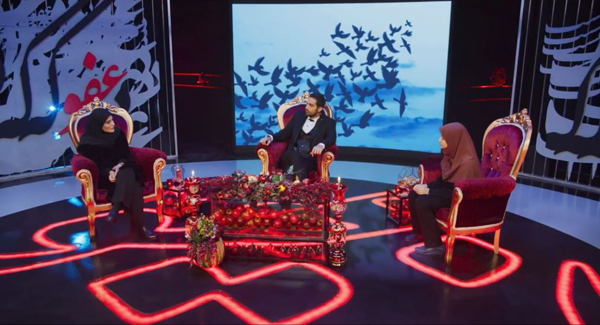
The film centers around one episode of a television series, “Joy of Forgiveness,” based on the premise that each week someone convicted of a crime seeks to be forgiven by the victim or a relative of the victim. Although not an actual law, such forgiveness is encouraged in Iran under Islamic law. If forgiveness can be obtained, the criminal is typically absolved of the crime. There are now charities, celebrities (including film director Asghar Farhadi), and other forces working informally to foster forgiveness and free guilty people, though this may include a payment of “blood money” given to the person doing the forgiving. (A real TV show based on this premise, “Honey Moon,” was the inspiration for Yalda.)

In this case, a young, shy working-class woman, Maryam, who had been married to a wealthy older man, has been convicted of killing her husband. She insists, however, that it was an accident. As the film begins, Maryam’s mother brings her to the television station. The young woman is terrified and declares she does not want to participate. But since this would mean a death sentence being carried out, her mother and the production team of the show ignore her protestations and hurry her through the preparations.

Representing the victim is Mona, his daughter, who, as the title of the TV series suggests, is expected to provide the standard happy ending to the show by forgiving Maryam. Mona seems to have  reasons to do so, since she would receive the blood money proffered by “Joy of Forgiving” and is planning to emigrate from Iran in the near future.

So far we seem to have a situation familiar from the films of Asghar Farhadi, with two or more people at odds who are gradually revealed to be flawed and to some degree at fault. The situation then typically ends in reluctant understanding between or among the opponents.

As the host interviews the two women, however, he shows a distinct bias toward Mona’s viewpoint. Rather than pleading her case humbly, as the television crew expects, Maryam becomes desperate and accusatory. Her exchanges with Mona grow more heated.

The producers begin to panic. As one points out, this show is occurring on Yalda, a festival held on the day of the winter solstice. The longest night of the year is believed to be unlucky, and traditionally Iranian families gather to eat, tell stories, read poetry, and generally cheer each other up through the night. Seeing a sad ending to the program would badly disappoint the audience.

Telling his story in what is essentially continuous time and at a brisk pace, Bakhshi starts out by sticking closely to Maryam, building up considerable sympathy for her as everyone ignores her pleas and bosses her around. Once the program begins, the increasing hostility of Mona generates a suspense that is well maintained up to the final twists of the ending–twists showing that Bakhshi is not going for a Farhadi-style resolution.

The script is tightly constructed and engrossing, so much so that one could imagine a Hollywood remake–if a plausible legal situation could be devised as the premise.


The Shepherdess and the Seven Songs (2020)

The Shepherdess and the Seven Songs (director Pushpendra Singh) also was shown at the Berlin festival, in its Encounters section. It also won best director in the “Young Cinema Competition (World)” at the online competition for this year’s cancelled Hong Kong International Film Festival.

The film begins with a young man, Tanvir, struggling to lift and shoulder a heavy stone, a traditional test for a prospective husband among a tribe to which whom the beautiful shepherdess of the title, Laila, belongs. Soon a title is superimposed: “Song of Marriage,” the first of the seven songs. These songs are sung over the action–unsubtitled, unfortunately–and give a sense of the story taking place in some old folk tale. (Indeed, a title in the credits declares that the film is “Based on a Rajasthani folk-tale by Vijaydan Detha,” a well-known twentieth-century author of numerous such short stories.)

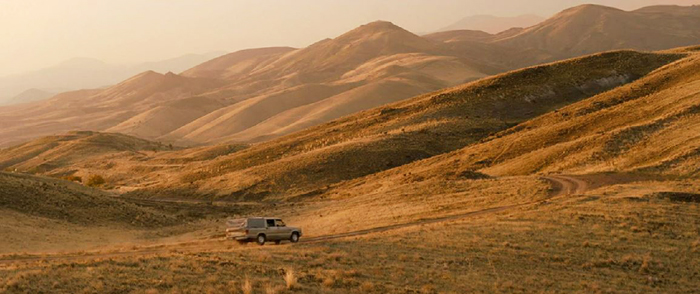
The fact that the tribes cook over open fires and follow what seem to be old traditions reinforces this impression, until a night scene where some of the men wield LED flashlights. Another title, “Song of Migration,” leads to a the journey of the nomadic tribe into which Laila has married herding their large flock toward the village that is their home base. They pass along modern highways, moving aside for traffic to pass, through landscapes that provide beautiful shots (see the top of this entry). This stretch of the film is lyrical and captivating, thoroughly drawing the spectator into the film.

Abruptly another modern touch, a radio carried by one of the men, thrusts the action into the troubled politics of the present. A newscaster declares, “In the Kashmir Valley protests against Article 5A have escalated.” Two protestors, he says, have been killed. The reference is to Pakistan and India’s dispute over control of Kashmir, and the Kashmiri struggle for independence from both. Laila, it later is revealed, is Kashmiri, while Tanvir’s tribe lives in an area controlled by India.

Laila’s beauty soon attracts the attention of the local Station-master and his subordinate, Mushtaq. They hint that as a Kashmiri she might possibly be a terrorist. This accusation comes to nothing, and Mushtaq’s clumsy attempts to seduce Laila lead to a switch in tone. A series of episodes, each a separate “song,” follow Laila promising trysts with him and then bringing her husband along on a pretext. Mushtaq’s continued gullibility in trusting that each new assignation is made in earnest lends a farcical comic touch to this lengthy passage of the film. At the same time, however, Laila is testing whether her husband, strong enough to lift the stone and win her as his bride, has the moral power to defend her rather than currying favor with Mushtaq by turning a blind eye to his designs on Laila.

I felt that the last portion of the film ran out of the energy it had sustained so well, since Laila is strong enough to turn her back on two unacceptable men but has no apparent sense of where to turn once she has done so. Still, overall The Shepherdess is beautifully filmed, as the frames at the top of this section and of the entry demonstrate. It also tells a thoroughly absorbing story.


So far David and I have reported on six films from this year’s Vancouver festival. Already it has become clear that our accumulated experiences from past years have allowed us to trace the development of promising young filmmakers into great ones and to discover promising new ones whom we hope to encounter at future festivals.


Thanks to Alan Franey, Jane Harrison, and their colleagues for their help during the festival.

There Is No Evil (2020).

Second Trailer for 'The Monster Squad' Fan Doc 'Wolfman's Got Nards'

Wolfman's Got Nards Trailer

"Scaring the hell out of kids seemed like a great idea, and then the laughs played against that." Gravitas has released a new official trailer for the documentary Wolfman's Got Nards, a film about the huge cult success of the 1987 monster movie The Monster Squad. The title is an obvious reference to one of the film's iconic lines, where Horace yells out "Wolfman's got nards!" When the film was first released, it wasn't a big box office hit and didn't get great reviews, but over the last 30 years it has become a hugely popular beloved genre classic. This "heartfelt" doc film explores the power of cult film and the impact this amusing cult classic has had on fans, cast and crew, and the industry. For those who don't know, The Monster Squad was directed by Fred Dekker and co-written by Shane Black, two key names in the industry who were relatively unknown at the time. We ran a trailer for this when it first premiered at festivals two years ago. It will finally be available to watch on VOD in October, for those who've been looking forward to catching this.

Here's second trailer (+ poster) for Andre Gower's doc Wolfman's Got Nards, direct from YouTube:

Wolfman's Got Nards Poster

When it was released in 1987, The Monster Squad was deemed a failure by critics and was, according to the box office, a film no one cared about. But over the last three decades, word of mouth has turned this sleeping hit into a cultural phenomenon. Wolfman's Got Nards explores the relationship a dedicated audience (including celebrities and filmmakers) has with The Monster Squad. This documentary takes an in-depth look into the film’s conception, response, cult status, and revival. Through interviews with the cast, crew, screenwriters, directors, academics and original reviewers as well as through never-before-seen footage, it turns the lens on an audience of self-proclaimed misfits who have kept The Monster Squad alive for more than thirty years. Wolfman's Got Nards is directed by American actor-filmmaker Andre Gower, making his directorial debut. This originally premiered at the Chattanooga Film Festival in 2018, and won the Audience Award at the Overlook Film Festival also that year. Wolfman's Got Nards will finally be released direct-to-VOD starting on October 27th this fall. For more info, visit the film's official website.

New Uncensored Trailer for Long Lost Crazy 80s Movie 'Action U.S.A.'

Action U.S.A. Trailer

"When in Texas, I dress like a Texan!" Get ready to blast back into the 80s! Alamo Drafthouse has revealed a new trailer for a long lost 80s action movie titled Action U.S.A., made by filmmaker John Stewart (not the comedian). The film has been found, restored, and just premiered at this year's Fantastic Fest (online) run by Alamo Drafthouse. And even better - the film is now available to watch online via their "Alamo On Demand" system for the next two weeks (but only in the US). What's the flimsy 80s action movie plot? After her boyfriend is murdered by the gangsters whose diamonds he stole, a girl is protected by two FBI agents who plan to keep her from sharing the same fate. This stars Gregory Scott Cummins, Barri Murphy, Rod Shaft, William Smith, Cameron Mitchell, Ross Hagen. Best of all it features an endless amount of stunts: "the most explosive, death-defying, bullet-riddled, grenade-launching, flame-broiled, anti-human megattack in independent film history." And yes, all of the stunts are real, ’cause it was made by a stuntman.

Here's the brand new official trailer (+ posters) for John Stewart's Action U.S.A., direct from YouTube:

Action U.S.A. Poster

Action U.S.A. Poster

Turns out a Texas stuntman-turned-director unleashed the most explosive, death-defying, bullet-riddled, grenade-launching, flame-broiled, anti-human megattack in independent film history — shot right here in Texas – back in 1989, and no one knew… UNTIL NOW. When you think of the broad panorama of VHS-era action, your mind detonates with fast cars, helicopter chases, profanity, nudity, cocaine-ity, fisticuffs, stolen diamonds, FBI agents, defenestration, shotgun castration, men on fire and Casio soundtracks. But what if we told you there’s one single movie that impossibly squeezes all of the above into 89 minutes, not to mention sunroof gunfights, a car jumping over a school bus packed with screaming children, honkytonk brawlin’, bathroom kissin’, plus exploding cars, houses AND also recreational vehicles? Action U.S.A. is directed by Texas filmmaker John Stewart, a stuntman throughout the 80s and 90s who also made a few other films including Click: The Calendar Girl Killer, Cartel, and Hidden Obsession previously. The script is by David Reskin, from a story by John Stewart and David Reskin. "Fresh off the blistering Fantastic Fest sneak preview world theatrical premiere," the newly restored, rarely seen, soon-to-be-universally-adored Action U.S.A. is available now exclusively on Alamo on Demand until midnight October 12th. Watch it now.

The “Cubicle Movie” and How Cinema Reflects Periods of Stability

Welcome to The Queue — your daily distraction of curated video content sourced from across the web. Today, we’re watching a video that explores the “cubicle movie’ and how movies from 1999 in particular processed a period of relative stability.

Twen


We are currently in the midst of an ongoing, unprecedented crisis: a global pandemic that has uprooted day-to-day life for the foreseeable future. If and when the dust settles, it will interesting (to put it lightly) to see what kind of films we make in the wake of COVID-19.

From Cold War anxiety to terrorist attacks, cinema is very efficient at representing and ideally making sense of real-world chaos. It’s for this very reason that German cultural critic Siegfried Kracauer described our relationship with cinema as a reflective one; that, in this way, the screen mirrors the psychology of the nation that produced it.

This isn’t a terribly complicated idea, but it is worth remembering that mirrors aren’t especially picky. So if we are to ruminate on how cinema represents a crisis (a natural response given we’re in the throes of one ourselves), perhaps it’s also worth considering how cinema reflects stability. How do you derive narrative conflict out of a culture of stasis and, more to the point, how do you reckon with the fact that things are rarely stable for everybody?

The video essay below makes the case that ’90s Hollywood reflects a period of stability, singling out 1999 as a boom year for films reckoning with the pros and consequences of monotony. The video explores how films like Fight Club and Office Space underpin the unrest at the heart of corporate stuck-ness, how periods of apparent peace allow for future-thinking introspection, and how “the cubicle movie” became a call to action for those trapped in a safe rut.

Watch “Why All Movies From 1999 Are The Same“:


Who made this?

This video essay on the fruitful monotony of the late ’90s comes courtesy of Now You See It, a YouTube channel dedicated to film analysis searching for meaning in unexpected places. You can follow Now You See It on YouTube and check out their back catalog here. Now You See It is run by Virginia-based software engineer Jack Nugent, whom you can follow on Twitter here.

More Videos Like This

Monday, 28 September 2020

Watch: Antics at the Beach Stop-Motion Animation Short 'Heatwave'

Heatwave Short Film

Who doesn't love the beach? Or more aptly, who misses the beach already? Have a gander at this fun short film titled Heatwave, made by a Greek animation filmmaker named Fokion Xenos. This premiered last year and picked up tons of awards playing on the festival circuit, finally online to watch for free thanks to Short of the Week. In the midst of a searing heatwave, two little children find a way to cool everyone down! A playful stop motion short film animated in a hybrid technique between cut out, and claynimation and thousands of replacements pieces. There's a good amount of creative stop-motion filmmaking, from various materials like plastic wrap for the water, to amusing claymation characters galore. 'Heatwave is essentially an ode to the Greek summer of my childhood and every summer since,' Xenos reveals. It's dialogue free, but does feature a nice score by Andreas Gutuen Aaser. Only 7 minutes - this animated film is worth a watch.

Heatwave Poster

Thanks to Short of the Week for debuting this. Brief description from YouTube: "In the midst of a searing heatwave, two little children find a way to cool everyone down." Heatwave is directed by Greek animator / filmmaker Fokion Xenos - see more of his work on his Vimeo or visit his official website. This project was created as his graduation project from the National Film and Television School in London. The screenplay is written by Fokion Xenos & Stella Heath Keir. Produced by Priya K. Dosanjh. Featuring cinematography by Brenden Freedman, and music by Andreas Gutuen Aaser. This originally premiered at the Edinburgh Film Festival last year. Xenos explains: "A beach can be the microcosmos of a society I guess, and it is easier to observe how similarly we behave when we are all exposed under the sun in our swimsuits. I find something humane and funny about that." For more info, visit SOTW or his site. For more shorts, click here. Thoughts?

Copyright © Cinenus | Powered by Blogger

Design by Anders Noren | Blogger Theme by NewBloggerThemes.com