"It's September already." Cinetic has debuted a festival promo trailer for the new film from iconic Swedish filmmaker Roy Andersson, titled About Endlessness. This premieres at the Venice Film Festival this week, which is why the trailer has arrived, and then it will stop by the Toronto Film Festival next after that. Andersson's last film was A Pigeon Sat on a Branch Reflecting on Existence in 2014, and this one looks just as bleak and absurd and fascinating. As is usual with his films anyway, this one only features a description that says it is "a reflection on human life in all its beauty and cruelty, its splendour and banality." Featuring Tatiana Delaunay and Martin Serner. Andersson is one of those funky niche filmmakers that not many are familiar with, but he has a very distinct style and I highly recommend exploring his work if you're brave enough. I'm curious about watching this one and enjoying its bleakness. Nothing like a Roy Andersson film.
Here's the first official trailer for Roy Andersson's About Endlessness, direct from Cinetic's YouTube:
A reflection on human life in all its beauty and cruelty, its splendor and banality. We wander, dreamlike, gently guided by our Scheherazade-esque narrator. Inconsequential moments have the same significance as historical events: a couple floats over a war-torn Cologne; on the way to a birthday party, a father stops to tie his daughter's shoelaces in the pouring rain; teenage girls dance outside a cafe; a defeated army marches to a prisoner-of-war camp. Simultaneously an ode and a lament, About Endlessness presents a kaleidoscope of all that is eternally human, an infinite story of the vulnerability of existence.About Endlessness is both written and directed by iconic Swedish filmmaker Roy Andersson, of the films Saturday October 5th, A Swedish Love Story, Giliap, Songs from the Second Floor, You the Living, and A Pigeon Sat on a Branch Reflecting on Existence previously. This is premiering at the Venice Film Festival, then at TIFF this fall. No other release dates are set yet - stay tuned for updates. First impression? Anyone?
Plenty as twenty-one Golden Lion hopefuls can offer, leaving the Venice Film Festival without having ventured beyond the fest’s official lineup and into its parallel sidebars would be a missed opportunity. Aside from the notorious Horizons (Orizzonti)—a competitive selection running parallel to the official lineup and designed to showcase new trends in cinema—the festival invites you to explore a panoply of other programs and events, including Out of Competition slots, a selection of restored masterworks (Venice Classics), a virtual reality section (Venice VR), and independent sidebars such as the International Critics Week and Venice Days (Giornate degli Autori), an independent program modeled on Cannes’ Directors' Fortnight. Now at my fifth year here on the Lido, I must confess I am yet to step foot on the island of Lazzaretto Vecchio, home to the Venice VR screenings—a trip that would be well worth the ticket, if anything for the prominent role Venice has come to play in the field ever since it became, in 2017, the first international festival to turn its VR program into a competitive sidebar. Still, the past weekend marked my first escape from the red-carpeted Golden Lion slots, and first trip of the year to Venice Days, where I caught up with one of the fest’s scintillating gems: Jayro Bustamante’s La Llorona.
No longer than six months ago, the Guatemalan 42-year-old had unveiled his second feature at the 69th Berlinale, Tremors. A follow=up to his debut feature, Ixcanul, about an indigenous teenage girl grappling with a pre-marital pregnancy, Tremors followed an evangelical married man who comes out as gay, and pays the price for his confession. If Ixcanul was a study of the legacy of Guatemala’s colonial past, and Tremors a takedown of the country’s heteronormative society, La Llorona is the triptych’s missing piece. It unfurls an exhumation of the country’s atrocious civil war, an internal conflict the Armed Forces fought against various leftist rebel groups supported largely by ethnic Maya people and Ladino peasants, which spanned the years 1960–1996 and left an estimated 200,000 casualties.
Legend has it la Llorona (the Weeping Woman) drowned her children after being abandoned by her husband, and was condemned to wander the Earth and bring misfortune to all who crossed her path. A Medea-like mythic figure prominent in South American folklore, Bustamante turns her into a vehicle to process an unavenged national tragedy, conjuring a perturbing genre piece where the legend’s mystery teems with history’s own horrors. Despite there being no title card to reiterate it, fiction as it may be, La Llorona is firmly rooted in true events. In 2013, Guatemala’s former president Efraín Ríos Montt was found guilty of genocide and crimes against humanity, and sentenced to fifty years in jail—a time he never served, as the ruling was later overturned on judicial technicalities. Bustamante reimagines Ríos Montt’s case through the fictional General Enrique Monteverde, once a fearsome senior officer, now struggling with the early stages of Alzheimer’s, who is convicted of genocide against the country’s native Mayan populace. But echoing Montt’s own trial, no sooner has the judge found Monteverde guilty than the sentence is overturned, leaving an angry mob of protesters to besiege the general’s plush mansion, where he finds refuge with his wife Carmen (Margarita Kenéfic), his daughter Natalia (Sabrina de la Hoz) and granddaughter Sara (Ayla-Elea Hurtado).
Tension mounts, as the crowd organizes a permanent sit in outside the villa and locks the family in a state of house arrest. Fearing an escalation of violence, the in-house staff abandons Monteverde, and the family recruits a new maid from a faraway village. She’s Alma (María Mercedes Coroy, who already starred as lead in Bustamante’s Ixcanul), a young girl with a cascade of black hair and two inscrutable, glassy eyes. A laconic, eerie new guest, the rare times she opens her mouth, her words come out as whispers. “Sometimes the house can feel haunted,” older maid Valeriana (María Télon, also seen in Ixcanul) warns her, and it is no euphemism: at night, the walls reverberate to the sound of a woman crying, and Monteverde, tiptoes behind the noise with a gun in hand, eyes bloodshot with fear. Having worked with cinematographer Luis Armando Arteaga in Ixcanul and Tremors, Bustamante relies here on Nicolás Wong’s lensing to capture a drama unfolding largely within closed doors, and in semi-darkness. As the family peers at the mob through the villa’s windows, a halo of light caresses their faces, donning them an almost unnatural, ghost-like brightness. I am weary of dropping the oft-abused “every frame’s a painting,” but it feels most apt here: the use of symmetries, the slow tracking shots pulling out of medium close-ups, and the wintry, glacial palette grace La Llorona’s tableaux with a magnetic beauty, with Eduardo Cáceres Staackmann’s sound design and Pascual Reyes’ music amplifying the eerie feeling.
This is a far cry from a romanticized portrait of a maid-employer liaison, an estranged and much darker cousin of Cuarón’s Roma. Alma and Valeriana’s subaltern position vis-à-vis the Monteverdes is trumpeted throughout; as members and synecdoches of the Mayan folk, they are the victims of a tragedy that shrinks from the national to the domestic, as the general subjects both to his voyeuristic gaze and sexual impulses. Shrewdly though, Bustamante understands the maids’ plight as part of a far larger struggle against a calcified patriarchy—one that connects Alma and Valeriana to Carmen and Natalia. This is not to suggest La Llorona uncritically puts the plight of employers and employees on the same level, only that it sheds light toward the different ways in which the four women suffer from and fight against a common enemy. Bustamante (in writer-director duty) pens a world over which men enjoy unbridled freedom, and you get the feeling that the patriarchy is so deeply rooted that it’s taken as a given, surfacing most eloquently in the reply Carmen tosses once Natalia wonders whether her own father might have perpetrated some of the atrocious sexual abuses the indigenous women recounted during the trial: “even generals are men.” But the only male figure inside the house, safe for the intermittent cameos of the family’s bodyguard, is also the most fragile. Monteverde is dying, clutching to an oxygen mask for dear life and hobbling through the house like the chrysalis of the man he once was. Together with his health, his authority is crumbling too, and as Ama’s presence grows more mysterious and the women unite to exorcise past traumas, La Llorona turns into a disquieting hymn to female agency, a battlecry against a patriarchal world that turns a cursed demon into a symbol of justice.
Curiously, la Llorona was not the only ostensibly evil character to turn into a justice warrior over the weekend. On Saturday, Venice premiered Joker, Todd Phillips’ take on the genesis of Batman’s archenemy, starring Joaquin Phoenix as the deranged psychopath turned clown turned mass murderer. Arguing that Joker marks a rupture from the plethora of superhero movies churned out each year by the endless wells of the Marvel / DC universes would be quite an understatement. This is no traditional superhero film, both in the very literal sense that it focuses on a super-villain—perhaps the DC villain par excellence—but also because it does not look anything like the comic-book studio blockbusters that regularly swamp multiplexes all year long. The Gotham City where Phillips stages the Joker’s ascent has the gritty looks of a 1970s-era New York, a crime-ridden turf where garbage strikes and “super-rats” invasions echo the grim aura of scum-infested streets De Niro’s Travis Bickle’s drove around in Taxi Driver. In a movie that’s so indebted to Scorsese’s vision—where nods of Taxi Driver, Mean Streets and King of Comedy abound—the references strike less as a cinephile’s homages and more as cinematic detritus amassed to strengthen the film’s credentials. Joker begs to be taken seriously, and if the drama thrives on Phoenix’s performance (far more convincing when he improvises off his character’s insanity than when he seems to resuscitate his Freddie Quell from The Master), it is when it tosses some social commentary and lays bare a clumsily sketched political subtext that all its self-importance feels all the more troublesome.
As Arthur Fleck, Phoenix shares a tiny apartment in a rundown building with his lonely and ailing mother (Frances Conroy), and earns a meagre living as a sign-waving street clown. He’s the biblical meek made flesh, a psychically damaged, heavily medicated soul with mental asylum stints under his belt and a medical condition that results in uncontrollable bursts of hysterical laughter. The laminated card he hands to perturbed strangers says the laughs “do not match” the way he feels, and the warning rings true, as Phoenix meshes laughs with tears, convulsions, hiccups, chuckles that rasp and wobble. A brooding Nick Cave-lookalike with flocks of black wet hair curling down his neck, skinny to the point of malnourished (Phoenix reportedly lost 52 pounds for the role, and there are scenes where his ribcage surfaces under his skin like an insect’s body), Arthur is—very literally—a walking punching bag on which Phillips spares no blows. “People think you’re weird,” his boss reminds him, “they do not feel comfortable around you.” And indeed, the man’s biggest humiliation may well be his own invisibility, and the only solace comes at night, in the shape of a late-night show hosted by Robert De Niro’s Murray Franklin; eyes agleam with happiness and fixed on his small TV set, Arthur daydreams of becoming a standup comedian, and Phillips grants him some mirages of hope. But it’s all too short-lived: Arthur’s world is orphaned by an all-pervasive sense of loneliness and disgrace, and when three Wall Street bros attack him aboard a train, he snaps and shoots them dead. It’s a pivotal, character-defining juncture. “My whole life, I didn’t even know if I really existed,” he tells his counsellor shortly after the murders, “but now I do.”
The incident effectively instigates Arthur’s transformation from disenfranchised loner to raging killer—a shift Phoenix choreographs in a standout scene inside a public toilet, twirling and dancing his way into the Joker under cinematographer Lawrence Sher’s neon-infused palette and Hildur Gudnadóttir’s string-heavy, ominous score. But the murders also give new fodder to Joker’s political subtext, heightening the class warfare that fathered Arthur’s blood-thirsty alter-ego, and to which he is pitted as a problematic response. Phillips and co-writer Scott Silver depict Gotham as a wasteland sinisterly close to our own zeitgeist, a city simmering with tension between the haves and have-nots. Trump-esque billionaire and mayor hopeful Thomas Wayne (Brett Cullen) promises to restore order, but only exacerbates matters when he refers to the poor as clowns, prompting people to put on chalk, wigs and masks and set the whole city on fire to the paean “kill the rich,” a mass insurgency unwittingly propelled by Arthur’s killing three of its affluent sons. A quiet, introverted outcast turns into the symbol of what Joker all-too simplistically heralds as a revolution, a justice crusade waged by the downtrodden against the corrupted.
The problem with Joker is not Arthur’s character arc per se. This is the story a villain’s genesis, where his descent into mass-murdering psychopath is a given. It is Phillips decision to allow Arthur’s persona to constantly seesaw between villain and hero, to never really dissipate the Messiah-like, savior-esque dress Phoenix’s Joker continues to wear (along with a cranberry suit, ochre vest and other gorgeous garments designed by Mark Bridges) long after his merciless self comes under full light. By casting his uber-villain against a society that’s problematically reduced to a mass of heartless and raging animals, Philipps is in a position to peddle the suspicion that Arthur may well be the only sane person in a world gone crazy. And while efforts to stir empathy may feel legitimate during the drama’s outset—when Arthur still is poor, invisible Arthur, and the Joker a dormant beast—when the same pleas resurface at the height of the man’s killing spree, they feel far more tactless, if not outright dangerous. “Nobody thinks what it’s like to be the other guy,” Phoenix complains on live TV, in an outburst of self-pity that’s just as awkward as De Niro’s own help in making the mass-murderer’s manifesto go viral. In the end, the moral compass Joker embraces feels just as deranged and troubled as its eponymous villain. If this is meant to be a joke, Philipp’s attempt to land on a note the Joker himself would be proud of, it’s hardly a funny one.
"It's hard. He in hell for staying faithful to a 'hood." Dreamville has released the full official trailer for an American documentary titled Out of Omaha, which premiered at the DocNYC Festival last year and won the main Audience Award prize. The latest feature from acclaimed doc filmmaker J. Clay Tweel (of Print the Legend, Finders Keepers, Gleason), the film is about two black brothers overcoming systemic injustice in the city of Omaha, Nebraska (with a population of 460,000, but less than 13% of them are black). The social film is described as an "award-winning, intimate portrait of twin brothers Darcell and Darrell Trotter, young black men coming of age in the divided city of Omaha." Executive produced by J. Cole. Check it out below.
Here's the official trailer (+ poster) for Clay Tweel's doc Out of Omaha, direct from Dreamville's YouTube:
The documentary follows twin black brothers Darcell and Rell as they come of age in the racially divided city Omaha, Nebraska. The film examines what it takes to overcome systemic injustice in a predominantly white city.Out of Omaha is directed by acclaimed American doc filmmaker Clay Tweel (or J. Clay Tweel), director of the doc films Make Believe, Print the Legend, Finders Keepers, and Gleason previously. This first premiered at the DocNYC Festival last year, where it won the Audience Award. Dreamville will release Tweel's Out of Omaha direct-to-VOD starting on September 9th coming up this month. Who's intrigued?
"We need to contain this." Vega Baby has released an official trailer for the indie sci-fi thriller Encounter, which is being released straight-to-VOD at the start of October. This premiered at the Other Worlds Austin Film Festival last year, but hasn't played at any other fests - which is not a good sign. It's about a group of friends who uncover an alien object in a rural field, which they learn holds great secrets. The object attaches itself to one of them, but what is it doing to him? Starring Luke Hemsworth (not to be confused with his brothers Chris and Liam), with Anna Hutchison, Glenn Keogh, Christopher Showerman, Vincent M. Ward, Cheryl Texiera, and Tom Atkins. Looks as bad as it sounds, but maybe it's still a fun B-movie.
Here's the full official trailer (+ two posters) for Paul Salamoff's Encounter, direct from YouTube:
A group of friends uncover an otherworldly object in a rural field, which they soon discover holds greater secrets than they could imagine. Encounter is both written and directed by American producer / filmmaker / writer / VFX technician / SFX make-up artist Paul Salamoff, director of the feature film The Last Breath previously, as well as a few shorts. This first premiered at the Other Worlds Austin Film Festival last year, but hasn't played anywhere else before this release. Vega Baby will release Paul Salamoff's Encounter direct-to-VOD plus on Blu-ray/DVD starting on October 1st coming up this fall. Anyone interested in watching?
In the 20 years since the release of The Matrix, the movie has influenced a lot of other entertainment. We highlighted parts of its legacy recently. Before that, The Matrix was itself a product of many influences and inspirations, all of them filtered through the creative minds of the Wachowskis to deliver one of the most iconic films ever.
Most of the major works of cinema that informed The Matrix are well-known, but as the 1999 sci-fi classic returns to theaters this week, remastered for Dolby Vision and Atmos, and perhaps a new generation is discovering it, this is a good time to revisit the list of what fans should seek out after watching Neo’s awakening and his origin story as The One.
eXistenZ (1999)
Usually, when I devote a Movies to Watch After… list to an older movie (i.e. not a new release), I keep all the recommendations to titles that came out before the one in focus. This is a special exception because David Cronenberg’s eXistenZ opened just a few weeks after The Matrix and so you could technically see this in the theater before that or vice versa. And they make a great double feature.
Compared to the revolution in visual effects that is the Wachowskis’ effort, this cult film is low-fi sci-fi. But it plays in the same sandbox as The Matrix as far as their both involving VR (accessed through ports in the gamers’ bodies) and confusion between the virtual and the real, and main characters being chased by guys who want them dead. It’s Cronenberg, so there’s a lot of fleshy practical effect as opposed to the digital wizardry of The Matrix. It’s also not as much of an action movie.
“Cronenberg’s film is as loaded with special effects as The Matrix,” wrote Roger Ebert in his review of eXistenZ, one of many at the time that had to compare the two movies, “but they’re on a different scale. Many of his best effects are gooey, indescribable organic things, and some of the most memorable scenes involve characters eating things that surgeons handle with gloves on.
Of course, there were a lot of movies in that sandbox during that time. Many fans would prefer to double The Matrix up with The Thirteenth Floor (released another few weeks later) or Dark City (out the year before) or The Truman Show (also out in 1998) or Kathryn Bigelow’s Strange Days (from 1995). (“We thought it was very strange that Australia came to have three films…that were all about the nature of reality,” the Wachowskis acknowledged: “Dark City, The Truman Show, and The Matrix.”)
The decade was big into Philip K. Dick (see also a lot of similarities with the 1990 version of Total Recall) and the new technology of virtual reality (go back to 1992’s Lawnmower Man). But eXistenZ also owes a lot to Cronenberg’s own 1983 movie Videodrome. These movies go back and then even further back. They’re all worth watching with The Matrix but eXistenZ and the Wachowskis’ movie will transport you together to a very specific time at the end and peak of the trend.
Ghost in the Shell (1995)
The most recent movie to influence The Matrix was Mamoru Oshii’s landmark anime feature Ghost in the Shell, based on the manga by Masamune Shirow. The story of an augmented member of an agency investigating cybercrime was directly cited by the Wachowskis on their movie’s website along with Akira (1988) and Ninja Scroll (1993).
The Matrix producer Joel Silver further acknowledged the influenced in a video interview stating that the Wachowskis “opened my eyes to it. [They] showed me Ghost in the Shell, and they showed me what they wanted to do with that type of action and photography and try to make it with real people, with real actors, and create a hybrid.”
Hiroaki Takeuchi, one of the producers of the Matrix animated spinoff The Animatrix, said of the hybrid (translated from Japanese): “They took angles that are used quite a bit in Japanese manga, the direction of Japanese animation, and Hong Kong wire action and successfully combined them all into a cohesive whole. To do all this in live-action is incredible!”
Here is a video showcasing many scenes from Ghost in the Shell and The Matrix side by side. The shooting of the watermelons is pretty on the nose.
Fist of Legend (1994)
There’s a kind of meta quality to the influence of Hong Kong martial arts movies such as Fist of Legend, Tai-chi Master (1993), Iron Monkey (1993), Once Upon a Time in China (1991), Drunken Master (1978), and others. They all share a fight choreographer with The Matrix: Yuen Woo-Ping.
So, yes, certainly the Wachowskis love these movies and that’s why they imported him to Hollywood (where he and other wire-work experts found tons of gigs through the next decade-plus), but then a lot of what appears to be homages are also kind of just Yuen repeating himself.
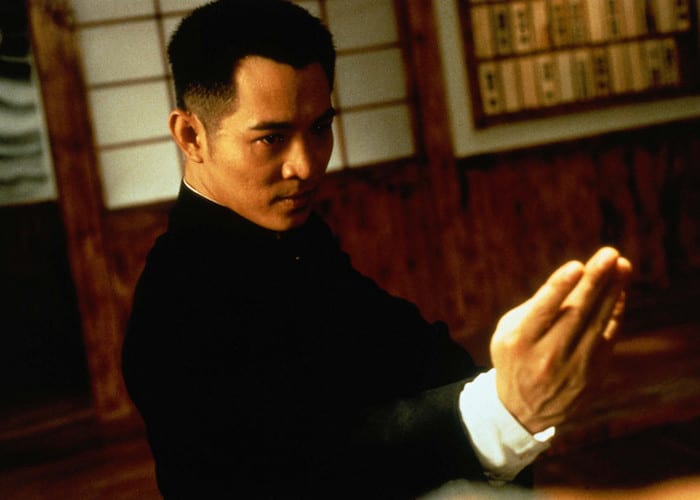
Fist of Legend is the most recognizably copied in The Matrix, and much of the lifts are seen in the fight training sequence with Morpheus and Neo. If we look at that sequence for what it is — a program that the characters are playing within — then what are the chances the program itself could be itself a tribute to or copy of the action in Fist of Legend?
Whoever designed that program within the world of The Matrix could have themselves been a fan of the movie, in which case the stunt choreographer has significance both diegetically and non-diegetically. Whoah.
Orlando (1992)
When both of the Wachowskis came out as transgender, The Matrix was read retrospectively as an important work of trans cinema. There’s the metaphorical level of people who are living one kind of reality that’s a lie and coming out to their true identity. There’s also a character, Switch (Belinda McClory) who was written in the script as being a different gender in each realm.
Unfortunately, Warner Bros. wouldn’t let the character be played by different actors, as it was deemed confusing. While revisiting The Matrix in the rerelease, without knowing that trivia about the screenplay, Switch still came across to me as at least of ambiguous gender, enough that I could appreciate some fluidity to their identity.
Anyway, Switch wouldn’t have had to be played by a man and a woman for the idea to work, unless the Wachowskis were looking to be too on the nose about it. Sally Potter was able to make it work in her Virginia Woolf adaptation Orlando, in which Tilda Swinton plays the long-living title character, who changes gender about two-thirds of the way through.
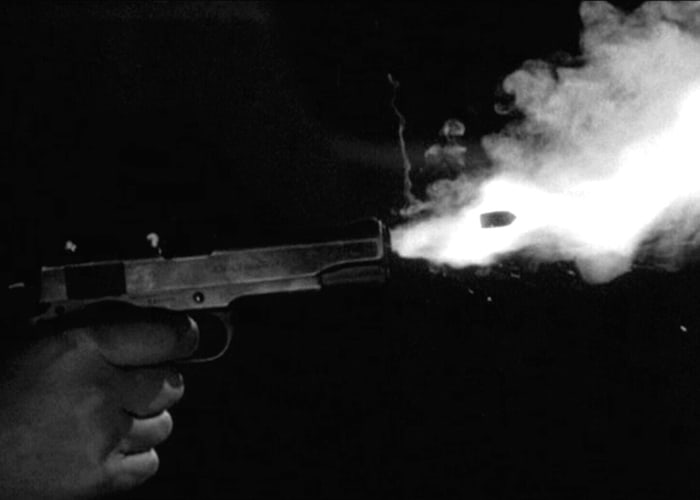
The Killer (1989)
The Wachowskis looked to two different types of Hong Kong action movie for the fights in The Matrix. We’ve already seen the martial arts type, which was brought through to their vision with Yuen Woo-Ping himself by their side. The other is the gun-heavy action of John Woo movies, including The Killer and 1992’s Hard Boiled.
Going back even further, the “Mark Gor” character played by Woo regular Chow Yun-Fat in 1986’s A Better Tomorrow is believed to be an inspiration for Neo’s look. Woo’s movies also have a balletic feel that itself is influenced by martial arts. Guns are just in the place of fists and swords. The mashup idea of “gun-fu” also originated from A Better Tomorrow.
When you look at just how much shooting occurs in the lobby sequence of The Matrix, you may think Hard Boiled, with its similarly violent hospital sequence, deserves this spot as the primary Woo example. But as seen in Robert Grisby Wilson’s Everything is a Remix video for The Matrix, The Killer gets the most explicit tribute with the standoff between characters laying on the floor.
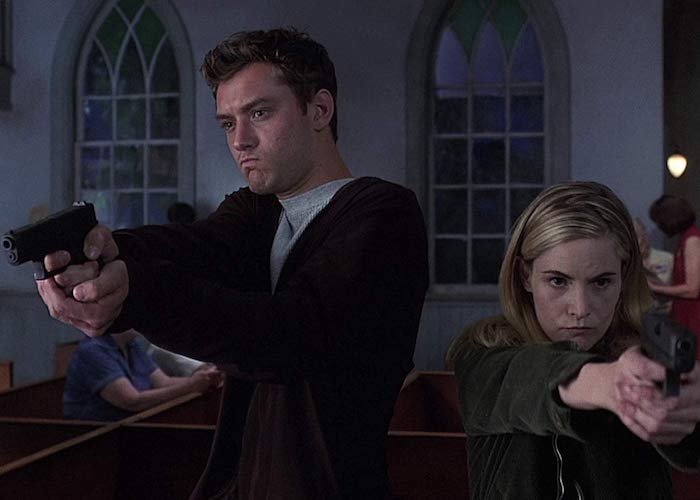
The Killer is also just the epitome of a Woo action movie — the best and the first to introduce to newbies. The slow-motion bullet casings flying everywhere kind of operatic violent action that The Matrix also revels in. “There are many incredible and beautiful images in violence, and I think violence can be a great storytelling tool,” Lana Wachowski told American Cinematographer in 1999. “[Filmmakers] have come up with an incredible language for violence. For example, what John Woo does with his sort of hyper-violence is brilliant. He pushes violent imagery to another level. We tried to do that with The Matrix as well.”
Koyaanisqatsi (1982)
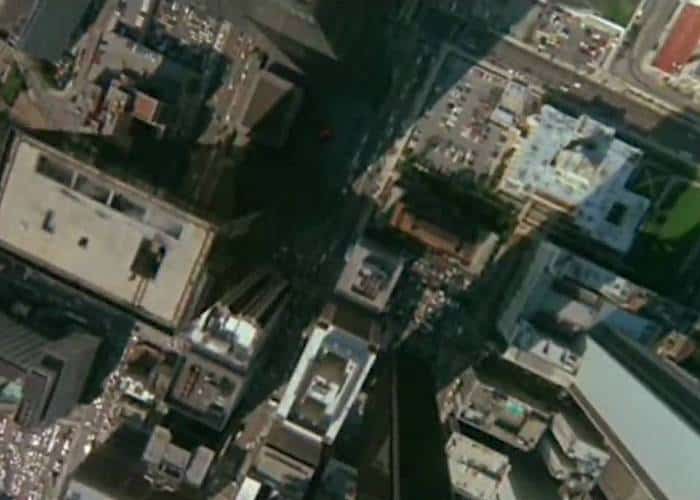
This week’s documentary pick is kind of easy since it’s always referenced as one of the movies that influenced The Matrix. Was it truly an inspiration for that one little moment on the television when Morpheus shows Neo the fake world as we see it in The Matrix? There’s an overhead shot of buildings, a shot of cars in time-lapse… sure, that’s the kind of stuff you see in Godfrey Reggio’s montage masterpiece. And I’ll accept any reason to recommend Koyaanisqatsi and its sequels, but it’s a bit of a stretch.
Still, while the material of Koyaanisqatsi was shot mostly 20 years before the year of those visuals representing 1999, Reggio’s film was also interested in man’s relationship to technology and the depiction of a modern world that was out of balance. The filmmaker says of its meaning, “It’s not the effect of, it’s that everything exists within [technology]. It’s not that we use technology, we live technology. Technology has become as ubiquitous as the air we breathe.” And then it eventually becomes sentient and enslaves us.
TRON (1982)
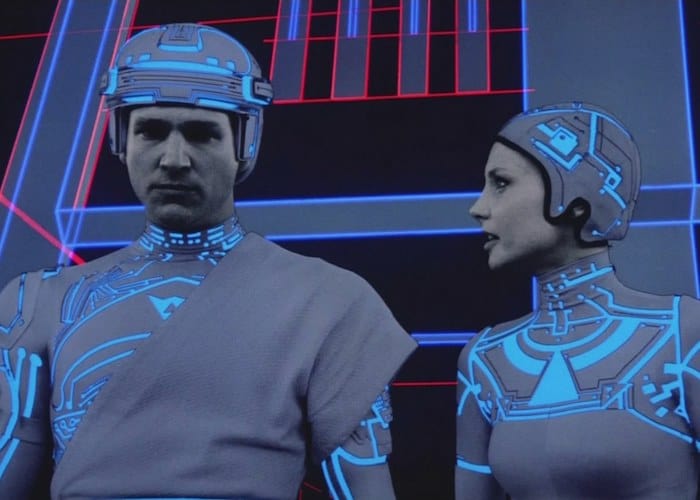
You can say anything you want about Disney, but they do try for innovation. Occasionally at the expense of a satisfying whole. Sometimes, as in the case of the new Lion King, that works out for them. Other times, as in the cases of such films as Dick Tracy and TRON, it doesn’t. This one could have been The Matrix of its time, but perhaps it was just ahead of its time.
Or maybe it looked too unique, whereas The Matrix advances on aesthetics and themes familiar enough to audiences to make it a hit and something with a strong legacy afterward. TRON, which pulls a character into a virtual reality rather than pulling him out of one, wound up a flop but a cult favorite, one that would eventually spawn a sequel that itself was influenced by The Matrix.
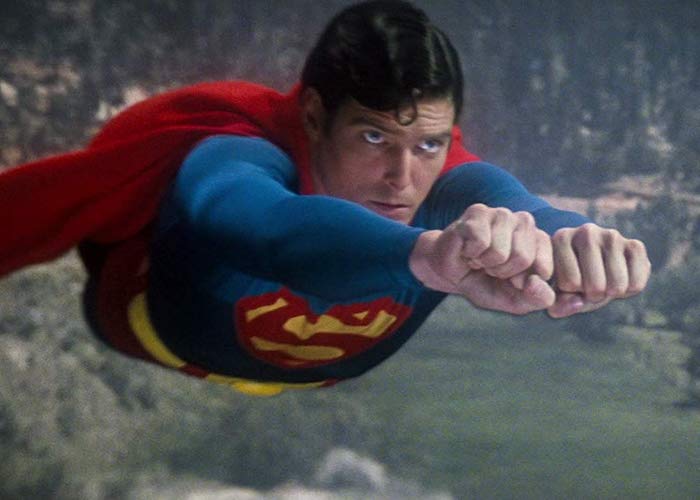
Superman (1978)
One genre that’s overlooked when discussing the influences of The Matrix is the superhero movie. Yes, the Wachowskis clearly loved martial arts and Hong Kong action and anime and philosophy and Philip K. Dick stuff, but they also took from comic books and the basic myths and narratives that inspire superheroes. The idea that Neo is “The One” is your typical messianic tale that also serves as origins for many superheroes. Superman being one of them.
Of course, there weren’t a lot of good superhero movies in existence at the time of The Matrix to specifically look to for inspiration. Richard Donner’s Superman, which is still arguably the gold standard if not best ever superhero movie (I’ll swear by it to my grave), doesn’t have a ton in common with the story in The Matrix, save for phone booths being important to both protagonists and Neo flying into the sky like Superman at the end of his first movie.
Unlike Neo, Superman starts out as a god among men. There’s still a Christ allegory there but Superman never has to be convinced that he’s got gifts or that he can use them for good. One additional similarity the first Superman has with The Matrix, though, is that love definitely fuels the heroes’ last great act at the end of their respective movies. For Superman, it makes him reverse time to save Lois Lane. For Neo, it brings him back to life when Trinity professes his love and gives him a fairytale kiss.
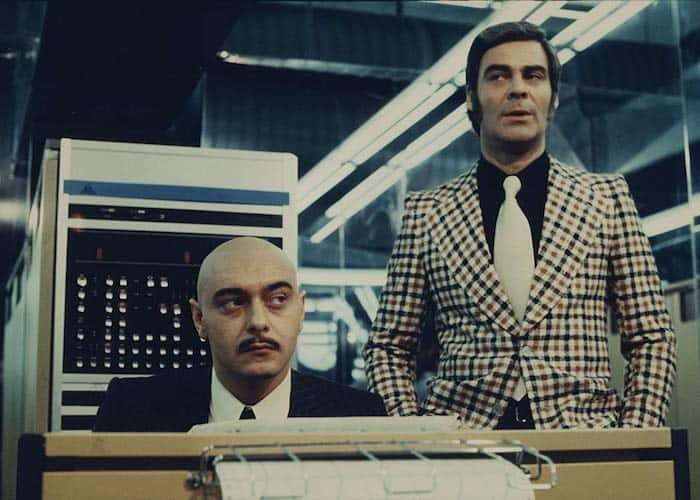
World on a Wire (1973)
The work of Rainer Werner Fassbinder, one of the most prolific and profound filmmakers who ever lived, is sadly still unknown by a lot of Americans. Not all of his movies are accessible to basic US audiences, but like many foreign auteurs, he did make a sci-fi film that could prove to be a gateway to some viewers who need a genre to carry them over.
World on Wire, which originated as a two-part miniseries, more directly informed another 1999 movie viewed as part of the same trend: The Thirteenth Floor. That was based on the same novel, Simulacron-3, which also likely influenced The Matrix. World on Wire is so much earlier and so little seen that many fans of The Matrix will be shocked at its existence.
This is close to being future-noir before Blade Runner brought out that term, and it’s about a computer simulation program before VR was really being developed as a possibility. The paranoid conspiracy thriller plot is certainly more convoluted than the one in The Matrix, but even if it takes you multiple views to get it, the retro-futurism is such a visual delight every time.
Zotz! (1962)
The Matrix is famous for its “Bullet Time” effect, even though the concept involved with the visual goes back to before the dawn of movies, with the proto-cinema photo experiments by Eadweard Muybridge. And even closer to the making of The Matrix, music videos and commercials were messing with the technique. But this obscure feature that came 37 years earlier is a very particular precursor.
Directed by gimmicky horror master William Castle, Zotz!is more of a superhero movie that stars Tom Poston as a man who comes into the possession of a magical amulet. In one scene that will seem to fans uncannily connected to The Matrix, he’s able to make a bullet slow down enough to dodge being shot. He can do the trick with a punch, as well.
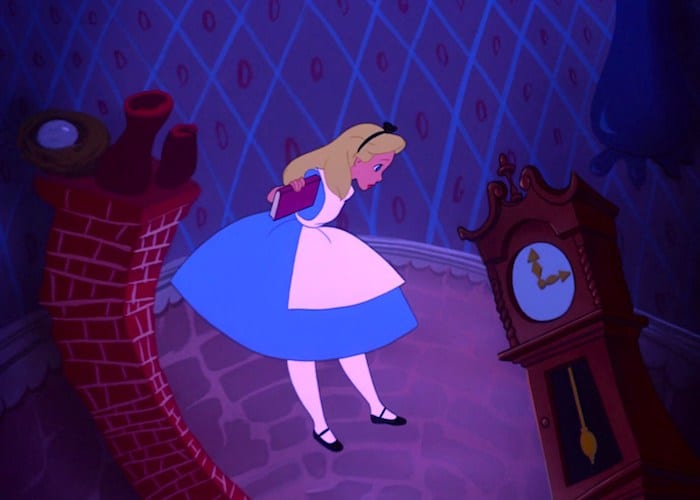
Alice in Wonderland (1951)
One movie directly referenced in The Matrix, besides the bit of Night of the Lepus (1972) on the TV at the Oracle’s apartment, is Alice in Wonderland. Actually, it’s the Lewis Carroll story, not necessarily Disney’s animated adaptation. But this is the version that everyone thinks of, even if Tim Burton’s live-action remake made a billion dollars and is more recent.
There are references to following the white rabbit and going down the rabbit hole and the whole movie is similarly about two different worlds, one of which is all in the imagination and/or just a dream. The Wizard of Oz (1939) also gets a shout out at one point with a line of dialogue, but Carroll’s fantasy tale is older and far more aligned with The Matrix.
Alice in Wonderland isn’t the only link The Matrix has to Disney animated classics, either. The way Trinity brings Neo back to life at the end with a kiss and profession of love, that’s the kind of happily ever after stuff we get from Disney fairytales, particularly Snow White and the Seven Dwarfs(1937) and Sleeping Beauty (1959).
Every film culture, probably, has that one maverick genius defying induction into the national cinema pantheon—that one auteur seemingly every generation has to re-discover. Well, that's the wrong word, really—re-embrace feels better, more to the point. In the Federal Republic of Germany, that eternal wild card would be Roland Klick: the master without pupils proper, the director who wasn't able to create a career for himself. The latter is actually meant to be understood in double-edged way: as it is an interesting question whether the obstacles put into his pathway were simply too huge to push aside, or whether Klick, due to his character, was his own stumbling block. About the former we can say: While his contribution to Young German Cinema was officially cherished by certain cinephiles and audiences alike, the new powers-that-be did have some very serious problem with him.
(It is funny to imagine that Klick's extraordinary looks could have been one of those; Roger Fritz, back then and still today quite a dangerously attractive guy himself, suggested that idea with a savagely funny grin in Dominik Graf and Johannes Sievert's diptych about the more exciting fringes of FRG film culture from the 60s onwards, Verfluchte Liebe deutscher Film and Offene Wunde deutscher Film, 2016 and '17 respectively.)
Let's start out with the second-most remembered incident in Klick's professional life. The story goes like this: Back in 1970, Klick's second fiction feature, the Can-score-driven existentialist acid Spaghetti Western desert noir Deadlock (1970), got invited to screen in Cannes's competition; the film, it seems, hadn't been submitted for consideration through the official channels—it was the festival itself that had shown an interest in Klick and communicated with him sans interlocutors. Apparently, some folks back home freaked out when they got wind of this, especially when Cannes did invite Deadlock to represent the FRG smack in the festival's spotlight. Then, legend has it, this happened: A group of people claiming to represent the Young German Cinema complained about Klick's selection and demanded that his invitation got revoked, as per them Deadlock wasn't a fitting example for Young German Cinema's general character. Cannes, to its eternal shame, complied, and replaced it with Peter Lilienthal's portrayal of an anarchist, Malatesta (1970). Let's just say this: That a clique of (mainly) filmmakers would behave exactly like official FRG politics in the 50s—when, most notorious-cum-shamefully, the nation's embassy to France had in the government's name voiced objections to the screening of Alain Resnais' Night and Fog at Cannes' 1956 edition saying that the film could be the cause of diplomatic frictions between countries, meaning that it didn't reflect the FRG's official position on matters of WWII and the Holocaust (there were similar incidents before and after)—is troublesome enough, and extremely disgusting; but that the festival didn't have the nerve to stick to its guns and yielded to that clique's demand: that is, besides beyond disgusting, deeply puzzling, for what kind of pressure could those people have exerted? Should this be read as a sign for the rapid rise to the film cultural top of Young German Cinema—or at least that it was dealt as the hottest ticket in town?
But maybe that's not the most interesting point here; more important might actually be that Deadlock is the avant-garde, very internationally minded version of a popular genre movie, while Malatesta was a heady art-house film (one might find it ironical that both works relate to Italy—Klick's in terms of style and form, Lilienthal's in terms of content). Which is to say that Young German Cinema at that point in time was not allowed to be popular, at least not in terms of self-promotion, popular image—for there were enough directors interested in various ways in the idea of popular cinema, and who made quite a few films that kick ass still today; but: the new film subsidizing system the Young German Cinema's self-anointed leaders were working hard on institutionalizing depended on the idea of producing artistic films—a cinema that doesn't work without state support as it wasn't targeted per se at general audiences, and that was willing to allow lots of space for experiments which at some point might lead to something for once commercially viable. This concept was based on the experiences made by Young German Cinema's first generation, of which quite a few members suffered bankruptcy (or were threatened by it) because their films failed at the box office. To be represented by a film like Deadlock in a moment when Young German Cinema had to look difficult and obviously artistic and prone to appeal mainly to a few especially refined souls was probably a nightmare for the subsidizing system's architects—just imagine if it had done well and scored nicely on awards night, then gotten sold like sliced bread and made a lot of money!—politicians would have said: Why don't you make films like that? In the end, the situation was a deadlock itself, as those who wanted to protect their embryonic subsidizing structure were probably mighty right if indeed they feared that a film like Deadlock would send the wrong signals to a bunch of power jocks reluctant to fork out money for movies and only willing to do so if it furthered the nation's glory (which the likes of Herzog, Wenders, Kluge, et cetera did by making films that could easily be aligned with certain clichés about German culture ranging from wildly irrational via romantic to extremely rational—doesn't mean that's all there is to the films, quite the contrary, but those aspects, mere morsels of tone and meaning sometimes, certainly made them appealing to the rest of the world). On the other hand, they destroyed what in hindsight turned out to be Klick's best shot at a career different from what he ended up with—same way that in the long run their subsidy creation meant to help produce the unusual and searching turned into a creature that seems to be all about destroying talents and re-enforcing mediocrity: a bureaucracy destined to prevent troublesome originality; due to which Klick would have today as many problems as back in his years, just different ones.
Bübchen
There's also a tragic irony to the fact that Deadlock remained in terms of tone and style a total exception in Klick's œuvre. Everything else––even his lone other adventure in a more manly vein of genre: the 1976 bestseller-based espionage melodrama Lieb Vaterland magst ruhig sein; even his goofy way-too-late comedy Schluckauf (1992); even his pseudonymously done episode for the TV-series Drei Damen vom Grill; and most definitely his fabulously wide-eyed while tongue-in-cheek documentary essay about sports and rituals apropos Louisville (KY)'s annual horse racing insanity, Derby Fever USA (1979)––was closer to the heightened realism of his mid-length masterpiece Jimmy Orpheus (1966) and his debut feature Bübchen (1969); and, yes, in an off-beat way that also includes the hysteria of his punk'ishly apocalyptic look at the world of popular music, White Star (1983), a film in many ways a ruin as Klick couldn't properly finish the production and had to work with what he had, which makes the movie into even a bigger miracle than it already is––but also because of its feel of willful fragmentation, a disinterest to add up totally, a need to just let it rip and let something give, finally go.
The latter came into being after the most remembered incident in Klick's career: His sacking from the production of Christiane F. - Wir Kinder vom Bahnhof Zoo (Uli Edel, 1981) by the film's producer Bernd Eichinger—or his leaving behind of a project he couldn't believe in anymore due to excessive interference. In hindsight, this was a sign—or to be more precise: a signal. No more director-worship—the hour of the producer-as-star had come. If Klick is to be trusted—and for all his gleeful delight in self-mythologizing he still seems more trustworthy than Eichinger and his surroundings ever could be—the problem during the pre-production of Christiane F. - Wir Kinder vom Bahnhof Zoo was one of leadership: whom did the team follow, the actors in particular, many of them amateurs? Klick says that he had developed a strong bond with them that excluded Eichinger et al., for he wanted the youngsters to react to him and him alone; while Eichinger, in his first big production (that became the blueprint for things to come: preferably famous source material, classy look, emotional simplicity, conservative morals for all its siding with unorthodox figures; only the stars were missing here), could probably deal even less than what would become usual with the idea of not being in absolute control of everything. This is also why Eichinger could never really work with directors and other creative personnel who had a vision and the ego to protect it after this seemingly traumatic experience with Klick (instead he got himself gofers like Edel, Jean-Jacques Annaud, Sönke Wortmann, Oliver Hirschbiegel, et cetera).
Read: Inside ten years Klick had turned from being seen as too popular-commercial to being seen as too artistic-individualistic.
In fact, Klick just did what he did: He made his films, following the idea that cinema is a mass medium that should engage the audience emotionally and intellectually in as complex a fashion as possible––for this is what the people deserve. Klick believes in every person's willingness to behave in a socio-politically helpful fashion; and each of his films tries as hard as humanly possible to offer viewers something that talks to this side, part of one's character. Klick might be wild and unruly, but he's not that different from the rest. And that is remarkable: That his films consider human beings as very special and precious as such.
There's a humanism to his cinema that's shattering once one stops obsessing about those damn crazy bad-ass zooms in Deadlock, the glorious gun-play in the film that might nail the essence of his art best, Supermarkt (1974), or the awesomely hellish ecstasy of Dennis Hopper going nuts in White Star.
Bübchen is arguably still the film if one wants to get an idea of what the late 60s looked and sounded, felt and smelled like from a working-moving-lower-middle-class point of view. Here, especially in the performance of the incomparable Sieghardt Rupp (as a father wanting to protect his little son who out of bored stupidity killed a little girl), is the vibrancy and cheek, the lust for life of a generation that grew up in destitution, that knew hunger, that knew human existence at its most basic and then less; these are the people that would in many ways carry the status quo for it had offered them ample opportunities to leave misery behind; these are the women and men those who deemed themselves politically enlightened and radical would consider the enemy—more maybe even than the upper echelon, for they were more, much more. And if Bübchen looks like a pietà for that generation, Jimmy Orpheus is its ribald, rowdy nativity with its chico-hombre Kristoff, who could be, say, the younger brother of Bübchen’s father, going through the proletarian ritual of growing up through the hard knocks of the desire-power-play lost to an echt St. Pauli-hooker—which for all its macho posturing has an air of adventure, getting-to-know-the-wide-world that remains enchanting for being so free-spiritedly carnal. Willi, the youngster with big dreams and zero cash from Supermarkt, then, could be a grown-up son of that father who, in a lull between the birth of left-wing armed insurrection in the FRG (which happened around the time Bübchen got made) and its first generation's violent apotheosis in the autumn of '77, got ideas in his head that taking matters in one’s own hands looked mighty sensible, and a Tommy gun looks like just the right tool (which also Paul thinks in Klaus Lemke's eponymous monument from—1974; it must have been the year for those thoughts.). Yet mind that the most telling gestures in Supermarkt have nothing to do with violence but need—how he steals food, or how he tries to offer some warmth to a hooker not much older than he is, and possibly still underage; these small gestures performed by amateur Charly Wierzejewski with a sense of knowledge too depressing to contemplate for too long add up to a desperate tenderness at times almost unbearable—one understands: this is rock bottom, this is what it all boils down to, this is the essence. And Charly Wierzejewski knows.
"I want my celebration long before I die," sings Marius Müller-Westernhagen on the soundtrack of Supermarkt. The track is called Celebration and should be sung as the anthem of all things Roland Klick, which is not only one man's cinema but a whole idea of cinema behind which creatives souls as different as Dominik Graf, Klaus Lemke, and Robert Schwentke can unite. Directors from other nations may gladly be added, for the genius of Klick is one not German at all, but international, cosmopolitan—it's the best in all of us.
"There's magic in this play. As if I've given it all that I lack." Roadside Attractions has debuted an official trailer for the French historical drama Cyrano, My Love, which premiered last year and opened in most of Europe at the beginning of this year. The film is about Edmond Rostand, played by Thomas Solivérès, a famous playwright who is struggling to figure out his next project before he turns 30. Ignoring the whims of actresses, the demands of his producers, the jealousy of his wife, his best friend's heart and the lack of enthusiasm of all those around him, Edmond must focus and put to pen to paper. For now, he has only the title: "Cyrano de Bergerac". The cast includes Olivier Gourmet, Mathilde Seigner, Tom Leeb, Lucie Boujenah, Alice de Lencquesaing, Clémentine Célarié, and Igor Gotesman. This looks like a lively look back in time at the life of a playwright and the creation of his finest work. That mustache is a wild one.
Here's the official US trailer (+ poster) for Alexis Michalik's Cyrano, My Love, direct from YouTube:
December 1897, Paris. Edmond Rostand (Thomas Solivérès) is not yet thirty but already two children and a lot of anxieties. He has not written anything for two years. In desperation, he offers the great Constant Coquelin (Olivier Gourmet) a new play, a heroic comedy, in verse, for the holidays. Only concern: it is not written yet. Ignoring the whims of actresses, the demands of his Corsican producers, the jealousy of his wife, stories of his best friend's heart and the lack of enthusiasm of all those around him, Edmond starts writing this piece which nobody believes. For now, he has only the title: "Cyrano de Bergerac".Cyrano, My Love, also titled Edmond internationally, is directed by French actor / filmmaker Alexis Michalik, making his feature directorial debut after a few other short films previously. The screenplay is also written by Alexis Michalik. This premiered at the Angoulême Film Festival last year. Roadside will debut Michalik's Cyrano, My Love in select US theaters starting on October 18th, 2019 this fall. Anyone interested in this?
Welcome to Steven Soderbergh's history class. Today we will be learning about the history of money, and how our obsession with it has gotten seriously out of hand. Steven Soderbergh's latest feature film, titled The Laundromat, is an ingenious social commentary based around the Panama Papers and the terrifying truths they revealed. Following in the footsteps of The Big Short, this fourth-wall-breaking comedy / drama / satire / educational film / cautionary tale features a brilliant script written by Scott Z. Burns (of The Informant!, Contagion, Side Effects, The Mercy, The Report) that borrows heavily from Adam McKay's film in style and structure. It's essentially a film about the despicable men behind Mossack Fonseca, but it shows us a number of parables to remind us all just how much trickery, greed, corruption, and bullshit is out there.
Soderbergh's The Laundromat stars Gary Oldman as Jürgen Mossack, and Antonio Banderas as Ramón Fonseca, allowing them to narrate and talk directly to the camera throughout, telling "their side of the story" about what happened with them being indicted after the Panama Papers were released. From there, we're also introduced to Meryl Streep playing Ellen Martin, a woman who loses her husband in a tragic accident at the start and spends the rest of the movie experiencing first hand the amount of corruption and financial deception that is prevalent in all aspects of the world - from receiving money from the insurance company, to buying a condo to live out the rest of her life and remember where she first met her husband. The film then dips off into various parable vignettes to tell stories about how horrible the people involved in this are.
Similar in tone to the Coen Brothers' anthology of parables, The Ballad of Buster Scruggs, this film features side stories that not only tell us more about how financial secrets & tricks benefit the wealthy, but remind us that these are not good people no matter what excuses they want to use. Some of the side stories are better than others, and some of them he spends a bit too much time with even though there's not much being said. They start to feel a bit distant when all I want to do is get back to the main characters (Oldman, Banderas, Streep) and follow them to the truth, with the hope that by the end they'll get what's coming to them. The framing and the storytelling techniques used throughout are still amusing and captivating enough to make this an easy film to watch, even though it's dealing with very real, very heavy subject matter about how many people's lives are ruined because of the greed of a few. It even opens with a hilarious setup explaining the concept of "money" to give us a basic understanding of why society is the way it is now (for better or worse).
By now, we all know that Steven Soderbergh is an indisputably talented filmmaker who can do pretty much everything himself - write, direct, edit, work as the cinematographer, producer, or any other production job. All he needs is a damn good script, and he can bring that script to life on the big screen in an effective way, and put it all together as engaging, fascinating entertainment. And this film is just that - a near-perfect film based on a brilliant script that hits very hard regarding just how bad greed is and how America, of course, is where all this trickery and corruption and evasion begins. And even though some of the stories in this are weaker than others, it's such a refreshing and important work of necessary social commentary that I can't help love it anyway. And all the lively performances throughout make it sing. It's the truth we need to hear.
Alex's Venice 2019 Rating: 8 out of 10 Follow Alex on Twitter - @firstshowing
“I do not separate the man from the art,” Jury President Lucrecia Martel said on the eve of the 76th Venice Film Festival, as the fest’s first press conference prompted her to comment on the inclusion of Roman Polanski’sAn Officer and a Spy (J’accuse) among the year’s twenty-one Golden Lion hopefuls. While the remarks sparked further debate around Polanski’s competition slot, the idea of a schism between artist and craft (or the impossibility to draw one) seemed all the more relevant to director’s latest, a chronicle of the Dreyfus affair, a scandal that swept across France in the late nineteenth century and led to the disgrace of an army officer falsely convicted as spy. Difficult as it may be to gloss over the meta-fictional echoes—corroborated by the parallels Polanski himself has spotted between his situation and Dreyfus’ own in an interview circulated as part of the film’s press notes—this is a solid, gripping procedural, homing in on men fighting against a corrupted and racist apparatus, a period piece that rings perceptively timely.
On January 5, 1895, Captain Alfred Dreyfus, a promising 35-year-old French officer of Jewish descent, was degraded for spying for Germany and sentenced to life imprisonment on Devil’s Island, a rock jutting out of the Atlantic off the coast of French Guiana. Serving in the court martial that ruled his incarceration was Georges Picquart, an officer later promoted to the rank of lieutenant colonel and appointed to helm the military counter-intelligence unit that instigated Dreyfus’ fall from grace. Except the investigation, as Picquart later found out, was a farce. The man spying for the Germans was not Dreyfus, but a senior French officer, Major Esterhazy, and Picquart spent the years that followed to shed light on the corrupted system that led to Dreyfus’ fall—a case that formally ended in 1906, when the officer was reinstated in the French Army.
To audiences unfamiliar to the affair, An Officer and a Spy may strike, at least for the first third of its 132 minutes, as a history lesson. But there’s nothing pedantic or didactic about it. Drawing from the 2013 historical fiction thriller penned by Robert Harris—credited as Polanski’s co-scribe—the script maintains tension throughout, from the early stages of Picquart’s internal inquiry down to the court procedural the final act morphs into. Peppered all throughout it are echoes of the populist discourse that foraged Dreyfus’ conviction, a hatred toward the Other that manifests itself through antisemitic slurs as much as jibes at foreigners and homosexuals, with army geriatrics ranting against the decay of “all moral and artistic values,” mourning a country they no longer recognize. It’s a subtext that helps sponge up some of the pestilent zeitgeist, and adds further timeliness to a drama that conjures Dreyfus’ plight as an uninterrupted history of xenophobia. But there’s also a curious vintage pleasure to it all: much like Coppola’s 1974 The Conversation, An Officer and a Spy resuscitates a largely defunct espionage universe, where spies must painstakingly open envelopes with water vapor, patch together torn apart letters, and develop photos in darkrooms.
Louis Garrel plays Dreyfus, but the officer and the spy the title alludes to really are the same person: Jean Dujardin’s Picquart. Astutely, Polanski keeps Dreyfus on the background to zero in on the man who first took part in his trial, and upon uncovering the scandal, put his honor and life at risk to set him free again. This is Picquart’s story, and a one-man show brilliantly sustained by Dujardin as a man whose staunch faith in the institution upon which his whole life pivots starts to shake, and grapples with an identity crisis. But the transformation from Dreyfus’ enemy to unlikely ally is not uncritical. Even as it eventually trumpets Picquart as a disgraced victim of an ossified apparatus that first lulls him as its poster boy and later fights him as some cancerous cell, An Officer and a Spy never simplistically trumpets him as a hero. In a pivotal early exchange, Dujardin tells Garrell he dislikes Jews, and as much as the man’s antisemitism stands out more as the result of some tradition than genuine and visceral hatred, it corroborates the feeling that his quest to save a disgraced soldier comes second to the need to salvage the integrity of an institution he could no longer belong to.
Shot by Pawel Edelman, this is a drama that unfolds almost exclusively inside closed rooms: Picquart’s bachelor apartment, high-ceilinged, frescoed government offices, courtrooms, and of course, military prisons. But the feeling of claustrophobia spans throughout. A wintry, milk-tinged light falls on rooms and tenants, beaming through curtains that are never drawn. Jean Rabasse’s production design adds an olfactive quality to the visuals, and you can almost smell the dust, the moldy scent that billows from the closed rooms. An Officer and a Spy thrives on Picquart’s moral struggle, but it also works as a taut, intelligent examination of weaponized masculinities. The men populating Polanski’s drama fight to keep their honor as well as their virility intact, an urge to salvage a heteronormative notion of manhood that reverberates in the lingering homophobic discourse as much as the efforts to resolve personal affronts through violence, with a standout duel scene encapsulating the kind of toxic masculinity at stake.
A similar interest in the dissection of manhood cut to the core of the lineup’s seventh title. Two years after Jackie, which screened in competition here on the Lido in 2017, Pablo Larraín returned to Venice with Ema. If the Natalie Portman-starring biopic stood as an outlier within a canon comprising largely of dramas hailing from Larraín’s native Chile, Ema, set in the port city of Valparaíso, also heralds a return to the director’s home turf. Except for the first time the story does not unfold as an autopsy of the past, but is set in the present-day, set among a generation that’s not Larraín’s own. Early as it may be to say after a mere four days of screenings, and with only a third of the whole program unveiled, Larraín’s is one of the fest’s most daring entries. A far cry from from an even ride, it still manages to pulsate with rambunctious, unbridled energy, conjuring an incandescent hymn to female liberation.
Eponymous Ema (Mariana Di Girolamo)—a reggaeton dancer with silver dyed hair and anthracite, magnetic eyes—shares a bohemian apartment with her husband Gastón (Gael García Bernal). He helms an experimental dance troupe where she serves as lead performer, a choreographer-dancer relationship that brought to mind, in more ways than one, another Golden Lion contender, Noah Baumbach’s Marriage Story. Like Adam Driver and Scarlett Johansson’s director-actress duo, this is a couple watching powerless as their married life collapses. Gastón, twelve years older than Ema, was not able to give his wife a son, which led the couple to adopt six-year-old, pint-sized Polo. But as Larraín’s drama kicks off in medias res, the child has already disappeared from the picture. A boy with severe attachment issues that would often in violent tantrums, the last shocking incident he was responsible for forced the adoptive parents to hand him back to social services, which found him another family.
The child’s abandon rattles through the couple’s life like an omnipresent ghost, a reminder of their shared guilt. Never mind however harsh the insults, however atrocious the accusations they dart at each other, this is something they’re both responsible for, a tragedy that’s consumed within and beyond the confines of their own apartment, as Gastón and Ema hurl against a society that shuns both as heartless pariahs. “People look at us as if we suffocated a dog with a plastic bag,” she tells him, and in a world where even her own mom reminds her that “mothers do not abandon children,” because “children make families” this is no understatement.
The only moments of respite come from dancing, and Larraín’s regular cinematographer Sergio Armstrong captures Ema as she careens and twirls against planets burning on the background, arty performances choreographed by José Vidal that billow to life in entrancing hues and blobs. But this is not her dancing: it is Gastón’s own vision of what dancing should look and feel like. Among the most interesting offerings of Ema’s rich, multilayered universe is a strife over opposing artistic worldviews. Gastón’s attempts to add some avant-garde flair to Chile’s traditional routines are juxtaposed with Ema’s penchant for contemporary, unhinged street performances. Folk dances versus reggaeton, past versus present: as the young woman drifts away from Gastón and her married life to find solace in the sisterhood promised by her best friends and fellow dancers, Ema swells into a celebration of reggaeton as a life-affirming, empowering tool—a means to both debunk and escape the patriarchy Gastón smothers her under.
Penned by Larraín, Guillermo Calderón, and Alejandro Moreno, Ema unfurls as a sinuous, fragmented journey, with dance montages and Nicolas Jaar’s electronic score acting as collagen. The use of fire as a means to underscore Ema’s burning rage, with the young woman meandering across Valparaíso with a flamethrower, can feel a tad too on-the-nose, all the more so as she later finds a symbolic counterpart to it in the shape of a fireman who teaches her how to operate a water pump, and later shares some rather retrograde musings on women’s role as men’s appendices. The secret connection she’s kept with Polo leads to embark on a byzantine quest to be reunited with the boy and his new parents, and the approach, veering from tragedy to absurdist comedy, may strike as convoluted, if not too mannered. But this remains—arguably more so than any of the titles unveiled in these first four festival days—a bold, ambitious work, graced by a towering performance by Di Girolamo, who dances through it with an irresistible and intoxicating aura. Ema takes plenty of risks, and if the end result sometimes strikes as maddening and anfractuous, it is journey well worth embarking on.