The film industry in one place - Articles, Reviews, trailers and hype!

Sunday, 3 March 2019

Brian Michael Bendis On What Made ‘Into the Spider-Verse’ Unlike Any Other Adaptation

With great power there must also come – – great responsibility! Those words, originally written by Stan Lee in 1962 for “Amazing Fantasy” #15, have appeared and reappeared in numerous comic books, cartoons, and films. They are the backbone of every Spider-Man narrative. For the character of Peter Parker, they represent a moment of shame, an instant in which he used his gifts for profit over altruism. The words are a memory of betrayal to his Uncle’s selflessness that ultimately resulted in his murder. They are a call to action; an oath to never again falter on the lessons of the father figure that sacrificed so much for his welfare. Peter Parker has a gift, and he must use it for the benefit of those that don’t.

Those words, however, do not belong to Peter Parker. They belong to anyone who needs them. They belong to us.

In the year 2000, Marvel Comics was looking to revitalize their line by rebooting a few key titles. Brian Michael Bendis was brought on board to rediscover the relevance behind those words. For eleven years, in the pages of “Ultimate Spider-Man,” Bendis explored the motivation that drove Peter; he put a fresh coat of paint on his rogue’s gallery, expanded and played around with his large cast of supporting characters, and pushed them to conclusions the regular line of comics would not possibly dare to venture.

Peter Parker died. His last moments spent fending off the Green Goblin on the front lawn of Aunt May’s home. His shame finally redeemed; his responsibility fullfilled. The words though, they stuck. They remained inside the hearts and minds of Peter’s family, and they waited for another who needed them.

Along came Miles Morales. Created in 2011 by Bendis and artist Sara Pichelli, Miles spun into his own “Ultimate Spider-Man” title as a response to the outrage spewed on the internet after a rumor circulated that Donald Glover wanted to play Spider-Man. A white face is not a requirement for the wall-crawler. Anyone can put on the mask; anyone can absorb Stan Lee’s mission statement.

So, yes, 56 years after his creation, we’ve seen Spider-Man and his mantra portrayed in numerous ways. Tobey Maguire has ruminated over the words, Andrew Garfield had a turn, and Tom Holland most recently got to the core in Captain America: Civil War without actually ever uttering the famous line. Pretty nifty trick.

I thought we were good. There was no topping Spider-Man: Homecoming. Yeah, well, we now know that the quintessential web-head adventure is truly here and its name is Spider-Man: Into the Spider-Verse. This film is one massive celebration of “With Great Power Comes Great Responsibility.” Directors Bob Persichetti, Peter Ramsey, Rodney Rothman, along with producers Phil Lord and Chris Miller, scream Stan Lee’s message to the heavens. Heroism is not bestowed; it is snatched.

Brian Michael Bendis was there from the beginning. As Miles’ co-creator, he was at the ready whenever the filmmakers had a question or an argument that needed arbitration. He’s found himself consultant on several Spider-Man films, but he knew something was different about Into the Spider-Verse almost from day one. He was giddy watching the film come together, and he was giddier still when he realized that it wasn’t going to fall apart.

I spoke to Bendis over the phone just days after the film was named Best Animated Feature at the 91st Academy Awards. We talked about how surreal this entire experience has been for him, and he explains the whirlwind of emotions that whip through your mind when such an announcement strikes. We discuss the key ingredient that Spider-Man: Into the Spider-Verse understood that previous versions might have lacked. Our conversation leads into the importance of representation, our possibly misguided reverence for Stan Lee’s characters, and the health scare he experienced that put everything into perspective.

Here is our conversation in full:

I gotta start this conversation with a great big Congratulations! The Academy Award-winning Spider-Man: Into the Spider-Verse. That’s got to be surreal.

Beyond surreal, not fully unpacked in my head yet, so.

What was your initial response when they announced the film the winner?

It’s a very surreal experience — the whole thing’s surreal. So, the Golden Globes happened, and everybody was floored beyond comprehension. Everyone’s coming up to me shaking me by the arms, “Can you believe it!?” And I can’t. I’m with everybody on this. Right? Then, by the next day, everyone in my life, everyone I’ve met, everyone on Twitter, everyone I come across says, “Oh, it’s gonna win the Oscar, it’s a done deal.” I go, “No, it’s not. What done deal? Yesterday wasn’t even a deal; now it’s a done deal?” So, it was a lot of that, just the way the wheels turned, and I did not accept any of that, by anyone on any level, because that’s weird and not gonna happen. So, yeah, I was genuinely surprised and delighted when it happened, because I don’t know how that other thing is – that predestined thing. It was weird.

What’s astonishing to me, regarding Into The Spider-Verse, is that I thought I had seen the best possible adaptation of the Spider-Man character in Homecoming, and then here comes this animated film that almost feels like the perfect copy of the perfect comic book iteration of the character. How does that happen?

I’ve always been a big fan of Lord and Miller. From their earliest work, I was a big fan, and we kind of cut from the same cloth in certain areas and the team that gathered around them was perfect. It really was a well-cast behind the scenes kinda thing, like Peter [Ramsey] and Rodney [Rothman] and Bob [Persichetti], they all brought something very special that was just desperately needed for this project, right? Just from talking to them over the years, you got the sense that they knew this wasn’t just a gig. Do you know what I mean?

Sure, their fandom bleeds from the screen.

Yeah. Like, “Oh you know, gigs are great, but this isn’t just a gig.” And if everyone in the room has decided it’s not just a gig, then it won’t be. It will be art, and I’ve been in that situation before, and so when I walked into their situation and saw that – “Oh, they’re taking this very seriously.” And I was like, “I really hope this turns into something.”

Now as a consultant, I saw the earliest cuts of the movie. Very, very early cuts. And sometimes those early cuts are filled with all kinds of cool stuff that slowly gets cut out of it as they get it ready for release. All the fun stuff slowly disappears, but in this instance, the opposite happened. More and more stuff kept finding its way in. I remember just watching that and being like, “Ooh.” It’s like watching someone play Jenga or something, like, “Oh, oh, oh, it’s stressful!” Like how much crazier can this movie get? Can it handle Spider-Ham? Can it? Can it handle it? And it could. That kinda stuff is really exciting to be part of and watch.

Well, take me through that a little bit. What does it mean to be a consultant on a film like this?

It literally means whenever they need me, they can call me. Sometimes they call you for the big stuff. And sometimes they call you for little stuff. You’re often called because they’ve been fighting for hours about something and they need a tie-breaking vote.

I’ve had that happen on quite a few projects, and where I didn’t even understand that’s what was being asked of me. They would just ask me questions, and then I would answer. And then the whole group would break out into a huge fight amongst each other ’cause they’d been fighting about this for months. They decided whatever I say is the answer. I accidentally made some headlines during the Spider-Man movie – the Andrew Garfield one. When they were developing that they called me and they go, “They need you in right away.” And I go, “Oh yeah, sure I’ll come in.” And I came in, and they sat me down at a table with Amy Pascal and Avi Arad and all the producers, all the writers, and they said, “Web shooters: organic or mechanical?” I said, “Mechanical.” And the room broke out into a crazy frenzy ’cause they had decided my vote was the answer.

Well, that is the right answer.

So it was things like that, and then there were things like this where I would get a 2 o’clock in the morning email from Phil Lord asking what day was this character born and what is their middle name?. You know, that kind of stuff. Or it would be, “Here please watch this entire cut and give us elaborate notes. It could be anything from that to that.

You yourself have been in the position where you’ve had to re-interpret the character of Peter Parker in the Ultimate Universe comics. For you, what is the key to the character? Not just Peter Parker, but for anyone picking up the mask?

Well, it’s “With great power comes great responsibility.” It’s that phrase. From that phrase, from wherever you are in the world, whatever your perspective is, whatever your experience is, that phrase can mean different things as applied. And different actions can be applied to it. I have studied this phrase and written about it under more than Miles and Peter, under other characters as well. I can tell you that you can base a whole religion on this idea and be very successful. It is an idea that is so pure, and bulletproof and applies to everybody.

That’s it. Don’t worry about designing the costume; everyone is always worried about that. I see all these Spider-Personas, and they’re awesome. They are awesome! But when you’re developing your character, it’s how they react to the phrase “With great power comes great responsibility” that will tell the story of that character.

So, in your own experience, how do you know if you are remaining true to that concept or if you’re straying too far from it?

I think…for me…for Miles, I have the benefit of a scenario where Miles heard the phrase from Gwen Stacy in the comic books – not the movie. So hearing it from Peter’s best friend, he heard it from the source. And he got to meet Aunt May, right? He heard that phrase first as an abstract idea; he had to figure out what it meant to be Spider-Man. Then he got to go to the source, and for me, it felt like when a musician becomes a rock star based on the philosophy of another rock star, and then they get to meet that rock star and see what it was like for real, you know? I got to do that with him. Not until Miles heard, “With great power comes great responsibility” did he act like a hero. And he had powers for years before he heard that phrase.

Miles Morales solidifies this idea that we need to stop getting hung up over what one character should look like or even how they behave. Yes, “With great power comes great responsibility” is essential, but it can be interpreted and filtered in numerous ways. Many people, many characters could inhabit the philosophies of our favorite superheroes, and that’s what Miles does for Peter. If Spider-Ham can stand and fight for what’s right, so can you. 

Part of writing and writing on a global stage – you can call it a global stage because people all over the world speak in the data cloud and you get such a great dialogue going – you get such great feedback from people. They give you their perspective. They give you their experience, right, on how Spider-Man affected them. It’s there, and you realize that’s what diversity is really talking about and what it looks like, but what we’re really writing about is the experience and the perspective of the character. That is why we can tell new stories, from all over the world, with this character.

You mentioned earlier that you’ve been working on Into the Spider-Verse for years. Animated films are a mountain to climb; they take time. But you’ve been a consultant on most of the Spider-Man adaptations. Was there a moment during this production that separated it from the others?

Yeah. It felt different from the get-go. It felt different even from the animation style. As a storyteller, I was just curious to see what the final product was gonna look like because, the earliest versions – as people can now see in the Art of Spider-Verse books, I’m so glad people can see that stuff online and know what I’m talking about – because literally for years, I was the only person who, outside of the studio, who had seen this stuff but I couldn’t talk about it, and the design was so illustrative and some places old school and some places as future-forward as anything I’d ever seen. And I’d say, “Wow, what is the final product gonna look like?”

Then here comes Spider-Ham and I was like, “Oh, I hope that works.” It was, by the way, pre-John Mulaney, like all the pieces were there. My head goes to “What’s the worst version of Spider-Ham showing up?” Right? It was like, the horrible version of Spider-Ham showing up. We didn’t get that. We got the good one. So, all of that, I tend to get very Zen about it because there is no other way to do it. I watch it, and I offer my studious opinion. I really make sure my opinion is studious and not just a know-it-all. I realize that me just standing there over them is frustrating enough. They don’t need me pontificating, but I’m fascinated as a craftsman by the process of it all, that I kinda get lost in it too. It didn’t matter to me how the movie did or even if it came out. I was already having a great time.

Miles Morales is a creation shared between you and artist Sara Pichelli. Now, you’ve given him out to the world. You’ve left Marvel comics, and you’re playing around in the DC comics sandbox. What’s it like to let go of Miles, and to see him interpreted by other people?

I’ve had that experience with other things, but this is like the full-let-go. One of the reasons I felt good about letting go was because I had lots of room with Donny Cates and Matthew Rosenberg and Ed Brisson and Kelly Thompson. There was a stable of awesome writers at Marvel given to me. I was like, “Get out of their way. People got out of my way to let me come back, so why don’t you get out of their way?” Right? I told them as I left the house, that nothing would make me happier than you taking these characters and going nuts. You will go to places I would never go. Scare me. Make me open up a comic book website and go “What did they do?” I want that.

Because that’s what Stan [Lee] offered me when I was coming in. He gave the freedom to just go nuts. We were talking years and years ago, and he told me, “Look at my first two years as editor-in-chief of Marvel and look what I did to The Avengers. I ripped up the Avengers and threw them out by Issue 16. I replaced Captain America and Ironman with Hawkeye and Scarlet Witch. People were furious.” He goes, “There is a good chance you wouldn’t even recognize the Marvel universe if I was still in charge.”

Awesome. So true.

He goes, “You guys are way more flattering about my work than I am.”

Yeah, true. That’s a fact.

Right? He said this to me and Joe [Quesada], and we were so empowered by that. Anytime you feel that “Oh you don’t wanna break that toy?” You respond “No, Stan told us to.” Right. So I damn well made sure that I told them and that they didn’t need my permission. We let them know, ’cause we see each other on Twitter, that I want them to go as nuts as possible.

Have you read the new Miles comes from Saladin Ahmed?

I will. I’m not alone on this – other writers will let you know – you sometimes need a little buffer.

Sure.

You need a little break. Remember this is a little different for me. Last year I got real sick and almost didn’t make it. And I had one more issue of Spider-Man left to go on my 18-year run. I didn’t think I was gonna get to write it. Right? In fact, I was told I wasn’t gonna get to write it, not from Marvel, but from my doctor. So, the fact that I did get to write it, and got to write it to reflect everything that had happened to me over that period, was such an emotional over-powering thing that then was slotted in with this movie happening. I’ve been a little overwhelmed emotionally about my illness and what it’s meant, and what it’s meant to my daughters and everything. So, I’m gonna take a break, and then I will get back to reading. Does that make sense?

Yeah, it makes total sense.

Okay good.

Well, Brian, I’m going to let you go here, but I just wanted to say that your work has meant a lot to me over the years. When my wife and I first started dating, she wanted to understand my comic book obsession a little better, so I gave her your Ultimate Spider-Man. She’s been an obsessive ever since, and she thought I was cool because of those books. So, thank you for that.

Awesome. Tell her I say “Hi.”

Oh, I will. Don’t worry. I’m gonna play her this whole damn interview.

[Laughter] Well “Hello” to her and I and can’t wait to see you guys online.


Spider-Man: Into the Spider-Verse is out now on Digital and is available on 4K, Blu-ray, and DVD on March 19th.

The post Brian Michael Bendis On What Made ‘Into the Spider-Verse’ Unlike Any Other Adaptation appeared first on Film School Rejects.

Colin Farrell Joins Kogonada’s Dreamy Cinematic Universe

We first heard about Kogonada‘s next movie in June 2018. Back then, the filmmaker’s dreamily meticulous feature debut, Columbus, had quietly entranced the film community just a year prior, everyone had been waiting on news of a follow-up, and we absolutely rejoiced.

Deadline has announced more riveting news about the project since. Kogonada’s sophomore effort After Yang has landed its star: Colin Farrell.

Farrell is confirmed to headline the film, which is based on Alexander Weinstein‘s speculative short story, Saying Goodbye to Yang. Kogonada is slated to write as well as direct the movie, which A24 has picked up and greenlit.

After Yang is a family drama with a sci-fi bent, set years in the future when scientific innovation has unearthed new forms of childrearing and family planning. The narrative follows a white couple who adds two children to their household. First, they adopt a Chinese girl named Mika. They then purchase Yang, her robotic counterpart.

To quote a portion of the short story (which can be read here), “[Yang is] a Big Brother, babysitter, and storehouse of cultural knowledge all in one.” Thanks to his intelligent programming, he is able to help his sister stay in touch with her Chinese roots. Furthermore, Yang is actually adept at American customs that his new parents are used to as well, effectively making him the perfect son.

So, when the boy suddenly malfunctions, the family must learn to cope with losing someone who has become more than a caretaker and helper within their family unit.

Everything about After Yang rings true to Kogonada’s sensibilities as a filmmaker. It may sound conventional in plot, but imagining how he will incorporate his shrewd yet lovely insights into a different kind of relationship-based story is a treat.

Because putting John Cho and Haley Lu Richardson together in Columbus sounded like a great if unlikely collaboration at the time. However, through Kogonada’s visionary craftsmanship, the film portrays its protagonists’ personal journeys — as brief friends at vital crossroads of their lives — with deeply-felt empathy.

Columbus is a visually meaningful film, too. The architectural genius of its Indiana setting doesn’t simply splice pretty shots together into an empty collage either. Instead, Kogonada creates a genuine and organic onscreen relationship that drives the softest and most fulfilling tale of self-actualization through clean frames of modernist architecture complementing similarly complex interpersonal discussions.

And despite being set in the present day, as well as defined by starkly relatable issues, there is something timeless and otherworldly about Columbus. The all-encompassing filmic experience of the story wakes audiences up to different kinds of beauty in the world within and out of the film, reflecting conceptions of passions and self-worth off of gorgeous towering structures.

I don’t doubt that Kogonada will bring that same ethereal realness into the futuristic story of After Yang. The movie is very much rooted in the complicated nature of what it means to be a complete, “real” family. After Yang utilizes sci-fi mechanics that allow characters — who end up being far more than meets the eye — to unearth their true selves in heartrending, natural ways.

Where does Farrell fit into Kogonada’s dreamy aesthetic? For a long time, the actor was the most easily identified through a range of roguish and oftentimes violent characters that pepper his repertoire. Farrell’s onscreen presence was heavily defined by an obvious defiant charisma that oozes throughout his work, from his Martin McDonagh collaborations to Sofia Coppola’s The Beguiled. Even bigger studio pictures — S.W.A.T., Fright Night, and Fantastic Beasts and Where to Find Them, to name a few — employ or tease a hot-headed bad boy persona.

Nevertheless, Farrell still has a chance to shine in a Kogonada drama. Notably, After Yang‘s unexpectedly funny source material will work to his advantage. Weinstein’s writing isn’t just poignant. There’s enough humor in the prose to break apart its emotional undercurrents. And Farrell is electric with comedic material, if Intermission, In Bruges, and Seven Psychopaths are any indication.

But I think if we looked at Farrell’s filmography holistically, we’ve got a man named Yorgos Lanthimos to thank for truly pushing the actor the furthest within the auteur sphere. The Lobster and The Killing of a Sacred Deer are quiet standouts requiring more subdued performances that Farrell delivers extremely well. Their individual premises are certainly stifling. Nevertheless, they ensure that unsettlingly human questions spawn from wacky and creepy situations.

The Lobster displays instances of pure ache and desire that encourages a more immediate comparison to Columbus. Meanwhile, The Killing of a Sacred Deer is pretty much the diametrical opposite to a film so loving.

Nonetheless, these Lanthimos projects immediately came to my mind in the wake of Farrell’s involvement in After Yang because of their uncanny marriage of setting, aesthetic, and performance. They are all complete cinematic outings in their own ways. Farrell does well to find more indie success with yet another distinctive filmmaker, while After Yang nabs a credible star. Match made.

The post Colin Farrell Joins Kogonada’s Dreamy Cinematic Universe appeared first on Film School Rejects.

This is The Golden Age of Sex Positive TV

Porn magazines, Tumblr, anatomy books, Youtube videos, advice columns: young people learn about sex, more often than not, from self-propelled research and pop cultural exposure. Still, one medium stands above the rest in terms of cultural influence; like it or not, we’ve all been molded by what we’ve seen on TV.

Almost since its inception, television has been broadcasting conflicting messages about sex. In the ‘70s, ABC After-School Specials often portrayed sex as scary and out-of-control even as they were purported to be educational, while a few channels over, Maude’s titular character contemplated an abortion in a progressive, level-headed plotline. In the ‘80s, The Golden Girls broke new ground discussing the sex lives of women of a certain age, while at the same time many a sitcom was still equating LGBT+ characters, especially trans women, with perversion.

Degrassi is perhaps the best indicator of 20th century TV’s mixed-bag portrayal of sex. The seemingly eternal Canadian teen soap (the series has been on and off the air under different titles since 1979) has in turn been progressive and damning, confident in its assertion that sexuality is healthy and there’s a whole spectrum of identities and experiences out there, and equally redundant in its assertion that whatever bad thing you can imagine–teen pregnancy, slut shaming, STDs–can and will happen to pretty much everyone.

There have always been bright spots in the sex-shaming landscape of prime time TV–the ‘90s were a highlight, with Seinfeld, Sex and the City, and My-So Called Life all cultivating candid, positive conversations about sex–but there’s no denying we’re in a sex-positive renaissance right now. There is an unprecedented variety of currently or recently aired shows across networks, genres, and demographics which are both affirming and gently educating (or re-educating, in the case of common misconceptions) in their portrayals of sex and its relation to gender, identity, and culture.

In perhaps an even more impressive step, there are also plenty of series’ whose sex positivity–a phrase which describes the idea that sexual autonomy in all forms and across all spectrums of experience, within the limits of consent, should be celebrated–is so deep in their DNA that it’s not even explained, just lived out. Broad City, Crazy Ex-Girlfriend, Jane the Virgin, Sex Education, Big Mouth, Pose, Grace and Frankie, and recently ended series like Girls and Sense8 are all part of a new wave of varied and largely non-judgemental representations of sexual identity. For young people growing up in an era of endless information and mixed messages, or adults who live with deep-seated shame or confusion based on the sex-negative messages they grew up with, this brave new world of entertainment is invaluable.

Sex Education Season

Netflix’s astoundingly great new series Sex Education is, if not leading TV’s sex positivity movement, at least perfecting it. The series follows a teenage boy named Otis (a neurotically funny Asa Butterfield) who is at once knowledgeable about sex thanks to his mom’s (Gillian Anderson) career as a sex therapist, and inexperienced due to his own psychological hang-ups. Otis is quickly pushed into the role of a high school sex therapist, a plot which allows the series to take on a case-of-the-week approach that is at once entertaining and, for actual high schoolers watching, likely educational. The series works well on both levels. Like another Netflix show, Big Mouth, Sex Education makes the insecurities, fears, and desires of young people–and their elders, who still don’t have it figured out–central to its premise rather than incidental. This allows for a type of representation and normalization that doesn’t feel forced but acknowledges a truth that is more apparent now than ever–that kids are going to learn from TV, so we’d better make it good.

In one of the most memorable plots of Sex Education’s first season, a leaked nude photo circulates the school, provoking discussions about body shaming and revenge porn and leaving the picture’s subject anxious and ashamed. During an assembly at which the photo’s subject is set to be revealed against her will, one high school girl after another stands and proudly yells, “It’s my vagina!” culminating in the real subject, arms linked with her classmates in a demonstration of sisterhood, shouting the truth as well. It’s an unorthodox show of solidarity that at once acknowledges the power of shame and demonstrates the solution–support and understanding–in a way that’s at once funny and empowering. To the age-old question, “Am I normal?” which has in reality been asked a thousand different ways by a million different people, Sex Education and other shows like it offer a significant and resounding “Yes.”

Odaat Unit R

These lessons existed before these shows, but this era of sex-positive TV is different from past ones for another reason; its stories refuse to flatten the diversity of human experience. Another Netflix series (in my research, Netflix and The CW emerged as two of the networks with the most clearly sex positive shows), the family sitcom One Day at a Time, is more didactic in its presentation of sex and gender, using the familiar very special episode format but focusing on nuanced discussions. When Penelope (Justina Machado) finds out her daughter Elena (Isabella Gomez) had sex for the first time, she acknowledges that her reaction is different than expected because Elena is in a queer relationship. Though it goes unstated in this episode, Penelope’s status as both a single parent and self-professed overprotective Cuban mom also clearly influences her reaction. Rather than arrive at some pat, one-size-fits-all conclusion, the series acknowledges the intersections of sexuality, class, gender, and race that influence this particular scenario. The series takes a similar approach in an episode about consent, airing the perspectives of several main characters–a rich white man, an older religious woman, a young queer couple–without shying away from the complicated power dynamics informing each person’s position. In the post-MeToo era, there cannot and should not be such a thing as a simple conversation about sex, and One Day at a Time knows it.

Fortunately for anyone who’s ever struggled to have that conversation, or conceptualize their own sexual identity within the once-limited frame of reference offered on the small screen, the list of sex-positive modern series goes on. There’s FX’s 80’s-set drama Pose, which delves into the particulars of transgender and gay sex and acknowledges that while advice and mentorship are important in the queer community, no two people have the same experiences and preferences. There’s bawdy New York comedy Broad City, which consistently imagines a world in which women can be both gross and sexy, confident and uncertain, and autonomous and dependent on friendship. On The CW, the Rachel Bloom-led musical Crazy Ex-Girlfriend features songs like “Period Sex” and the wonderful male bisexuality celebration “Gettin’ Bi” while Jane The Virgin celebrates its protagonist’s ability to be both celibate and sexual. Animated series Big Mouth mixes gross-out humor with factually accurate information about both the anatomical and social sides of puberty, while Grace and Frankie addresses the age-specific sexual concerns that affect older people.

After years of one-dimensional representation and unrealistic moralizing, TV is finally catching up to reality as we experience it. There’s still work to be done–plenty of network sitcoms still give into easy jokes that reinforce outdated stereotypes, and topics like sex and disability are still largely invisible on screen–but the pop cultural landscape has come a long way. Mostly gone are the days of TV when your “first time” is always presented as a magical, love-infused experience with a presumably offscreen condom. LGBT+ sexuality, women’s health and pleasure, and the varied experiences and expectations of masculinity are no longer played for a punchline. Sex is and always will be a formidable topic, but it’s also an important and personal one. Lucky for us, our favorite shows have finally caught on.

The post This is The Golden Age of Sex Positive TV appeared first on Film School Rejects.

REINVENTING HOLLYWOOD in paperback: Welcome to the Variorum

Happy Death Day (2017).

DB here:

Reinventing Hollywood: How 1940s Filmmakers Changed Movie Storytelling came out about eighteen months ago in hardcover. Amazon and other sellers have been offering it at robust discounts. Now there’s a paperback, priced at $30, though that could also be discounted. I hope all these options put it within the range of readers interested in the period, in Hollywood generally, and in the history of storytelling in commercial cinema.

But of course time doesn’t stand still. Since I turned in the manuscript around Labor Day 2016 I’ve encountered some intriguing things that were more or less relevant to my research questions. (I’ve also found a few errors, most of them corrected in the paperback edition. Meet me in the codicil if you’re curious.) In this blog entry and some followups, I’ll discuss some films, books, and DVD releases that came out after I finished the book. They don’t force me to change my case, I think, but they’re things I wish I could have cited, if only in endnotes.

The first entry in this series is here.

Seeing Happy Death Day 2U reminded me of one of the central arguments of Reinventing. But before I get to that, let me talk about English drama of the years 1660-1710. No, really.


500 plays and more

In the late 1960s a young scholar named Robert D. Hume became curious about Restoration drama. Going beyond the canon, he started reading minor works, eventually discovering a collection of microform cards that included virtually all English plays between 1500 and 1800. The set cost about 10% of his pre-tax annual salary, and he struggled to read the bad reproductions of 17th century printing. Still, the effort revealed something important. “All the modern criticism was so radically selective that the critics had no grasp at all of what was really being performed in the theatre.”

Hume’s method was simple and drastic. He read all of the preserved plays publicly performed in London between 1660 and 1710. Along with revivals, pageants, translations, and adaptations, there were about five hundred “new” plays, and these he concentrated on. They included famous ones like Marriage à la Mode and The Way of the World, as well as many obscure pieces.

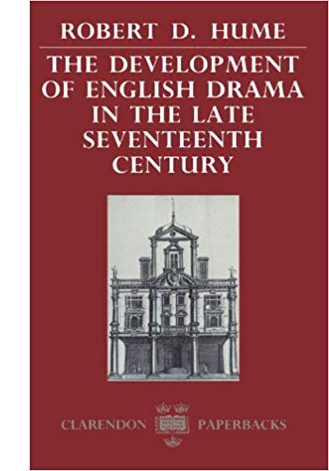
The result was The Development of English Drama in the Late Seventeenth Century (Oxford: The Clarendon Press, 1976). Its first part surveys the conventions and formulas found in subgenres of comic and serious drama (sentimental romance, horror tragedy, and many others). In the second part Rob traces the development of these types across the period.

From the standpoint of my research I was fascinated to see that Rob reveals a teeming set of variations on generic schemas. Characters, situations, and plot twists are mixed and matched. A plot based on romance leading to marriage commonly shows the couple outwitting blocking characters. Sometimes, though, the man must win the woman over. Or she must conquer him. Similarly, when extramarital seduction drives the action, a man may pursue a woman but

occasionally an amorous, often older woman is the pursuer (She wou’d if she cou’d; The Amorous Widow) or an ineffectual male, usually a henpecked husband, is a comic pursuer (Sir Oliver Cockwood in She wou’d).

In Planet Hong Kong I called this tendency of mass entertainment a “variorum” one, by analogy with editions that print all the versions of a major text.

Once a genre gains prominence, a host of possibilities opens up. Horror filmmakers are likely to float the possibility of demonic children, if only because the competition has already shown demonic teenagers, rednecks, cars, and pets. Similarly, once the male-cop genre is going strong, someone is likely to explore the possibility of a tough woman cop.

You might object that using the term “variorum” is just a fancy way to talk about the mechanical formulas of mass entertainment. But by putting the emphasis on variety within familiarity, the label points up the need for constant innovation, great or small. Fans of film genres readily recognize this churn, but what I began to realize is that it’s common as well in both folk narratives and more “industrialized” ones, like theatre and popular literature.

Monuments of scholarship like Hume’s Development remind us that the variorum principle is a primary engine of popular entertainment. The urge for novelty puts pressure on artists to try to fill every niche in the ecosystem, sometimes forcing competitors to strain for far-fetched possibilities. The wild treatment of noir conventions in Serenity is a recent example.


Beyond genre: Style and narrative

Cover Girl (1944).

Some time in the 1990s I began to realize that a lot of my research applies the variorum principle to domains outside genre. For instance, Figures Traced in Light and the last chapter of On the History of Film Style look at cinematic staging from this standpoint, showing how basic principles of staging got realized in many ways across film history. I applied the variorum principle to particular narrative techniques in some essays in Poetics of Cinema, considering the options of forking-path plots and network narratives.

Reinventing tries to trace a wide range of storytelling options as they consolidated in the 1940s. Rob Hume could study every preserved play, but I couldn’t do that for films. I managed to watch about 600. (Later entries in this blog series will mention some I missed.) Not surprisingly, I found the variorum principle at work in the narrative techniques on display.

I set out a couple of prototypes for the most common plots: the single-protagonist one (Five Graves to Cairo) and the plot based on a romantic couple (Cover Girl). Beyond those, I considered less common plot options, such as multiple protagonists and network narratives. Then I went on to consider narrational strategies that cut across all types. What strategies were available for mounting flashbacks, or expressing subjective states? In effect, I tried to reconstruct Forties Hollywood’s storytelling menu, largely independent of genre.

Another way to put this is that I was tracking norms. But the variorum principle shows that a norm isn’t just a mandate: Do this. Any normative practice is a cluster of stronger and weaker options.

These options lead to a cascade of further (normative) choices. Shoot a dialogue scene in a two-shot and you’ll need to adjust performances for viewer pickup. Shoot using a lot of close-ups and you’ll need to cut among your actors more frequently to keep everybody “in the scene”–that is, salient for the audience.

Choose a flashback and you’re forced to decide how far back to start it, what to include that’s relevant to the present action, and how to remind the audience of action that preceded the flashback. Of course you may also choose to try to make viewers forget, because you’ve misled them. That’s what happens in Mildred Pierce and Pulp Fiction.

Usually we find the variorum principle working among several films. What if creators put the principle to work within a single film?


The first day of the rest of your life

Every now and then filmmakers try out forking-path narratives. These plots, I suggest in this essay, trace out alternative futures for their characters. Blind Chance and Run Lola Run are prototypes, though there are plenty of examples earlier and later.

Sometimes the protagonist is dimly aware of the options. The protagonists of Blind Chance and Run Lola run seem to learn from their mistakes in the parallel lines of action. This can yield “multiple draft” narratives in which later story lines show characters struggling to achieve the best revision of circumstances they can.

I’d distinguish plots like these from Groundhog Day, which presents not alternative futures but identical replays of a specific time period. What makes each iteration different is that Phil, realizing he’s living the same day over and over, struggles to behave differently. This pattern has come to be called a time-loop narrative.

The time-loop and forking-path patterns usually provide only changes in the story-world elements of each track. Phil’s changing his routines takes place against a background of recurring situations. Similarly, the protagonist of Source Code gets to try out different ways to stop a train bomber.

What, though, if a looped or forking-path movie tried to survey several alternative genre conventions? That would give us a sense that the variorum idea has been swallowed up within a single film.

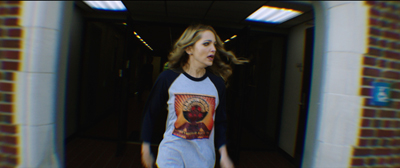
This happens, I think, in Happy Death Day. By now it’s not a spoiler to indicate that this slasher movie borrows the Groundhog Day premise and loops a single day in the life of mean girl Tree Gelbman. Each day she’s killed by a stalker in a babyface mask. Each time she dies, she awakes in the bed of Carter Davis, who brought her to his dorm room (without sexytime) to recover from a night of partying. As the days repeat, Tree becomes more desperate to avoid her fate and tries a variety of stratagems. They fail, until they don’t. In the course of them Tree learns to become a nicer person.

What’s interesting to me is that several variorum alternatives of the slasher genre are squeezed into this one film. The stalker kills Tree in a shadowy underpass, in a bedroom during a frat party, in her sorority bedroom, under a friend’s window, on a campus trail, and after chasing her through a hospital, a parking ramp, and a highway. She’s knifed, bludgeoned, hanged, run over, and stabbed with a broken bong.

Of course the shooting-gallery premise of slasher films often generates a string of variations across the film. Boyfriends, girlfriends, figures of authority, and passersby are dispatched by Jason or Freddie Krueger in ever more exotic ways. But in Happy Death Day, the sense of genre replay is heightened by Tree’s being the sole target of the ten variant homicides (one of which is a forced suicide). It’s as if we were watching a performer auditioning for screen tests in which she might be cast as one victim or another. But here the victim is always the Final Girl.

The comedy that haunts many slasher films is enhanced by the preposterous premise that Tree will survive. The deaths become vivid as replays by virtue of their tongue-in-cheek humor, as each slaying tries to outdo the earlier ones and as Tree sarcastically comments on her fate.

With the time-loop convention put into place by Groundhog Day, our interest goes beyond changes in the story world and concentrates more on narrative structure. We watch for scenes we’ve already seen, expecting them to be revised in surprising ways. The handling of the replays foregrounds film technique as well, as when in Happy Death Day Tree’s frantic walk across the quad after a late reset is rendered in distorted imagery reflecting her confusion. We register this as a variant on her earlier stride down the same route–hung-over, but not yet desperate.


One virtue of such repetitions for low-budget cinema is that the variant passages can be shot quite economically. You can save time on location by reusing camera setups, with the actors altering their performance, or their costumes and makeup. In the DVD bonus material, director Christopher Landon talks of following this production strategy. Why does low-budget cinema explore odd narrative options? They can come cheap.


Variants times 2 or 3

Happy Death Day 2U (2019).

A film series often self-consciously varies the story world that the continuing characters confront. In the studio era, Charlie Chan went to the circus and the opera, Mr. Moto got involved in a prizefight scheme, and Ma and Pa Kettle visited Waikiki. Today’s superhero franchises rely on fully-furnished, constantly changing story worlds. Back to the Future, though, launched a series that did more than present a story world that shifted from film to film. The trilogy self-consciously reorganized its plot structure and narration, with replays and alternative outcomes enabled by a time-travel premise. We’re expected to appreciate the altered replays as part of the film’s experience.

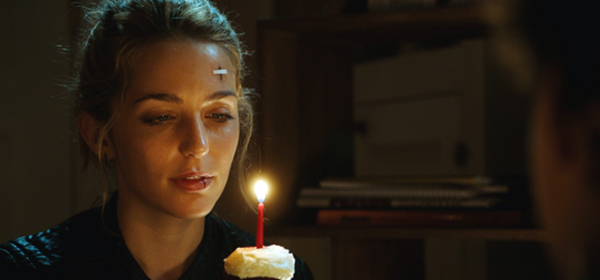
The sequel Happy Death Day 2U has just been released in that Dead Zone in which low-end American genre cinema flourishes. I have a lot to say about it, but it’s probably too soon. Still, it’s no spoiler to indicate that it offers a set of variants on the givens of the first film. For one thing, what caused the time loop of the original is now explained. The birthday motif gets elaborated via Tree’s backstory, with strong doses of sentiment. And suspects who were eliminated in the initial film step forward as plausible culprits in this one.

Just as important, there’s an added structural premise that gives the new entry an acknowledged affinity with Back to the Future II and other forking-path tales. To top things off, the second installment supplies a revised version of the outcome of the first one.

Although the sequel isn’t thriving at the box office, perhaps there will be a third entry.

I have the third movie and I have already pitched it to Blumhouse. Everybody is ready to go again if this movie does well. I keep shifting the tone, genre a little bit. The third movie I know is going to be a little different. It’s going to be really bonkers and really fun.

Bonkers or not, having another version would show that the Variorum never sleeps.


Two last points. First, a film I discussed last time, Confession (1937), internalizes the variorum impulse in a milder way, by replaying a key scene from a different character’s viewpoint. More unusually, Confession is a remarkably close remake of a German film, Mazurka, and thus constitutes a homegrown variation on the original.

Secondly, why study the variorum principle? Hume points out:

To insist on analyzing the famous writers and plays in isolation is a mistake: much may be learned by viewing them as they originally appeared–variably successful in the midst of a prolific, unstable, and rapidly changing theatre world.

So one argument is that we can best understand and appreciate masterful filmmaking against the background of normal practice. That seems right to me, but I think there are other good reasons to ask these questions.

For one thing, through bulk viewing of a lot of films, you may discover accomplished works. Many well-regarded films have gained their renown through accidents of release and critical reception. (His Girl Friday is one such.) Good films lurk in many crevices of film history.

I also think that the norms are of interest in themselves. They can show that craft practices harbor more variety than we sometimes think. Studying norms can also reveal offbeat possibilities that are sketched for future development. In Reinventing, I sometimes point to films, either obscure or awkwardly constructed or both, which anticipate trends to come. One example would be the strange, time-shifting exercise Repeat Performance (1947). It’s a Forties counterpart to Dangerous Corner (1934), a two-path plot looking toward more elaborate forking-path storytelling. It shows as well that rather unusual options can float around the edges of the variorum.


My quotations from Rob Hume come from correspondence and The Development of English Drama in the Late Seventeenth Century, pp. ix and 129. Thanks to Rob for sharing the backstory of the book’s composition. Readers interested in his method can learn much more about it in his later study Reconstructing Contexts: The Aims and Principles of Archaeo-Historicism (Oxford, 1999).

This entry relies on a distinction among a film’s story world, its plot structure, and its narration. The idea is explained in this essay and applied to a single film in a blog entry on The Wolf of Wall Street. Plots with loops and forking paths are connected with the idea that “form is the new content” in films from the 1990s and after. I try to chart that ecosystem in The Way Hollywood Tells It: Story and Style in Modern Movies. See also this entry for a quick summary of early examples of multiple-draft plotting. For more on the virtues of Charlie Chan and Mr. Moto, go here.

The following errors in the hardcover version of Reinventing Hollywood are corrected in the paperback.

p. 9: 12 lines from bottom: “had became” should be “had become”. Oops.
p. 93: Last sentence of second full paragraph: “The Killers (1956)” should be “The Killing (1956)”. Arrgh. Elsewhere on this site I discuss Kubrick’s heist film at some length.
p. 169: last two lines of second full paragraph: Weekend at the Waldorf  should be Week-End at the Waldorf.
p. 334: first sentence of third full paragraph: “over two hours” should be “about one hundred minutes.” Doggone.

We couldn’t correct this slip, though: p. 524: two endnotes, nos. 30 and 33 citing “New Trend in the Horror Pix” should cite it as “New Trend in Horror Pix.”

Whenever I find goofs like these, I take comfort in this remark by Stephen Sondheim:

Having spent decades of proofing both music and lyrics, I now surrender to the inevitability that no matter how many times you reread what you’ve written, you fail to spot all the typos and oversights.

Sondheim adds, a little snidely, “As do your editors,” but that’s a bridge too far for me. Instead I thank the blameless Rodney Powell, Melinda Kennedy, Kelly Finefrock-Creed, Maggie Hivnor-Labarbera, and Garett P. Kiely at the University of Chicago Press for all their help in shepherding Reinventing Hollywood into print.

Happy Death Day (2017).

Saturday, 2 March 2019

What’s New to Stream on Hulu for March 2019

Hulu has been stuck in the third place position when it comes to movie streaming behind Netflix and Amazon Prime because most people still see them strictly as a home for next-day television. They have movies too, though, and more than a few of them are terrific gems that make Hulu a destination beyond last night’s TV shows.

The complete list of new movies hitting Hulu this month — March 2019 — is below, but I wanted to highlight the best of the bunch along with several others worth seeking out.

Red Dots

Hulu Pick of the Month

You wouldn’t know it by the outcome of last month’s Academy Awards, but Hirokazu Koreeda’s Shoplifters (premieres 3/14) is the best foreign language film of 2018. It’s the story of an unconventional family, one made by circumstance and compassion, who live just outside the fringe of society. They’re thieves scraping by, but when they take in a neglected young child they confirm their humanity even as they risk their freedom. It’s a sweet, sad, and affecting film that will leave you crying openly with a bittersweet smile on your face.


Slipped Through the Cracks

Assassination Nation

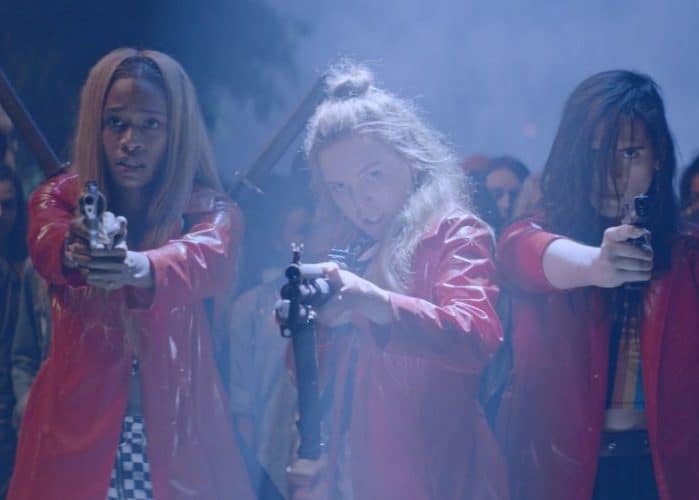
Assassination Nation (premieres 3/18) is a film designed from the ground up to find and foster division among its audience. It sees a group of boisterous, outspoken teenage girls targeted by an ignorant, morally “superior” populace after a computer hack leaves townspeople’s digital secrets revealed. It’s over the top and exaggerated for effect, but if you can make it past the first thirty minutes you’re in for an exciting cautionary tale about Trump’s America. The Domestics (premieres 3/29) is a far more traditional thriller in most ways as it introduces us to a couple struggling to survive a post-apocalyptic United States overrun by violent gangs, killers, and cannibals. It never breaks the genre mold, but it’s fantastically effective in delivering suspense, thrills, and the occasional surprise.


Going Into the Dark

Review Treehouse

Hulu’s collaboration with Blumhouse TV for the year-long Into the Dark series has seen highs (Down) and lows (Pooka), but March’s entry is happily among the former group. Treehouse is every bit a horror tale for the #MeToo era as a man’s questionable actions come back to haunt him. Jimmi Simpson and a smart script deliver plenty of laughs, but the story and theme are deadly serious and well worth a watch.


A Documentary?!

Free Solo

Documentaries aren’t typically my scene, but once in a while one comes along that tells an undeniably captivating true story. Free Solo (available 3/13) follows Alex Honnold’s journey toward an unprecedented feat — climbing Yosemite’s 3000 foot high El Capitan wall without a rope. It’s a harrowing thought made even more nerve-wracking by video of him scaling rock walls without the benefit of a safety line. It’s terrifying to watch from the comfort of your couch.


Unlikely Sequels

Basic Instinct

Several sequels are hitting Netflix this month, but two of them stand out for a couple reasons — one, I haven’t seen them, and two, it’s pretty obvious why. Basic Instinct 2: Risk Addiction (2006) sees Sharon Stone’s saucy novelist return and once again find herself suspected of wrongdoing. Sex, death, and poor decisions presumably follow. A third Legally Blonde movie with Reese Witherspoon hits theaters in 2020, but if you can’t wait until then you’ll be happy to know the direct-to-video and Witherspoon-free Legally Blondes (2009) is now on Hulu. It follows her young cousins instead as they try to prove their innocence or some such thing.


The Complete List

March 1st
Drifters: Season 1 (Funimation)
Into The Dark: Treehouse (Episode 6) Premiere (Hulu Original)
Rick Steves’ Europe: Season 10 (PBS)
8 Heads in a Duffel Bag (1997)
Abduction (2011)
Ace Ventura: Pet Detective (1994)
Ace Ventura: When Nature Calls (1995)
Alex & Emma (2003)
American Beauty (1999)
An American Haunting (2006)
Astro Boy (2010)
Basic Instinct 2: Risk Addiction (2006)
Batman Begins (2005)
Black Sheep (1996)
Blast from the Past (1999)
Boomerang (1992)
Breakheart Pass (1975)
Bruce Almighty (2003)
Bushwhacked (1995)
The Chumscrubber (2005)
The Cider House Rules (1999)
The Crying Game (1992)
The Dark Knight (2008)
Death at a Funeral (2007)
Deuces Wild (2002)
Dirty Work (1998)
The Dogs of War (1981)
Double Jeopardy (1999)
Easy Rider (1969)
Edward Scissorhands (1990)
Fire in the Sky (1993)
The French Lieutenant’s Woman (1981)
He Named Me Malala (2015)
Heaven’s Gate (1981)
I, Dolours (2018)
The Ice Storm (1997)
Impostor (2001)
Inventing the Abbotts (1996)
Ironweed (1987)
It’s Arbor Day, Charlie Brown (1976)
JFK (1991)
Jumanji (1995)
Legally Blondes (2009)
Lego Batman: DC Super Heroes Unite (2013)
Lego DC Comics Super Heroes: The Flash (2018)
The Mighty Quinn (1989)
Nacho Libre (2006)
Not Another Teen Movie (2001)
Office Space (1999)
Open Season (2006)
Open Season 2 (2009)
Open Season 3 (2011)
Open Season: Scared Silly (2016)
Ouija House (2018)
Ouija Séance: The Final Game (2018)
Perfect Creature (2005)
The Piano (1993)
The Pope of Greenwich Village (1984)
Rambo III (1988)
Reasonable Doubt (2014)
Red Corner (1997)
Red Dragon (2002)
Regarding Henry (1991)
Return of the Living Dead 3 (1993)
Return of the Living Dead 4: Necropolis (2006)
Return of the Living Dead 5: Rave to the Grave (2007)
River’s Edge (1987)
S.F.W. (1995)
Saved! (2004)
Shaolin Warrior (2013)
Small Soldiers (1998)
Summer Catch (2001)
Tapeheads (1988)
Toys (1992)
Tristan & Isolde (2003)
Two Weeks Notice (2002)
Vice (2015)
W. (2008)
Waterworld (1995)
What a Girl Wants (2003)
What Lies Beneath (2000)
What’s the Worst That Could Happen? (2001)
Witness (1985)
Yes Man (2008)

March 4th
American Idol: Season 2 Premiere (ABC)
Cosmos: Possible Worlds: Series Premiere (FOX)
Good Girls: Season 2 Premiere (NBC)

March 5th
The Closet (“Le Placard”) (2001)
A Frozen Christmas 3 (2018)
Where Hands Touch (2018)

March 6th
MasterChef Junior: Season 7 Premiere (FOX)
Mental Samurai: Series Premiere (FOX)

March 7th
Dudes (1987)
Rock ‘n’ Roll High School (1979)
Suburbia (1983)

March 8th
Hang Ups: Complete Season 1 (Fremantle)
I Can Only Imagine (2018)
A.P. Bio: Season 2 Premiere (NBC)
For The People: Season 2 Premiere (ABC)

March 9th
Keeping Up with the Kardashians: Season 15 (E!)

March 10th
Black Clover: Season 1 (Dubbed) (Funimation)
Middle Men (2009)

March 11th
The Party’s Just Beginning (2018)

March 12th
Acrimony (2018)
Trigger (2018)

March 13th
Free Solo (2018)

March 14th
Shoplifters (2018)

March 15th
The Fog (2005)
Like Water for Chocolate (1992)
No Way Out (2018)
Shrill: Season 1 Premiere (Hulu Original)
Wings of the Dove (1997)

March 16th
Tea with the Dames (2018)

March 17th
Divide and Conquer (2018)

March 18th
Assassination Nation (2018)

March 19th
Fear the Walking Dead: Season 4 (AMC)
A Frozen New Year’s (2018)
Juda: Season 1 (Banijay)
The Fix: Series Premiere (ABC)

March 20th
The Act: Series Premiere (Hulu Original)
Girl Most Likely (2013)
The Village: Series Premiere (NBC)

March 21st
The Last Race (2018)
Pretty Little Liars: The Perfectionists: Series Premiere (Freeform)

March 22nd
Cardinal: Season 3 (CTV)

March 24th
Catfish: Season 7, Episodes 1-28 (MTV)

March 26th
A Cam Life (2018)
Dr. K’s Exotic Animal E.R.: Season 7 Premiere (National Geographic)

March 27th
Monsters and Men (2018)

March 29th
Abby’s: Series Premiere (NBC)
The Domestics (2017)

March 30th
Chef Flynn (2018)

Red Dots

Follow all of our monthly streaming guides.

The post What’s New to Stream on Hulu for March 2019 appeared first on Film School Rejects.

‘Treehouse’ Review: Sometimes You Have to Go Into the Dark to Reach the Light

The year-long Blumhouse/Hulu collaboration has reached the halfway mark, and while the first four episodes of Into the Dark have been a mixed bag at best the series stepped up its game with last month’s battle of the sexes in the elevator-set Down. That trend, both in content and quality, continues for March with the the best entry yet. Treehouse is a funny and fast-moving tale of comeuppance with surprising story turns, a memorable lead performance, and some real heart.

Peter Rake (Jimmi Simpson) is a celebrity chef with books, restaurants, and a TV show to his name, but he also has some trouble brewing in the form of unspecified accusations his lawyer is working hard to settle. He’s divorced and shares custody of a young daughter, but looking for an escape from the noise Peter heads to his family’s country estate for the weekend to spend time with a sister he hasn’t seen in a few years. A group of women renting a house nearby catch his eye, but his efforts to woo them run into unexpected obstacles including stray animals, mysterious figures, the betrayal of his own body, and some angry reminders from his past.

Director/co-writer James Roday, he of Psych (2006-2014) fame, takes the holiday themed series in an unexpected but welcome direction — leprechaun horror was right there! — with the concept of the Ides of March. As applied here the term refers to a day set aside for the settling of long-standing debts, and it’s that particular nightmare that Peter finds himself immersed in. The film opens with a breezy attitude introducing Peter as a “bad boy” chef who loves his daughter, enjoys his freedom to insult people under the excuse of a joke, and has something of an old-fashioned attitude about women. He’s a likable enough guy if you didn’t know better, and it’s there where the film comes into focus.

Peter’s night goes from the high of hosting several young women for dinner in the hopes of flirting, impressing, and maybe even bedding one or more of them to the low of realizing why they’re really there. His actions, both past and present, demand reckoning, and like so many men before him he has answers, excuses, and defenses aplenty that only result in the heat and terror being turned up even higher.

One question the film raises is the idea of forgiveness, and another is the prospect of change. Today’s world seems to offer very little opportunity for either as online mobs are so quick to pounce and denounce anyone who crosses the line, and the fast-moving world of social media has shown itself again and again uninterested in the possibility that someone might better themselves and make restitution. It’s all about the punishment, and the film puts an interesting spin on that reality.

The Blumhouse TV budget has kept the series in check so far when it comes to cinematography and visuals, and that television feel remains here, but Roday takes full advantage of the California landscape and the large house’s grounds ensuring that his very timely nightmare unfolds against an attractive backdrop. He also manages the single creepiest image of the series so far when Peter is visited by a terrifying-looking being that walks through his front door.

The message of Treehouse rarely strays from being pretty on the nose — the shit men have gotten away with since the beginning of humanity was never okay, whether done in jest or true maliciousness, and it ends now — but the theme is wrapped up in an entertaining and occasionally very funny package. Several of Peter’s comments earn a chuckle thanks as much to the writing as to Simpson’s ace delivery, and some of them challenge the viewer for having that response. The quest for laughs does push too hard and at the wrong time here and there, but it works with this character more often than not.

As fun and creepy as it gets, though, the episode also delivers two powerful dialogue beats that hit hard with both purpose and intent. One comes at the end of the film, but the other is delivered by Agnes (Nancy Linehan Charles), the family’s housekeeper of many years approves of the young women’s celebration but cautions never to forget past pains. “Something terrible happens to a woman, and it just lives in you,” she tells them, and it’s likely she’s speaking more than metaphorically. Charles is quite memorable in the small role thanks to smart comic timing and the way she carries the weight of past misdeeds on her seemingly frail frame. The women (including Julianna Guill, Mary McCormack, and Brooklyn Nine-Nine‘s Stephanie Beatriz) represent all those he’s crossed paths with throughout his life, and they each stand tall as a jury to his crimes.

Treehouse is going to lose some viewers through its tone and outcome (not to mention the inevitable label of “#metoo horror”), but it entertains regardless of how well its message lands. Simpson finds wit and humor in his character’s pre-hell existence, the supporting players walk a fine line between playful and threatening, and the film leaves viewers with an emotional punch. Odds are it won’t be the last swing in this particular battle.

The post ‘Treehouse’ Review: Sometimes You Have to Go Into the Dark to Reach the Light appeared first on Film School Rejects.
‘Dragged Across Concrete’ Review: An Unapologetic, Provocative Crime Opus

Since bursting onto the scene with Bone Tomahawk in 2015, S. Craig Zahler has made a name for himself as a distinct storyteller and provocateur. He makes slow-paced, character-driven exploitation movies that are peppered with eruptions of brutal violence and questionable politics. It goes without saying that they aren’t for everyone, but he’s garnered a dedicated fan base in that time. With his latest opus, Dragged Across Concrete, he’s delivered another slice of slow-burn pulp that’s bound to divide audiences and cause some controversy. That was always going to happen, though.

The story follows detectives Brett Ridgeman (Mel Gibson) and his partner Anthony Lurasetti (Vince Vaughn), who find themselves suspended without pay for six weeks after a video of them strong-arming a Latino perp finds its way to the media. Without money to live on or much luck in the way of future job prospects, they decide to turn to the life of crime and put their skills to effective use. However, this puts them on a collision course with gang-bangers Henry (Tory Kittles), Biscuit (Michael Jai White), and some ruthless masked killers, all of whom are also out to get paid and aren’t willing to split the profits.

From this foundation, Dragged Across Concrete presents a multidimensional narrative featuring an array of protagonists and antagonists who all receive ample attention. The plot isn’t complex at all, but the movie spends the majority of the running time getting to know its characters in-depth, including those who add no real significance to the overall story. Some throwaway characters are given a big introduction only to be met with a swift, sudden, merciless demise, but moments like this are what makes Dragged Across Concrete so compelling: even the bit-part members of its populace feel like three-dimensional human beings, and their brief stories are worth our emotional investment.

Zahler is also a master when it comes to humanizing some pretty morally questionable folks. Every backstory here is a tale of people trying to escape a rut, and the actions and motivations of these criminals are given strong justification and sympathy. This is a movie that wants us to root for two opposing factions who will eventually come to blows with each other. Don’t be surprised if you find yourself hoping that everyone finds their happily ever after.

A substantial portion of the breezy 159-minute running time revolves around our corrupt dicks sitting in cars, staking out their targets, exchanging buddy cop lingo, and eating sandwiches. Like all good heist movies, the crime is carefully planned before the real action commences. When shit eventually hits the fan, we’re treated to thrilling shootouts and bloodshed. Despite being the most violently-titled film in Zahler’s oeuvre, though, it’s his least gruesome project yet. Of course, that doesn’t mean it’s tame either, as limbs are blown off and people are disemboweled, but it’s not quite as depraved as his previous outings. Still, gorehounds won’t be disappointed by any means.

Unfortunately, we can’t discuss a Zahler movie without mentioning its potentially offensive aspects. Bone Tomahawk is a western which features white heroes on a quest to butcher Native cannibalistic savages. Brawl In Cell Block 99 centers around a white patriot who beats up minorities to prevent a Korean abortionist from killing his unborn baby. Elsewhere, Puppet Master: The Littlest Reich, which he wrote, is a gore-fest about Nazi puppets laying waste to marginalized groups. While Zahler has repeatedly stated that he’s fascinated with writing material that makes him feel uncomfortable, it’s completely understandable why some people think he’s a right-wing filmmaker.

Dragged Across Concrete contains its fair share of politically incorrect and confrontational moments, too. There’s a scene where Ridgeman and Lurasetti’s lieutenant (played by Don Johnson) compares accusations of racism in the modern age to those of communism in the ‘50s. Characters also criticize gender politics and make throwaway racist jokes (“I order a dark roast every Martin Luther King Day.”). That’s to name a few scenes, and naturally, this has led some reviewers to condemn the movie as a racist, right-wing fantasy.

However, Zahler’s work is much more nuanced than his naysayers would have you believe. Go read his novels and countless unproduced screenplays for a wider picture. Dragged Across Concrete, however, is his best work to-date for presenting a world of conflicting ideologies and characters with differing viewpoints. A film featuring police brutality that stars two outspoken Hollywood conservative actors as antihero cops has already led people to make assumptions that this is something that it’s not. Maybe the casting is a tad on-the-nose, but the movie doesn’t have an agenda that endorses the behavior of the characters or the politics of the actors playing them.

The only overarching viewpoint in Dragged is nihilism. We’re introduced to characters from all walks of life — ranging from vile racists to underprivileged people of color — who have been dealt a crappy hand in life, which causes them to do bad things to better their respective situations. The film’s worldview is one of bleakness and misfortune for everyone whether they’re cops, sympathetic crooks, or everyday civilians. It’s not a pleasant world to be in, but it is a compelling one that leaves us with plenty to ponder

If there’s one thing Zahler is great at it’s bringing out the best in his performers. The performances are excellent across the board here. Gibson and Vaughn have great chemistry together as our buddy cop duo, and they’re given some terrific hard-boiled dialogue to work with. However, it’s Gibson who steals the show as a chain-smoking, weathered, sympathetic macho man who’s unable to change with the times. Say what you will about the man himself, but few actors play tortured and worn out as well as him. Kittles is another standout, and he’s also given some terrific novel-esque dialogue to chew while stealing every scene he’s in.

Ultimately, Dragged Across Concrete is a movie that’s going to stir some controversy and incite a flurry of opinions on all sides of the political debate. Movies that operate in this kind of moral grey area inspire all kinds of interpretations, and that was probably Zahler’s intention from the get-go. It’s also further proof that he’s a filmmaker who marches to the beat of his own drum, and one who’s unafraid to challenge the moral positions of his audience. Whether it’s strong appreciation, hateful ire, or frustration, this movie will inspire some loud reactions.

Still, if you just want to see a great crime epic that cares more about telling a great story than promoting an agenda, you’ll want to check out Dragged Across Concrete. It’s going to be a contender for the best of 2019 when it’s all said and done, even if some viewers will feel guilty about enjoying it so much.

The post ‘Dragged Across Concrete’ Review: An Unapologetic, Provocative Crime Opus appeared first on Film School Rejects.
Watch ‘The Boy Who Harnessed the Wind,’ Then Watch These Movies

He’s been nominated for an Oscar, holds CBE status as bestowed by the Queen, and he co-starred in the Marvel Cinematic Universe. But what Chiwetel Ejiofor really wanted to do is direct. Well, it’s one of the many things he’s wanted to do in his career, and now more than a decade after his directorial debut with a short called Slapper, he’s finally made the leap to feature filmmaking with the Netflix Original drama The Boy Who Harnessed the Wind, in which he also stars.

Based on a true story, which had already been documented in a nonfiction film, and inspired by both Ejiofor’s heritage and his favorite film of all time, this new streaming title has a lot of roots worthy of recognition. Below is a list of some of these roots, movies to watch after you see The Boy Who Harnessed the Wind. Some of them are directly linked to the story and this production and others are titles I was reminded of while enjoying the inspiring and dignifying film about a young man saving his village.

Queen of Katwe (2016)

It may seem ignorantly convenient to compare William Kamkwaba, the hero of The Boy Who Harnessed the Wind, and Phiona Mutesi, the main character of Queen of Katwe. They’re both from eastern nations in Africa, both grew up in poverty, found something they excelled in that gained them international fame, and wound up in American universities yet still gave back locally to their places of origin, where they still call home. They have a lot of differences, too, of course, most prevalently in that Kamkwaba’s claim to fame is building wind turbines and Mutesi’s is playing chess.

Queen of Katwe is a bit more of a feel-good movie, but it’s still not the fluff you’d expect for it being a Disney production. What’s great about both The Boy Who Harnessed the Wind and Queen of Katwe is there’s no attempt at whitewashing or otherwise disrespecting the setting and culture of their stories. They’re both even filmed in the real places where their heroes hail from. Sure, they’ve got Oscar-caliber movie stars in parental roles, but fortunately these days there are persons of color in this industry famous enough that you don’t need a made-up white savior role or anything like that. They’re faithful as can be without being the documentary versions (which exist for both, too).


William and the Windmill (2013)

Here is that documentary version of The Boy Who Harnessed the Wind. Had I realized that Ejiofor’s movie was coming out and had I known what it was about, I probably would have recommended William and the Windmill on my list of movies to watch before you see the new releases of 2019. But it’s fine that I didn’t, because the dramatic telling of Kamkwaba’s life is not quite a remake of the nonfiction film. William and the Windmill follows Kamkwaba after he’s become known for his first wind turbine, so the earlier documentary is kind of a sequel to the new biopic.

As a follow-up, fans of Ejiofor’s movie might be disappointed to see that the happy ending of that story turns into a less than joyous. Director Ben Nabors follows Kamkwaba through TED Talks and a book tour and on his way to Dartmouth for his eventual studies far from his home in rural Malawi. It’s not exactly a miserable existence for the science whiz, but it’s a lot of limelight pageantry for a rather humble figure who’d rather be doing more than talking about what he’s done and will do. For a recent compliment, check out On Her Shoulders, which follows now Nobel Peace Prize winner Nadia Murad being paraded through public appearances and the occasional moments where she actually gets to perform active activism rather than a ceremonial sort.


Columbite Tantalite (2013)

Ejiofor’s first short film isn’t available anywhere (that I can find anyway), but his second film might be more relevant to his feature debut anyway. Columbite Tantalite, which isn’t nearly as straightforward a narrative as The Boy Who Harnessed the Wind, is concerned with another part of Africa: the Democratic Republic of Congo. The nearly 13-minute film is almost more of an essay in response to the actor’s having portrayed Patrice Lumumba in a production of A Season in the Congo at London’s Young Vic theater. It spotlights soldiers in the past and a video game developer in the present, linking their lives through the titular resource used for all electronic gadgets today. Watch it here:

Ejiofor says of the idea for his film in his introduction for The Guardian:

“Coltan is with us almost everywhere we are – in smartphones, laptops, desktop computers, games consoles – but few people have heard of it. And its story reaches back directly to Congo, where the mining industry has been linked with everything from bankrolling civil wars in the region to the destruction of gorilla habitats. In full, coltan’s name is columbite-tantalite, after Tantalus, the figure in Greek mythology who was condemned to a horrifying eternal torment, of the things he most desired being just out of his grasp. For many people in Congo, that’s exactly what coltan is – close enough to touch, but its riches out of reach. Like copper at the birth of the electrical age, rubber during the era of automobiles, diamonds for as long as they have been mined, it’s a substance that Congo has supplied to other countries, and which, for all the wealth it generates, has turned into a kind of curse. I knew then that I had the nugget of an idea. And the title for the film.”


The Man Who Stopped the Desert (2010)

Now we move to another part of the continent for the documentary The Man Who Stopped the Desert. There’s a similar structure to the title of this film and The Boy Who Harnessed the Wind. That’s probably only a direct coincidence, as the films do likely have kindred storytelling origins. The Man Who Stopped the Desert, which like William and the Windmill is distributed by Journeyman Pictures, is about Yacouba Sawadogo, a farmer in Burkina Faso who began experimenting with soil rehabilitation in the 1970s and helped transform his region’s terrain so that it wouldn’t just become part of the Sahara. Part of what he sought to do was what Ejiofor’s father complains isn’t being done in his area, where forest are sold off despite their natural importance.

The Man Who Stopped the Desert‘s heavy use of dramatization makes for a slightly corny tone but because of the technique, we may never need a full-on biopic of Sawadogo the way we now have one of Kamkwaba. Fans of this doc and Sawadogo’s story, though, might want a sequel at some point. The ongoing conflict between the man and local urban expansion would allow for another compelling narrative. So far, director Mark Dodd has kept tabs on Sawadogo’s developments but for his follow-up, he made Ethiopia Rising: Red Terror to Green Revolution, which profiles a similar man, Aba Hawi, working toward transforming his environment and saving his own village.


Gale Wamkulu: The Great Dance (1991)

One of the best things about The Boy Who Harnessed the Wind is the continual appearance of the Gale Wamkulu, a sort of secret cult of the Chewa people that wears incredible masks and costumes and performs a dance, also known as the Gale Wamkulu. One legend says they’re the spirits of ancestors. Regardless, their thing is a ritual signifying the initiation of young men into adulthood, and they’re also relevant to harvests and may be a part of other kinds of celebrations and events. In Ejiofor’s film, they’re a motif as well as an honored inclusion of local culture. This anthropological short puts them in the spotlight.


Harvest: 3,000 Years (1976)

Haile Gerima’s Ethiopian classic might not be the easiest film to find, but it can be located in the archives at UCLA (where Gerima studied) or BFI, through which Ejiofor managed to watch it, or at festival and other special event screenings. Although you wouldn’t know it by their difference in tone and style, the black-and-white 16mm experimental-documentary-like film Harvest: 3,000 Years was one of the biggest influences on The Boy Who Harnessed the Wind. The story here is specifically about a class feud between a landowner and peasants, but it’s really a portrait of the people and place and culture Gerima came from, albeit now in the midst of a civil war following the overthrow of Haile Salasee.

Speaking to The Guardian about the film and its director, Ejiofor said:

“I could watch that film every day for 1,000 years. I actually went to meet Gerima in Washington to talk with him and get his advice. He was very moved that William was stressed by the conditions of his family, and he said that was the heart of his motivation, that somehow subconsciously he was aware that these conditions were wrong, that something was broken in the expression of humanity. His motivating energy was to reconnect with what things should be.”


Distant Thunder (1973)

I knew that I wanted to recommend something by Satyajit Ray on this list, if only because he’s the first filmmaker I think of for movies about Third World rural living. Also, Ray was heavily influenced by Ejiofor’s favorite film (see below). Distant Thunder is one that’s relevant for its hardships caused by famine, and it’s also not one of his best-known works.  The drama is set during World War II, specifically focused on the Bengal famine of 1943. It’s not too much of a stretch, even if the comparison is on different scales, to note that then the global war had an influence on the deadly famine while for the famine in Malawi was certainly overlooked on the world’s stage given, as is teased in The Boy Who Harnessed the Wind, the aftermath of 9/11.

Distant Thunder, a rare color film from Ray, is about the pressures of the famine on one village and its new Brahmin and his family. Like what we see in Ejiofor’s film, here is a look at what the disaster and its resulting starvation do to people. Desperation leads to rioting, looting, killing. The once but briefly privileged Brahmin is made humble by the socially leveling conditions. It’s a far more daunting film than The Boy Who Harnessed the Wind, which gets close but never really reaches the kinds of stakes that should be shown in a film dealing with famine. Of course, millions died during the Bengal famine compared to hundreds in Malawi, but either way it’s a tragedy and displayed more seriously by Ray.


A Leak in the Dike (1965)

Imagine if you got Charlie Brown drunk and then had him recite the legend of the little Dutch boy who plugged up a dike with his finger. The animated short film A Leak in the Dike is like an episode of Drunk History but the storyteller is some silly child who ignorantly says things like “they got him plastered in Paris” and “gobblestone street” and — “because this is a family show” — “Amsterdarn” instead of Amsterdam. What does this ridiculous cartoon have to do with The Boy Who Harnessed the Wind? Well, Amsterdam is known for their windmills… also, the legend of the little Dutch boy who plugged up the dike is one of the most famous stories, made-up or not, about a boy saving his town through some sort of inventiveness. Watch it here:

There’s an earlier animated short film that tells the story and stars Casper the Friendly Ghost (Dutch Treat) as well as an even earlier newsreel film about the commemoration of the story in the form of erecting a statue in honor of the fictional hero. That one is called Dutch Boy at Dike is Immortalized. But Jack Mendelsohn’s A Leak in the Dike, which was unsuccessfully submitted for Oscar consideration, especially leans heavily into that fairy tale and nursery rhyme aspect of the kind of story we hear growing up regarding heroes like the Dutch Boy and William Kamkwaba, but as Ejiofor has stressed and as is obvious with his film, “there is no African fairy tale.”


Bicycle Thieves (1948)

Bicycles are significant to Kamkwaba’s story, from the realization made with his teacher’s bike to the need for parts from his father’s bike at the end. But that’s not why this iconic Italian neorealist film by Vittorio De Sica is on this list. Bicycle Thieves is also Ejiofor’s other regularly cited influence on The Boy Who Harnessed the Wind. In fact, it’s Ejiofor’s favorite movie, as he’s been claiming for years. He’s called it a “perfect film.” He also admitted to the Guardian that it was only later in life that he saw it in its entirety, and then again and again. In a write-up of “the film that changed my life,” he wrote:

“‘Bicycle Thieves’ now influences how I see other stories. I suppose I’ve started to measure other films and scripts against it. Thinking about it, before seeing this film I perhaps didn’t look for themes as much; I previously might have looked for good characters and a compelling story. But Bicycle Thieves taught me that a strong reliance on themes can enrich a narrative. I think about the film a lot – it’s certainly enhanced my life and I like the idea of emulating some of its qualities in my future roles.”

He’s also apparently emulating its qualities in his directorial efforts, as well. Talking about his new film, Ejiofor has specifically referenced this heartbreaking father and son drama about a man whose livelihood, in the form of his bicycle need for his work, is stolen. He told the Guardian (yeah, them again) in a recent interview:

“I started looking at Vittorio De Sica’s ‘Bicycle Thieves,’ a film that I’ve always loved. I felt like that neorealism had such a resonance for me. Post-war Italy dealing with all that poverty, that broken structure, and yet this father and son at the center of it finding this new space to communicate and express themselves was a very influential story, not to mention the bicycle at the center.”

The post Watch ‘The Boy Who Harnessed the Wind,’ Then Watch These Movies appeared first on Film School Rejects.
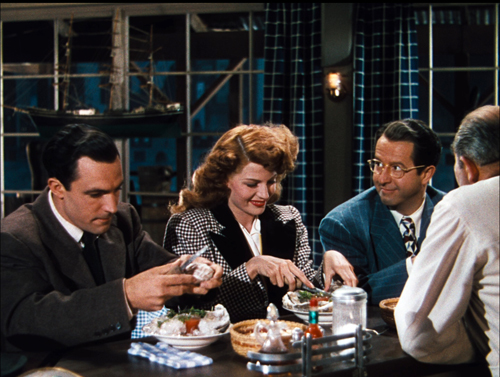
Copyright © Cinenus | Powered by Blogger

Design by Anders Noren | Blogger Theme by NewBloggerThemes.com