The film industry in one place - Articles, Reviews, trailers and hype!

Wednesday, 21 July 2021

A Brief History of NBA Players in the Movies

Brief History is a column that tells you all you need to know about your favorite — and not so favorite — pop culture topics. This entry looks at some of the best movie performances by NBA players.


Space Jam: A New Legacy, perhaps more commonly referred to as Space Jam 2, is here. The sequel stars Los Angeles Laker LeBron James as a fictionalized version of himself. After attending a pitch meeting at Warner Bros., he and his son become trapped in the “Serververse” by an AI villain named Al-G Rhythm. And similar to the plot of the first Space Jam, which stars pro basketball icon Michael Jordan, James must win a high-stakes game. Naturally, he also assembles the Looney Tunes cartoon characters to play for his team.

That movie’s release comes on the heels of an announcement that Uncut Gems will enter the Criterion Collection in October. The film is about a jeweler and degenerate gambler. One day, NBA great Kevin Garnett visits the jewelry store and becomes infatuated with a rare black opal imported from Ethiopia. Garnett borrows it, excels in his next game, and comes to believe the opal is the reason for his success. By the end, the jeweler obtains the money to pay off his debts, but instead of taking the easy way out, he decides to place a bet on a three-way parlay centered on Garnett’s performance in the NBA playoffs. 

James, Jordan, and Garnett are only a few of the many NBA players who have graced the big screen over the years. It makes sense: rhythm, movement, and style are just as important to cinema as they are to the game of basketball. While no history of the relationship between the NBA and the movies could be contained in a single article, in honor of both Space Jam 2 and Uncut Gems being in the news this week, here is a brief history of some of the NBA players who have made their way into the movies:


Jamaal Wilkes in Cornbread, Earl and Me

Today, many appearances in movies by professional athletes are limited to comedies, either in supporting roles or one-liners in cameos. But in 1971, Jamaal Wilkes, a future member of the Basketball Hall of Fame, took on a leading role in a movie that deals with systemic racism and police brutality head-on.

Cornbread, Earl and Me follows the story of Nathaniel “Cornbread” Hamilton (Wilkes, credited as “Keith Wilkes”), a standout basketball player and the first in his neighborhood to receive an athletic scholarship. Mere weeks before Hamilton is set to enroll, however, he is mistaken for another man by the police and is murdered in the street. After his death, the film follows the trial in court and shows a community full of leaders and witnesses willing to lie, rewrite history, and protect those in power.

“Cornbread’s fate says you can get straight-A’s, never commit a crime, mentor kids at an afternoon program, and have a vice as tame as constantly playing basketball and you can still get shot down in the same manner as the worst criminal in your neighborhood,” writes film critic Odie Henderson in a powerful personal essay about the movie. “And it’s all because of where you live and what you look like. Rather than admit a mistake, the city will cover it up and blame you, assault and destroy your character, so they can close a case.” 

After the murder of George Floyd by Minneapolis police officers in 2020, many NBA players were criticized for their vocal support of the ensuing protests, Black Lives Matter, and calls for police reform. But as many journalists and historians noted, the role of NBA players in the fight for social justice and civil rights — and many professional athletes more generally — is nothing new. And one need look no further than Wilkes’ compelling performance in Cornbread, Earl and Me. 


Dr. J in The Fish That Saved Pittsburgh

Long before Michael Jordan went pro, let alone starred in Space Jam, there was Julius “Dr. J” Erving, whose speed, dunks, and class helped define the sport in the ’70s and ’80s. In 1979, the NBA player starred in the movie The Fish That Saved Pittsburgh. Here’s the hilarious premise: the ball boy of a losing professional basketball team seeks advice from an astrologer and comes up with a plan to create a team of only players with the same astrological sign as their star, Moses Guthrie (Erving). They become the Pittsburgh Pisces, and with their off-the-charts chemistry, they make a championship run.

During one scene, Erving goes to a playground and dunks for a few minutes. It’s pretty damn cool.

In a 2013 interview, Bill Simmons asked Erving about one of the film’s then-looming curiosities. At the climax of The Fish That Saved Pittsburgh, Guthrie’s team faces off against a Los Angeles squad headed by NBA Legend Kareem Abdul-Jabbar, who, Simmons notes, disappears halfway through the game. 

“On the set that day,” Erving says after many laughs. “He got pissed about something … so he takes the director’s chair, and he slams it on the court. He slams it and he walks out.” Erving said Abdul-Jabbar often suffered from migraines and deserves “a Mulligan” for the incident, adding, “I think he’s gotten over it.” 


Kareem Abdul-Jabbar in Airplane!

The ’80s saw some of the most famous big men in NBA history take on big-screen movie roles that had nothing to do with basketball. Perhaps the most famous pre-Space Jam performance in a movie by an NBA player came in 1980 when the aforementioned Kareem Abdul-Jabbar starred as co-pilot “Roger Murdock” in Airplane!.

In one of the comedy’s best scenes, a young boy visits the cockpit and recognizes “Murdock” as Abdul-Jabbar, who insists he isn’t the NBA player. But the kid is persistent. “My dad says you don’t work hard enough on defense,” the kid goes on. “And he says that lots of times you don’t even run down the court. And that you don’t really try, except during the playoffs.” This cracks Abdul-Jabbar, who mutters, “The hell I don’t.” He grabs the kid by the shirt and says, “Tell your old man to drag [Bill] Walton and [Bob] Lanier up the court every night for forty-eight minutes.”

The role is among the most iconic sports cameos in film history. It’s brilliant in the way it blends Abdul-Jabbar into the world of the movie without pretending he is anyone else. In doing so, it pokes fun at the general absurdity of celebrity cameos without condescension. 

“I mean, he couldn’t have been better in a million years as far as being what we were looking for,” director Jim Abrahams told The A.V. Club as part of their oral history of the film. “He wasn’t supposed to be able to act. [Laughs.] So that just played into it all the more. But he’s a really bright, fascinating man. He’s the original Renaissance man and just a very interesting guy. Basketball never defined him, ever. Not even during his heyday. He was about a lot more stuff than just basketball.”


Wilt Chamberlain in Conan the Destroyer

Wilt Chamberlain, who holds the record for most points in a single game, made his big-screen debut in Conan the Destroyer. The title character (played by Arnold Schwarzenegger) must complete a quest in order to be reunited with his lover. Joining him is Bombaata (Chamberlain), who has secretly been ordered to murder Conan once the quest is complete. Eventually, Bombaata’s treachery becomes clear, and after a confrontation, the men engage in a bloody duel to the death. If you’ve ever wanted to watch the former governor of California kill one of the all-time best NBA players — in a movie — this is your chance.


Michael Jordan et al. in Space Jam

If you were a movie-going NBA fan in the ’90s, you were in heaven. In addition to the great Air Jordan, the original Space Jam features a number of basketball pros, including Larry Bird. In fact, it’s while golfing with the Celtics legend that the chaos of Space Jam beings, when Jordan is sucked into the world of Looney Tunes through a golf hole.

The movie also features a number of other NBA players: Charles Barkley, Shawn Bradley, Patrick Ewing, Larry Johnson, and Muggsy Bogues. Their talents are stolen by the movie’s villains, the “Nerdlucks,” who morph into basketball-playing monsters. The Nerdlucks become “Monstars” and then play the Looney Tunes characters in a game of basketball. If the Monstars win, then the Looney Tunes must become amusement park attractions on their home planet.

As is noted in the 2020 Michael Jordan documentary series The Last Dance, the year of the first Space Jam‘s release marked Jordan’s return to the NBA after a brief stint as a minor league baseball player. A highlight of the ten-part doc for me was learning that Warner Bros. built a full basketball court on set so Jordan could train during the shoot, and many NBA greats of the ’90s traveled to the set to scrimmage. Jordan went on to win three more championships. I wonder if the players regretted helping him return.

Next Page

Shot by Shot with ‘The Last Duel’ Trailer

Welcome to Shot by Shot, our ongoing series of movie and TV trailer breakdowns. We’re constantly scouring for perfect shots, and in this column, we share our favorites and discuss them. In this entry, we cross blades as we cut into The Last Duel trailer.


If you’re looking to get a big historical costume drama on-screen, you merely need to pique Ridley Scott‘s interest. The director can’t shake his costume habit, and we can’t shake the director. His latest movie, set in 14th century France, during the Hundred Years’ War, reunites Scott with sweeping vistas and hordes of extras caked in mud and blood. Based on a true story, The Last Duel depicts the last “trial by combat,” a legally sanctioned fight between the knight Jean de Carrouges (Matt Damon) and a squire, Jacques Le Gris (Adam Driver), after Carrouges’ wife, Marguerite (Jodie Comer), accuses Le Gris of sexual assault.

The clashing of swords resolves the dispute. If Carrouges comes out the victor, God has decreed Marguerite righteous, and his honor will be restored. If Le Gris wins in combat, God has condemned Marguerite’s lies, and she must burn at the stake. Presiding over the match is Count Pierre d’Alençon (Ben Affleck). He is a supporting character in the movie but a critical figure during the Hundred Years’ War. Before these events, he was held hostage by the British for nearly fifteen years until he was exchanged for King John after the Battle of Poitiers.

Watch the new trailer for The Last Duel here:

A lot of concern swarmed The Last Duel during its production. One, due to its grim subject matter, some thought Disney would sell the property after their Fox merger. Two, it’s a screenwriting reunion for Damon and Affleck, who won the Oscar for Best Original Screenplay in 1998 for Good Will Hunting, plus a bonus partnership with Nicole Holofcener, who earned an Oscar nomination for Best Adapted Screenplay for Can You Ever Forgive Me? in 2019. Three, the massive movie was forced to halt production amidst Covid, and getting such a beast back up and running was a colossal endeavor.

All of that falls by the wayside now that the trailer for The Last Duel is here. What we witness in the shots below is Ridley Scott doing what he does best: trapping actors in wretched history and having them match their epic setting with grandiose performances. While these particular Scott vehicles don’t always pan out, we’re hoping for a Gladiator or Kingdom of Heaven (director’s cut, of course) rather than a Robin Hood or Exodus: Gods and Kings.


The Last Duel Trailer Shot

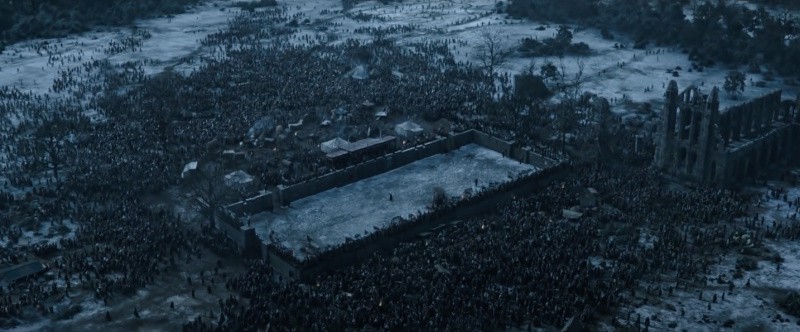
The Last Duel trailer starts small with Marguerite being accosted by the only question that matters: “Do you swear on your life that what you say is true?” The movie reveals itself in tiny strips over black. We’re in prison with her until the trailer blows open, and we are buffeted by Ridley Scott violence. This first wide shot, depicting the surge of humanity rushing toward the combat arena, reveals our hunger for supervised bloodshed. We can’t control the royal whims that dictate our fate, but we can happily munch on snacks and watch these lords do each other in.


The Last Duel Trailer Shot

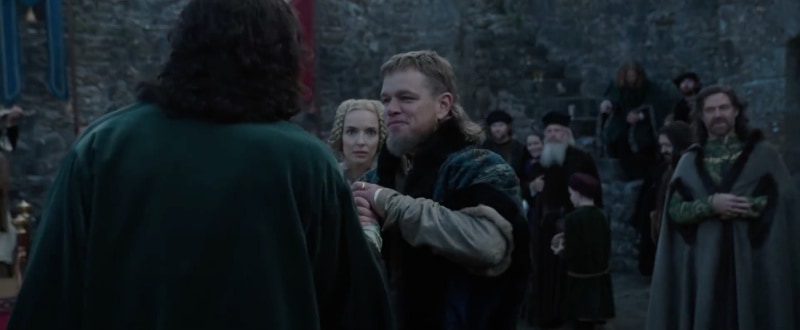
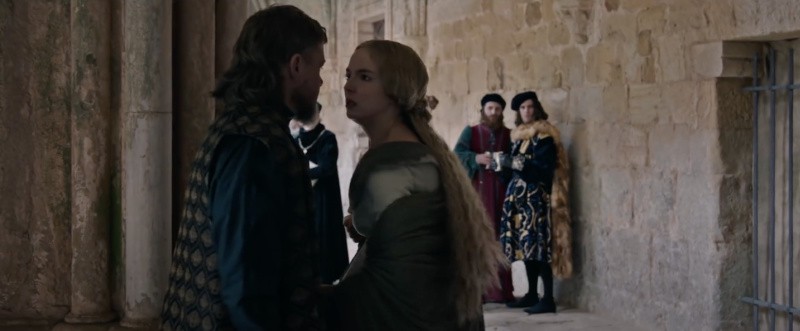
Here is our first meeting between knight and squire. The trick is not to be distracted by Damon’s handsome mullet and gnarly facial scars. Observe Comer’s death-stare slicing through Carrouges and Le Gris’ handshake. Whatever has occurred between her and Le Gris is firmly rooted in the past. She appears petrified by her husband’s camaraderie. Their embrace is her enslavement.


The Last Duel Trailer

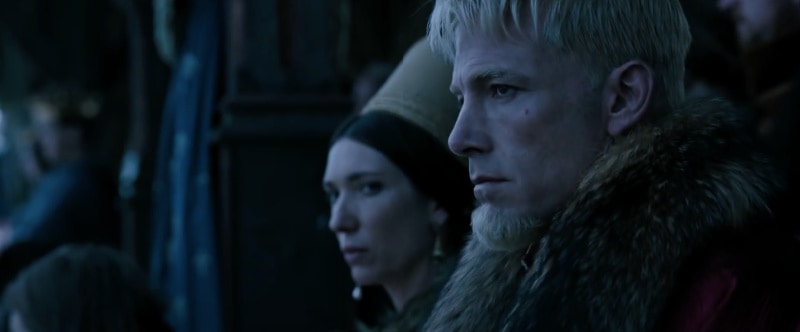
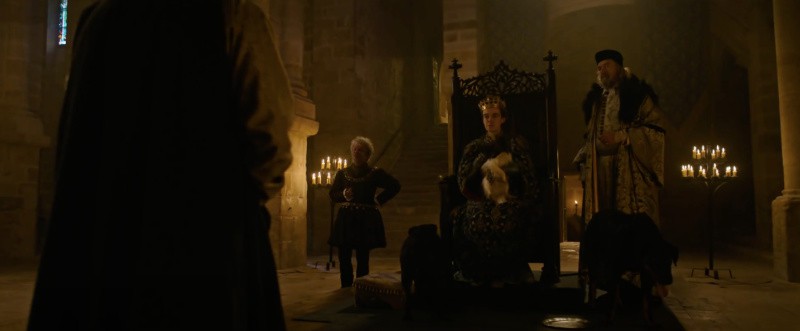
Not to be outdone by Damon’s mullet, Affleck is sporting an equally fresh look. Marguerite speaks over this shot, explaining how she was, at some point, a good wife, but it led only to judgment and shame. Affleck’s d’Alençon squirms in his seat. His comfort does not appear as easily obtained as the subjects that surround his stage. The duel is an absurd act and on its way out as far as its legal binding is concerned. As the last one ever sanctioned in France, we see how its observers struggle with the execution. Yet, no one dares stop it; they’re still bonded to the system and the religious and patriarchal terror driving it.


The Arena

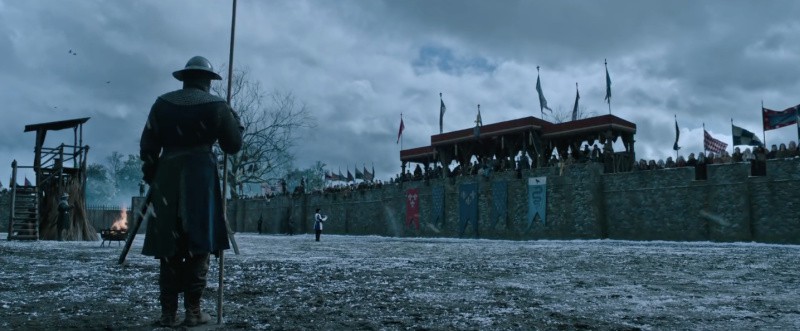
Inside the arena, the rules are decreed. Carrouges and Le Gris are strapped into their armor and mounted on their horses. Their game faces appear strong, their stride less so. As Marguerite is forced to profess her truth to the crowd, we watch two men on horseback collide with each other. Ridley Scott is slamming hard into the folly and the futility behind the action.


The Last Duel Trailer

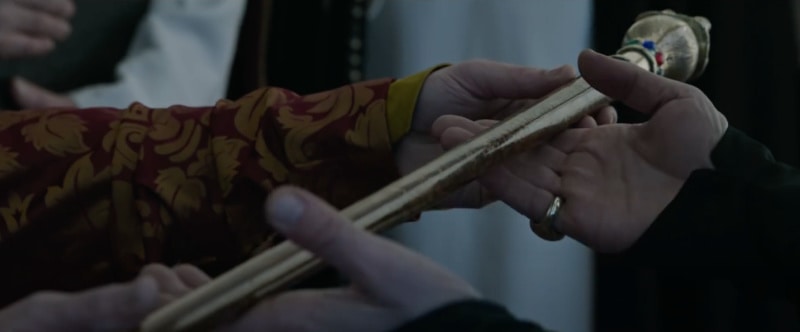
It’s all pomp and circumstance. We’re watching boys playing men, passing gold scepters between each other as if there was any real meaning to the gesture. Except, there is real meaning there. As the Last Duel trailer fires directly at Marguerite when d’Alençon hands the gold over to Le Gris, “The truth does not matter; there is only the power of men.” What they decree meaningful is meaningful. Those seated above you write your future. Breaking that process demands a drastic course.


King Charles VI

Carrouges goes before King Charles VI (Alex Lawther) and requests his duel to the death. Does anything underscore the childish nature of royalty more than an actual child royal? How about a mad one? King Charles began his reign known as “The Beloved,” but eventually, he would earn the title “The Mad.” The kid king is ultimately consumed by mental illness, terrifying those around him with extreme psychotic episodes. It was not uncommon for Charles to be constrained by his advisors during these frenzied outbursts. He also believed that he was made of glass, and this delusion drove him to wear iron rods in his clothes so he would not shatter if he collapsed on the floor or into another person.


Background Actors Aghast

Carrouges grabs hold of Marguerite and exclaims how he is risking his life for her. But she retorts, “You are risking my life so you can save your pride.” It’s the Last Duel trailer’s mic drop moment, nearly ruined by a few folks in the background. Go rewatch the sequence. I’ll wait. Those two extras are aghast! They appeared on set ready to act, and they did so with every fiber of their being. I’d be annoyed if their comically dropped gobs weren’t so entertaining.


Matt Damon

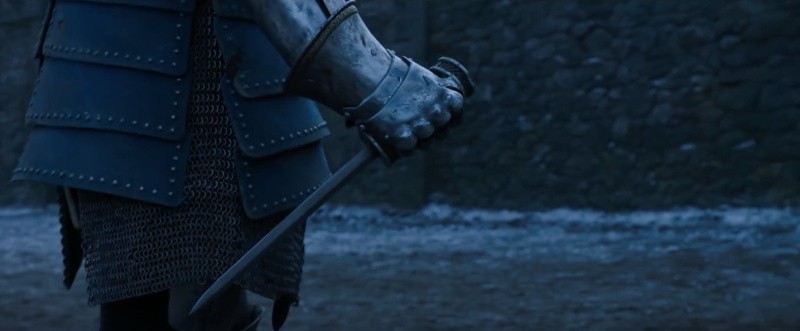
The killing blow is prepared. Carrouges tightens his grip on the blade and approaches Le Gris. What happens next can easily be spoiled via Wikipedia. The climax belongs to history, and history is rarely cheery. And Scott’s histories are even less so.


The Last Duel hits theaters on October 15th.

TIFF 2021: What’s Premiering and What’s Missing So Far

This article is part of our ongoing press coverage of the Toronto International Film Festival. From reviews to interviews to recap lists, follow along for all things TIFF 2021.


Well, gang, it’s that time of year again. The smell of Tim Hortons double-doubles is in the air. The Scotiabank escalator has broken down. And you can practically taste the excitement of looping around the corner of Yonge Street in the middle of a torrential downpour. The Toronto International Film Festival is back, baby. Where last year’s festival was fully digital, things are looking a little more in-person this year, hopefully. While the specifics (especially for non-Canadians) have yet to shake out, we’re at least excited to see the first inklings of a schedule taking shape.

In all the excitement, it seems the invite for what is sure to be the best movie of the year got lost in the mail. That’s right, folks, we’re talking about Paul Verhoeven’s dogmatically erotic nun thriller, Benedetta. The film, which we’re pretty sure won the Palme d’Or at Cannes and will not be fact-checking, is primed for a North American festival rollout. For us, and many other devout, big-brained cinephiles, its Toronto absence is a glaring one that we can only hope will be remedied any day now. But we won’t let this oversight stop us from highlighting the major talking points of TIFF so far.

So join us: for a giddy peek at what we know is coming to the festival and what, we believe, is still missing from the perfect TIFF 2021 slate.

This article was co-written with Anna Swanson.

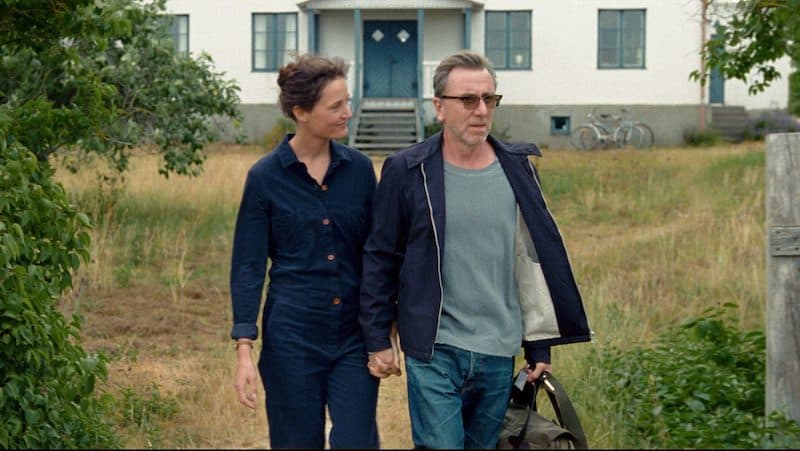
Bergman Island

Bergman Island at TIFF 2021

What is it?: Mia Hansen-Løve’s meta homage to the Swedish master Ingmar Bergman follows a filmmaking couple who journey to the island of FÃ¥rö, where reality and fantasy start to blur as their creative process unfolds.

Why we’re excited: With a cast that includes Phantom Thread’s Vicky Krieps plus Tim Roth and Mia Wasikowska, Bergman Island is sure to be a wonder to behold. Hansen-Løve is a deft and delicate filmmaker. She’s experienced in drawing out magnificent performances from her cast and capturing some of the most breathtaking images you’ll see on the silver screen. If her past work, including Eden and Things to Come, is any indication, this will be another home run.

What’s missing: Hansen-Løve is one of the greatest French filmmakers working right now. Speaking of the French, and to borrow a line from George Michael Bluth, we like the way they think. Specifically, we like the way they think about what goes on behind closed doors in Medieval convents. This is something we sure would like to see more of, perhaps from the film Benedetta.


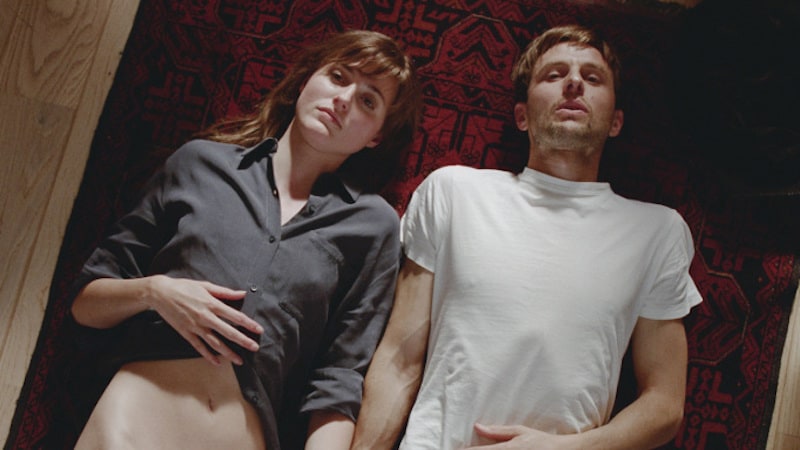
The Worst Person in the World

The Worst Person Iin The World Neon

What is it?: The Norweigan dramedy completes director Joachim Trier’s Oslo trilogy (including Reprise and Oslo, August 31) by following Julie (Renate Reinsve) as she rethinks her calling as a med student and uproots her life.

Why we’re excited: Upon premiering at Cannes, the film was met with widespread acclaim. Trier has been building his reputation as an impressively bold filmmaker with films such as Thelma and Louder Than Bombs, and this character study will surely elevate his status even further.

What’s missing: TIFF 2021 will host the North American premiere of The Worst Person In The World. The worst person in the world is also what cowards called Benedetta director Paul Verhoeven when Showgirls came out. Hopefully, Trier’s film fares better with critics. Meanwhile, we’ll be waiting for everyone who made the wrong call in 1995 to apologize.


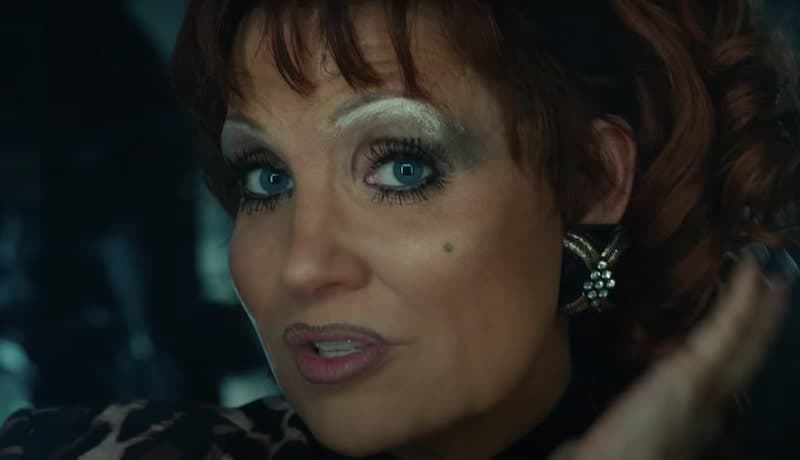
The Eyes of Tammy Faye

The Eyes Of Tammy Fay at TIFF 2021

What is it?: Jessica Chastain stars as the flamboyant, big-hearted televangelist Tammy Faye Bakker in what promises to be a humanizing portrait of the rise and fall of the Bakker network empire. Directed by Michael Showalter (The Big Sick), The Eyes of Tammy Faye also stars Vincent D’Onofrio and Andrew Garfield.

Why we’re excited: Tammy Faye Bakker is a confounding personality within the wide and often frightening world of American Christian fundamentalism. But few fundies can also claim to be queer icons. Tammy Faye’s story is a wild one and certainly primed for a prosthetics-happy biopic.

What’s missing: In a way … Benedetta’s gay nuns walked so that religious-turned-LGBTQ personality Tammy Faye Bakker could run. This is a double bill begging to happen. Come on, TIFF.


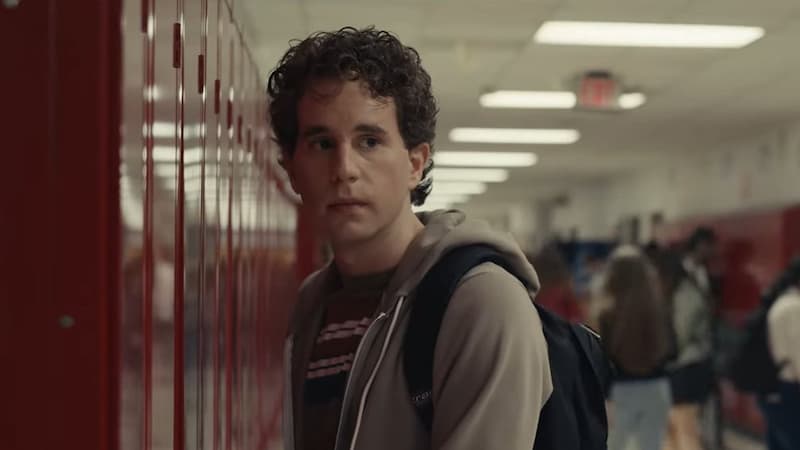
Dear Evan Hansen

Dear Evan Hansen Universal Pictures

What is it: Directed by Stephen Chbosky and based on the musical of the same name, Dear Evan Hansen’s titular teen (Ben Platt) writes himself a therapeutic letter, which is stolen by a classmate who later commits suicide. When the classmate’s family misunderstands the origins of the letter, Evan begins to insert himself into the boy’s past. The movie also stars the likes of Kaitlyn Dever, Amandla Stenberg, Julianne Moore, and Amy Adams.

Why we’re excited: Something at TIFF 2021 has to be dubbed “the movie we need right now” and “the Oscar frontrunner,” and it might as well be this.

What’s missing: People are already angry with Platt’s “how do you do, fellow kids” vibe. So why not lean into the absurdity of it all and add in some lesbian nuns? All we’re saying is it couldn’t hurt.


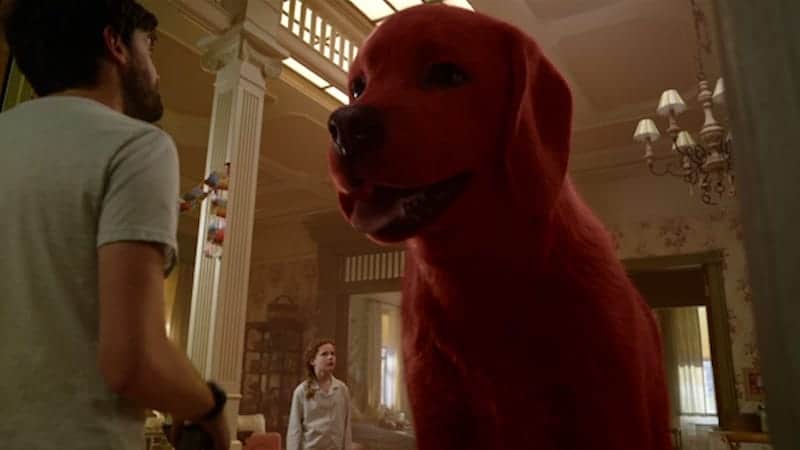
Clifford the Big Red Dog

Clifford Paramount Pictures

What is it?: From Walt Becker, the auteur who brought us Wild Hogs and Alvin and the Chipmunks: The Road Chip, comes Clifford the Big Red Dog, a movie that was probably foretold in Revelations. Based on Norman Birdwell’s illustrated series of the same name and starring Jack Whiehall, John Cleese, and Tony Hale, it promises to do exactly what it says on the dog food tin. It’s going to be about a big red dog named Clifford.

Why we’re excited: How can you not be excited about this? Clifford the Big Red Dog is, quite literally, too big to fail. It will be a lot of things: monstrous, uncanny, unsettling, probably not family-friendly. But it will not be boring. And that is more than most movies can say for themselves.

What’s missing: What is Clifford, a large red crime against nature, if not the Devil? And who deals with devils? Nuns. Clifford needs nuns. Lesbian nuns, preferably.


More films coming to TIFF 2021:

Gala Presentations 2021

  • Belfast, dir. Kenneth Branagh | United Kingdom
  • The Electrical Life of Louis Wain, dir. Will Sharpe | United Kingdom
  • Jagged, dir. Alison Klayman | USA
  • Last Night in Soho, dir. Edgar Wright | United Kingdom
  • The Mad Women’s Ball (Le Bal des folles), dir. Mélanie Laurent | France
  • Night Raiders, dir. Danis Goulet | Canada/New Zealand
  • One Second, dir. Zhang Yimou | China
  • The Survivor, dir. Barry Levinson | USA/Canada/Hungary

Special Presentations 2021

  • Ali & Ava, dir. Clio Barnard | United Kingdom
  • All My Puny Sorrows, dir. Michael McGowan | Canada
  • Benediction, dir. Terence Davies | United Kingdom
  • Charlotte. dir. Eric Warin, Tahir Rana | Canada/France/Belgium
  • Dionne Warwick: Don’t Make Me Over, dir. Dave Wooley, David Heilbroner | USA
  • Drive My Car, dir. Ryusuke Hamaguchi | Japan
  • Encounter, dir. Michael Pearce | United Kingdom/USA
  • The Guilty, Antoine Fuqua | USA
  • I’m Your Man, dir. Maria Schrader | Germany
  • Inexorable, dir. Fabrice du Welz | Belgium/France
  • Lakewood, Phillip Noyce | Canada
  • The Middle Man, dir. Bent Hamer | Norway/Canada/Germany/Denmark
  • Official Competition (Competencia Oficial), dir. Mariano Cohn, Gastón Duprat | Spain/Argentina
  • Paris, 13th District (Les Olympiades), dir. Jacques Audiard | France
  • Petite Maman, dir. Céline Sciamma | France
  • The Starling, dir. Theodore Melfi | USA
  • The Story of My Wife, dir. Ildikó Enyedi | Hungary/Germany/Italy/France
  • Three Floors (Tre Piani), dir. Nanni Moretti | Italy/France
  • Violet, dir. Justine Bateman | USA
  • The Worst Person In The World (Verdens Verste Menneske), dir. Joachim Trier | Norway/France/Sweden/Denmark

‘Marie Antoinette’ and the Argument for Mise-en-Scène as Film Form

Welcome to The Queue — your daily distraction of curated video content sourced from across the web. Today, we’re watching a video essay on the narrative role of mise-en-scène in Sofia Coppola’s Marie Antoinette.


There’s definitely an argument to be made that, as film fans, we see mise-en-scène the most but appreciate it the least.

Maybe the term’s theatrical origins put it at odds with some of the more uniquely cinematic elements of film, like cinematography and editing. Maybe the term’s right-out-the-gate French-ness makes it feel unapproachable and pretentious. But we’re getting ahead of ourselves. What is mise-en-scène, anyway?

First appearing in the early 19th century, the term literally translates to something along the lines of “placing on stage.” In the theater, mise-en-scène describes the arrangement of actors and scenery. Its cinematic definition is not too dissimilar and covers everything you see within the film frame: setting, costume, makeup, lighting, color, and staging.

Because it refers to all of the elements that comprise a single shot, properly giving it its due can feel a bit daunting. To boot, like editing, you’re not supposed to really notice it. But all rules have exceptions. And mise-en-scène can be much, much more than world-building props and set-dressing.

A great example of its potential as film form can be glimpsed in Sofia Coppola‘s Marie Antoinette, which charts the rise and fall of the last queen of France before the French Revolution. With a giddy sense of anachronism, Coppola’s film is pointedly and appropriately fixated on stuff.

By unambiguously foregrounding the Old Regime’s fixation on indulgent materialism, Marie Antoinette acts as a perfect case study of distinctly cinematic uses of mise-en-scène.

Watch “What is Mise-en-scène?: Marie Antoinette”:

Who made this?

This video essay about Marie Antoinette and mise-en-scène is by Jordan Schonig, who holds a Ph.D. in Cinema and Media Studies from the University of Chicago. They are a Film Studies lecturer and make video essays on, what else, film. You can subscribe to Schonig on YouTube here. And you can follow them on Twitter here.

More videos like this

    28 Things We Learned from the ‘Spiral’ Commentary

    Welcome to Commentary Commentary, where we sit and listen to filmmakers talk about their work, then share the most interesting parts. In this edition, Rob Hunter listens to the filmmakers behind this year’s Saw reboot, Spiral.


    The Saw franchise is one of the horror genre’s longest-running and most successful. Its sequels ran their annual course in 2010, but two attempts to reboot it have met with mixed results. The latest, Spiral, sees the return of director Darren Lynn Bousman who previously helmed the second, third, and fourth entries (see my review here). But the bigger surprise is the interest and presence of a certain comedic performer. The film is new to 4K UltraHD, Blu-ray, and DVD, so I sat down for a rewatch. Keep reading to see what I heard on the commentary track for Spiral.

    Spiral (2021)

    Commentators: Darren Lynn Bousman (director), Josh Stolberg (co-writer), Charlie Clouser (composer)

    1. Bousman wanted to “open up” the traditional world of the Saw films by opening this latest entry with a crowd. Look at all those extras! Probably more people on screen here than in the entirety of the franchise combined.

    2. The opening scenes were filmed at a fairground in Toronto where they thought they had permission — but they did not. Authorities kicked them out, but Bousman and his team managed to steal these shots “which I’m pretty proud of.”

    3. A physical manhole was built, but it was “a Canadian manhole” that stood three feet above the ground. It was nixed in favor of a visual effect.

    4. Bousman wanted a subway tunnel, but he was told the logistics just weren’t in the budget. He held his ground, and they eventually built a subway tunnel set to meet their needs. It’s a super small set that uses forced perspective to make things look bigger than they are.

    5. The opening kill in Spiral was originally written to have fish hooks piercing Det. Boswick’s (Dan Petronijevic) tongue, but Bousman is a firm believer in having traps that would physically work the way they’re suggesting — and fish hooks would have simply shredded the tongue as opposed to ripping it out. They changed it to a vice, and “when one of the producers showed up on set they were not happy.”

    6. Surprising no one, Det. Zeke Banks’ (Chris Rock) introductory scene was essentially written by Rock himself.

    7. Banks’ undercover “robbery” was shot as a single shot, but it ran three minutes and they were worried they’d lose the audience so it was trimmed.

    8. Bousman realized during production on Spiral that Marisol Nichols (who plays Cpt. Angie Garza) played Audrey Griswold in Vegas Vacation (1997), and he geeked out.

    9. Part of the appeal for Bousman in returning to the Saw universe — his first time back since Saw IV (2007) — was the opportunity change things up visually. He accomplished this with the help of cinematographer Jordan Oram.

    10. One of Bousman’s few disagreements with Rock was about Banks not recognizing his best friend’s remains. Rock thought he would, but Bousman felt the body was destroyed to such a degree that it would be impossible. They shot additional dialogue at the scene with Banks commenting to that point, but it was trimmed for time.

    11. There was no puppet in the original script for Spiral, but Bousman insisted on its return in some form. The result was Mister Snuggles the marionette pig cop.

    12. There’s an extra in a black tank top during the police station scenes who kept “finding the camera” and forcing Bousman to cut around or zoom past her.

    13. The two big influences here outside of the Saw films are Seven (1995) and 48 Hrs (1982).

    14. Rock looked into the camera after his emotional outburst in the police station and said “Lest anyone forget, I was in Pootie Tang, so I have range.”

    15. The director was unsettled while filming the first scene with Banks’ father (played by Samuel L. Jackson). He told the actor what to do for a shot, and Jackson said “nah” and added that he was going to sit in a different spot instead. “My butthole puckered,” says Bousman, but after speaking to a friend who had previously worked with Jackson he realized the actor was just testing him to see if he was a filmmaker who would stand up for what he wanted.

    16. Det. Drury (K.C. Collins) originally had a bigger role and a “horrific death” scene but they cut it out for being “too much.” Other words used to describe the death and its practical effects include intense, gruesome, graphic, horrific, and mean-spirited — and they cut it to appeal to a more mainstream audience. What a terrible goddamn choice.

    17. Jackson’s very first line of dialogue on his very first day of production was… “Mother fucker.”

    18. The killer’s voice went through numerous iterations as Bousman didn’t want it to sound like Jigsaw. He preferred something akin to a child’s voice, which didn’t quite work, and they tried using Max Minghella‘s as well. They ultimately went with the underwhelming one we have now.

    19. “I get so fucking angry watching this,” says Bousman during the finger-skinning sequence knowing that they lost so much of it to the whims of the MPAA. “You saw every finger break, every bone pop, every knuckle snap.”

    20. The meth dealer is played by “an insanely talented magician” named Chris Ramsay whose YouTube videos helped teach Bousman magic tricks.

    21. The scene in the church was originally set to be filmed in a basement, but Rock wasn’t having it. He walked Bousman to a nearby church and said they should film it there, and while the director doubted they would be given access Rock made it happen. He did the same with an earlier scene moving it from a repeated location to a nearby diner.

    22. Test audiences predominantly suspected Det. O’Brien (Thomas Mitchell) as the killer, which is nuts seeing as Minghella’s inescapably obvious Det. Schenk is right there. To that last point, there were some dialogue beats that Minghella didn’t want to say as he felt they would give his guilt away.

    23. They shot a brief look at Schenk’s body hanging to help convince viewers he was actually dead, but they wanted to abide by the rules meaning they could only show things that actually happened.

    24. The MPAA ripped into the skinning scene, insisting on shots being cut by mere frames at a time, and they also shredded the wax face peel. Because they’re dicks.

    24. Bousman’s favorite trap in Spiral is the wax waterboarding.

    25. No one on the commentary explains why the police precinct’s evidence room door has a combination lock.

    26. Rock initially pitched the studio who put him in touch with producers Mark Burg and Oren Koules. They in turn contacted Stolberg and told him to make it happen. He and co-writer Pete Goldfinger worked with Rock starting from his original setup — he wanted to see what would happen if he/his character woke up handcuffed to a pipe and was asked to cut off his own hand to escape.

    27. There are no official plans for a sequel, but Bousman and Minghella had numerous conversations regarding the character and where they could go with him and the story.

    28. Bousman asked Jackson why he agreed to play a character in a Saw film, and the actor said “if there’s an interesting death, I’ll do it, and this is an interesting death.” He’s not wrong, and it’s also the best scene in Spiral as it marries the trap mechanics with a strong condemnation of the police mentality about shooting first and asking questions later.

    Best in Context-Free Commentary

    “Your house was a musical instrument.”

    “I think I was fired this day.”

    “If you’ve not seen the movie, turn off the fucking commentary.”

    “We can’t use this room because it was used in Saw blankety blank.”

    “I have those fingers sitting on my desk at home.”

    “As a fucking filmmaker you design a fucking shot, you’re like look at this awesome oner oh wait it’s cut into twelve pieces now.”

    “I don’t know that James [Wan] knows who I am to be honest.”

    Final Thoughts on the Spiral Commentary

    Spiral remains an odd duck of a franchise entry — the core concept involving bad cops is great, but the movie itself is not. Happily, Bousman gives a fantastic commentary track. His enthusiasm is evident throughout as he shares production details, anecdotes, and the thought process behind what works and what doesn’t. Fans should definitely give it a listen — and then go sign the petition for a director’s cut as Bousman’s constant references to unseen gore and one-shot sequences cut by editing has me wanting to see more.

    Read more Commentary Commentary from the archives.

    Tuesday, 20 July 2021

    Alain Delon and Romy Schneider Headline Our Pick of the Week

    Streaming might be the future, but physical media is still the present. It’s also awesome, depending on the title, the label, and the release, so each week we take a look at the new Blu-rays and DVDs making their way into the world. Welcome to this week in Home Video for July 20th, 2021!

    This week’s home video selection includes a French classic, a cult favorite in 4K, and more. Check out our picks below.


    Pick of the Week

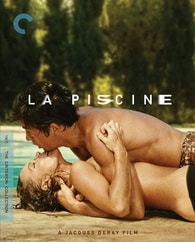
    La PiscineLa Piscine [Criterion Collection]

    What is it? A couple’s languid summer is interrupted by visitors.

    Why see it? This French gem was remade in 2015 as A Bigger Splash, but while that film is perhaps more outwardly entertaining (thanks to in large part to Ralph Fiennes) this original captures the heat, sex appeal, and discomfort sitting just beneath the surface of its characters. Alain Delon and Romy Schneider are weathered stunners who captivate sitting still and mesmerize with their every movement. The second half shifts into darker territory, but it’s never less than compelling. Criterion’s new Blu-ray includes both the French and English-language versions — director Jean-Claude Carriere filmed both simultaneously — and while the differences are minor they’re notable.

    [Extras: New 4K restoration, English language version, documentary, interviews, alternate ending]


    The Best

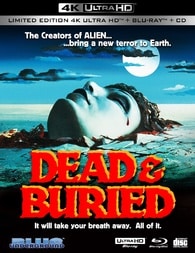
    Dead And BuriedDead & Buried [4K UltraHD, Blue Underground]
    What is it? A series of murders confounds a small-town cop.

    Why see it? Gary Sherman’s genre bonafides include Raw Meat (1972) and Vice Squad (1982), but it’s the film that came between those two that has always been a personal favorite. Dead & Buried features some cruel and bloody kills and an unsettling atmosphere as the small town’s charm shifts quickly into a disturbing haze. It’s co-written by Dan O’Bannon, and its various reveals deliver a creepy ride through to a grim little ending. Blue Underground continues their brilliant streak of 4K upgrades with another winner, and while the disc retains the film’s intentional softness the finished product reveals new clarity. The extras add an in-depth look at the film’s production and reception as well.

    [Extras: Soundtrack CD, commentaries, featurettes, interviews, poster]

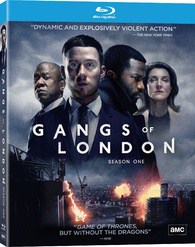
    Gangs Of LondonGangs of London – Season One

    What is it? A London crime family faces fights from both sides of the law.

    Why see it? Shows about criminals and their families are nothing new, but even those prone to violence pale beside the latest effort from Gareth Evans. The director of The Raid (2011) and The Raid 2 (2014) brings his love for elaborate, intense, and bloody action to the small screen infusing the gangsters’ antics with absolutely thrilling fight sequences. The choreography and execution are legit, but even the non-action scenes hold the attention with sharp writing, solid acting, and suspense. It’s Macbeth with martial arts in modern day London, and it rules.

    [Extras: Featurettes]

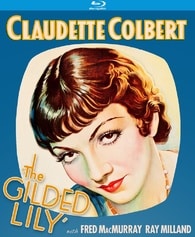
    The Gilded LilyThe Gilded Lily [KL Studio Classics]

    What is it? A love triangle comedy!

    Why see it? The first of seven pairings between Claudette Colbert and Fred MacMurray, and the first of two hitting Blu-ray this week, The Gilded Lily is arguably among their best. The two play strangers moving towards romance who are interrupted by the arrival of a classy dude from England plated by Ray Milland. The romantic antics may be predictable, but the laughs and characters deliver lots of enjoyment from a pair demonstrating great chemistry from the start.

    [Extras: Commentary]

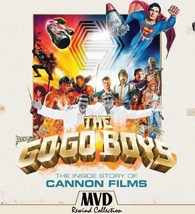
    The Go Go BoysThe Go-Go Boys: The Inside Story of Cannon Films
    What is it? A documentary on the rise and fall of Cannon.

    Why see it? If you were a genre movie fan in the 80s then you loved Cannon Films. The gloriously mad mini-studio brought to life by cousins Menahem Golan and Yoram Globus became a home to the likes of Charles Bronson, Jean-Claude Van Damme, Chuck Norris, and others, and they became major players in the industry. It didn’t last, though, and the doc charts both the rise and fall through interviews new and old, film clips, and more. It’s a fascinating look at the collision of ambition and hubris.

    [Extras: Poster]

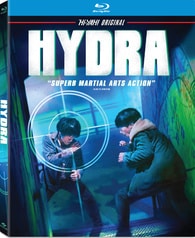
    HydraHydra

    What is it? An ex-killer is forced back towards violence.

    Why see it? The setup here is as familiar as they come, but at seventy-seven minutes this Japanese gem doesn’t waste much time worrying about it. Masanori Mimoto plays a man who left violence behind to run a small cafe and look after the daughter of a man he killed, but when a new organization moves into town he’s once more marked for death. There’s some strong character work here infusing scenes with calm and atmosphere, and while the action is minimal in frequency it’s epic in quality. The fights would make Donnie Yen proud, circa 2007’s Flash Point, as lightning-quick hits, fierce grappling moves, and painful intensity make for some thrilling sequences.

    [Extras: None]

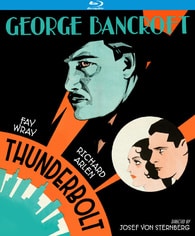
    ThunderboltThunderbolt [KL Studio Classics]

    What is it? A gangster plots revenge out of jealousy.

    Why see it? Josef von Sternberg remakes his own silent classic, Underworld, and make some memorable advancements with sound along the way. George Bancroft plays the villain, and both the narrative and arc compel alongside von Sternberg’s style. The gangster frames the guy who stole his girl (Fay Wray) and then plots to kill him while the two are in the same prison, and the film finds suspense in the setup on its way to a softer ending. Good stuff.

    [Extras: Commentary]


    The Rest

    The Bride Comes Home [KL Studio Classics]

    What is it? A woman is torn between two suitors.

    Why see it? Robert Young doesn’t stand a chance against Fred MacMurray, but he puts up a good fight for Claudette Colbert’s hand and heart. The three manage some fun banter as financial straits, competition, and the struggle of running a magazine all filter through their varied personalities and interests. It’s an entertaining watch, but while it never reaches the highs of the genre screwball comedy fans should still give it a spin.

    [Extras: Commentary]

    I Wouldn’t Be In Your Shoes [Warner Archive]

    What is it? A man struggles to prove his innocence on death row.

    Why see it? Warner Archive brings a nifty little noir to Blu-ray, and while it’s held back a bit by its budget — there are maybe three locations in the entire film — it manages some engaging characters and minor suspense. Don Castle plays a man whose unfortunate choices land him the only suspect in a murder, and he’s banking on his wife and a lonely detective to prove his innocence. The third act is good stuff.

    [Extras: Short film, cartoon]

    J.C. [Code Red]

    What is it? A hippie finds religion and violence.

    Why see it? Biker exploitation films come in various forms, but they’re typically built around immoral or “misunderstood” thugs causing havoc and finding trouble. This early 70s effort takes a different tact, though, as J.C. runs a hippy-dippy gang who land in a Southern town to visit family only to find ignorant cops and townspeople. It’s an interesting choice to focus more on their pacifism, but when violence erupts it’s ultimately too little too late to make for a memorable slice of exploitation.

    [Extras: New 4K restoration]

    Nana

    What is it? A woman snares a married man and ruins his life.

    Why see it? Jean Renoir’s second film adapts Emile Zola’s novel into a handsomely mounted drama about one woman’s life. From an unfortunate childhood to a sad adulthood, Nana’s life is a ride ending with a married man who she pulls down into her own misery. It’s a well done drama that fans of Renoir and/or Zola will appreciate, and its Blu-ray debut offers a visibly successful restoration and an informative commentary track.

    [Extras: New 4K restoration, commentary, comparison]

    Spiral: From the Book of Saw [4K UltraHD]

    What is it? Jigsaw is back, kind of, but not really, or is he?

    Why see it? Chris Rock expressing interest in continuing the Saw series automatically makes this movie worth a watch, but the end result leaves more than a little to be desired. The writing is not good — dialogue is silly, the puzzles underwhelm, the killer’s identity is incredibly obvious — and it just doesn’t manage to thrill or entertain beyond its goofiness. But hey, that may be enough for some of you, and if that’s the case this new 4K release is a solid one with an informative commentary or two to boot.

    [Extras: Commentaries, featurettes]

    Step by Step [Warner Archive]

    What is it? Nazis in the US!

    Why see it? Lawrence Tierney and Anne Jeffreys star as a young couple whose budding romance is interrupted by Nazis. It’s a playful thriller that sees innocents framed for murder, mistaken identity, and spies co-mingling with sharp dialogue. The film deals with “serious” genre antics but feels loose enough to never be taken too seriously. That’s not a bad thing, but it leaves the film more firmly entrenched as minor entertainment than memorable classic.

    [Extras: Short film, cartoon]

    The Time Guardian [Scorpion Releasing]

    What is it? A future city returns to the past.

    Why see it? This Australian genre effort seems like a dumb cheapie on the surface, but look past the marketing and it’s a solid piece of action/sci-fi. It also looks damn good with some solid special effects bringing its creatures, high tech hardware, and action to life. Carrie Fisher co-stars in a supporting turn, but while the leads aren’t recognizable to US audiences they make for a good time. The concept — an entire city travels back in time — is fun stuff, and the action follows suit. Get your nose out of the air, and give this one a spin.

    [Extras: New 2K scan]


    Also out this week:

    633 Squadron / Mosquito Squadron, The Plainsman [KL Studio Classics], Royal Deceit, Star Trek: Discovery – Season Three, Unconquered [KL Studio Classics], Whirlpool of Fate

    Why James Gunn Cut the Joker from ‘The Suicide Squad’

    Entering the Discourse is a thrice-weekly column where we dig into who is saying what about new releases and upcoming projects. Today, we discuss James Gunn’s comments about his upcoming DC movie, The Suicide Squad, and the Joker character.


    David Ayer’s 2016 entry in the DC Extended Universe was unsuccessful, to say the least. The movie’s action-packed trailer promised badass action sequences and interesting villains. But Suicide Squad delivered a convoluted story with too many characters and a boring interpretation of the Joker by Jared Leto.

    So, when Warner Bros. announced that James Gunn was directing a new interpretation of the same DC Comics IP, this time titled The Suicide Squad, it was met with skepticism. We’d just got that story. What could Gunn do to make it better?

    In an interview with the New York Times, Gunn shares that he asked the studio what he was allowed to change from the first movie. They told him: anything. He didn’t even need to bring back Margot Robbie as Harley Quinn, though they hoped he would.

    A Mostly New Suicide Squad

    With the creative freedom that Warner Bros. allowed him for their second Suicide Squad movie in just five years, Gunn says:

    “I wanted to create what I thought of as the Suicide Squad. For me to react to David’s movie would make it the shadow of David’s movie. I wanted it to be its own thing completely…My mission statement was just to make the most fun film I could and not balk at anything. I knew I had a chance that very few filmmakers have ever had, which is to make a huge-budget film with no holds barred in terms of the plot, the effects, the sets. I felt a responsibility to take chances.”

    Gunn was able to come up with new characters, remove characters, keep characters. Whatever he thought would make the movie work. So added characters he did. He brought in a few ridiculous names from the comics to play up the standalone sequel’s humor and over-the-top nature.

    The Suicide Squad features returning badasses, including Robbie’s Harley Quinn and Jai Courtney as Captain Boomerang. And also newcomers such as Polka-Dot Man (David Dastmalchian), who is covered in glowing tumors, King Shark (voiced by Sylvester Stallone), who is half-human, half-shark, and an evil alien starfish named Starro.

    Why the Joker is not in The Suicide Squad

    Bringing in new characters into The Suicide Squad did require some cuts to other familiars, however. Including Leto’s interpretation of the Joker and Will Smith as Deadshot. But these were voluntary choices by Gunn. He says:

    “I just don’t know why Joker would be in the Suicide Squad. He wouldn’t be helpful in that type of war situation.”

    Gunn also explains casting Idris Elba as Bloodsport and the significance of the role:

    “I really wanted to work with Idris. It is a multi-protagonist film… But if there’s one protagonist, it’s Idris. And I wanted somebody who had that gruff, ‘Unforgiven’-type feeling about him. This guy who had been reduced from being a bigshot supervillain — he took Superman out of the sky — [to] now scraping gum off the floor at the beginning of the movie. He absolutely doesn’t want any part of it. He just has accepted this is his life. And I just think that character is Idris Elba.”

    Why Harley really had to return

    No matter the changes, he intended on keeping Robbie as Harley Quinn, if only for the change it brought him. He says:

    “For me, Harley Quinn belongs on the wall next to Batman, Superman, Wonder Woman, Captain America, Spider-Man, Hulk. Most of my career has been writing characters who existed in the comics but weren’t well-defined personalities, and having to create their cinematic personalities, whether it’s Star-Lord or Drax or Groot, who were all very different in the comics. Harley was pretty incredibly written by Paul Dini from the beginning, and so to be able to capture the essence of that character — her chaotic, sweet nature — and give her her due as the trickster and allow her to go wherever she wants, was surprising even to me as a writer.”

    The Suicide Squad — minus the Joker — comes to theaters and HBO Max on August 6th.

    Monday, 19 July 2021

    The Cinematic Life (and Death) of Robin Hood: How Realism Kills Legends

    Welcome to The Queue — your daily distraction of curated video content sourced from across the web. Today, we’re watching a video essay on why Disney’s Robin Hood rules.


    When an animated film becomes a “timeless classic,” it can be easy to forget that it was made during a specific time and place. While old-fashioned techniques like rotoscoping and cel animation can give up a film’s age, at face value, animated classics — from Sleeping Beauty to My Neighbor Totoro — don’t tend to feel as tied down to any particular decade as their live-action counterparts. Which makes sense. Like musicals, animated films tend to intentionally lean into the suspension of disbelief. Animals talk, the laws of physics wobble, and the world feels overwhelmingly filled with color. And this is why, in part, animated films make such a perfect medium for myths.

    Disney’s Robin Hood came out in 1973, and if you’re looking for them, there are giveaways that point to the film’s origins both within a tumultuous decade and a tumultuous period within the company’s history. Robin Hood was made in the midst of the “Disney Dark Age,” a period of creative and financial uncertainty in the wake of Walt Disney’s passing. The film was forced to cut financial corners, trim its runtime, and assume a more uncinematic gait. But adversity worked in Robin Hood‘s favor, endowing the film with a compact and light-hearted informal breeze. It is both knowingly unpolished and impressively economical. The film squeezes centuries of folklore into a sort of “greatest hits” album for the myth itself.

    The video essay below offers a more in-depth explanation of why Disney’s Robin Hood slaps, both on its own terms and as a “Robin Hood movie.” The essay concludes by noting that Disney’s Robin Hood was, in a way, one of the final films to let the legend exist untethered from the grim realities of the real world. Gritty reboots aren’t a new invention. A keen eye towards historicism has its time and place. But by anchoring a mirth-filled legend in a mirthless world, the legend of Robin Hood became a little less legendary.

    Watch “Disney’s Robin Hood and the Death of Color”:

    Who made this?

    This video on Disney’s Robin Hood is by Jace, a.k.a  BREADSWORD, an LA-based video essayist who specializes in long-form nostalgia-heavy love letters. Impeccably edited and smoother than butter, BREADSWORD essays boast an unparalleled relaxed fit and an expressive narrative tone. Long essays like this take a lot of time to put together, and somehow BREADSWORD makes it all look effortless. You can subscribe to them on YouTube here. And you can follow them on Twitter here.

    More videos like this

      ‘Space Jam 2’ is a Much Bigger Hit Than the Last Looney Tunes Movie

      Welcome to our weekly box office report, which we do a little differently. Rather than focusing on the money, FSR senior editor Christopher Campbell is more interested in the estimated attendance — or number of tickets sold. Because the value of money changes over the years, but the value of actual moviegoers remains the same. This week, we primarily look at the opening box office attendance numbers for Space Jam: A New Legacy. Also: Escape Room: Tournament of Champions, Roadrunner: A Film About Anthony Bourdain, and Pig.


      No, Space Jam 2 did not open bigger than the original. Back in 1996, Space Jam debuted with a gross of just $27.5 million, but that would have equated to about 6.2 million tickets sold. The new sequel, Space Jam: A New Legacy opened over the weekend with a three-day (plus Thursday night) gross of $31.7 million (estimated*). But at today’s prices, that’s only about 3.5 million tickets sold**. That’s still pretty impressive, especially considering the new Space Jam was also available day-and-date on HBO Max without additional cost to subscribers. And the movie topped the box office even ahead of Marvel’s Black Widow, which is also available at home yet with an extra cost to Disney+ subscribers.

      Space Jam 2 Box Office

      Space Jam: A New Legacy did open bigger than the last Looney Tunes movie, however. The 2003 feature Looney Tunes: Back in Action debuted with a three-day attendance of roughly 1.5 million. That’s less than half what Space Jam 2 did in its opening weekend. Can we assume the Looney Tunes themselves aren’t the box office draw and that Michael Jordan and LeBron James were the respective appeals of the first and second Space Jam installments? There’s not enough data to make that claim, especially when there’s not really any box office information for the Looney Tunes compilation films that hit theaters in the 1970s and 1980s save for Bugs Bunny’s 3rd Movie: 1001 Rabbit Tales selling only around 27,000 tickets on a limited amount of screens in its 1982 opening weekend.

      LeBron James vs. Looney Tunes

      We can compare the opening weekend attendance for the last three Looney Tunes movies to the viewership of Looney Tunes TV shows. Two of them anyway. The Looney Tunes Show, which brought the original Warner Bros. cartoon characters back for an updated series in 2011 on the Cartoon Network, was watched by almost 2.5 million people in its premiere. Over its few years on the air, the show fell in viewership. It finished with just 1 million sets of eyes for its last episode in 2014. The following year, New Looney Tunes premiered on the Cartoon Network with around 1.2 million viewers. The ratings were mostly steady but occasionally dipped as low as 0.5 million. Then it went to Boomerang and audience numbers seem to have ceased being documented. The popularity of those programs is definitely more Back in Action size than Space Jam.

      What the Critics and Moviegoers Think of Space Jam 2

      The box office attendance for Space Jam 2 is in line with its reception compared to its direct franchise predecessor, as well. The new movie’s reviews (31% on Rotten Tomatoes, 36 on Metacritic) are worse than the already negative Space Jam (44% on Rotten Tomatoes, 59 on Metacritic). But Looney Tunes: Back in Action had relatively negative to mixed reviews and fared a bit better with the aggregate sites (56% on Rotten Tomatoes, 64 on Metacritic). Audience Scores on Rotten Tomatoes, however, favor the Space Jam movies by a lot. Meanwhile, the fans approved of the Space Jam movies more than they did Looney Tunes: Back in Action. According to Cinemascore, first-night audiences polled by the firm gave both the original Space Jam and Space Jam: A New Legacy a grade of A-. They gave Looney Tunes: Back in Action a B+.

      Space Jam 2 Box Office vs. Forecast

      Despite the mostly negative reviews and unfavorable buzz surrounding the IP exploitation of the movie, the opening for Space Jam 2 exceeded expectations. Last month, Box Office Pro forecast the debut as more like 1.6 million to 3.3 million tickets sold in the first weekend. And even last week, the same site only upped the low end of its forecast range to the equivalent of 2.2 million tickets. The main prediction for the movie was the equivalent of 2.9 million tickets. Other movies that did better than expected over the weekend include The Forever Purge, F9: The Fast Saga, which finally exceeded $150 million domestic gross, and the new documentary Roadrunner: A Film About Anthony Bourdain. It’s hard to tell if the ethics controversy over Roadrunner‘s use of AI-aided narration helped, but its attendance of 207,000 was nearly double the expected 109,000.

      The Other New Sequel

      Box Office Pro was impressively right on the money for another sequel that opened over the weekend, guessing right that Escape Room: Tournament of Champions would draw a little less than 1 million people*. That’s about half as many people as went to see the original Escape Room two years ago. The new movie’s reviews were also lesser than its predecessor (42% vs. 51% on Rotten Tomatoes, 47 vs. 48 on Metacritic). Finally, one more new movie broke into the box office top ten over the weekend: Michael Sarnoski’s Pig, which has garnered rave reviews, especially for Nicolas Cage’s performance. In fact, it’s his best-reviewed live-action release ever, breaking his previous record with Moonstruck. And at 100,000 tickets sold, it’s his best opening for a live-action starring vehicle since 2014’s Left Behind. Previous to that: Ghost Rider: Spirit of Vengeance.

      Outsiders Break Through

      Overall, it was a pretty good weekend for moviegoing. No movie in the top ten doing less than 100,000 ticket sales. Sure, the top seven titles are sequels. But the fact that there’s also a documentary and an indie film in the mix feels pretty good to me. Even if Space Jam: A New Legacy‘s popularity goes along with the idea that franchise IPs are all that matter to the industry lately, there’s still room for outsiders. Finally, I have one note about Black Widow following out of the top spot after just one weekend. First of all, that’s just the box office attendance in general right now. Particularly for the movies available in digital form — meaning quickly pirated as well. Second of all, it happens on occasion even with Marvel movies. Before Black Widow, it happened to The Incredible Hulk, Captain America: The First Avenger, Guardians of the Galaxy, and Ant-Man and the Wasp.

      Box Office Chart for July 16-18, 2021

      Rank Movie Title Weekend Attendance Per-Screen Attendance Total Attendance Studio
      1 Space Jam: A New Legacy 3.5 million 871 3.5 million Warner Bros.
      2 Black Widow 2.9 million 670 14.4 million Disney
      3 Escape Room: Tournament of Champions 0.96 million 341 1 million Sony Pictures
      4 F9: The Fast Saga 0.83 million 247 16.9 million Universal Pictures
      5 The Boss Baby: Family Business 0.52 million 149 4.9 million Universal Pictures
      6 The Forever Purge 0.45 million 166 3.9 million Universal Pictures
      7 A Quiet Place Part II 0.3 million 359 16.9 million Paramount Pictures
      8 Roadrunner: A Film About Anthony Bourdain 0.2 million 224 0.2 million Focus Features
      9 Cruella 0.121 million 103 9.1 million Disney
      10 Pig 0.103 million 187 0.1 million Neon

      *Initially box office grosses are estimated and then are later updated for actual figures.

      ** Ticket sales and attendance figures are determined with each year’s average ticket prices. Currently, for 2021, that average is $9.16.

      All box office gross figures are sourced from Box Office Mojo, The Numbers, and Box Office Pro unless otherwise stated.

      Sunday, 18 July 2021

      ‘Gunpowder Milkshake’ Tastes Like a Missed Opportunity

      A lot goes into the making of a film, and while it usually starts with a script it grows to include casting, direction, production design, music, and so much more on its way to becoming a finished movie. It’s like ingredients coming together to create a satisfying meal, but sometimes, even when those individual elements seem appealing, the end product can taste… off. Gunpowder Milkshake is not the tasty treat you’re expecting.

      Sam (Karen Gillan) is an assassin for an organization called The Firm, and it’s the only life she’s known since being abandoned by her mother Scarlet (Lena Headey) when she was a child. Her status quo is upended, though, when she pulls the trigger on someone connected to a competing group that demands retribution — and just like that, The Firm gives her up. Hunted by killers and with a young girl in tow, Sam looks to women from her past for help.

      In keeping with the sloppy metaphor above, the ingredients that make up Gunpowder Milkshake are undeniably appealing. The cast — which also includes Michelle Yeoh, Angela Bassett, Carla Gugino, and Paul Giamatti — is absolute aces. Director/co-writer Navot Papushado is one half of the team (alongside Aharon Keshales) that gifted genre fans with Big Bad Wolves (2013) and Rabies (2010). And the plot, while familiar enough over the past few years, is a terrifically promising setup for something special. So why is the end result so damn dissatisfying?

      The film is an exercise in style over substance, but that in and of itself isn’t a criticism. When done well, style can effectively heighten a film’s other elements in memorable ways. Here, though, Papushado feels compelled to infuse each and every frame with imagery that screams “look at all this color and cool shit!” While the production design works to create a world detached from time and just this side of reality, the mishmash of vibes — noir! neon! comic book! family-friendly dialogue! bloody violence! — keeps the film off balance in ways that detach viewer interest rather than engage it. Locations like the diner and library look good, but they almost feel like backdrops rather than immersive settings.

      Gunpowder Milkshake‘s script, from Papushado and Ehud Lavski, fumbles some in its attempts at humor leaving jokes falling limp to the floor like so many spent bullet casings. Gillan has proven her comedic abilities elsewhere, but she’s unable to find the funny in dialogue that’s equally clumsy with its attempts at more serious beats that instead feels stilted and precious. The film wants an emotional dynamic between Sam and Scarlet, and between them and the trio of librarians, but the groundwork is absent in building those moments.

      The film’s trailer handles the reveal of the power trio — Bassett, Gugino, and Yeoh — far better than the film itself as they’re rolled out here unceremoniously in a clunky first act. Flashbacks only add to the problems by padding the film’s running time with wholly unnecessary sequences that serve only to drag down the momentum. Their placement doesn’t help either, and whether due to the script or choices in the editing room, they result in an opening thirty minutes that visibly struggles to find its footing.

      While it’s being billed as an action movie, Gunpowder Milkshake‘s weakest element might just be the action itself. Like its clearest inspiration, John Wick (2014), the film delivers a blend of gunplay, fisticuffs, and car antics alongside its abbreviated worldbuilding, but little of its manages to thrill or energize. Papushado’s desire for style consumes some of that energy as he slows down numerous action beats like Zack Snyder to highlight the imagery, and while a late-film diner sequence looks very cool in its slow-motion carnage it’s far from exciting. Most sequences play out at normal speed, but you’d be forgiven for thinking some of the fights have also been slowed down as the choreography and execution suggest that a bit more time in rehearsal was needed.

      The legendary trio of Yeoh, Gugino, and Bassett look fantastic (and kudos to the costume department for an excellent job here), but despite the film feeling too long they’re not given the time or the script to stand out. They’re glorified window dressing in Gunpowder Milkshake leaving Gillan to hold the film up on her own, but while she gives it her all it’s an uphill battle against empty noise. Cinematographer Michael Seresin captures much of the film and characters well and finds some striking images here and there, but the aforementioned issues with the action can’t be remedied by his camera. Similarly, Haim Frank Ilfman‘s score finds some dramatic and genre-tinged sounds, but it’s in service of a film that can’t match it.

      As mentioned, all of the pieces are here for one hell of an exercise in genre, style, and fun, but they just don’t gel. Papushado’s spoken about his inspirations and intentions, but while the strands and connections are visible they too often miss the mark when it comes to the execution. The cast alone makes Gunpowder Milkshake worth a watch, but that rumbling in your stomach isn’t from lactose intolerance — it’s a pain in your gut from realizing this should have been a tighter, better, more cohesively entertaining movie. Still, the filmmaker’s talent is abundantly clear meaning we can’t help but look forward to his next genre-flavored treat.

      Copyright © Cinenus | Powered by Blogger

      Design by Anders Noren | Blogger Theme by NewBloggerThemes.com