The film industry in one place - Articles, Reviews, trailers and hype!

Friday, 26 March 2021

‘The Irregulars’ is an Entertaining if Uneven Riff on Familiar Characters

The character of Sherlock Holmes has probably seen more incarnations and adaptations than most, but while the bulk of them fit into Arthur Conan Doyle’s canon a select handful dare to stretch those expected boundaries. From Young Sherlock Holmes (1985) to Without a Clue (1988) to last year’s Enola Holmes, the upside to fictional creations falling out of copyright is that others can go crazy playing in their sandbox. That last film is a Netflix production, and now the streamer is once more dipping its toes into a “what if?” scenario involving the world’s favorite detective. As the title suggests, though, in the world of The Irregulars, Sherlock is only a supporting player — and he’s not quite the world-class investigator we’re expecting.

Per Doyle’s stories, the Baker Street Irregulars are a band of filthy, unhoused street urchins who occasionally help the famed detective secure information that’s perhaps out of reach for a man in high society. Creator Tom Bidwell uses that as an inspiration for his origin story where the dirty-faced teens take the lead, and the result is a show that both hits and misses the mark with almost equal precision. Comparisons to Stranger Things seem inevitable, but it turns out the 1880s were just as wild as the 1980s.

Four friends live in a dank basement just a short walk away from 221B Baker Street, and while they make do however they can it’s their tight friendship that keeps them strong. Bea (Thaddea Graham) is the pint-sized bull looking after the others, and she wouldn’t have it any other way. Her younger sister Jessie (Darci Shaw) is her main concern as the pair, abandoned as young children, have seen a rough life in the workhouses until now. Worse, Jessie is suffering from nightmares that Bea worries might be connected to their mother’s mental illness. Rounding out the quartet are Billy (Jojo Macari), a tall brute with a heart of gold, and Spike (McKell David), a smooth-talker struggling to remain the optimistic one.

They take a break from the grift when Dr. John Watson (Royce Pierreson) arrives offering to pay for their services in an ongoing investigation involving babies being snatched from their cribs all over London. It leads to some unsettling discoveries, as do the following “monster of the week” episodes, and all of it points to a tear in dimensions threatening not just London but the world of the living itself.

The Irregulars delivers some solid thrills and fun, gory beats with its individual mysteries, and, perhaps surprising no one who’s been watching shows and films over the last year, its throughline is one exploring the dangerous weight of grief upon its characters. It’s the thematic topic du jour, it seems, and while Bidwell’s handling of it can be a bit messy at times its eventual destination is one with substantial heart and wisdom.

Getting there is something of a winding journey, though, involving the arrival of a drug-addicted, washed up Sherlock (Henry Lloyd-Hughes), a prince named Leopold (Harrison Osterfield), revelations involving family, love triangles, city-shaking supernatural threats, villainous reveals, and more. There’s a lot going on here, including more than a few nods to other Doyle characters, and while some of it stumbles in its execution other elements deliver the goods.

The clear highlight to The Irregulars is Graham’s spirited portrayal of Bea. The show is an ensemble piece, but Bea is the undeniable center and with good reason. She’s been hurt by the past and struggling in the present, but it’s never enough to knock her off her feet as she fights for her sister and her friends with wits, ferocity, and heart. Graham finds the humanity in the character’s heroism, and that carries over into her connection to two others — Jessie and, surprisingly, Watson. The sisterly bond is expected, and Graham and Shaw interact as if their chemistry has been a lifetime in the making with the love, spats, and knowing looks between sisters enriching the story in visible ways. Bea’s growing relationship with Watson finds its own power as the two move from strangers to antagonists and beyond, and Lloyd-Hughes is equally at his best when sharing the screen with Graham. Their growing bond eventually finds a heart equal to that of the sisters, and it’s due as much to the performances as to the writing.

The show’s production design helps bring the time and place to life whether its immersing viewers in a Dickinsonian nightmare, dancing among the nation’s royals, or facing off against murderous locals possessed by an evil force. Visual effects increase as the series continues with both flashy, digital work and some gory violence, but the show keeps its human characters front and center as they learn about themselves and others — both their strengths and weaknesses — with sometimes deadly results.

Less effective than those three characters and the surrounding thrills are The Irregulars‘ attempts at romance. Bea finds herself between Billy and Leopold, and viewers will be hard-pressed to root for either of the horndogs as neither is all that interesting of a character. Both get more to chew on than poor Spike who’s left seemingly forgotten by the writers at times, but the competing love interest angle is still endlessly dull and bogs down any/every scene in which it becomes the focus. An adult romance explored in the series’ back half fares a bit better, but as it’s between supporting players it unavoidably carries less weight. Still, the character dynamics that work best — Bea and Jessie, Bea and Watson — do so exceedingly well guaranteeing viewers will be invested through to the end.

The mystery/horror narrative driving The Irregulars is intermittently engaging, but along with the trio of characters highlighted above it’s more than enough to satisfy viewers through all eight episodes. An eventual second season would hopefully give more care to Billy, Spike, and Leo as all three actors seem capable and hungry for more to do. Barring that, more time with Bea, Watson, and Jessie will be enough to make a follow-up season worthwhile.

‘The Falcon and the Winter Soldier’ Episode 2 Exposes Our Bloody History

The Falcon and the Winter Soldier Explained is our ongoing series delving into Marvel’s grand new bromance between Sam Wilson and Bucky Barnes. In this entry, we examine the troubling history revealed in The Falcon and the Winter Soldier Episode 2 (“The Star Spangled Man”) and wonder if Sam can ever pick up that shield. Yes, prepare for SPOILERS.


Captain America was never the goal. The United States military was not looking for one super-soldier. They wanted an army. Steve Rogers was a test subject, an experiment. Dr. Erskine’s assassination by Hydra ruined everything, creating a one-of-a-kind propaganda tool in Steve, and propelling the Army back to square one.

While Steve saved as many days as he could as Captain America, scores of scientists tormented themselves attempting to replicate Erskine’s formula. In the Marvel Cinematic Universe, we’ve already met several super-soldier knockoffs. The Red Skull was the first to put himself under the needle, and his red facade was his reward. James Buchanan “Bucky” Barnes (Sebastian Stan) got a bastardized dose from Armin Zola. Bruce Banner became the Hulk after combining Erskine’s science with Gamma radiation. In The Incredible Hulk, General Thunderbolt Ross permitted the abominable mercenary Emil Blonsky to give an updated serum a shot.

There is more to Steve Rogers’ legacy than a shield and a do-gooder attitude. Many have suffered in the United States’ hunger for the ultimate human weapon. The Falcon and the Winter Soldier Episode 2 exposes the horror behind the Avengers’ most noble action hero. Whether he was in the ice waiting to be rediscovered or on the battlefield bringing the hurt to Thanos, Steve Rogers never saw the evil being committed in his name behind the scenes. He was too busy, but he also never looked.

His buddy Bucky, however, knows a thing or two about evil. He was reborn from it, and he never got the popsicle vacation that Steve did. As the Winter Soldier, Bucky spent decades brainwashed, killing the innocent and the not-so-innocent so Hydra could gain a tighter grip on the globe. During his time as an assassin, Bucky encountered other government agents seeking his eradication. One such soldier was Isaiah Bradley (Carl Lumbly).

Halfway through The Falcon and the Winter Soldier Episode 2, Bucky and Sam (Anthony Mackie) have their asses handed to them by the Flag-Smashers. These terrorists seek to reunite the world as it was during The Blip, a.k.a. The Snap, a.k.a. when half the world got dusted. What gives them their edge is a super strength, one seemingly supplied via Erskine’s serum. The revelation rattles Sam, but Bucky less so. He’s not shocked to learn Captain America dupes are running around.

Bucky takes Sam to Baltimore, where they knock on Mr. Bradley’s door. His grandson Eli (Elijah Richardson) answers and denies entry. Then, Bucky says, “Tell him the guy from the bar in Goyang is here.” The old man allows entrance, and the former enemies stare each other down.

Bradley and the Winter Soldier traded blows during the Korean War. They’re not thrilled to see each other. Bradley’s enraged. He has every right to be. Like Steve, he was a US test subject. Unlike Steve, he did not volunteer.

Bucky introduces Bradley to Sam as a hero, but the old man scoffs at the notion. He spits at the two, “You know what they did to me for being a hero? They put my ass in jail for thirty years.” Bradley was an imprisoned guinea pig, poked and prodded and robbed of his blood. Steve got to smile for the camera. Bradley was left to rot.

The first Black Captain America’s hidden history can be further explored in the comic Truth: Red, White, and Black. The story positions the super-soldier program alongside the Tuskegee Syphilis Experiment, where the US Public Health Service secretly injected three-hundred-and-ninety-nine African-American males with syphilis so they could observe how the bacterial infection would ravage the body untreated. Bradley was the super-soldier study’s sole survivor, and when the government was done with him, they dumped his shattered self back into civilian life.

Bradley’s story rocks Sam to his core. What did Bucky hope to get from the confrontation? Was he trying to encourage Sam to pick up the shield and honor Steve and Bradley’s legacy? Is there honor to be found, or only atrocity? Was Bucky merely showing Sam that the super-soldier program ain’t that special or hard to replicate? Anyone can get juiced.

Bucky tells Sam that he never revealed Bradley’s existence to Steve. That’s convenient. One more horror committed in Captain America’s name that Steve will never have to reconcile. If Bucky was attempting to boost Sam’s desire to wield the shield, he did a piss poor job. The stars on that Star Spangled Man are scabbed in blood.

To further prove this atrocious fact, Sam and Bucky’s argument in the Baltimore streets is immediately busted by the cops. The BCP sees a Black man yelling at a white man. That’s all the information they need to flip the lights and whoop their siren. Only when Bucky illuminates the cops to the Falcon’s identity do they cool their jets.

If The Falcon and the Winter Soldier is going to conclude with Sam Wilson donning the Captain America uniform like so many hope, the show must do more than confront America’s stained history. The series is not about protecting Steve’s legacy. Sure, it’s annoying to see a pretty boy like John Walker (Wyatt Russell) prancing around in that uniform, but maybe that uniform is not as precious as we once thought it to be.

Sam and Bucky have many more wretched stones to unturn. There’s more to Isaiah Bradley. There’s more to his grandson Eli (psst, he’s a Young Avenger in-the-making). There’s definitely more to the super-soldier Flag-Smashers.

While we’re waiting for Zemo (Daniel Brühl) to put on his hood and reveal himself as the series’ big bad, The Falcon and the Winter Soldier Episode 2 might have actually uncovered the real villain. We learned this week that the Flag-Smashers stole their super-soldier serum from The Power Broker. This mysterious figure has a long history within Marvel Comics. He’s a mafioso type who helps wannabe thugs become all they can be, enhancing their bodies through scientific and technological augmentation.

The Power Broker is not happy with the Flag-Smashers. Besides sending them threatening texts, he’s also unleashed a goon squad to take them down. With this new threat in play, Sam and Bucky are quickly being surrounded by all manner of treachery. Rather than pulling back to think for a bit, the buddies double down and request an audience with their Captain America: Civil War nemesis.

The Flacon and the Winter Soldier Episode 2 ends with a shot featuring Zemo in his cell. He looks harmless enough, but you would never have said that about Hannibal Lecter, and we know we can’t trust this crafty, angry Sokovian killer. He nearly destroyed the Avengers when he peeled back their hypocrisy, and this show has exposed several new tiers of repulsive posturing for him to dissect. He’s a button pusher, and there are a lot of buttons that need pushing.

Bucky is on a mission to make amends for his past misdeeds. It’s a mission America needs to take on. The Winter Soldier and the country can’t heal until all sins are disclosed. The pain isn’t trapped to history; Americans can’t be either. No more excuses. Let’s admit our horror and hold ourselves accountable.

Earnestness and Irony: The Double-Minded Cinema of ‘Carrie’

Welcome to The Queue — your daily distraction of curated video content sourced from across the web. Today, we’re watching a video essay about the self-aware New Hollywood horror of ‘Carrie.’


How do you classify Carrie (1976)? As a cautionary coming-of-age tale? As one of the best book-to-screen adaptations of Stephen King‘s work? What about as one of cinema’s great “period” pieces? Okay, that last one was a joke. Unless…

Whichever way you slice it (long kitchen knives preferred), Carrie is an essential benchmark of genre cinema. The film was a mainstream breakthrough in Brian De Palma‘s career as well as a fulcrum point of horror and New Hollywood, the cinematic revolution that took place in American filmmaking during the 1960s and 1970s.

Briefly put, the New Hollywood movement was a reaction to several competing factors. These include an increased academic study of film, better access to international cinema, and a perceived staleness in the Studio System. It was a movement that welcomed radical perspectives and self-conscious filmmaking. No surprise, then, that someone like De Palma — in all his irony and opera — would be one of its most interesting players.

Viewed under the filter of New Hollywood sensibilities, Carrie conjures a takedown of puritanism that is equally amusing and horrifying. In true New Hollywood fashion, De Palma used Carrie as a means of engaging with the conventions of the horror genre itself, from repressed moralists to teenage dramatics, all while still making space for sincerity. Indeed, irony and earnestness literally co-exist on-screen with the help of De Palma’s infamous affinity for split screens and split diopter shots.

The result, as the following video essay explains, is a bilateral approach of cynicism and empathy that pokes fun at the superficiality of high school life while treating the teenage need for acceptance with the utmost severity.

Watch “Carrie – Bringing Self Awareness to Horror | New Hollywood Series“:

Who made this?

This video essay comes courtesy of The Discarded Image, a video series created by Julian Palmer that deconstructs film. The series began with a deconstruction of how Steven Spielberg creates suspense with the beach scene in Jaws. It has steadily grown from there. You can check out The Discarded Image’s video essays here. This essay was co-written with Manuela Lazic, who you can follow on Twitter here.

More Videos Like This

Thursday, 25 March 2021

Gamera: the Godzilla Knockoff That Became So Much More

In the world of kaiju cinema, Godzilla is widely believed to carry the crown of the king. As the monster responsible for kicking kaiju films into full gear, it’s a rightful title. But lurking in the shadows, often forgotten or cast aside, despite a loyal legion of followers, is the fire-breathing turtle Gamera. Written off by many as a poor imitation or kid-friendly version of the giant lizard, Gamera is treated like a little brother. It’s cute that he tries hard, but not everyone takes him seriously.

Overlooking him, however, would be a mistake. While Gamera does not have Godzilla’s polish or notoriety, he’s every bit as worthy of sitting atop the kaiju throne.

The Birth of Gamera

In the early 1960s, Daiei Films was looking to capitalize on the success that Toho had with Godzilla. The studio initially tinkered with the idea of a movie about giant rats. However, special effects failures forced the production to use real rats, which eventually caused health concerns. The giant rat film was scraped, and Daiei was forced to audible. Insert Gamera.

Where the idea of Gamera originated from is the source of some debate. According to the 1991 retrospective “Remembering the Gamera Series,” the then-President of Daiei Films, Masaichi Nagata, had the idea come to him while on a flight from the United States to Japan. He claims that he imagined a giant tortoise flying alongside the plane. Masaichi’s son and Daiei producer Hidemasa Nagata and fellow producer Yonejiro Saito have also claimed credit for creating the flying turtle.

Filmmaker Tomio Sagisu laid claim to being Gamera’s creator as well. His account of the story is that years prior, he pitched the idea of a kaiju television series to various studios. During this time, he shared a demo reel with Daiei executives featuring a stop motion turtle that could fly. Sagisu believes this to be the original reference point for Gamera.

While the true origins are unclear, there is no doubt what happened next. Nissan Takahashi and Noriaki Yuasa — the writer and director of the defunct rat project — helped flesh out the idea. Using the premise of a flying tortoise, they developed a plot around a giant prehistoric turtle frozen in the Arctic. After a plane crash lands and accidentally detonates an atomic bomb, the colossal beast awakens and goes on a rampage across Tokyo. A franchise was born with Gamera: The Giant Monster.

With the release of this first film, it’s easy to see how Gamera earned a reputation as the store-brand version of Godzilla. It’s a cheaply made film — the studio chose to make it in black and white to save money — and the razor-thin plot is quite absurd. After Gamera is released from the ice, he’s upset, presumably because he hates being bothered while trying to sleep, but it is never clear what exactly he’s trying to accomplish. So he goes on a rampage, destroying everything in sight.

Toshio, a small boy with a fondness for turtles, is convinced Gamera must be good since he is a turtle. Gamera proves this theory by rescuing Toshio from certain death, although he is the one who put Toshio’s life in danger. Gamera surely killed hundreds, if not thousands, stomping through Tokyo, but he saved this one boy, so he’s cool. This act of heroism is enough to convince authorities that Gamera means well, and instead of destroying him, they give him a one-way ticket to Mars so that he can live happily in peace.


Shōwa Period (1965-1980)

The Gamera films can be split into two different eras with slightly varying origins for the behemoth. The first is the Shōwa Period, beginning in 1965 with Gamera: The Giant Monster and concluding in 1980 with Gamera: Super Monster. This fifteen-year period saw eight total Gamera films released, with the first seven being released in subsequent years, from 1965 to 1971.

During these early years of Gamera, the backstory is pretty lean. He’s linked to the lost city of Atlantis, and stories of Gamera, or Gamera-like creatures, have been passed down through folklore over the years. Eskimos are the most familiar with Gamera, passing down a stone tablet about the beast and referring to him as “The Devil’s Envoy.” At some point, he got trapped in an iceberg in the Arctic, and that’s where the Shōwa Period begins.

The Shōwa films are light-heartened and kid-friendly, with children heavily factoring into many of the stories, providing Gamera with a reason to save the day. This does not mean the films are light on kaiju action, however. With the exception of Gamera: The Giant Monster, Gamera squares off with a different kaiju enemy in every Shōwa film, including two in 1969’s Gamera vs. Guiron.

And the battles are often quite violent. Perhaps the most fierce fight comes in that 1969 film. Guiron, a monster with a knife-like head, squares up with Space Gyaos, a space version of the pterodactyl-like creature that is Gamera’s biggest nemesis. The fight ends with Guiron slicing Space Gyaos into many tiny pieces.


Heisei Period (1995-2006)

After fifteen years in hibernation, Gamera returned in a reboot in 1995 with Gamera: Guardian of the Universe. This was the start of the Heisei Period: eleven years of four films, including a trilogy widely regarded as one of the best and most important series of kaiju films ever made.

The Heisei Period gave Gamera a much more thorough backstory. He wasn’t just an ancient monster from the city of Atlantis but was instead human-made. In Gamera: Guardian of the Universe, it’s explained that the city of Atlantis was an extremely advanced civilization that possessed great technology. The people of Atlantis first created Gyaos to clean up their pollution. The abundance of pollution allowed Gyaos to grow to great strengths and eventually turn into a man-eater. The scientists of Atlantis responded by creating Gamera to defend them from Gyaos. Gamera worked in defeating Gyaos, but in the process, he destroyed Atlantis.

There is a clear message present in the Heisei trilogy: humans are destroying the planet. It’s an excellent addition to the Gamera mythos and gives the franchise a bit more weight. Rather than being merely light-hearted, goofy monster fun, Gamera is goofy monster fun with a commentary on global warming.


Turtle Power

Gamera’s design has remained essentially unchanged over the years. He’s a giant, dark green turtle with sharp claws and a mouthful of sharp teeth. He also has two protruding fangs, similar to that of a sabertooth tiger or warthog. He also likes to walk on his back legs like he’s people. Of course, that’s not his only means of transportation. He can walk on all fours, and he’s a skilled swimmer like most turtles. What sets him apart, however, is his ability to fly. Gamera retracts his limbs, and they turn into jet rockets, zipping him through the air like a flying saucer.

This method of whipping through the air is also used as a form of attack. Gamera is capable of staying low to the ground and spinning into enemies, essentially turning himself into a flying disc of destruction.

While flight is Gamera’s most famous skill, it’s not the only trait that sets him apart. Gamera spits fire, and it’s his primary method of attack. This skill is derived from Gamera’s internal thermal energy, which he generates with his unusual diet of fire, oil, coal, lava, and any other flammable substance known to man.

Gamera does have one glaring weakness: the cold. He just doesn’t like it. He’s more of a tank top weather kind of guy.

The idea of a creature like this existing is preposterous. A giant fire-breathing turtle with fangs that can also fly? The entire concept is silly and yet, at the same time, perfect. Gamera fully leans into his goofiness to the point that it’s cool.


The Legacy of Gamera

More than fifty years after starting as a cheap money grab to cash in on the Godzilla fame, Gamera has crafted a lasting legacy of his own. With twelve feature films, a comic book miniseries, and multiple video game appearances, the cult of Gamera is one that cannot be denied.

At Bloody Disgusting, Brian Solomon ranked Gamera eighth on his list of twenty-one most kick-ass giant monsters, calling Gamera “nothing short of a cult icon.” Sharp‘s Rick Mele also placed Gamera eighth on a list of giant movie monster rankings, calling the big turtle “the Pepsi to Godzilla’s Coke.”

Director Guillermo Del Toro has heaped praise on Gamera, calling the films the perfect “mixture of silliness and charm with the staples of a great kaiju movie.” Del Toro went one step further and placed Gamera: The Giant Monster among his top five kaiju films of all time.

Here at FSR, Gamera vs. Guiron made our list of 37 must-see monster movies. This was also the first time I publicly declared the Gamera franchise to be better than the Godzilla franchise, a statement I still stand by to this day. Gamera just has that extra something. He’s a flying, fire-breathing turtle that is a friend to all children. He also has his own theme song, and as the kids say, “it’s a banger.” Gamera will never dethrone Godzilla as the kaiju king, but he’ll always wear the crown in my heart because he is so very strong and has mighty jet propulsion.

Zendaya and the Extraordinary Evolution of Celebrity

Welcome to Filmographies, a column for completists. Every edition brings a working actor’s resumé into focus as we learn about what makes them so compelling. In this entry, we spotlight the filmography of Zendaya.


Zendaya is an entertainer in every sense of the word. The erstwhile Disney Channel mainstay has cultivated one of the most sensational onscreen careers of the 2010s, moving seamlessly from the machinations of the Mouse House towards equally coveted, if more mature, acting roles as an adult.

In the past, Filmographies has covered a couple of actors with their own version of mega mainstream success. However, celebrity status in and of itself has long been built into the foundation of Zendaya’s performances, given that a large portion of her career spotlighted the star’s very own poise and charisma.

Many of Zendaya’s early professional credits put her front and center plainly as herself, while Disney-fied fictional roles utilized her exceptional singing and dancing skills to create larger-than-life personalities. But what’s even more compelling about Zendaya’s résumé is that although she very much embodies and embraces the term “triple threat,” her brand of success evolves with so much precision and intention that it allows her to break free from it, too.


Shake It Up (2010-2013)

Zendaya’s initial break arrived in one of the Disney Channel’s sparkly tween sitcoms. In Shake It Up, she plays Rocky Blue, one of two precocious girls who land their dream job as professional dancers on their favorite eponymous TV program. Simultaneously, Rocky and her best friend, CeCe (Bella Thorne), navigate varying misfortunes in their regular lives that could impede their presence on Shake It Up! Chicago, taking their families and friends along for a ride of saccharine self-discovery.

The three-season Shake It Up operates in the vein of Disney Channel crowd-pleasers such as Hannah Montana and Sonny with a Chance — flagship shows that propelled their respective stars, Miley Cyrus and Demi Lovato, to the forefront of kids’ minds everywhere. Yet, while sitcoms like these are generally a dime a dozen in Disney’s back catalog, Zendaya showcases an affinity for spectacle that goes beyond classic cute kid appeal.

Although Shake It Up tends to classify Rocky as CeCe’s sidekick, I beg to differ. Audiences see her evolve from an awkward, skittish brainiac to a confident, composed dancer who stands up for what she believes in. This is all due to Zendaya’s wholehearted espousal of the show’s borderline slapstick tendencies as well as its genuine relationship arcs.

Zendaya certainly holds her own as a dancer as well, having begun her career as part of an Oakland dance troupe when she was eight. Furthermore, she and Thorne foster naturalistic onscreen chemistry with one another that highlights their individual quirks. They are each other’s linchpins when portraying their respective sweet and sassy archetypes, easily playing off and sometimes even adopting each other’s supposedly opposing traits. Rocky and CeCe are ultimately fuller characters because of Zendaya and Thorne’s easygoing performances.


Frenemies (2012)

This pair-up reasserts itself in other Disney Channel projects, albeit in a much smaller amount. The anthology movie Frenemies banks on Zendaya and Thorne as recognizable bookends for narrative segments featuring fellow up-and-coming stars Nick Robinson and Stefanie Scott.

The Shake It Up duo gets a portion of the movie to call their own, too. This time, they play aspiring fashion bloggers. Once again, Zendaya and Thorne lean into their strengths and personalities — the former being on the wordier side of their joint web venture with the latter focusing on styling the outfits they post.

Unfortunately, not enough time is afforded to either actress to really explore this dynamic in the movie. To Zendaya’s credit, she makes her character very likable with the right balance of flustered nerves and headstrong determination. Still, there is little reason to invest in her role in Frenemies unless you’re already a Shake It Up fan.


A.N.T. Farm (2012)

Perhaps dedicating an entire section of this column to one of Zendaya’s smallest roles comes across as an odd decision. But her guest appearance in A.N.T. Farm is noticeably enjoyable because it exhibits a potential villainous streak that I’d love to see more of.

A.N.T. Farm tells the story of an eleven-year-old musical prodigy attending a school for gifted kids. Zendaya makes an appearance in the show’s second season as a famous actress named Sequoia researching her next big movie role at the institute. This requires her to tail the aforementioned protagonist and study her every action, although it slowly seems like Sequoia is trying to steal the latter’s identity entirely.

Mostly, this guest spot works well due to its meta nature, considering that Zendaya was by then a couple of seasons into Shake It Up. Her onscreen endeavors were in tandem with the release of her very first single, too. Zendaya’s celebrity bubble bolsters the appeal of this random little side character, which is further amplified by her gleeful depiction of the age-old stereotype of entitled fame. Zendaya’s role in A.N.T. Farm is one of her most outrageous, and it adds further intrigue to her body of her work.


Zapped (2014)

Zapped notably invites change in Zendaya’s filmography — incremental though that shift may be at first. She steps into the shoes of Zoey Stevens, an average sixteen-year-old who must adjust to living with a new family after her mother remarries. Gaining a loud, ebullient stepdad and three overbearing stepbrothers overnight makes for a tough transition for Zoey. That is until she discovers an app that can control the minds of the boys in her life.

The premise is just as abrupt to witness as it is to summarize. In true Disney Channel Original Movie form, Zapped leverages its lead’s inherent likability in a coming-of-age story with an extravagant flourish in the name of levity. Sadly, this film demonstrates that such an inclusion can be shoehorned and thus obtrusive.

Luckily, Zendaya is adorable in every sense of the word in the movie without coming across as annoyingly flawless. She ensures that Zapped’s emotional beats still work with its weird technology-related plot, fleshing out Zoey’s wistfulness and ethical questioning from the film’s underwritten part. What could’ve easily distracted audiences from a grounded relatable performance thankfully has no match for her empathetic magnetism.


K.C. Undercover (2015-2018)

Zendaya’s final form during her Disney Channel years culminates in a superhero role of sorts at the helm of her own show. She adopts the mantle of a full-fledged teenage spy in K.C. Undercover as the lead of the same name.

The three-season series follows its protagonist as she juggles life-threatening responsibilities as part of a covert crime-fighting family alongside daily dilemmas in her personal life. K.C. Cooper succeeds at this, though, since she just seems to be good at everything. Her prowess in activities like martial arts and basketball complement her witty, intelligent, and suitably social persona, making her appear almost too infallible.

Regardless, as Zendaya plays dress-up and kicks ass, she equally effectively personifies K.C.’s less desirable characteristics. There is an arrogant and judgmental side to the character that festers amid those first-rate mental and physical capabilities. As expected, this Mouse House production tends to gloss over those moments of uncertainty, but she excels in portraying the pockets of normalcy that the character experiences among K.C.’s interpersonal relationships.

In the same way that Zendaya’s A.N.T. Farm role utilizes her status as Disney Channel elite to boost its effectiveness, K.C. Undercover banks on the gracefulness and self-possession that she had been continuing to cultivate since her initial stardom. Notably, the interim years between the premieres of both of Zendaya’s Disney Channel series saw her blossom as a singer and dancer. Intertwining the aplomb of her burgeoning celebrity emboldens her to morph beyond the roles of her past.


Black-ish (2015)

Zendaya’s appearance in the family comedy Black-ish may be yet another minor guest spot, but it feels vital to her process of breaking away from her Disney Channel roots. In general, the long-running series chronicles the lives of the Johnsons, an upper-middle-class African-American family living, struggling, and thriving in their predominantly white neighborhood.

Zendaya portrays Rasheida, a friend of the oldest Johnson daughter, Zoey (Yara Shahidi), in the second season episode “Daddy’s Day.” When the Johnson patriarch Dre (Anthony Anderson) grapples with earning his children’s affection, he creates the eponymous holiday to reclaim a supposedly overlooked Father’s Day. However, while Zoey refuses to participate in such bonding efforts, Rasheida — whose arc involves an absent father of her own — eagerly takes up the duties in Dre’s desired father-daughter dynamic.

Black-ish marks a pre-eminent mellower turn for Zendaya, continuing to facilitate her organic shift towards more true-to-life fare. She still plays an agreeable “chosen one” type of character — in this case, she represents an “ideal” daughter — but for the first time, she adds someone expressly ordinary to her filmography.


The MCU’s Spider-Man (2017-present)

Nothing beats the publicity of the Marvel Cinematic Universe, though. Zendaya’s key role in Spider-Man: Homecoming, which was later expanded on for its sequel Spider-Man: Far From Home, put her on the map in an entirely new fashion.

In Spider-Man: Homecoming, she was initially teased simply as Michelle, a smart-mouthed, highly observant loner who attends high school with Peter Parker (Tom Holland). Makeupless and dressed in unassuming attire, the character mostly hangs about on the fringes of the film. She silently watches Peter and his friends but is also often ready with a sarcastic quip aimed at students and teachers alike.

Despite Michelle’s largely unaffected demeanor, Zendaya memorably makes every hilarious intonation count. The mystery of her cynical allure then gives way to the perfectly sensible revelation that she is, in fact, embodying the MCU’s version of Spider-Man’s iconic paramour, MJ Watson. A giant personality such as hers demands a part so beloved.

In Spider-Man: Far From Home, Zendaya infuses Michelle with a cheeky personality and warm softness that elevates her beyond the status of a standard love interest. The detached persona that we see in the Spidey origin story organically unravels in this sequel thanks to Zendaya’s chemistry with Holland as well. The actress ends up being Spider-Man: Far From Home’s secret weapon due to her open-hearted portrayal of Michelle’s self-sufficiency, kindness, and bravery.

Next Page

‘Where Are My Children?’ and Lois Weber’s Trailblazing Films About Women

Beyond the Classics is a bi-weekly column in which Emily Kubincanek highlights lesser-known old movies and examines what makes them memorable. In this installment, she highlights the historical value of Lois Weber’s Where Are My Children?


Few filmmakers knew how to make silent films about women as well as Lois Weber. Social topics barred from most feature films were never off-limits for Weber, who came to fame thanks to her scandalous political films of the 1910s. Weber’s films were revolutionary for their time, and even now they depict historical events like the birth control movement and the complicated ideas that came with them in rare moving image form.

Thanks to Weber’s insistence on bringing tough realities into narrative film, we can see how women viewed the subject of birth control and abortion more than one hundred years ago in Where Are My Children? (1916). Weber fictionalizes Margaret Sanger‘s landmark obscenity case in an emotional story that is still fascinating to watch today. One of her first social issue films, Where Are My Children? kickstarted a career centered around crafting remarkable films about women’s issues, even if those issues are thought of differently today.

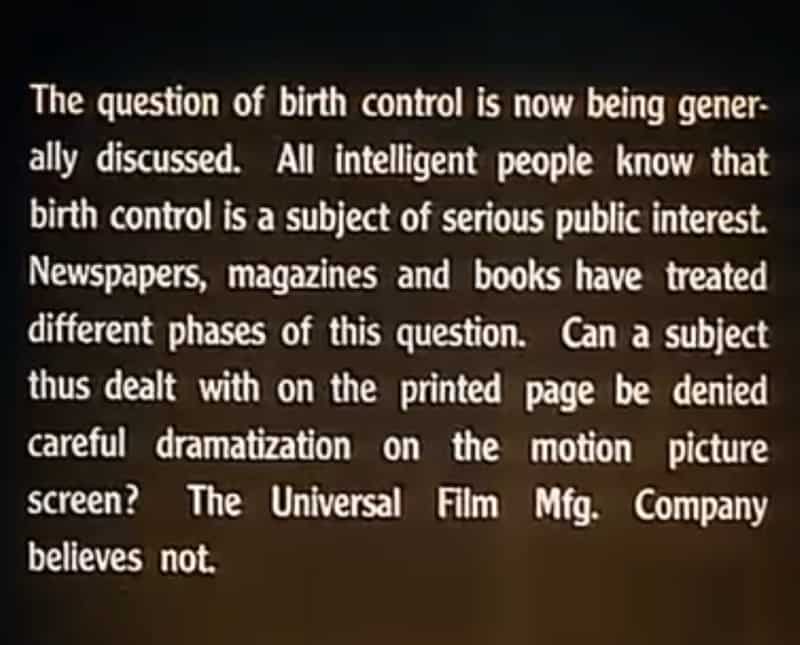
Co-written and co-directed by Weber and her husband Phillips Smalley, Where Are My Children? is not shy about its political stance on birth control. The film begins with a statement onscreen stating the importance of discussing birth control and Universal’s support of depicting the subject in a drama film. While the studio and filmmakers note the necessity of adults having access to this film, it does not condone unsupervised children being subjected to the topic of birth control. The choice to begin the movie with a stark declaration of intent gives viewers a clear indication of what they’re in for, which was something audiences in 1916 had yet to experience.

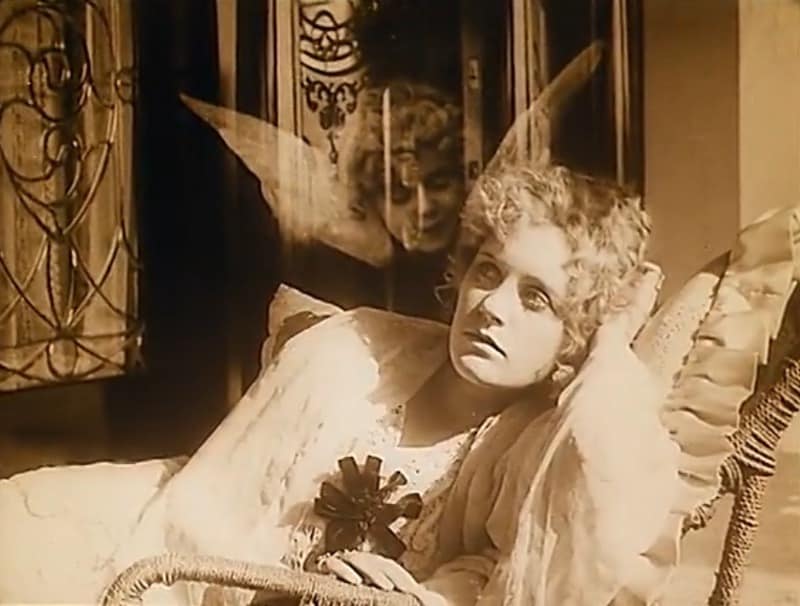
The film then enters Heaven’s gates, where a golden hue tints the angelic images of clouds and angels. The intertitle cards tell us that unborn children reside here until they are either born on Earth, often unwanted, or they’re sent back to Heaven, hinting at abortions. Immediately, this is much different than most movies we watch today that deal with abortion or birth control, but the religious perspective on reproduction was the perspective many people understood in 1916. Weber knew this and recognized the effect it would have on capturing its audience. To modern viewers watching today, it’s the first of several signs of this film’s age, but also of the historical value of the film, too.

Where Are My Children Prologue

The main plot of Where Are My Children? centers around District Attorney Richard Walton, played by Tyrone Power, Sr., and his wife, Mrs. Walton. They live a lavish life but lack the one thing Mr. Walton longs for: a family. His wife cannot have children and so he soaks up time with his nieces and nephews to fill the void. Mrs. Walton is a socialite and liaison between her high-class friends who need abortions and the one doctor she knows will perform them in secret. What she isn’t telling her husband is that she is capable of having children but isn’t ready to be a mother yet and has had several abortions herself.

One of the events that impact the Waltons is a case that Mr. Walton takes on involving a Dr. Malfit, who has been charged with obscenity for distributing pamphlets on the new idea of birth control. This is a direct reference to Margaret Sanger, who coined the term birth control and was charged with obscenity two years earlier in 1914. Sanger, like Dr. Malfit in the film, spent time as a nurse in the poorer neighborhoods of the Lower East Side of New York City. There, she witnessed similar scenes depicted in the film, including worn-down mothers with more children than they can feed. The overcrowding and lack of sexual education in poorer neighborhoods led Sanger to advocate for efforts of preventing pregnancy before the need for abortion.

Many adults did not understand how to prevent pregnancy on their own, since the topic of sex was far too foul a topic to discuss openly. This is what led Sanger to distribute several magazines and pamphlets on the subject, including one in 1914 titled Family Limitation. This is also what led to her being indicted for obscenity. However, she did not plead her case in court like Dr. Malfit does in the movie. Instead, she fled to England, where she hid out and educated herself on European birth control methods until the charges against her were dropped.

The Dr. Malfit case takes up a small portion of Where Are My Children?, but its role in the film and in representing the birth control movement as a whole is very important. Sanger is a figure with a complicated legacy as we look back at what she believed in during the years she advocated for birth control and eventually founded the first Planned Parenthood. Like many scientists and doctors at the time, she supported the concept of eugenics as a viable reason for birth control within the United States.

Eugenics is most notably connected with the torture and genocide perpetrated by the Nazis during World War II, but before that, many prominent Americans advocated for some kind of “selective breeding.” Eugenics was grounded in prejudice and racist ideals that viewed poor families, disabled adults, or people of color as lesser choices for parents. Since the invention of birth control by Sanger and the Nazis’ eugenics “experiments,” the beliefs that backed eugenics have been discredited. However, it’s still important to consider when we remember the birth control movement and first-wave feminism of the early 20th century.

Eugenics bleeds into Dr. Malfit’s case in Where Are My Children?, especially in the dramatized scenes of the doctor working with poorer families before his arrest. The people he takes care of are either helpless or drunks who are deemed unfit for parenthood. Many believe today that this sentiment underlined a lot of how advocates for birth control thought of people in poverty at this time.  Eugenics is also within the other plots in the film that depict abortion.

Mrs. Walton helps her wealthy friends get abortions when they need them, but she also helps a young girl who is staying with the Waltons. They take in the daughter of one of their servants, but she soon comes under than charms of Mrs. Walton’s skeevy younger brother. She becomes pregnant, but the father wants nothing to do with her or her baby. Mrs. Walton takes the girl to her doctor, but the procedure goes much differently for this young girl. She stumbles back to their house after the procedure and collapses in Mr. Walton’s arms shortly before dying of complications from her abortion. Like the rest of the lower class characters, the young girl does not sidestep the consequences of unprotected sex and perishes as punishment.

Soon after, Mr. Walton takes the doctor to court for performing illegal abortions, and he learns that his wife has been lying to him and using the doctor’s services as well. When Mr. Walton finds his wife and her socialite friends having a party at his home when he returns, he goes on a rampage. He tells them that they are selfish heathens who are killing what should be children born to further the human race. These women are viewed as potentially the only thing worse than a poor mother of many children: a childless wealthy woman.

Lois Weber Where Are My Children

The outdated morality within the plot of Where Are My Children? is vastly different than what is believed today in terms of a woman’s right to abortions and why birth control is important. Still, it is a historical feat for Weber to have put these controversial and complicated topics on screen. When most movies skirted around the social issues involving American women, Weber put them front and center. It’s thanks to her insistence on incorporating everyday issues into her films that we can see the origins of birth control, as problematic as they may be.

We also see in the story the prevalence of abortions at the time, which has been distorted when people discuss the history of abortion today. Weber’s film is an artifact that we can analyze alongside Sanger’s speeches or pamphlets as representations of this point in history. It also laid the groundwork for films that we watch today about abortion in our current political climate, like the fantastic 2020 drama Never Rarely Sometimes Always

Where Are My Children? also led Weber to a prolific career in representing women in feature films. While it sparked massive controversy throughout the country, leading to bans on screening the film, it also led to significant recognition of Weber’s name as a filmmaker. She soon became the highest-paid director, male or female, of 1916, and went on to make more films focused around women’s issues, including her masterpiece Shoes that same year. Eventually, Weber’s contributions and control over her films outshined her husband’s, and she made films on her own, even creating her own production company. Other films she made that were concerned with women’s experiences include What Do Men Want?, The Blot, and Too Many Wives.

Social issue films started to become outdated in the latter half of the 1920s, but Weber’s legacy has gained recognition in the past few decades. Beyond her ability to bring reality to movies, she has created some of the most striking images in cinema history. The cracked mirror shot in Shoes is an iconic image in and outside the world of film. And Where Are My Children? ends with Mr. Walton and Mrs. Walton sitting by the fire with their ghostly children they never raised hovering behind them, which is a scene as haunting as they come.

Lois Weber remains one of the greatest filmmakers of the silent era and her films are a rich source for understanding the social consciousness of the early 20th century. She dared to create social change via entertainment, which reached more people than other activists realized. Addressing the audiences’ lived experiences also moved them in ways other films that tried to separate themselves from real-life could not. Weber was committed to making the films she wanted to make, which were inseparable from politics. To Weber, “Truth holds her mirror up to politics.”

Wednesday, 24 March 2021

Why the ‘WandaVision’ Visual Effects Team Went Blue for Vision

Welcome to World Builders, our ongoing series of conversations with the most productive and thoughtful behind-the-scenes craftspeople in the industry. In this entry, Brad Gullickson chats with Tara DeMarco about WandaVision’s hidden and not-so-hidden visual effects.


Uh, who the heck is that? The thought rippled through the Twitterverse the moment Disney+ launched their Assembled premiere episode on the making of WandaVision. In peeling back the curtain, they revealed Paul Bettany‘s on-set appearance as Vision, and the shock was unnerving for many. There are several steps to bringing the Synthezoid Avenger to life. Most monumental of which is replacing Bettany’s very-real human face with a total digital construct. Yes, Wanda’s robo-lover is a visual effects miracle not far removed from War for the Planet of the Apes‘ Caesar or Avatar‘s Na’vi.

While WandaVision contains obvious VFX like the Hex barrier and the witch-on-witch fireball showdown, there are just as many hidden touches spread throughout the series. In replicating various sitcom aesthetics, from the 1950s to the 2000s, WandaVision slyly and slowly flexes its blockbuster muscles. The show looks like a billion bucks and nearly cost as much.

Marvel Studios promised they were bringing the big screen experience to the small screen, and it fell on Visual Effects Supervisor Tara DeMarco to deliver. During pre-production, she spent a few months devouring the movies in the Marvel Cinematic Universe, experimenting and fine-tuning her methods. When she and her team snipped segments from Captain America: Civil War and applied them to WandaVision‘s desired Dick Van Dyke sheen, a few problems arose.

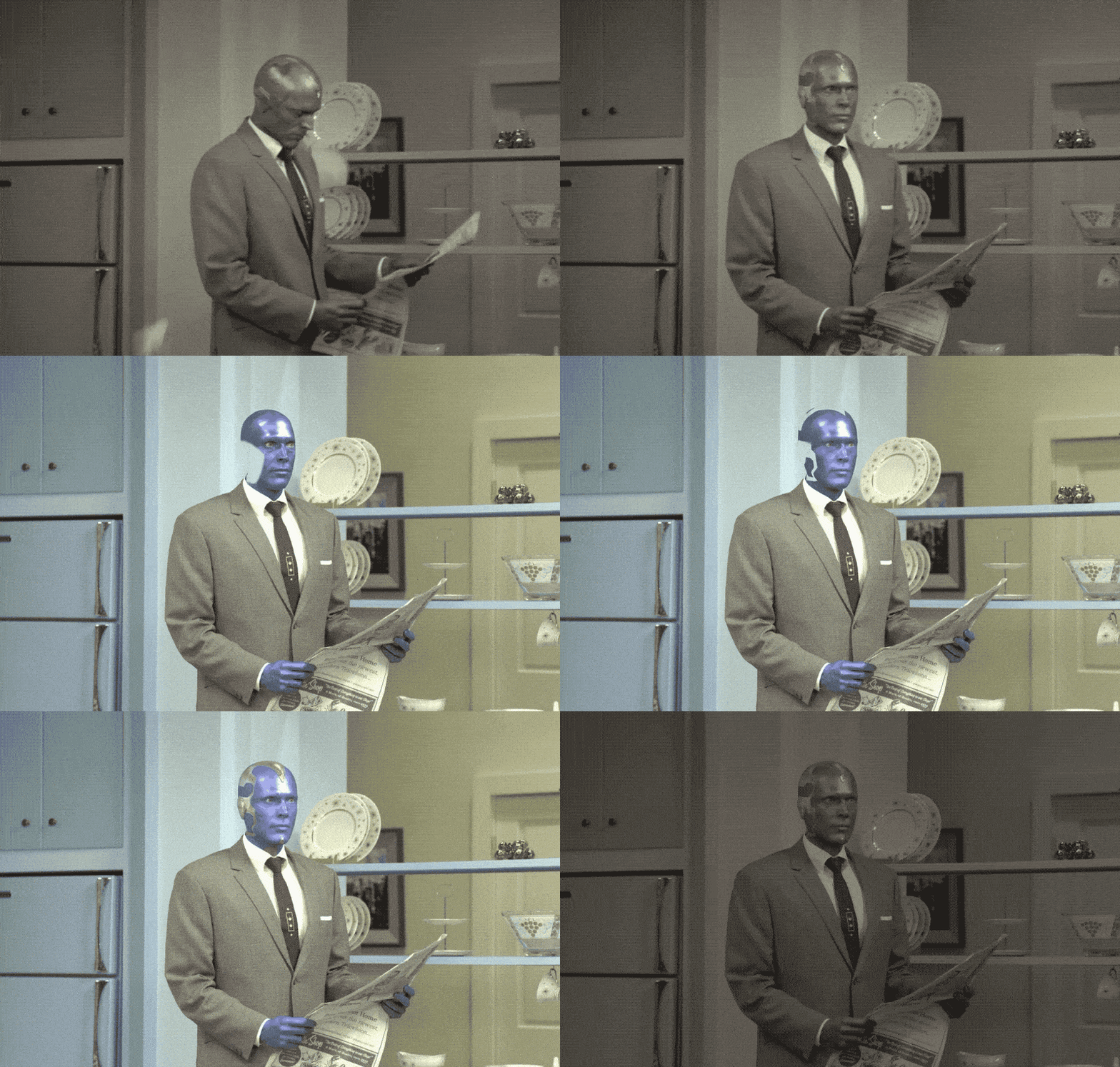
“We tested with footage from Civil War just to see what the red looked like in black-and-white,” explains DeMarco. “Ultimately, we determined that it was too dark and you couldn’t really read him. Once we had cameras and lights and lenses and everything, we did [our testing] as part of the normal hair and makeup and lens testing. We did a few different shades of blue. It’s a little stressful because it’s a beloved character, and you want to make sure he looks right. Beyond that, it was okay.”

During television production in the ’50s and ’60s, actresses would apply blue lipstick to their lips to appear red within the black-and-white frame. The same logic was used for translating Vision into these early sitcom eras. Color, however, was not the only obstacle. Vision’s new overly comedic demeanor, and the facial elasticity that comes with it, required additional solutions.

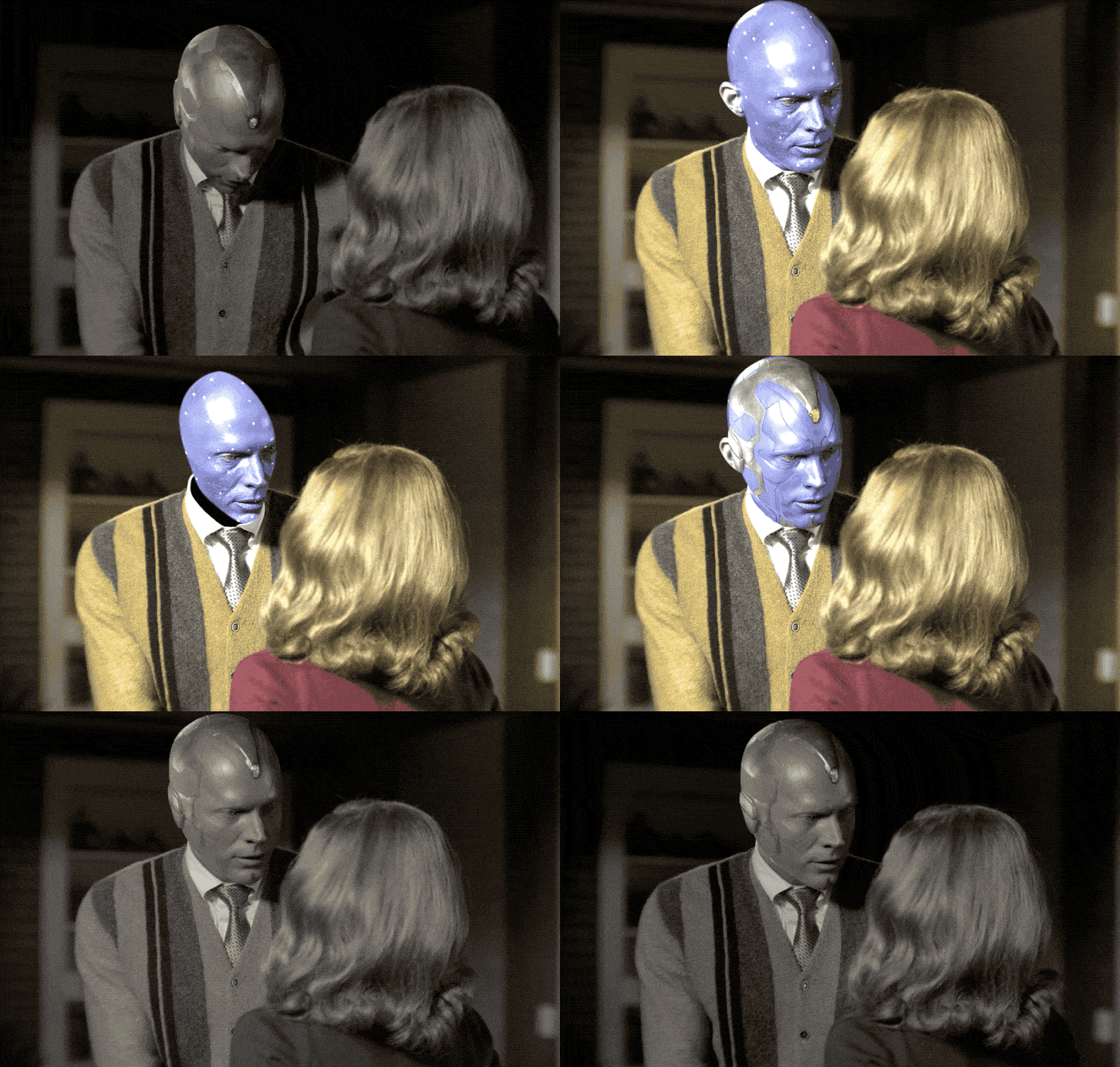
“The interesting challenge for Vision in the sitcoms,” DeMarco continues, “is that he makes many more faces than he did as a robot in the MCU. So, we spoke with the vendors that would be executing Vision, about testing and making sure we liked the way his skin panels looked while he was making all his different funny faces. Once we were into filming, we did a few selects and sent them along even before we were cutting. We made sure that Matt Shakman, our director, liked them.”

With a thumbs up from Shakman, approval was then moved to the studio. Once everyone felt like the black-and-white Vision looked like the regular MCU Vision, DeMarco could update her rig, a.k.a. the character’s digital skeleton. Going forward, capturing Paul Bettany’s on-set micro-facial movements presented no issues.

The Making Of Wandavision Vfx Blue

Every decision that was made extends from the script. Once hired, diving into the story was DeMarco’s first task. She’s like the rest of us, caught up in the adventure and where it’s going to drop these characters. She’s invested and wants the best for them.

“I try very hard not to put on my Visual Effects Supervisor hat in the first read,” says DeMarco. “I just read it. Read for story, read for character and for plot and for vibe.  I don’t want to immediately go down the rabbit hole of, ‘This we’ll have to film in this many pieces and make that part CG.’ The first read is always just for story. Then, on the second read, I’ll break down the scenes and figure out what pieces we can capture for real. Because we want to capture as many pieces for real as we can. And then, what pieces need CG enhancement or what pieces need to be full CG.”

As DeMarco works her way through the scripts, certain set-pieces set off her spider-sense. You know, the sci-fi brawls and bright beams of light in the sky. Their difficulty level is evident on the page, and they become the sequences she focuses on first.

“The scenes that we knew would be hard would be Vision in the home and the town being created in black-and-white,” she says. “Wanda saying goodbye to Vision and taking the Hex down. The scenes where Vision gets torn apart by the Hex. The whole pop-up base turning into a circus. Those read as complicated, and we knew that they would be hard.”

Wanda Vision Bw Vfx

The fun occurs amongst the surprises. The sections that feel like problems you’ve already tackled and solved in the past. Assumptions are made, but then on the day, problems erupt, and answers must come quickly.

“What ended up being a challenge in a way [we didn’t expect] was the kid’s super-speed,” says DeMarco. “Part of why it didn’t appear a challenge in the first read was that it was already established. It was established in Age of Ultron. We knew we wanted it to look like Pietro’s super-speed. We were like, ‘Oh yeah, we know what that looks like, that’s fine.” But in actuality, the kids hold hands at the beginning, and there’s a costume change, and those scenes are just a little more complicated than we all first imagined. We got it, but the first few were a little tricky, and we ended up picking a few additional pieces up on green screen or whatever to help support the visual.”

In the case of Quicksilver, DeMarco not only had his MCU appearance in Age of Ultron to consult, but there were also the X-Men films that originated with 20th Century Fox to consider. With Evan Peters as Uncle Pete in play, Marvel Studios had to contemplate other visual effects possibilities.

“We all love that [X-Men: Days of Future Past] Michael Fassbender/Quicksilver kitchen scene,” she says. “But I’ve done a number of other frozen moment shots in my life. We had talked about potentially doing a frozen moment here, but — and it didn’t really have anything to do with Fox. It was more like, is this a cool, beautiful effect that drives the story? Which is ultimately where we go with everything.”

DeMarco doesn’t spend much time online. She’s been made aware of certain reactions to the show, but she’d rather not fall down that black hole. It delights her knowing that folks are watching Assembled and having their minds blown by Paul Bettany’s big blue head.

“I have seen one incredibly hilarious fake Funko Pop of Blue Vision with ears out,” she says. “It made me really smile, and I sent it to our entire VFX team.”

These days, there is no sincerer form of flattery than a custom Funko. DeMarco’s work on WandaVision brought both titular characters into new emotional realms. In bouncing through various sitcoms, Wanda and Vision were unchained by their previous genre and free to convey themselves radically. For Vision to crack more than a smile but a full spectrum of Bettany expressions, Demarco solved a mess load of math.

What Makes a Cut “Feel Right”?

Welcome to The Queue — your daily distraction of curated video content sourced from across the web. Today, we’re watching a video essay on editing, how it can just seem natural, and the science of why edits “feel right.”


You can tell that an edit in a film is “off” the same way you can tell when your shirt is on backward. It just doesn’t feel right. The question, then, is why doesn’t it feel right? Why do some cuts feel natural while others feel awkward?

When trying to put into words why some edits are more natural than others, there’s a temptation to throw your arms up and exclaim that some edits feel natural because they just do. That there is some enigmatic knowledge, embodied in both the audience and the editor, that knows and feels when an edit is “natural.” There is some truth to this answer. Editing, as an art form, does engage in a kind of musicality. Cuts can “feel right” the same way major chords do.

And yet, editors and audiences “just knowing when an edit is right” undercuts the reality that editors are expressive artists. That a cut can contain everything from explicit arguments to coded subtext. Continuity, while it often goes unnoticed, is no accident. And in the right hands, jarring edits that break the flow may be the natural choice for a given scene.

As the video essay below underlines, as an audience we identify with the camera first and the characters second. And editors make thousands of tiny decisions to affect how we experience the camera’s perspective, from its attention span to its dramatic and thematic interests. In the end, there is no hackable code as to why some cuts feel right and others don’t. But listening to editors describe their process is the next best thing.

Watch “Why Does an Edit Feel Right? (According to Science)“:

Who made this?

This video essay is by This Guy Edits, a.k.a. film editor Sven Pape, an A.C.E. award nominee, whose credits include work for directors James Cameron, Joseph Gordon-Levitt, and James Franco. You can subscribe to This Guy Edits on YouTube here. And you can follow them on Twitter here.

More Videos Like This

24 Things We Learned from Mel Brooks’ ‘Spaceballs’ Commentary

Welcome to Commentary Commentary, where we sit and listen to filmmakers talk about their work, then share the most interesting parts. In this edition, Rob Hunter revisits a sci-fi spoof from a master satirist with Spaceballs.


Mel Brooks is such a ubiquitous name in comedy that it’s easy to forget he’s only directed eleven feature films. I’d argue that at least three of them are classics, but while I wouldn’t include Spaceballs (1987) in that grouping there’s no denying its presence in pop culture. The film is new to 4K UltraHD from Kino Lorber, so we decided to celebrate by giving a listen to the film’s commentary track. Is the funnyman good at the commentary game? Let’s find out together.

Keep reading to see what I heard on the commentary track for…

Spaceballs (1987)

Commentator: Mel Brooks

1. The original script was 247 pages, but “we hit paydirt around 140 pages.” The first cut was roughly two hours and twenty minutes long before being trimmed to the current ninety-six.

2. He refers to the film as a period picture as “it harkens back to an earlier fairy tale kind of 14th century setting, and yet it’s taking place in the future in space.”

3. Dark Helmet (Rick Moranis) is drinking from a Styrofoam cup as crew members would forget them around the set anyway so Brooks just made it part of the universe.

4. Co-writer Ronny Graham plays the priest planning to perform Princess Vespa’s (Daphne Zuniga) wedding ceremony.

5. Brooks doesn’t like to eat lunch with the actors as “they are animals, as you know,” but he made an exception here as the cast was lovely.

6. He had to cast Michael Winslow here as “he does all his own sound effects, and I saved over a hundred dollars.”

7. Brooks praises his entire cast, but he’s especially fond of Moranis as the actor was invested in the film and would go above and beyond in every scene. He also shows love to the late John Candy whose Barf brings him continual joy.

8. He’s both proud and ashamed of the “Druish princess” joke.

9. The desert sequence was filmed in Yuma, AZ. “The accommodations weren’t great.”

10. “This concept was one of the truly inventive concepts,” he says regarding the beat where Dark Helmet and his cronies watch a home video cassette of Spaceballs in order to find the protagonists. “I’m really very proud of this.”

11. Brooks first saw Zuniga in Rob Reiner’s The Sure Thing (1985), and when casting began for the role here he immediately went to her first.

12. He goes off topic on occasion, and after waxing poetic about the heyday of MGM before it changed hands multiple times he mentions that the studio’s commissary would always have matzo in honor of Louis B. Mayer. “The matzo would get in your teeth, but it was worth it.”

13. The shot at 43:30 of Dark “Pith” Helmet in the land speeder was accomplished by placing a mirror along the bottom to reflect the sand and create the illusion that it’s levitating.

14. Brooks got “a terrible rash” on his face and neck from the makeup used to turn him into Yogurt, and his knees also took a beating. “I love the character so it was worth it.”

15. The film cost $25 million which he says was his highest budgeted picture. IMDB lists Dracula: Dead and Loving It (1995) as costing $30 million, but Brooks claims it was closer to $22m.

16. Brooks says he wouldn’t have played roles like Yogurt “if Gene Wilder hadn’t abandoned me to do his own movies.” He adds that “it was a pity” and that he hopes to work with Wilder again some day. (This commentary was recorded well before Wilder died in 2016.)

17. Moranis improvised the scene where Dark Helmet plays with the Spaceballs action figures. “It gets a little dirty here.”

18. Brooks asked if Zuniga wanted someone else to sing the bit where Vespa is in the cell singing “Nobody Knows the Trouble I’ve Seen,” but she insisted she could do it — and she was right.

19. He directed his first feature, The Producers (1967), because he didn’t want anyone else to mangle it, and The Twelve Chairs (1970) was “an important, funny little movie” that he also didn’t mind directing. Brooks thinks he misstepped, though, starting with directing Blazing Saddles (1974). “I was deserting my private muse and getting into big stuff, and that may have been my mistake.” He laments the move into big studio movies and “the business of having to fill so many seats.”

20. The Metamorphosis/Kafka joke at 1:04:32 is one he’s ashamed of. “The intellectuals hate me, and the people who’ve never heard of Kafka don’t know what I’m talking about.”

21. Brooks’ love of writing far exceeds his fondness for directing. “Writing is, there is nothing and then there is something, so it’s almost godlike, it’s really creating. Once there is a script there’s something there to be cast, there’s something there to be designed, there’s something there to hire a cameraman to film, but it can’t equal the power of making something from nothing.”

22. George Lucas watched the film’s rough cut with Brooks and laughed along throughout. He and ILM helped out on the movie in post, and Lucas was never offended or put off by the satire.

23. Pongo was the name of Brooks’ first dog, inspired by One Hundred and One Dalmatians (1964). The movie reviewer on the news show is named in his honor.

24. John Hurt plays Jesus in Brooks’ History of the World: Part I (1981), and the two became friends. Brooks decided to ask him for a favor — recreate the chestburster scene from Alien (1979) for Spaceballs — and the actor happily obliged.

Best in Context-Free Commentary

Spaceballs is the brainchild of one Jew and two gentiles.”

“Poor jokes work for me.”

“It cost over a hundred dollars to build that and put it in the shot.”

“I’m enjoying this. I’m sorry, I should be commenting.”

“Bad jokes are good.”

“I don’t quite understand what’s happening here.”

“When I say nothing it means I have nothing to say.”

Blazing Saddles was a hit, and that was the making and the breaking of me.”

“It’s not easy to plot a movie successfully.”

Final Thoughts

Spaceballs remains a mixed bag of laughs and misfires, but there’s no denying that Brooks and friends never stop going for it. He laughs a lot during the commentary, and it seems clear that this is his first time watching in years meaning he also spends time in silence or pointing out what’s on screen. There are some fun bits here, but maybe a solo commentary isn’t ideal for Brooks — a moderator helping guide the commentary and asking questions would have been ideal. It’s at its best during the brief moments where he gets serious and insightful about his career, more of which would have made for a great track, but it’s still worth a listen for fans.

Read more Commentary Commentary from the archives.

Robert Kirkman’s Superhero Series ‘Invincible’ Packs a Surprising Punch

Welcome to Up Next, a column that gives you the rundown on the latest TV. This week, Valerie Ettenhofer reviews Amazon’s Invincible TV series, based on the popular superhero comic by Robert Kirkman.


When did comic book stories become mainstream? For me, it was 2010, when The Walking Dead premiered and brought comics to the small screen in a huge way. The FX series shattered TV-ratings records and was designed to continue for years in the way that comic books do, mining from nearly two hundred issues of source-material. While The Walking Dead is set to end next year, an adaptation of Robert Kirkman’s other popular publication, Invincible, is making its debut in a television landscape now filled with all kinds of sprawling, complex shows based on comics.

The animated series, also created by Kirkman and distributed by Amazon, follows teenager Mark Grayson (voiced by Steven Yeun) as he grows into the powers he inherited from his Superman-like alien father, Omni-Man (J.K. Simmons). Giving himself the titular moniker, Mark must learn to control and use these special abilities, which include flight, super-strength, and invulnerability, all while still attending high school. He is aided by his mother, Debbie (Sandra Oh), and his best friend, William (Andrew Rannells), while his romantic attention vacillates between classmate Amber (Zazie Beetz) and superpowered teammate Atom Eve (Gillian Jacobs).

At first, Invincible comes across like a tiringly traditional superhero saga, especially when compared to the past decade’s worth of bold small-screen storytelling within the genre. The series opens with a nine-minute world-saving sequence in which a Justice Leaguesque crew of heroes battle baddies who are attacking The White House. Despite coming from Image Comics and Skybound, the animation is sturdy and standard, reminiscent of shows from the DC Animated Universe. The pilot episode has a lot of run-of-the-mill writing, including several significant father-son talks and capital-I Important Lessons.

Here’s the good news, though: Invincible is not what it first seems.

Readers of the comics will know there’s a shocking twist early on that throws the entire series’ premise into question. The adaptation, to its benefit, reshuffles some plot points and emphasizes certain characters in order to make that defining moment even more upsetting and destabilizing on screen. The simplistic set-up, a lighthearted throwback that calls to mind beloved teen hero characters like Peter Parker, is only the tip of the iceberg. Below the surface, there’s a much darker series, one in which major threats against humanity are by turns hilariously commonplace and upsettingly relentless.

Fans of Kirkman’s comics may be hesitant to embrace some of the series’ aesthetic changes — which seem more in line with Amazon’s other superhero show, The Boys — as it thrives on exploding heads and buckets of animated blood. Yet despite its taste for violence, Invincible is not as inherently callous or caustic as The Boys and still manages to temper its darker moments with homages and jokes that are rooted in pure love for all things superhero. Plus, the series smartly brings some characters into sharper definition. Debbie, for example, comes off as one-dimensional early in the comics, yet Oh already imbues her with a vital sense of strength and personality in the three episodes that were available to critics ahead of the series debut.

Invincible also boasts one of the most impressive voice casts of any series in recent memory. Joining the main players are Mark Hamill, Jon Hamm, Walton Goggins, Zachary Quinto, Mahershala Ali, Jason Mantzoukas, and Nicole Byer, and that’s only about half of the standouts. In one of the series’ most perfect bits of casting, Seth Rogen pops up as a dopey alien named Allen. Meanwhile. Yeun, fresh off an Academy Award nomination for Minari, establishes himself as a nimble voice actor. He’s excellent as a boy on the brink of adulthood who must often balance his own youthful confidence — several other characters point out the blind optimism of naming oneself Invincible — with the infuriating and exhausting reality of the world around him.

Within the constellation of superhero TV shows, Invincible might have shined a bit brighter if it had been made sooner — before the format became overcrowded with programs attempting to one-up each other in terms of cleverness and visual originality. Despite this, the series still stands on its own as having an intriguing and surprising story led by an inimitable cast. Kirkman’s comic ran for one-hundred-and-forty-four issues, taking readers to astonishing and fantastic places. I only hope that the TV version of Invincible, with its clear love for the heroes that came before, also gets the chance to grow into the epic it aims to be.

Invincible kicks off with a three-episode premiere on Amazon Prime Video on March 26th.

Copyright © Cinenus | Powered by Blogger

Design by Anders Noren | Blogger Theme by NewBloggerThemes.com