The film industry in one place - Articles, Reviews, trailers and hype!

Tuesday, 31 July 2018

The 20 Best Non-Actor Cameos Ever

Wait, is that who I think it is?

Cameos are to cinema what whipped cream and sprinkles are to sundaes — fundamentally ornamental, lacking the power to either make or break the films in which they reside. At worst, they’re unpleasantly pointless but temporary distractions, at best, a delightful garnish. That said, it’s hard to deny that a good cameo doesn’t have a certain charm.

Generally ubiquitous across film and television, cameos can be divided into a number of categories. The subject of this list is specifically non-actor cameos — that is, cameos made by anyone and everyone who does not act for a living. Considering the director-in-their-own-movie cameo is such a popular subtype in and of itself, these have been excluded from the running. So have cameo appearances by actor hyphenates, that is individuals who work in multiple fields but ultimately have appeared on screen in larger acting roles, even if they are primarily known for their non-acting endeavors (e.g. David Bowie, Rihanna).

So, without further ado, here are 20 highlights from the wonderfully weird world of non-actor cameos.

Red Dots

Wolf Blitzer in Mission: Impossible – Fallout

In 2015, Shepard Fairey, the artist behind the iconic Obama “Hope” poster and the OBEY Giant street art project appeared as an employee of the fictional store Shocking Art Supplies in a Portlandia sketch. Fred Armisen and Carrie Brownstein star in an ad for the aforementioned store, which sells supplies for “edgy,” “urban” art, including such specialty items as pre-smashed televisions, disembodied doll parts, and “upside-down” American flags. Poking fun at the sort of protest art made with the intent of waking up the “sheeple” masses from their capitalist daze (that 99.9% of said masses will never see), Fairey awkwardly lingering in the background of most shots or demonstrating possible doll part combinations provides the skit’s most convincing humor.

Red Dots

Aimee Mann in The Big Lebowski

Two-time Grammy winner Aimee Mann has done a handful of other cameos since, but her first, as a nine-toed German nihilist in the Coens’ beloved 1998 classic The Big Lebowski, remains unmatched. We see her in a diner, ordering late-night breakfast with some anarchist friends who’ve previously appeared to cause trouble for the Dude and co. After her lingonberry pancakes are ordered, the camera tilts down to reveal her bloody, bandaged left foot with green-painted toenails, effectively solving the mystery of where “Bunny Lebowski’s” severed toe came from. A rare cameo that also manages to further along the plot.

Red Dots

Kurt Vonnegut in Back to School

Vonnegut Backtoschool

The beloved scribe behind such classics as “Slaughterhouse-Five” and “Cat’s Cradle” appears as himself for all of four seconds in the 1986 comedy about a father, Thornton Melon (Rodney Dangerfield), who decides to join his son, Jason (future Vonnegut adaptation director Keith Gordon), at college in an attempt to convince him of the merits of continued education. Once there, Thornton finds that he enjoys partying much more than studying. However, he also has the hots for literature professor Diane Turner (Sally Kellerman), inspiring him to hire Kurt Vonnegut Jr. himself to write his Vonnegut paper for him. Thus, the man himself appears at the door, delivers his one line,”Hi, I’m Kurt Vonnegut. I’m looking for Thornton Melon,” and then disappears once more. Dr. Turner isn’t fooled by deception, realizing at once that Thornton’s paper was written by someone else and inspiring Thornton to give Vonnegut a particularly explicit call to voice his complaints.

It’s a great cameo appearance that would work with a lot of different authors, but the way the whole thing is so contradictory to Vonnegut’s actual persona makes it particularly delightful. After all, this is the man whose brief stint at Sports Illustrated ended after he was assigned a piece about a racehorse jumping a fence in an escape attempt, stared at his typewriter for a while, wrote “The horse jumped over the fucking fence,” and then left.

Red Dots

Patrick Leahy in five iterations of Batman

Dark Knight diehard and Vermont Senator Patrick Leahy has cameos in Batman ForeverBatman: The Animated Series, 1997’s Batman & Robin, two of three Nolan Batman films (The Dark Knight and The Dark Knight Rises) and Batman v Superman: Dawn of Justice. Leahy basically seems to be a pillar of constancy in all things, as the longest-serving senator (he’s been in the US Senate since 1975) and quite likely the longest-serving Batman cameo-maker.

His appearances in Batman Forever and Batman & Robin were run-of-the-mill face-in-the-crowd appearances, but his Dark Knight cameo is of special note: he’s the guest who tells the party-crashing Joker (Heath Ledger), “We’re not intimidated by thugs.” The Clown Prince of Crime then looks at Leahy like this:

Screen Shot At PmAnd then proceeds to escalate the situation to this:

Leahy Tdk

Before Rachel Dawes (Maggie Gyllenhaal) intervenes. As far as actual acting in cameo roles goes, Leahy deserves some serious props for this one. According to The Japan Times, Ledger didn’t actually know who he was holding at knifepoint — Leahy introduced himself as “Patrick from Vermont.” Michael Caine clued Ledger in afterward.

Red Dots

Madeleine Albright on Parks and Recreation

Albright Parksnrec

There are many incredible political cameos in Parks & Recreation, especially in later seasons once the show was properly established as a Big Deal, but Madeleine Albright’s appearance in the finale season takes the cake. The starstruck fangirl energy Leslie Knope (Amy Poehler) exudes in most of the series’ other major cameo encounters is fun, but the more blasé tone of Knope’s waffle lunch date with the former US Secretary of State gives it an extra comedic edge — especially once the scene reveals how the two ended up becoming so friendly (hint: Albright really didn’t have much say in the matter).

Her Gilmore Girls cameo is also pretty great.

Red Dots

Ian Brown in Harry Potter and the Prisoner of Azkaban
Ianbrown Hp

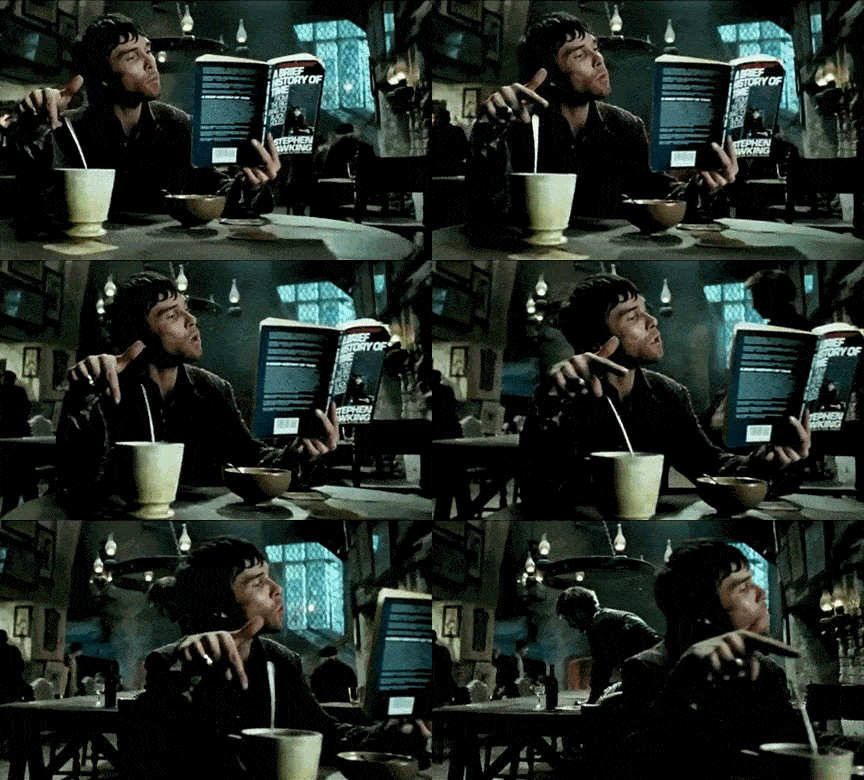
Ian Brown, frontman of the acclaimed rock band The Stone Roses, appears in a non-speaking role, casually filling up the foreground of this establishing dolly shot of the Leaky Beaker in the Alfonso Cuarón-directed installment of the Harry Potter film franchise. It’s a blink-and-you’ll-miss-it sort of moment, especially considering the ages of the film’s target demographic (particularly when it was first released) vs. the age demographic most likely familiar with The Stone Roses. However, the more you think about it, the weirder it becomes. Not only is Brown showing off serious wizard cred with his nonchalant display of wandless tea-stirring magic, but he’s absorbed in the decidedly Muggle classic “A Brief History of Time.” That is, his reading material indicates some level of comprehension, or at least awareness, of Stephen Hawking in a world where a self-described Muggle enthusiast doesn’t know how to pronounce “electricity” properly.

So, how did it happen? According to Brown, who was apparently at least somewhat friendly with Cuarón through his (now ex) wife, Fabiola Quiroz, he “did it for a laugh.” Apparently over dinner one night, Cuarón told Brown “that he had a part for me, so I asked my lads and they said, go for it.” No further comment was given as to who “the lads” are.

Red Dots

King Abdullah II of Jordan on Star Trek: Voyager
Abdullah St

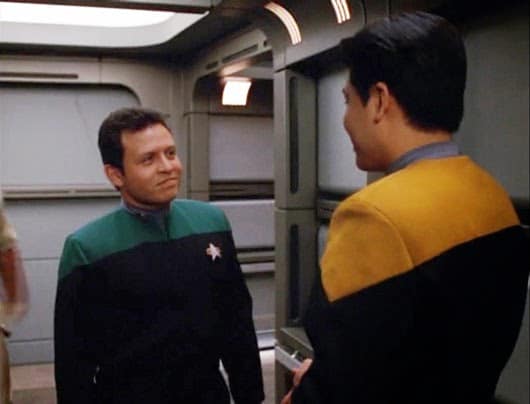
The future king of Jordan makes an uncredited cameo appearance as an unnamed ensign in the opening scene of the episode “Investigations” in Season 2 of Star Trek: Voyager. He’s a huge Trekkie, and the appearance was arranged for King (then Prince) Abdullah by his US advisor. The briefness and non-speaking nature of his cameo somehow increase the shock factor of his appearance for those Trek viewers familiar enough with the royal to recognize him on sight.

Red Dots

Buzz Aldrin on 30 Rock

Retired astronaut Buzz Aldrin has had plenty of fun since the 1970s, making cameo appearances as himself in everything from The Simpsons to The Big Bang Theory, but his special appearance in the 30 Rock Season 4 episode “The Moms” is particularly out of this world. Liz Lemon (Tina Fey) seeks out the aerospace legend after a heart-to-heart with mother Margaret (Anita Gillette) in which the latter claims Aldrin was the true love of her life—as opposed to, you know, Liz’s father. Their eventual meeting is delightfully strange in the way that great cameos often are, with Aldrin giving Liz a brief run-through of his youthful misadventures to assure her that her mother didn’t miss out on anything by ditching him, and concluding with the pair taking a few moments to hurl abuse at the moon (“I walked on your face!).

Red Dots

Marshall McLuhan in Annie Hall

Marshall McLuhan, the 20th-century philosophical icon known to film and media students everywhere for his “the medium is the message” theory, shows up early in Annie Hall after Alvy Singer (Woody Allen) gets into an argument over McLuhan with an overly loud mansplainer waiting behind him in line for a movie. The argument comes to a screeching halt when Alvy pulls out none other than McLuhan himself from his convenient location behind a display board. “I heard what you’re saying. You know nothing of my work,” McLuhan calmly tells the mansplainer.

It was actually originally planned for the cameo to be filmmaker Federico Fellini instead, but those plans fell through last minute, so McLuhan filled in. His delivery is somewhat stilted; after a strong start, his rather lengthy spiel becomes somewhat less coherent — apparently, McLuhan had issues delivering the line properly, even after several takes. Nonetheless, it’s a great “wait, is that—?” moment.

Red Dots

Hunter S. Thompson in Fear and Loathing in Las Vegas

Having the original author of a work make a cameo in the adaptation is quite common — as is having the real person cameo in a biopic of a living person. Considering Fear and Loathing is a loosely disguised autobiography on literal acid, Hunter S. Thompson’s appearance in Terry Gilliam’s film adaptation is of particular note. As Raoul Duke (Johnny Depp) floats through a partying crowd, high as a kite, recounting in voiceover “the Great San Francisco Acid Wave” of 1965, suddenly one figure among the masses catches his attention. “Mother of God, there I am,” Duke comments.Thompson Fearandloathing

And there, indeed, Hunter S. Thompson is.

Well played. Very well played.

Red Dots

Peter Jackson in Hot Fuzz

Hot Fuzz Blu Ray

The filmmaker best known for bringing Middle Earth to life in the outstanding Lord of the Rings trilogy and then ruining it a little with the study in excess and disappointment that is The Hobbit trilogy shows up in the opening montage of Hot Fuzz as the deranged Santa Claus who stabs Nick Angel (Simon Pegg) in the hand.

So how did this cameo come about? Well, Peter Jackson was apparently a fan of Shaun of the Dead, so he and director Edgar Wright ended up becoming friends. And then, as Wright explains in an About.com interview,  “I was telling him about Hot Fuzz and he said, ‘I’ll be in the UK and I’ll do a cameo if you want.’ Then I thought, ‘F**k, he should play Santa.’ It was brilliant, actually.”

Red Dots

Bertrand Russell in Aman

Bertrand Russel

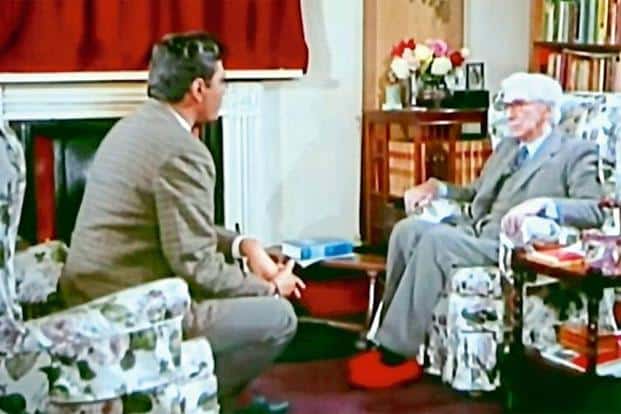
In what is almost certainly the most downright bizarre cameo on this list, Nobel laureate writer, philosopher, and mathematician Bertrand Russell made his one and only film appearance (as himself) in the 1967 anti-war Bollywood film Aman. In Russell’s one scene, he bestows some words of wisdom about world peace upon the young protagonist, Dr. Gautamdas (Rajendra Kumar). The details of how exactly this cameo came to be are unclear and seem fated to remain amongst the great mysteries of the universe.

Red Dots

Gwen Stefani in The Aviator

Jean Harlow Aviator

Back in ye olde era of 2004, in her pre-solo career days when she was still exclusively known as the lead singer of No Doubt, Gwen Stefani made a brief appearance as Jean Harlow in Martin Scorsese’s Howard Hughes biopic The Aviator. She shows up on the arm of Hughes (Leonardo DiCaprio) at the premiere of Hell’s Angels, the 1930 film in which she starred and which was written and directed by Hughes. The cameo is a lot smaller than this anticipatory MTV article might lead you to believe. Still, Stefani convincingly looks the part of Harlow. The story goes that Scorsese saw Stefani on the cover of Teen Vogue and thought she would be good for the part.

Red Dots

Tim Burton in Hoffa

Timburton Hoffa

Tim Burton, the filmmaker whose brand at this point is perhaps best described as “Disney Goth” makes a cameo as a corpse in Danny DeVito’s 1992 biopic of the legendary labor union leader (played in the film by Jack Nicholson).

You’ve got to admit, it makes sense.

Red Dots

Damien Hirst in Agent Cody Banks 2: Destination London

Admittedly, that Damien Hirst’s glorified specimen jars with hyperbolically pretentious titles have made him one of the world’s richest living artists hurts my soul a little. That said, Hirst did make a cameo as “Arty Farty Security Guard” in the kid spy movie sequel Agent Cody Banks 2: Destination London, so at least he has a sense of humor. Or, you know, he owed somebody a favor. The details of how this cameo came to be are unclear, but it probably has something to do with Hirst being friendly with director Kevin Allen’s brother, Keith. Photographic evidence is unfortunately lacking — amazingly, the internet isn’t abound with screencaps from this dated product of mid-2000’s youth culture — but it’s IMDb official.

Red Dots

Erin Brockovich in Erin Brockovich

Erin Brokovich Cameo

As mentioned before, cameo appearances from the actual person in biopics of living people is a pretty common trope. Most tend to be either blink-or-you’ll-miss-it type deals or extended concluding statements, but Erin Brockovich’s cameo in the Steven Soderbergh-directed movie about her whistleblowing role in Hinkley, California’s groundwater contamination scandal finds a commendable middle ground. Brockovich plays a waitress who serves Julia Roberts as Brockovich and her kids, and her name tag reads “Julia.” Geddit?

Red Dots

George Lucas in Beverly Hills Cop 3

George Lucas Beverlyhillscop

Beverly Hills Cop III might have been the weakest entry in the series, but in cameos the 1994 sequel sticks the landing — at least in this one, in which Star Wars creator George Lucas plays a disgruntled theme park attendee who gets jumped in line by Axel Foley (Eddie Murphy) as the latter escapes onto a ride. Lucas says all of one word, “Hey!,” and is referred to in the credits as “Disappointed Man.” No one on the internet has yet missed the opportunity to point out that this will, somewhat prophetically, be the very same role played by the majority of Lucas’ many fans just five years later.

The post The 20 Best Non-Actor Cameos Ever appeared first on Film School Rejects.

The Transgressive Films of Kurt Kren

An exploration of Viennese Actionism and one of cinema’s most shocking, provocative filmmakers.

From the car scene in Hereditary (2018), to the eyeball slicing in Un Chien Andalou (1929), to the final murders in Salò, or the 120 Days of Sodom (1975), cinema has regularly presented us with disturbing, confrontational, and shocking images since its conception. Reactions to these unnerving sequences can vary depending on the audience member: a quick wince, a look away in dismissal, a walk outside the theater, or a redirection of our gaze back to the screen out of morbid fascination — did we just saw what we thought we just saw?

In 1960s Vienna, avant-garde artists Günter Brus, Otto Mühl, Hermann Nitsch, and Rudolf Schwarzkogler produced transgressive, nauseating art of the Viennese Actionism movement. Brus, Mühl, Nitsch, and Schwarzkogler intended to shock the Austrian state out of its bourgeois, regressive postwar complacency. To achieve this, they indulged in anarchistic live happenings (“Actions”) performed for an audience or a camera. Most of these Actions take the naked human body as its canvas for deeds of defilement, sexual perversion, and gory violence via the chaotic use of paint, meat, and bodily fluids. The grotesquely harrowing Actions are meant to visually assault the spectator and, as Amos Vogel notes in the seminal “Film as a Subversive Art,” “‘stir up’ resides of the concentration-camp guard, rapist, masochistic victim, or brutal oppressor in all of us, and reintroduce us, in painfully original fashion, to the concepts of collective guilt (or catharsis?).”

Based on its transgressive aspirations and Vogel’s praise, Viennese Actionism may seem gloriously over-the-top punk, a radical counterculture deserving of more modern recognition (especially for its influence on performance art). Yes, some Actions succeed as legitimately effective subversions of mainstream aesthetics and politics. However, most of the movement’s work is unbearably revolting insofar as it strays from the moment’s actual artistic and social merit; many Actions feature animal cruelty and sacrifice, and Mühl’s work is blatantly misogynistic and self-aggrandizing. Also, Mühl, Brus, and Nitsch’s stomach-wrenching public performances led to charges of public indecency and brief imprisonment for each of the artists, not to mention moral outrage and near riots.

However, much of the more evocative work of the movement survives in the short films of Kurt Kren, an avant-garde filmmaker who documented Mühl and Brus’ Actions. While his involvement with the Actionists only comprised a small part of his prolific career, Kren’s compelling and innovative Actionist films stand as avant-garde cinema touchstones in their own right.

Mühl and Brus wanted their Action films to be unmediated representations of their art with a straightforwardness akin to a documentary. (For  16/67 September 20: ‘The Eating, Drinking, Pissing, and Shitting Film,’ Brus requested Kren to capture the artist’s own titular actions with the same precision Hitchcock used when filming Cary Grant’s forehead sweat.) Kren had other plans in mind.

Through the experimental manipulation of the film medium, Kren seized Mühl and Brus’ Actions and made them his own. The use of rapid editing and montage allowed the filmmaker to divide a singular performance into ragged, fragmented infinities of brief images — the antithesis of Mühl and Brus’ styless, naive conceptions of the films. Kren’s short Actionist films, therefore, transgressed the transgressor: by inverting Mühl and Brus’ art with a creative vision of his own, he scrutinized the ephemeral power of their Actions, transmitting their intense physicality and grotesque visuals with an unbridled, incoherent, yet gripping excess.

The first of Kren and Mühl’s three collaborations, 6/64 Mama und Papa (1964), is a typical Mühl Action, with its four minute runtime consisting of the coating of paint, eggs, leafs, powders, and liquids on staged, meticulously arranged naked models. It’s sick, slimy, vivid, gory, and gross.

Kren later insisted that he shot the silent, frenetically edited, and vibrantly colored film while severely intoxicated. However, the intricacy of Mama und Papa’s montages, as well as the two month editing job, suggests that Kren did not drunkenly or haphazardly approach the Action. Rather, he sought to juxtapose Mühl’s provocative content and mis-en-scene with his own Structural formal explorations, with an intention of imbuing the Action with crescendos, motifs, and general sense of disorientation.

While unsettling, Mama una Papa ranks among Mühl and Kren’s more accessible works; it certainly doesn’t go down easy, but it is fascinating (and not as vomit-inducing as Mühl’s other films like Sodoma (1970), Psycho-motorische Geräuschaktion (1967)). Specific images of the body, in its various stages of defilement, are returned to over and over again, propelling the singular Action into a pulsating, hypnotic, and rhythmic experience. While these leitmotifs of images grant Mama un Papa some sort of structure, their presence in the film is fleeting (no image is seen for more than a second or so), and Kren’s deranged, frenzied editing altogether ensures the viewer will never fully decipher the performance unfolding in front of them.

Unsurprisingly, Mühl was startled and outraged upon viewing Mama un Papa. The film both slimmed down Mühl ’s lengthy Action into a mere number of minutes and nullified his wish for a pure, unmediated documentation. However, Kren’s fixation on aestheticism ultimately worked in Mama und Papa‘s favor: the Action’s use of gore and sexuality is still palpably repellent, but the film’s montage effectively taunts the audience. Its urgency encourages us to become hyper-aware of our relegated roles as spectators, examine the very things we find disgusting, and furthermore reflect on our acts of looking at the salacious content onscreen — how we find ourselves comforted by the film’s repetitious and familiar images and flinching at the more offensive ones (the film’s climax, featuring Mühl himself, comes to mind).

Kren’s Mama und Papa, therefore, works on numerous levels: it sustains the shock value of Mühl ’s original Action, emerges as a transgressive film in its own right, and challenges the audience’s detached yet complicit gaze. Mühl was eventually able to recognize the merit of Kren’s work, and the two went collaborated on two more films together, the lesser 9/64: O Tannenbaum (1964) and 12/66 Cosinus Alpha (1966).

Meanwhile, Kren’s Actionist films with Brus noticeably differ from his collaborations with Mühl. The Kren-Mühl films entail a garish color palette, while the Kren-Brus films are starkly filmed in black-and-white. The Kren-Mühl films offer little symbolic meaning underneath its shock value, where the strongest of Kren-Brus films actually employ abstract and conceptual themes.

The first film Kren made with Brus, 8/64: Ana (1964), is even more fast-paced and manically edited than Mama und Papa. While centering on bicycles, nude models, and splattered paint, the content of the film is less extreme, but Kren de-famalizaries these ordinary objects into some deeply settling, nightmarish, and ineffable imagery. The film is so choppily stitched together that it’s difficult to actually clearly detect any movement or activity —  or extract any real meaning — but its visceral sense of anguish is worth a watch alone. Because of its impressionistic incoherence, the focus of the Ana is unequivocally on Kren’s innovative filmmaking rather than Brus’ actual Action, which renders Kren’s aptitude for using the film medium to convey new gestures out of another person’s art all the more evident.

Brus and Kren also created 10/65 Self-Mutilation (1965), the most remarkable film Kren ever made and perhaps the greatest achievement of Viennese Actionism. In the silent Self-Mutilation, Brus plasters his own face with viscous paste, rips his skin to shreds, and becomes subjected to a mauling by household objects: scissors, razors, knives, clips. Like Ana, Self-Mutilation is a pure expression of anguish, but this sense of anguish predominantly derives from Brus’ Action and harrowing performance, as opposed to Kren’s experimentation with form.

This is not meant to criticize Kren’s direction, which works fantastically for the film. Self-Mutilation is emblematic of Kren’s sensibilities in that he deconstructs the Action’s continuity via the editing. For Brus, the Action of self-mutilation was likely a straightforward process, a slow and linear unveiling of Brus scraping off his mud-white paste of skin and brutally reconstructing a new face thereafter. Kren subverts the Action’s narrative progression; Self-Mutilation doesn’t entail a beginning, middle, or end — it’s just a horrifying standstill of pain.

Self-Mutilation feels less mechanical and infinitely more human than Ana or any other Kren-Brus or Kren-Mühl films. Instead of treating the body like a passive recipient of defilement and abuse, Kren enables us to forge a deep concern and empathy for a man undergoing self-mutilation. Through a more languid pace and longer shots, Kren emphasizes Brus’ performance as he flails, contronts, and screams. With this, Kren communicates one of the central themes of Viennese Actionism: the imprisonment of the body. The suffering man is trapped by the constraints of his own being, unable to alleviate himself from his self-imposed yet cruel, undeserved pain. He can’t communicate anything other than a primal, barbaric yelp, and Kren’s constant framing on a closeup of Brus’ face — who expresses terror with fearful eyes and a mouth open in a silent, pleading howl — articulates these agonizing limits of our bodies and emotions. Kren’s filmmaking employs a relatively straightforward style, perfectly fit for the disturbing, tense, yet simple Action.

Kren’s involvement in Viennese Actionism transcended his role as the behind-the-scenes filmmaker who willingly repelled against Actionists to pursue his own creative preoccupations. As the main disseminator of Actions, Kren endured much harassment from authorities throughout his career. He was denied service from printing laboratories: when he attempted to get Mama und Papa processed, the lab employees looked at the film’s negative and demanded Kren to leave and never come back (the lab place that eventually agreed to develop the film was known for handling pornographic films in the Vienna suburbs).

At a public 1968 Art and Revolution event, Brus, Mühl, and other artists engaged in a variety of violent, anti-bourgeois, and outrageous performances near The University of Vienna. In a lecture hall, Brus cut himself, defecated, and masturbated himself while singing Austria’s national anthem. The police blamed Kren for filming the events, even though he had little participation in the performance (Ernst Schmidt Jr. was actually the filmmaker). Relying on the mere fact that Kren was involved with the Actionist movement, they raided his apartment and confiscated his films.

Kren’s close ties with Viennese Actionism resulted in getting fired from a bank job and self-exiling from Vienna. In the 1970s and 80s, he alternated between Germany and the US, where he made presentations about his films at universities, became involved in the early 8os Houston punk rock scene, and took a job as security officer at the Houston Museum of Fine Arts.

Kren’s short and aberrant alliance with the Actionists led to experiences of isolation and harassment by the police, which proves the extent to which Viennese Actionism was truly despised and condemned by the public. Kren’s films repulsed both the Actionists and the people the Actionists were rebelling against (the police, politicians, mainstream society), thereby cementing him as the ultimate transgressor of the movement. His collaborations with Mühl and Brus captures the intense energy of their Actions, though he the subject matter with an artful, invasive spirit. By scrutinizing the Actions and transforming them into products of his own fascination with the film medium, Kren remains one of the most subversive voices in avant-garde cinema, and his films retain their unsettling and raw power over 40 years later.

The post The Transgressive Films of Kurt Kren appeared first on Film School Rejects.

Monday, 30 July 2018

Nicolas Winding Refn's New Site Showcasing Restored Films Launches

Nicolas Winding Refn

"It comes with a mystery attached." Infamous Danish filmmaker Nicolas Winding Refn has launched a brand new cinema website, open to the public today, called byNWR.com. The new website is essentially a specialized streaming service, available entirely for free, where Refn handpicks and highlights "meticulously restored" films. This has been his own personal hobby already that he has decided to let the public in on. And he insists there's no catch, or gimmick, or anything else, he just wants to offer up these films and enrich the world of cinema (and the internet) with these rare, long-lost gems. There is a new release every quarter, divided into three monthly chapters. For the first volume, Refn invited acclaimed biographer and journalist Jimmy McDonough to be the initial guest editor for "Regional Renegades" - all three films available now.

So what is this all about? Refn explained the basic concept to The Guardian earlier this month. "Over recent years, I've bought and had restored scores of old movies as a hobby. I wondered what to do with them. Then I realised I should share them for free, so I set up a website where they could be streamed. There's no catch; you're not being sold anything. Take it or leave it." The site, byNWR.com, is basically a streaming service but he prefers not to call it that - it's "an unadulterated cultural expressway for the arts. It's there to inspire the youth!" Okay, it's a good pitch, I'm certainly curious. In addition to being able to watch each of the films, there will be more: "whether it be articles, biographies, essays, or original music, video and photography, all of it accompanied by a wealth of previously unseen cultural artifacts connected to the film itself." A poster:

byNWR.com

The very first volume to be released on byNWR.com, titled "Regional Renegades", includes three "regional" films hand-picked by Refn and guest editor Jimmy McDonough: The Nest of the Cuckoo Birds (directed by Bert Williams, first released in 1965); Hot Thrills and Warm Chills (directed by Dale Berry, first released in 1967); and Shanty Tramp (directed by Jose Pietro, first released in 1967). They are currently only available to watch in the UK and US, along with a few other select regions, with more locations coming soon. "Missing Links", byNWR’s second volume, will arrive in September and is guest-edited by Refn favorite Little White Lies, the UK film magazine. ByNWR will reveal guest editors for upcoming volumes in the near future and will be expanding into other markets, with the French edition to be unveiled in 2019. And of course, it will all be for free - all you need to do is sign up and join in on the fun. So, how does that sound? Worth a shot?

There are a number of specialty cinephile streaming services running, with FilmStruck and Mubi leading the way. These are compliments to all the other streaming services, between Netflix and Hulu and everything else. However, there's much more curation to the specialty ones. And byNWR.com is all about rare, restored discoveries including more content than just the film itself. It's all in hopes of using the internet to bring our attention back to art. Here's what he is really getting at with this site: "People will always go to the cinema. But the cinema industry is financed by certain films whose sole purpose is to maximise profit as fast as possible. There's nothing wrong with that. But what has changed history most in the last 20 years? A video camera and a telephone. One of the key things of the digital revolution is that sharing is a new definition of culture. People need to express themselves. The more you do that, the better a person you become." Damn.

So - check out the website, check out the content, and sign up if you want. Go watch something really rare.

First Trailer for Wacky Horror Film 'Puppet Master: The Littlest Reich'

Puppet Master: The Littlest Reich Trailer

"Vile and wicked." Cinestate has debuted the first official trailer for Puppet Master: The Littlest Reich, an updated reboot of the Puppetmaster horror film. The original Puppetmaster was released in 1989, about crazy animated, murderous puppets. This new film features a screenplay written by S. Craig Zahler (director of Bone Tomahawk and Brawl in Cell Block 99), along with some crazy new puppets, including a ringleader known as the "Littlest Reich". All hell breaks loose when a strange force animates the puppets up for auction at a convention, setting them on a bloody killing spree that's motivated by an evil as old as time. The film stars Michael Paré, Thomas Lennon, Charlyne Yi, Udo Kier, Nelson Franklin, Matthias Hues, Jenny Pellicer, and Barbara Crampton. This does look totally weird and violent and crazy, so have fun.

Official trailer for Sonny Laguna & Tommy Wiklund's Puppet Master: The Littlest Reich, on YouTube:

Puppet Master: The Littlest Reich

Puppet Master: The Littlest Reich

Recently divorced and reeling, Edgar returns to his childhood home to regroup his life. When Edgar finds a nefarious looking puppet in his deceased brother's room, he decides to sell the doll for some quick cash. Girl-next-door Ashley and and comic book pal Markowitz join Edgar for a doomed road trip to an auction at a convention celebrating the 30th Anniversary of the infamous Toulon Murders. All hell breaks loose when a strange force animates the puppets at the convention, setting them on a bloody killing spree that's motivated by an evil as old as time. Puppet Master: The Littlest Reich is co-directed by filmmakers Sonny Laguna & Tommy Wiklund, both of the films Blood Runs Cold, Wither, and Animalistic previously. The screenplay is written by S. Craig Zahler, based on the original film Puppetmaster from 1989. Cinestate will release Puppet Master: The Littlest Reich in select US theaters + on VOD starting August 17th. Interested?

Jonah Hill and Emma Stone Solve the Riddle of the Mind in ‘Maniac’

Four years after ‘True Detective,’ Cary Fukunaga returns to TV with this mysterious battle of wills.

Four years ago, Cary Fukunaga stole all our attention with True Detective. We removed ourselves from our lives so that we could devote our time to cracking the code of that series. What did it all mean? The answer was never going to be as fun as the question, or the quest to answer it.

Having stumbled in bringing his version of Stephen King’s IT to the big screen, and before gearing up to direct Jake Gyllenhaal in a Leonard Bernstein biopic, Fukunaga has returned to a streaming platform. Maniac is based on a Norwegian television series from 2014 and will drop its 10 episodes on September 21st via Netflix. As he did with True Detective, he’s packing his frame with two enticing performers.

What appears below is mysterious to the point of obtuse, but to deny its infectious quality would be a lie.

The post Jonah Hill and Emma Stone Solve the Riddle of the Mind in ‘Maniac’ appeared first on Film School Rejects.

Lena Waithe Jumps Into Social Commentary Horror Game With ‘Them’

The Amazon anthology series looks to both the past and our present to expose the terror of hatred.

How effective is the jump scare? Well, it’s immediate. The trick of misdirection and a screeching violin string will equal a fright, send a few goosebumps rippling down your arms, and get you chuckling for several silly moments afterward. The jump scare can be a clever jolt from a filmmaker to prepare you for the truly emotionally wretched horrors that await, or it can be the sum total of a hack who has nothing left in their bag of tricks.

The more horror you consume, and the older you get, living in a world surrounded by genuine human atrocity reported nightly on the news, the less power cheap gags hold in your popular culture. Horror can no longer simply be scary. We already exist amongst true nightmares, and artists are using the genre to wake up us poor lambs before the slaughter.

Lena Waithe is a creative eager to use her art as activism. Probably best known for acting in and co-writing Master of None for Netflix, Waithe also produced Dear White People, which spawned the current television series, co-starred in Ready Player One, and created Showtime’s The Chi. She’s having the moment, and she is taking this opportunity to push her voice into as many ears that will have her.

According to Deadline, Amazon has just ordered two seasons of the new horror anthology show Them from Waithe and screenwriter Little Marvin. The vibe seems akin to American Horror Story with each storyline existing over one season before hopping into a whole new arc in the next. No casting has been announced at this time, nor is it known whether the Season 1 cast will reappear in Season 2.

The first season is titled Them: Covenant. Set in 1953, the plot revolves around an African-American couple who move their family from North Carolina to an all-white neighborhood in Los Angeles. The white picket fences and palm trees hide “malevolent forces” that are both natural and supernatural in origin. The couple will have to fight for their new life in sunny California.

Waithe is extremely excited by Little Marvin’s script, and is anxious to get it out into the world, stating:

“He’s written something that’s provocative and terrifying. The first season will speak to how frightening it was to be black in 1953. It will also remind us that being black in 2018 is just as horrifying. This anthology series will examine the cultural divides among all of us and explore us vs. Them in a way we’ve never seen before.”

Little Marvin knows this is the moment to rage behind the camera, and that genre has the best opportunity to alter societal perception:
“I’ve always felt that dark, surreal times deserve dark, surreal mirrors to show us ourselves. And at this point in time one of the best ways to examine fractures in our world through the visceral and raw lens of horror. I’m beyond thrilled that our series has found its home with the fine folks at Amazon.”

We’re living in a cinematic renaissance regarding horror stories. Films like Get Out, The Babadook, It Follows, and Hereditary have more on their minds than “Boo.”  Even a weaker entry like Unfriended: Dark Web is trying to say something because the audience is listening for the first time in a long time. We deserve The Purge.

Our neighborhoods are already populated by the malevolent. These frights are here to shake us from our stupor. Our job is to push stories like Them into hyperbole and away from reality.

The post Lena Waithe Jumps Into Social Commentary Horror Game With ‘Them’ appeared first on Film School Rejects.

New US Trailer for Extraordinary Doc 'Makala' About a Charcoal Maker

Makala Doc Trailer

"Time is going by so fast." Kino Lorber has debuted an official US trailer for a documentary titled Makala, which premiered at the Cannes Film Festival last year and played at the Toronto & London Film Festivals. I saw this in London and loved it, writing a rave review. It's still often on my mind and with this new trailer I want to bring some attention to it again. Made by French filmmaker Emmanuel Gras, Makala follows one man from Congo (aka Democratic Republic of the Congo) who makes charcoal on his own then carries it on a bike to a nearby city to sell. As I said in my review: "it is one of the most engaging looks at humanity you can find on screen all year." Makala is an eye-opening cinematic experience that I highly recommend to all.

Here's the new US trailer (+ poster) for Emmanuel Gras' documentary Makala, direct from YouTube:

Makala Poster

You can also watch the original UK trailer for Gras' Makala here, for a bit more footage from this film.

A young man from a village in the Congo hopes to offer his family a better future. His only resources are his own two hands, the surrounding bush, and an iron will. When he sets out on an exhausting, perilous journey to sell the fruit of his labor, he discovers the true value of his efforts, and the price of his dreams. Makala is directed by French filmmaker Emmanuel Gras, of the films Bovines and 300 Souls previously. This first premiered in the Critics Week sidebar at the Cannes Film Festival last year, and also played at other fests including the Toronto, Tokyo, Vienna & London Film Festivals. This already opened in the UK in February. Kino Lorber will release Gras' Makala in select theaters starting August 24th. Who's interested?

Goblin Hosting Live-Score Screenings of Argento's 'Suspiria' This Fall

Suspiria

Big news, horror fans!! The Italian rock band Goblin has announced that they will be playing special live-score shows of Suspiria throughout America (and in the UK) this fall. This is clearly in connection with the release of Luca Guadagnino's upcoming remake of the original witch horror Suspiria, directed by Italian horror master Dario Argento, and first released in 1977. Amazon Studios has Guadagnino's new Suspiria scheduled for release in theaters starting November 2nd later this fall. Goblin has announced a tour that begins on August 5th in the UK, continuing in the US beginning on October 28th in Baltimore, MD at the "Days of Darkness Festival". They will then play shows throughout October and November, touring around.

Here's the promo flyer released by the band for the upcoming live show tour. Each show will feature a live performance of the score with the film, then an additional set performed by the band. More details to come.

Goblin Live Score

Thank you to Bloody Disgusting for the tip. There are not many other details, and it doesn't seem like tickets are available yet. The full list of dates and cities can be found on B-D. They will be playing in Austin, Texas on November 2nd when the new Suspiria film opens. Goblin is an Italian progressive rock band that first launched in 1972, known for their Argento scores (including Deep Red, Zombi, and Sleepless). The new film will feature a score by Thom Yorke, of the band Radiohead. It has become a regular occurrence to see live-score versions of films, sometimes with the original composer/musician, sometimes with a local orchestra or touring group. This announcement is particularly exciting because Goblin's very moody score for Suspiria is iconic, and it can be replicated, but it's hard to top (similar to Vangelis' score for the original Blade Runner).

The Metrograph cinema in New York showed a "recently discovered, uncut Italian 35mm print" of Argento's Suspiria on the big screen last year. This live performance is another great tribute to this cult horror classic.

US Trailer for Creative, Erotic, Gender-Fluid Adventure 'The Wild Boys'

The Wild Boys Trailer

"Not so clever now, Captain?" What do we have here? LGBTQ distributor Altered Innocence has debuted an official trailer for a very intriguing, edgy, erotic new art house film titled The Wild Boys, from Bertrand Mandico making his feature debut. The film is about five adolescent boys punished to go aboard a "haunted, dilapidated sailboat" where they're about to prepare for mutiny against the Captain, until they discover their destination. "Their port of call is a supernatural island with luxuriant vegetation and bewitching powers." The twist is that the five boys are all played by actresses, and it's about them discovering themselves. "Shot in gorgeous 16mm and brimming with eroticism, gender-fluidity, and humor, The Wild Boys will take you on journey you won’t soon forget." It's also similar in look and feel to films made by Guy maddin. I really don't know how else to describe this or what else to say, you just need to watch the trailer for a better idea.

Here's the official US trailer (+ poster) for Bertrand Mandico's The Wild Boys, direct from YouTube:

The Wild Boys Poster

The debut feature from Bertrand Mandico tells the tale of five adolescent boys (all played by actresses) enamored by the arts, but drawn to crime and transgression. After a brutal crime committed by the group and aided by TREVOR – a deity of chaos they can't control – they're punished to board a boat with a captain hell-bent on taming their ferocious appetites. After arriving on a lush island with dangers and pleasures abound the boys start to transform in both mind and body. The Wild Boys is both written and directed by French artist + filmmaker Bertrand Mandico, finally making his feature directorial debut after making over 15 short films previously. This premiered at the Venice Film Festival last year and other festivals, and already opened in France in February. Altered Innocence will release Mandico's The Wild Boys in select US theaters starting on August 24th. For more info, visit the official website. Anyone interested?

Copyright © Cinenus | Powered by Blogger

Design by Anders Noren | Blogger Theme by NewBloggerThemes.com