"We all thought we'd never see you again." Bleecker Street Films has unveiled the first official trailer for a romantic drama titled Disobedience, the latest film from Chilean director Sebastián Lelio, who also made the Oscar-nominated film A Fantastic Woman last year. This first premiered at the Toronto Film Festival, and will hit limited theaters this April. Disobedience stars Rachel Weisz and Rachel McAdams as forbidden Jewish lovers. Weisz plays Ronit, an Orthodox Jew who goes home to London, where she meets with a childhood friend and rediscovers her feelings for her. The cast includes Alessandro Nivola, Anton Lesser, Nicholas Woodeson, Cara Horgan, and Allan Corduner. This looks like it might be splendid.
Here's the first official trailer (+ poster) for Sebastián Lelio's Disobedience, direct from YouTube:
A woman (Rachel Weisz) returns to her Orthodox Jewish home after the death of her rabbi father and stirs up controversy when she shows an interest in an old childhood friend.Disobedience is directed by acclaimed Chilean filmmaker Sebastián Lelio, of the films The Sacred Family, Christmas, The Year of the Tiger, and Gloria previously, plus Oscar-nominated A Fantastic Woman most recently. The screenplay is co-written by Sebastián Lelio and Rebecca Lenkiewicz, adapted from Naomi Alderman's novel of the same name, first published in 2006. This initially premiered at the Toronto Film Festival last fall. Bleecker Street Films will release Lelio's Disobedience in select theaters starting on April 27th this spring. Who's curious?
This miniseries may be the most remarkable title in the German enfant terrible’s oeuvre.
Rainer Werner Fassbinderpassed away in 1982 at the age of only 37. Yet, despite his all-too-short life, he managed to complete more than 40 films, television miniseries, plays and other projects. He is often described as theenfant terribleof the New German Cinema — the generation of filmmakers who rebelled against the relatively stagnant German art scene post-World War II and attempted to reinvent their country’s culture themselves.
Fassbinder was the rebel amongst rebels. The filmmaker who, instead of thinking about his ideas for an extended period of time, immediately wrote them down and turned them into movies — hence why he was able to complete so many projects in so short a time. His peak year of productivity was 1972, in which he worked on a whopping seven films, including such masterpieces asThe Merchant of Four SeasonsandThe Bitter Tears of Petra von Kant. Yet the most ambitious project he shot that year was a five-part miniseries commissioned by Westdeutscher Rundfunk (WDR).
As described in the new documentary from Rainer Werner Fassbinder Foundation head Juliane Lorenz,Eight Hours Don’t Make a Day: A Mini-Series Becomes a Family Occasion, WDR had plans to produce two dramatic series that year — a crime series and a family series. The latter, it was determined, should focus on the working class — a segment of society generally underrepresented in German drama. And who better to execute this project, WDR reasoned, than the man who was quickly becoming one of the most sought-after and talked-about artists of his time?
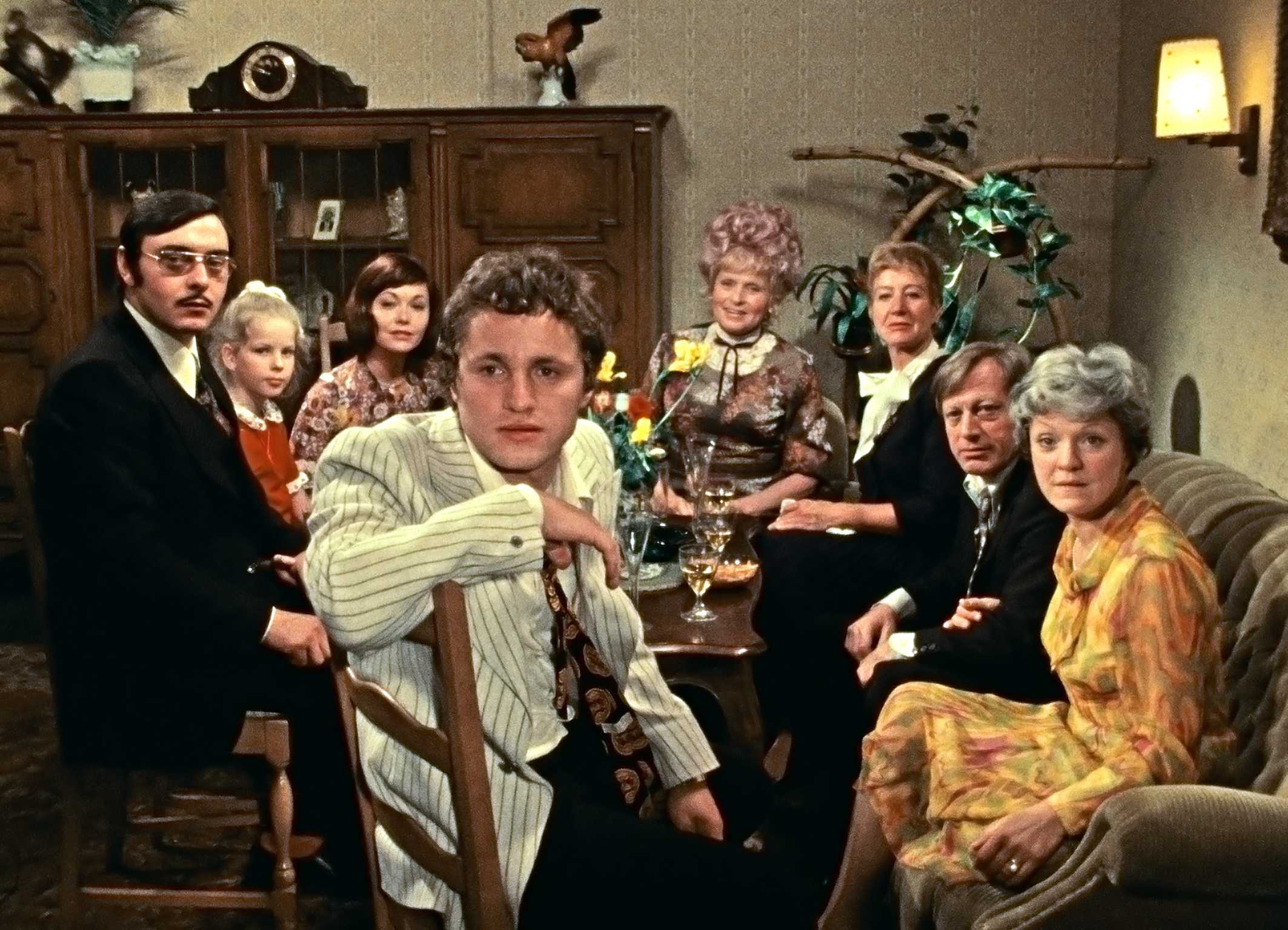
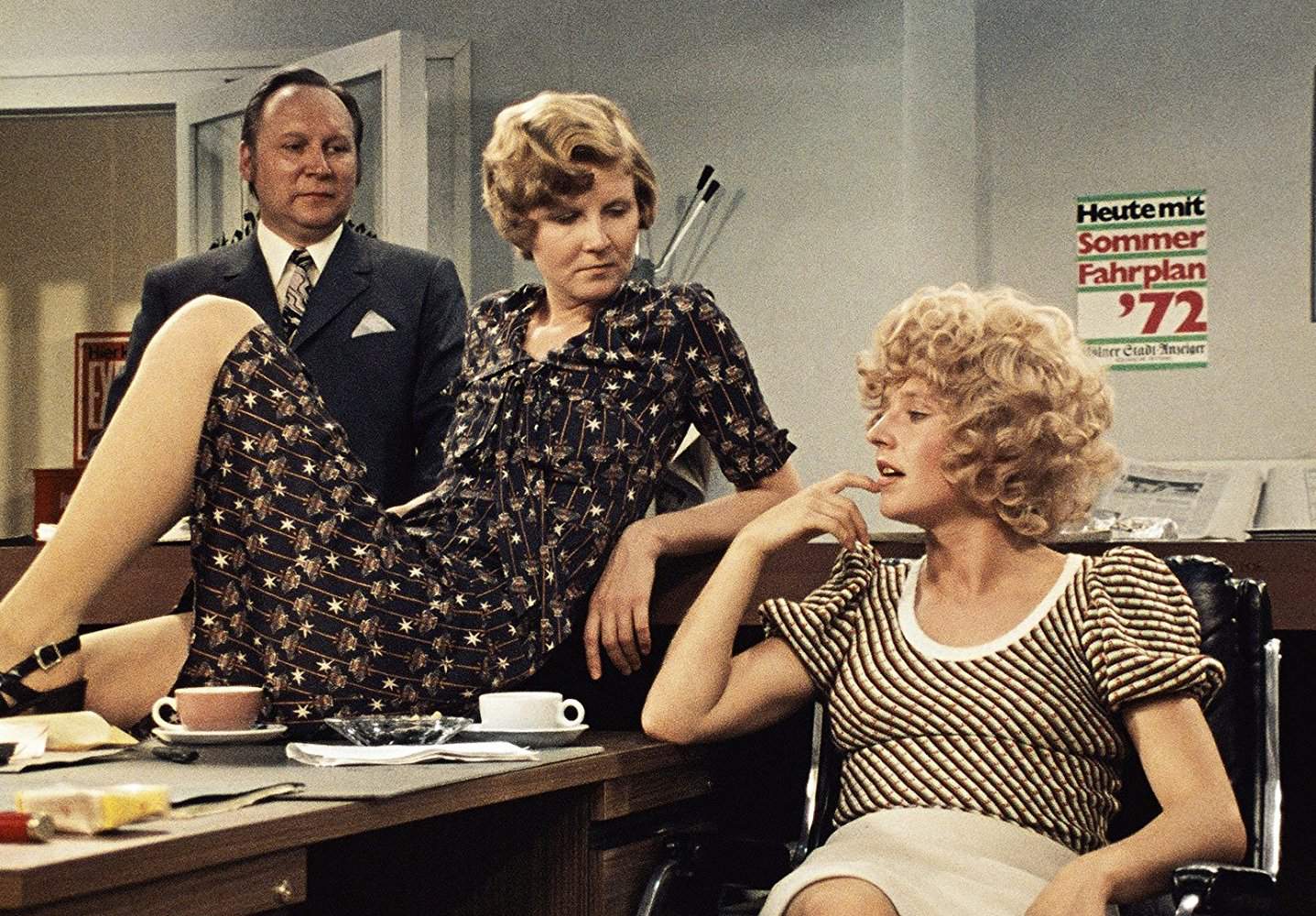
The resulting miniseries wasEight Hours Don’t Make a Day, a five-part, eight-hour event that told the story of three generations of one working-class family in the industrial mecca of Cologne. The main protagonists are Oma (Nazi-era starLuise Ullrich, cast by Fassbinder at a time when actors from the war were mostly blacklisted), the lively grandma who finds a new lease of life when she moves into an apartment with her new lover, and her grandson, Jochen (the one-of-a-kind Gottfried John), a young toolmaker who finds time to fall in love with the beautiful and headstrong Marion (iconic Fassbinder collaboratorHanna Schygulla) when he isn’t negotiating better working conditions for the men in his factory.
Both of the main storylines inEight Hours Don’t Make a Dayignited a fiery debate when the series first aired. At that time, it was inconceivable for a widowed woman of sixty to be shown having a lover — not to mention one with whom she fought against city officials to start a kindergarten for underserved children. Even more controversial was the factory plot; its celebration of workers’ solidarity and focus on fighting back against semi-authoritarian bosses caused socio-political waves in a country hyperconscious of these topics only two decades after the building of the Berlin Wall.
The newly restoredEight Hours Don’t Make a Dayrecently had its US premiere at the Museum of Modern Art in New York and will be opening at the city’s Film Forum in March. I attended the MoMA screening as well as a talk about the miniseries at NYU’s Deutsches Haus, and I came away convinced thatEight Hours Don’t Make a Dayis not only a surprisingly timely work 46 years after its debut but also quite possibly the most remarkable film in Fassbinder’s oeuvre. It contains all of the elements of his best work, applied to a story that critic Thomas Elsaesser fittingly described as an “ironic fairytale” for the working class.
Fassbinder’s parents divorced when he was young, and he was primarily raised by his mother, who went on to have roles in many of his films. She was a great influence on him; for that reason, Fassbinder surrounded himself with other strong women throughout his career, from Schygulla toIrm Hermannto Juliane Lorenz.
As Lorenz relayed to the audience at Deutsches Haus, Fassbinder enjoyed writing women’s stories so much because he found women inherently more interesting than men. His entire BRD Trilogy — The Marriage of Maria Braun,Lola,andVeronika Voss — is a tribute to how women like Fassbinder’s mother drew on their strength to survive after World War II and rebuild a country whose male population had been decimated.
Similar strong women also abound inEight Hours Don’t Make a Day. From Oma’s refusal to give up on finding an affordable apartment with her lover, to Marion stubbornly insisting to her disapproving middle-class mother that she will marry Jochen, to Jochen’s sister, Monika, finding the courage to leave her abusive husband even as he threatens to take their daughter away from her — the women of this family refuse to let societal expectations dictate their happiness.
Not only that: it is Marion who first convinces Jochen that he and his team should fight for a bonus denied them by the factory after they completed a project early. After all, she argues, Jochen devised, proposed and executed a new method of working that made the team more efficient and capable of finishing the project within the deadline; why should they be punished for that by being denied their bonus? Jochen’s activism in the factory is a major part ofEight Hours Don’t Make a Day, but it is because of Marion’s encouragement and anger on his behalf that he is able to unite his fellow workers and fight back against the bosses.
Another iconic element of Fassbinder films is a disdain for typical bourgeois life. He often told stories of those on the margins of society. During the mid-twentieth century, this also included homosexuals; being gay himself, Fassbinder was one of these outsiders. Many of his films also focused on immigrants dealing with racial prejudice, would-be gangsters, and attempts by desperate people to make a living by any means necessary. His heroes and heroines are often people stuck in so-called respectable situations who either suffer (such as the tragic titular character inEffi Briest)or rebel (like Maria Braun, who became a business magnate’s mistress just so she could rise to a position of power herself).
Fassbinder’s sympathy for people lacking in the traditional means of power and his admittedly left-wing politics are all overEight Hours Don’t Make a Day. Here, the most heroic thing a person can do is rebel against those in positions of authority. Oma does it when she opens her kindergarten illegally in a local library that had been shut down; she then teams up with local mothers to petition the city to allow the kindergarten to stay open.
Indeed, Oma is constantly trying to launch “associations” with other people in order to solve what she deems are society’s biggest problems, including the high price of tram fares and the lack of lower-income housing for older people living off their pensions. Her first instinct is to create solidarity with like-minded folks and, together, change the status quo.
Jochen’s story also revolves around leading the struggle of ordinary people against those in positions of privilege and power. For instance, when the man overseeing the factory floor insists on appointing an outsider as foreman, Jochen’s crew petition for one of their own to pass his foreman’s exam and get the job himself. They argue that it is far better to be overseen by someone familiar with their work than someone deemed superior just because he is an outsider.
Later, when the factory is suddenly set to move to the other side of town, drastically altering all of their commutes, the men come together to create a list of demands that they insist on being executed if they are to keep working there. The most shocking demand? That the factory workers be permitted to organize their work themselves and to work at a pace and a style that they determine — not the men in charge.
Many argued that Fassbinder’s portrayal of factory life was unrealistic and that these changes would be impossible to execute successfully in real life. Words like “utopian” were thrown around in the debates sparked by the series. Lorenz’s documentary includes one hilarious clip of Fassbinder arguing with an interviewer whose “silly question” concerned whether the factory scenes were realistic. Fassbinder noted that if you want to make a realistic film about ants, you just shoot the ants and overlay the footage with a commentary saying exactly what they are doing. Any other means of telling a story on film is inherently unrealistic. InEight Hours Don’t Make a Day, Fassbinder does not tell a hyper-realistic story about a working-class family; he tells one that shows how things could and should be in a world that values solidarity, community, and empathy.
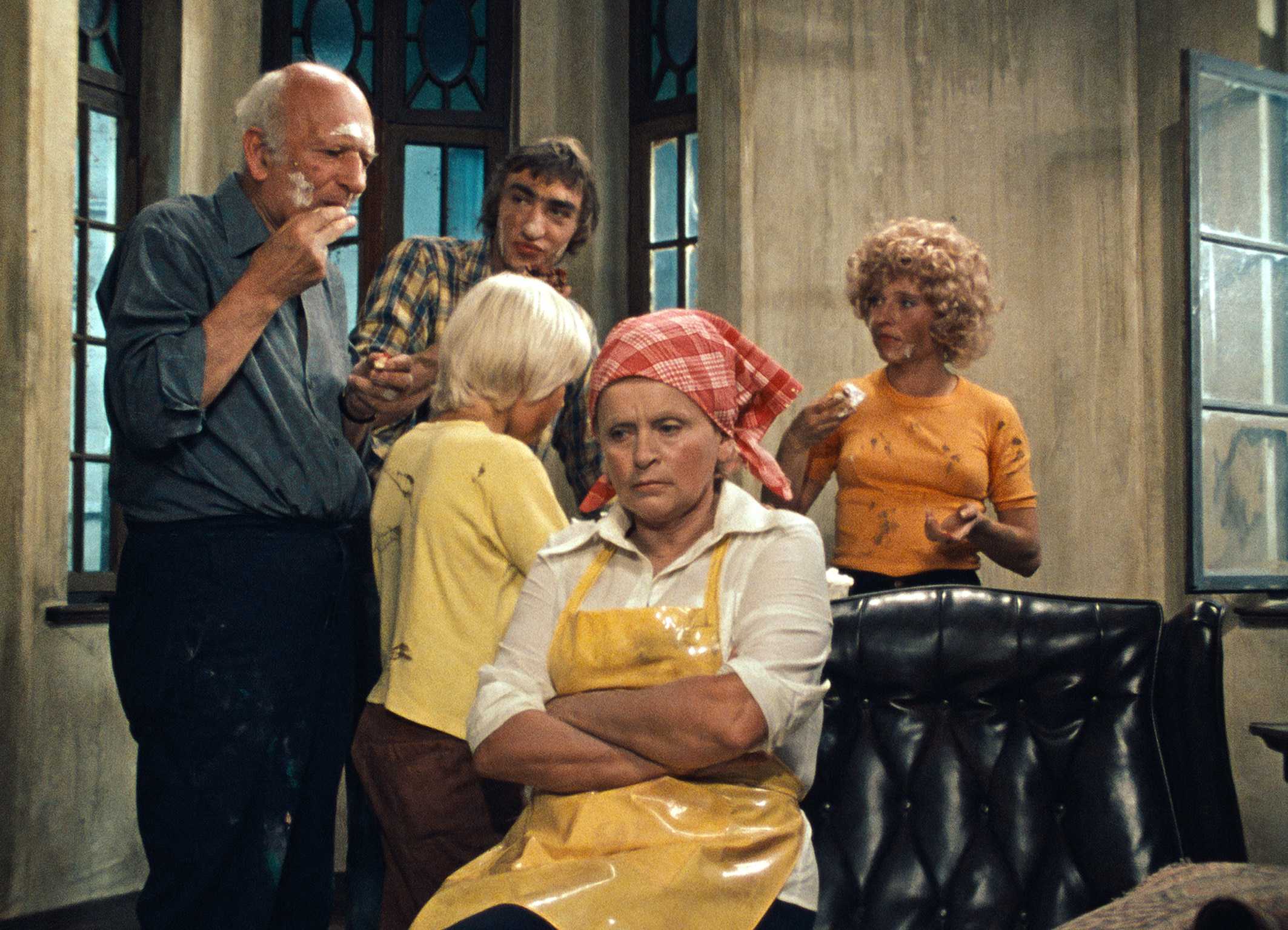
In addition to these thematic elements,Eight Hours Don’t Make a Dayalso contains the technical elements one can’t help but associate with a Fassbinder film — ambitious camera moves that seem like they should be impossible, liberal use of close-ups that allow the actors to underplay their parts and thus make the characters feel all the more realistic, and eye-popping costumes loaded with memorable details. However, it also stands out in sharp relief from the rest of his films in one very enjoyable way: it is hilariously funny. Fassbinder’s films are often tragic, and any humor is usually very dark. ButEight Hours Don’t Make a Day, while not without its share of tough moments, is laugh-out-loud funny to the point of even occasionally veering into slapstick. The comedic moments make the miniseries far easier to swallow than some of Fassbinder’s harsher and more cynical works.
Eight Hours Don’t Make a Daystands out as a special triumph for a filmmaker whose career was full of them. I encourage anyone who can get to Film Forum or another theater hosting a screening to go. You’ll be treated to a thought-provoking, yet truly funny film about people whose stories are far too often deemed unworthy of being told.
MacLaren will undoubtedly be awesome for ‘Cowboy Ninja Viking,’ but she also deserves so much better.
Award-winning director Michelle MacLaren will be in charge of a new Chris Pratt movie very soon. According to The Tracking Board, an adaptation of Cowboy Ninja Viking will be coming to big screens courtesy of Universal, and MacLaren will be at the helm.
Cowboy Ninja Viking will be based on the eponymous Image Comics series conceived by writer A. J. Lieberman and artist Riley Rossmo. The comics follow a counterintelligence unit of patients with a dissociative identity disorder. Individual agents are known as Triplets, due to the three personas in their heads which are — you guessed it — a cowboy, a ninja, and a Viking. Pratt will play one of these guys.
That synopsis honestly sounds problematic already. There’s a high chance that mental illness will be used as a plot device to create the new bunch of villains or antiheroes, and commentary and sensitivity will be severely lacking. Movies have done it before, even though it’s a tired, uncomfortable trope to rehash. We don’t need another Split. But Cowboy Ninja Viking might end up being just that anyway.
The Cowboy Ninja Viking writers leave plenty to be desired as well. Craig Mazin penned the latest draft of the script. That’s the same writer who worked on The Hangover II — yeah, one of a ton of movies that exoticizes, stereotypes and offends in the name of so-called ‘comedy.’ Zombieland and Deadpool scribes Paul Wernick and Rhett Reese brought the first draft of Cowboy Ninja Viking to life. Wernick and Reese have a better track record with commercially successful movies. However, this list of writers sets a strong overall precedent for the kind of movie Cowboy Ninja Viking could end up being; crude, violent and frustratingly male-centric.
Which, after having been a part of so many male-dominated shows for years, MacLaren would still be able to spin into something good anyway. Having directed a slew of episodes of aggressively male-dominated shows like Breaking Bad, Game of Thrones, The Walking Dead and Westworld — to name a few — MacLaren is a maestro at her craft. It’s the reason fans all cheered when MacLaren was initially tapped to direct Wonder Woman for Warner Bros. She eventually exited the DCEU due to creative differences, and Patty Jenkins went on to helm the empowering woman-led juggernaut that captivated audiences last year.
So, Cowboy Ninja Viking is both a noteworthy move for MacLaren and yet something so… underwhelming.
And to be clear, this is no dig at Chris Pratt. He has proven himself to be more than capable of leading giant franchises with charisma and fluency that’s unique and refreshing. Guardians of the Galaxy is a big enough hit for me to forego delving too deep into it, but would Jurassic World have worked as well as it did without Pratt and Bryce Dallas Howard? Some would argue that the Jurassic World conceit doesn’t work at all, but I certainly enjoyed the film through the formula, mostly because of Pratt and the rest of the cast.
MacLaren still deserves better, though. She deserved so much more than to be left off the list of directors for the final season of Game of Thrones, and she merits more in the film world. Moreover, I’m frankly wondering just what she sees in such a run-of-the-mill project (to want to direct it), but I’m no mind-reader, and it’s a huge opportunity to work for Universal anyway. Regardless, going from the anticipation of helming the first live-action solo Wonder Woman movie to something so generic is just a disappointing turn of events.
In the end, we’ll have faith in MacLaren, but that can only go so far if she doesn’t get better projects. Cowboy Ninja Viking can be expected to hit cinemas on June 28, 2019.
Barry Jenkins wrote and directed My Josephine in 2003 as a film student.
Barry Jenkins is a rule breaker. The Moonlight writer-director completely changed the game when his film took home best picture at last year’s Academy Awards. Moonlight is the first film with an all-black cast, as well as the first LGBT film to achieve this honor. This record-breaking feat would be impressive for anyone, but especially so for Jenkins; Moonlight is only his second feature-length film. His first was Medicine for Melancholy in 2008.
White men primarily make up the world of auteur filmmakers, creating films about straight white people. Seeing someone like Jenkins, who is breaking that mold, win prestigious awards is incredibly refreshing in an industry always in need of more diverse voices. The early work of these kinds of filmmakers can give us insight into their trajectory as an artist. Seeing the first film of a writer-director like Jenkins is a real treat.
My Josephine is an 8-minute short film written and directed by Jenkins in 2003. He was completing a BFA in film at Florida State University at the time. James Laxton, who is also the cinematographer of Moonlight and Medicine for Melancholy, shot the film.
As Netflix snaps up distribution rights abroad, studios have an opportunity to make movies that don’t chase global box office success.
Do you a remember a time when film criticism involved more than just arguing about Netflix? For years now, critics have engaged in debates about the value of Netflix to global film distribution. Maybe Netflix is a streaming oligarch who has done more to crumble distribution than any other movie business. Or maybe it’s given much-needed access to moviegoers around the world and defended the creative freedom of some of our most important filmmakers. However you may feel about Netflix, it does come with two constants: it will always be at the forefront of the distribution game and, as a direct result, it will always be a source of uneasiness for many cinephiles.
Yesterday, The Atlantic‘s David Sims published a piece on Paramount’s decision to forego international theatrical distribution for Alex Garland’s Annihilation. Building on a December 2017 Hollywood Reporterstory that claimed infighting and personality clashes had caused the studio to sour on director Alex Garland’s film, Sims pointed to this new blended release format – a domestic theatrical release paired with a streaming international release – as a possible new trend for the industry. “(T)his could be the sign of a more worrying Hollywood trend,” Sims wrote in his article, “in which the very idea of a bigger-budgeted film that isn’t a guaranteed financial success is simply anathema to a big studio, with Netflix used as a last-resort, cost-saving measure.”
As Sims notes, this isn’t the first time we’ve seen Hollywood dabble with the idea of international Netflix distribution. Deadlineannounced in October that New Line would be partnering with the streaming giant for the release of Shaft; it also broke a similar story last week regarding God Particle, Bad Robot’s Cloverfield sequel. If two is a coincidence and three is a trend, then it certainly seems that Hollywood is prepared to use streaming services like Netflix as an alternative to traditional distribution models. And in a world where international distribution has backed many studio releases into a creative and financial corner, this new approach may represent new possibilities for filmmakers and audiences alike.
Now that websites like Box Office Mojo meticulously tally every dollar spent at the global box office, we’ve gotten much better about discussing international grosses. We’re considerably less skilled at talking about international expenses. Back in 2014, for example, The Hollywood Reporterestimated that even modestly budgeted theatrical releases like The Fault in Our Stars ($12m), and Tammy ($20m) would still cost about $40 million for a studio to market, with bigger films costing upwards of $100 million in international marketing alone. This means a film like Annihilation could cost Paramount tens of millions of dollars just in the hope that it connects with an audience abroad. This might be a winning proposition for a tentpole action film, but for a high-concept movie like Annihilation, that money is probably best spent somewhere else.
Given that the best-case scenario for Annihilation is that it follows in the footsteps of Denis Villeneuve’s Arrival and pulls in around $100 million overseas, executives had to make a choice. Would you rather front $40+ million in marketing in the hope that you’ll clear $60 million abroad? Or, as the aforementioned Hollywood Reporter article suggests, would you take the sure $50(ish) million from Netflix and put the remainder of your energy into domestic marketing? Critics often complain that tentpole releases seem reverse-engineered for international success; taking away the need for universal appeal in Hollywood releases would allow writers and directors to pursue stories that speak uniquely to them. Suddenly, there might be a demand for movies that could do strong business domestically and lackluster numbers elsewhere.
But that’s not the only reason why Netflix’s Annihilation deal might be good news for moviegoers: it provides much-needed incentive for studios to consider making mid-budget movies. Critics have long lamented the disappearance of films costing north of $10 million but less than $100 million to make; this was a subject Sims even wrote about in a 2017 Atlanticarticle focused on the unconventional financing of Steven Soderbergh’s Logan Lucky. In that article, Sims points to the scope of studio distribution as a sticking point between filmmakers and producers. “(P)roducing a film for $29 million is a lot easier than distributing it wide,” Sims argued, noting that the “the latter usually requires the participation of a major studio, to the chagrin of many artists like Soderbergh.” In other words, while any movie can theoretically get made, not every movie can theoretically get distributed, and that has held movies like Logan Lucky back over the years.
If Netflix is willing to offset production costs for a slice of the pie, that could also unfreeze some of the mid-budget movies that have been kicking around Hollywood. Whereas before a 50 million dollar movie might cost a studio an additional $50 million in global marketing, now studios can break even internationally before the film has even finished production. Netflix will effectively subsidize domestic releases, making successes like Girls Trip – which grossed $115 million domestically against only $24 million abroad – something to consciously strategize around. It’s probably a bit too dramatic to say that this approach could usher in a new era in American cinema, but the higher the floor, the more likely some studios are to take a gamble on high-concepts films like Annihilation. It may not be the theater-focused future that many filmgoers were hoping for, but if we have to choose between the quality of the film and the quality of the venue, I’ll choose the former every day of the week.
Ignoring Dumbledore’s sexuality does not do the ‘Fantastic Beasts’ franchise any favors.
The Fantastic Beasts team is at it again with statements that just leave a bad taste in your mouth. In a recent interview with Entertainment Weekly, director David Yates addressed the possibility of Albus Dumbledore building a budding romantic relationship with peer and adversary, Gellert Grindelwald, onscreen. Harry Potter creator J. K. Rowling already declared Dumbledore gay years ago, so this isn’t a spoiler by any means.
However, when asked if the Fantastic Beasts sequel, titled The Crimes of Grindelwald, would portray the Dumbledore/Grindelwald relationship in any capacity, Yates replied, “Not explicitly.” He then attempted to justify that lack of acknowledgement of Dumbledore’s sexuality by implying that as long as fans knew the relationship was going to happen, it didn’t really need to be depicted outright in The Crimes of Grindelwald. Here’s what Yates had to say:
“But I think all the fans are aware of that. [Dumbledore] had a very intense relationship with Grindelwald when they were young men. They fell in love with each other’s ideas, and ideology and each other.”
While this doesn’t necessarily mean Dumbledore’s sexuality will remain undiscussed for the duration of the five-part Fantastic Beasts series, Yates’ remarks don’t instil a lot of faith nonetheless. Just because fans already know Dumbledore is gay doesn’t mean the character’s sexuality should be subtextual. This is especially so in such a crucial reintroduction to the big screen; we haven’t seen an incarnation of Dumbledore in seven years.
Letting a character be “a maverick and a rebel” does not negate the importance of acknowledging his sexuality in a substantial, meaningful way. Arguably, Dumbledore should be able to be all these things at once; this feels too obvious to state, but here we are. A gay Dumbledore exists to fans and critics alone, which does nothing for actual representation within both series. The portrayal of characters navigating their identities within any given text is vital for obvious reasons; the text is the reason these characters are alive and significant to readers or viewers in the first place.
Rowling herself has, in the past, been frustratingly coy about how Fantastic Beasts will eventually address Dumbledore’s relationship with Grindelwald. She once said, according to EW, that “You will see Dumbledore as a younger man and quite a troubled man… We’ll see him at that formative period of his life. As far as his sexuality is concerned … watch this space.”
Well, we watched and David Yates did not deliver. Honestly, neither did Rowling, who only revealed Dumbledore to be gay after the books were finished. There was no longer a way to work that kind of characterization into canon and really, the reveal felt inconsequential. Yes, Rowling’s announcement happened a decade ago, but even back then something felt oddly perfunctory about it. Were fans supposed to just reread everything and fill in the blanks? How is that different from having a headcanon, which fandoms indulge in on the regular anyway?
Nothing tangible changed after Rowling told the world Dumbledore was gay, because she just said it. It’s a safe option that didn’t rock any kind of heteronormative status quo when it comes to creating heroic fictional characters. Fantastic Beasts still has time to eventually include Dumbledore’s sexuality, but the fact that the writer, director and various producers didn’t jump at the chance to focus on that story is a tell; code for something that “doesn’t matter” to the story as a whole.
My own journey with the Fantastic Beasts series has fluctuated over several stages. First, it was me thinking it was an unnecessary cash cow when it was first announced. Then I actually saw Fantastic Beasts and Where to Find Them and thought it had a surprising amount of heart (even if the film really was a cash cow). It was easy to love Eddie Redmayne and co. That is, until the very end when Johnny Depp’s appearance proved to be one of the most disappointing cinematic twists in recent memory. The third stage was admittedly forgetting about …Where to Find Them in the midst of other blockbusters, but wondering when the sequel would come out with a modicum of interest. Fourth was the underwhelming title and image reveal of said sequel, and the warranted, renewed uproar surrounding Depp, which cast doubt on whether I’d personally see The Crimes of Grindelwald at all.
Now, the fifth stage is this new Yates quote that screams of LGBTQ erasure and for… what, exactly? There is no suspense “value” in “not explicitly” letting Dumbledore flourish onscreen — as gay as he is rebellious and conflicted.
Yes, Harry Potter and Fantastic Beasts are part of a sprawling universe about magic; possibly one of the most fictional things there is out there. But to cast aside something as important as sexuality — especially after going out of your way to talk about it after the fact of canon, Jo Rowling — simply reeks. There are no brownie points to be gained by teasing something that is below the bare minimum of inclusion. The general consensus of response to Yates’ comments have been disappointment, but a lack of surprise. This should no longer be the case. Audiences are tired of waiting around for a franchise to actually be inclusive, especially one that should be easy for everyone to love.
"Tonight, we're taking Game Night up a notch." Warner Bros has released a new full-length trailer for the comedy Game Night, the murder mystery horror (maybe?) comedy movie which opens at the end of this month. This comedy puts a spin on the popular "game night" concept and turns it into a crazy wacky, violent thriller. When a group of friends who meet regularly for game nights discover that the murder mystery game they're playing this time is actually for real, everyone starts to freak out but soon realizes the only way to win is to keep playing. Jason Bateman and Rachel McAdams star as the main hosts, along with Billy Magnussen, Sharon Horgan, Lamorne Morris, Kylie Bunbury, Jesse Plemons, Danny Huston, with Michael C. Hall and Kyle Chandler. This looks totally over-the-top absurd, possibly in a good way, but I can't exactly tell from this new trailer. There's so much going on in this. Might be fun? Join in below.
Here's the full trailer (+ poster) for John Francis Daley & Jonathan Goldstein's Game Night, on YouTube:
You can still watch the first teaser trailer for Game Nighthere, to see even more footage from this movie.
Bateman and McAdams star as Max and Annie, whose weekly couples game night gets kicked up a notch when Max’s charismatic brother, Brooks (Chandler), arranges a murder mystery party, complete with fake thugs and faux federal agents. So when Brooks gets kidnapped, it’s all part of the game…right? But as the six uber-competitive gamers set out to solve the case and win, they begin to discover that neither this “game”—nor Brooks—are what they seem to be. Over the course of one chaotic night, the friends find themselves increasingly in over their heads as each twist leads to another unexpected turn. With no rules, no points, and no idea who all the players are, this could turn out to be the most fun they’ve ever had…or game over.Game Night is directed by filmmakers John Francis Daley & Jonathan Goldstein, who last directed the Vacation reboot together previously. The original screenplay is written by Mark Perez. Warner Bros opens Game Night in theaters everywhere starting on February 23rd coming up. Who wants to play?
"Even with a dead friend beside you, you don't think of your own death." The first teaser trailer has arrived for the latest film made by prominent Korean filmmaker Hong Sang-soo, a feature titled Grass, which will be premiering at the Berlin Film Festival later this month. This is Hong Sang-soo's fourth feature film in two years time - following On the Beach at Night Alone, which premiered at last year's Berlin Film Festival, as well as The Day After and Claire's Camera. It's hard to keep up with all of his new films he keeps making them one right after another. Grass is about a young woman, played by award-winning actress Kim Min-hee, who sits at a cafe in the corner writing on her laptop about the people she sees around here. There's not much to this teaser, just setting up this idea of her sitting & writing, as well as a few lines from the film.
Here's the first teaser trailer for Hong Sang-soo's Grass, found on YouTube (via The Film Stage):
Grass is another cheerfully melancholy story about the guests at a small café whose owner loves classical music. Kim Minhee, who won the Silver Bear for Best Actress in 2017, plays a café regular who always seems to be at the table in the corner writing on her laptop. She repeatedly draws inspiration from what’s happening around her, picking up the threads of the dialogue and spinning them further and sometimes even actively intervening in conversations. Is she perhaps the author of these relationship dramas in miniature, whose stores and themes mirror one another?Grass is written and directed by veteran Korean filmmaker Hong Sang-soo, also known as "the Woody Allen of Korea", of many films previously including Woman on the Beach, Lost in the Mountains, The Day He Arrives, In Another Country, Hill of Freedom, Right Now Wrong Then, Claire's Camera, and On the Beach at Night Alone. This will premiere at the Berlin Film Festival this month. No other release has been set yet, stay tuned for more updates. First impression?
"Also, I would crank up the A/C, just gimme a nod." Netflix has debuted the first teaser trailer for the new Adam Sandler comedy premiering on the streaming service, titled The Week Of. As much as this should make you groan, this comedy is actually directed by the great Robert Smigel, most well known for his work on "Saturday Night Life". Adam Sandler and Chris Rock star as two "very different" fathers who come together to marry their children together, resulting in a crazy weird, wild, hilarious "week of" the wedding. The full cast includes Steve Buscemi, Rob Morgan, Rachel Dratch, Scott Cohen, Patricia Belcher, and Melanie Nicholls-King. This teaser doesn't show much, but thankfully this doesn't look as awful as Sandler's other Netflix movies. So, that's something. Hopefully it's not a disaster. Get your first look below.
Here's the first official teaser trailer for Robert Smigel's The Week Of, direct from Netflix's YouTube:
When two very different fathers (Adam Sandler & Chris Rock) come together for their children’s wedding, everything that could go wrong, does. Watch the hilarious hijinks as the two try to keep everything afloat, while dealing with their families…and each other. Before they get to the big day, they have to go through a long week.The Week Of is directed by veteran American comedy filmmaker Robert Smigel, making his feature directorial debut after extensive work on "Saturday Night Live" and other TV shows + all the "SNL" animated shorts (Smigel did also write the screemplay for Sandler's You Don't Mess with the Zohan). The screenplay is co-written by Robert Smigel and Adam Sandler. Netflix will be debuting Smigel's The Week Of streaming exclusively starting on April 27th this spring. First impression? Who wants to see this already?


 This Saturday, the Pickford Film Center in Washington presents a screening of Edward Yang’s four-hour coming-of-age epic A Brighter Summer Day.